

Phase 1: Empathy & Immersion
Hello! I’m the lead editor at Daily Hangul.
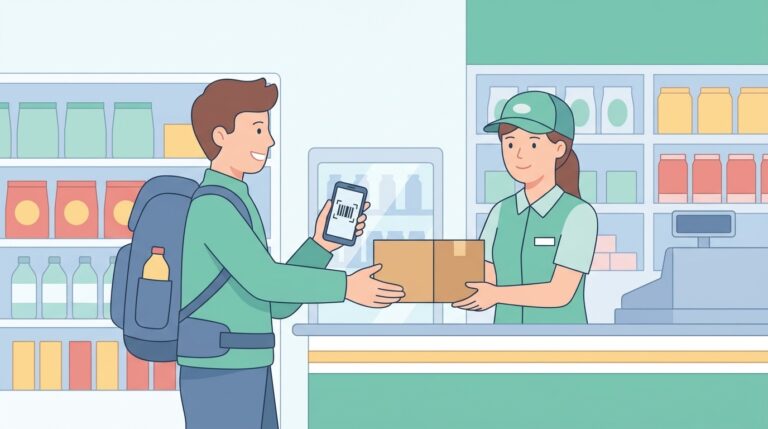
Picture this: You are in Seoul. You just bought a limited-edition K-Pop album or some highly raved K-Beauty skincare online. Since you’re out exploring all day, you smartly chose ‘Convenience Store Pickup’ (편의점 픽업).
Now, you are standing in front of the cashier at a brightly lit GS25 or CU. The part-timer is busy scanning barcodes, a line of people holding cup noodles is forming behind you, and it’s your turn. You know you need your package, but your mind goes blank. The English subtitles you rely on when watching K-Dramas aren’t floating in the air.
Do you just point at the boxes stacked in the corner and say, “Box? Me?”
Don’t worry! This is a classic “Pain Point” for many B1 learners. Knowing exactly what to say in this fast-paced Korean convenience store scenario won’t just get you your items quickly—it will make you look like a total local. Let’s dive into the essential expressions you need, based on real experiences from our Daily Hangul students!
Phase 2: Core Expressions Deep Dive
1. 택배 찾으러 왔는데요.
- Pronunciation: taekbae chajeureo wanneundeyo. [taek-bae / cha-jeu-reo / wan-neun-de-yo]
- Meaning: (Literal) I came to find my package. / (Real Nuance) I’m here to pick up my parcel.
- K-Culture Moment: If you watch a slice-of-life K-Drama, you will always see characters stopping by the convenience store on their way home from work to grab a beer and say this exact line to the part-timer.
- Editor’s Insight: The magic here is
~는데요(neundeyo). In B1 Korean, you learn that this grammar point gives background information. It softens your sentence. Instead of a blunt command, it implies, “…so could you help me?”- Situation Spectrum:
- Convenience store staff (Service formal): ✅
- Friends (Casual): 🚫 (Too formal, use 왔어)
- Boss (Formal): 🚫 (Not applicable here)
- 🤔 Think About It: Why do Koreans prefer ending sentences with
~는데요instead of a direct~습니다in service situations? How does it reflect the Korean culture of softening requests to be polite?2. 반값택배요. / 일반택배요.
- Pronunciation: ban-gap taek-bae-yo. / il-ban taek-bae-yo.
- Meaning: (Literal) Half-price package. / Regular package.
- K-Culture Moment: Bangap-taekbae (Half-price delivery) is a massive trend in Korea, especially in K-Pop fandoms. When fans trade photocards (포카), they send them from one convenience store to another to save money!
- Editor’s Insight: The cashier will often ask what kind of package it is. Knowing whether you ordered a regular delivery or a store-to-store “half-price” delivery saves you 5 minutes of awkward silence.
- Situation Spectrum:
- Convenience store staff: ✅
- 🤔 Think About It: Why is a “convenience store to convenience store” delivery system so popular in Korea compared to your home country?
3. 뒷번호 [일이삼사]요.
- Pronunciation: dwit-beon-ho [il-i-sam-sa] yo.
- Meaning: (Literal) Back number [1-2-3-4]. / (Real Nuance) The last 4 digits of my phone number are [1-2-3-4].
- Editor’s Insight:
뒷means back, and번호means number. To confirm your identity, the cashier will always ask for the last 4 digits of the phone number you used to order.- Situation Spectrum:
- Convenience store staff: ✅
Phase 3: Textbook vs. Real Korean
[Situation 1: Approaching the Cashier]
* 📖 Textbook Korean: 저는 택배를 수령하러 왔습니다. (I came to receive my parcel.)
* 🗣️ Real Korean: 택배 찾으러 왔는데요. (I’m here to pick up a package…)
* 💡 Why is it different?: “수령하다” (to receive) is heavily formal, mostly used in official emails or banks. In daily life, Koreans use the verb “찾다” (to look for/find) when picking up items!
[Situation 2: Giving your phone number]
* 📖 Textbook Korean: 제 전화번호의 마지막 네 자리는 1234입니다.
* 🗣️ Real Korean: 뒷번호 1234(일이삼사)요.
* 💡 Why is it different?: 빨리빨리 (Ppalli-ppalli / Hurry up) culture! Convenience stores are fast-paced. Dropping unnecessary subjects and getting straight to the core information is highly appreciated.
Phase 4: Cultural Context — K-Culture Deep Dive
4-1. Non-Verbal Communication: Convenience Store Nunchi
In Korea, 눈치 (Nunchi)—the ability to read the room—is everything. When picking up a package, good nunchi means having your pickup barcode or QR code already open on your phone screen before you reach the counter. Making the cashier wait while you scroll through your emails? That’s a nunchi fail! Also, when handing over your ID (신분증) or phone for scanning, subtly support your right arm with your left hand. It’s a non-verbal sign of respect.
4-2. The K-Pop & K-Life Connection
Why do Koreans pick up packages at convenience stores instead of getting them delivered to their doors?
1. Single-Person Households (1인 가구): Many young Koreans live alone in studio apartments (원룸) and aren’t home during the day. Convenience stores are safe, 24/7 drop-off points.
2. The Photocard Economy: If you are a K-Pop fan, the CU and GS25 delivery machines are your best friends. The Bangap-taekbae (Half-price delivery) system is the backbone of the Korean K-Pop trading community. When you trade a photo card on Twitter (X) or Karrot Market (당근마켓), you usually send it via this cheap, store-to-store method!
Phase 5: Real-Life Roleplay Scenario
Setting: Friday, 8:00 PM. A brightly lit GS25 in Hongdae. The store is playing the latest K-Pop hits. You are here to pick up a jacket you ordered online. The part-timer, Jiwon, is scanning items for another customer.
Characters:
* YOU: An expat or traveler who knows some Korean but gets nervous speaking.
* Jiwon (22): The part-timer (알바생). Fast, efficient, just wants to process the line quickly.
Dialogue:
YOU: 저기요, 택배 찾으러 왔는데요. 📦
(jeogiyo, taekbae chajeureo wanneundeyo.)
[Excuse me, I’m here to pick up a package.]
Jiwon: 아, 네. 반값택배세요, 아니면 일반택배세요?
(a, ne. ban-gap-taek-bae-se-yo, a-ni-myeon il-ban-taek-bae-se-yo?)
[Ah, yes. Is it a half-price delivery or a regular delivery?]
(🎭 Stage Direction: Jiwon turns toward the pile of boxes behind the counter)
YOU: 반값택배요.
(ban-gap-taek-bae-yo.)
[Half-price delivery.]
Jiwon: 고객님, 본인 확인을 위해서 전화번호 뒷자리 알려주시겠어요?
(go-gaeng-nim, bon-in hwag-in-eul wi-hae-seo jeon-hwa-beon-ho dwit-ja-ri al-lyeo-ju-si-get-seo-yo?)
[Customer, to verify your identity, could you tell me the last digits of your phone number?]
🔀 YOUR TURN! How should you reply?
– A) “나의 전화번호는 8282입니다.” (My phone number is 8282.)
– B) “뒷번호 8282(팔이팔이)요.” (The last numbers are 8282.)
– C) “저기 박스에 제 이름 있어요!” (My name is on that box over there!)✅ Best Choice: B — It’s the most natural and efficient response.
⚠️ Choice A Analysis: Sounds like a robot translating directly from English.
⚠️ Choice C Analysis: While true, it slows down their POS system process. They need to input the numbers!
Jiwon: 네, 8282… 김외국 고객님 맞으세요?
(ne, pal-i-pal-i… gim-oe-guk go-gaeng-nim ma-jeu-se-yo?)
[Yes, 8282… Are you customer Kim Wae-guk?]
YOU: 네, 맞습니다. 신분증 여기 있어요.
(ne, mat-seum-ni-da. sin-bun-jeung yeo-gi i-sseo-yo.)
[Yes, that’s right. Here is my ID.]
Jiwon: 확인되셨고요, 여기 택배입니다. 안녕히 가세요!
(hwag-in-doe-syeot-go-yo, yeo-gi taek-bae-im-ni-da. an-nyeong-hi ga-se-yo!)
[Verified. Here is your package. Goodbye!]
Phase 6: 10-Second Shadowing Drill
Let’s practice the rhythm! Pay attention to the pauses (/).
- 😊 Polite & Friendly: 저기요, / 택배 / 찾으러 / 왔는데요.
(jeo-gi-yo, / taek-bae / cha-jeu-reo / wan-neun-de-yo.)Pronunciation tip: Remember, the
어in찾으러sounds like the ‘uh’ in ‘uh-oh’. - 🗣️ Clear & Fast: 뒷번호 / 팔이팔이(8282) / 요.
(dwit-beon-ho / pal-i-pal-i / yo.)
Phase 7: K-Culture Mini Dictionary
1. 눈치 (Nunchi)
* Romanization: nunchi
* English: Social situational awareness / Reading the room.
* Context: Having your barcode ready so you don’t hold up the line is prime convenience store nunchi.
2. 알바생 (Albaseng)
* Romanization: al-ba-saeng
* English: Part-time worker.
* Context: Derived from the German word ‘Arbeit’. Most convenience store workers are university students doing alba.
3. 반값택배 (Bangap Taekbae)
* Romanization: ban-gap taek-bae
* English: Half-price delivery.
* Context: A logistics service where you send/receive parcels using the convenience store’s own delivery trucks, making it extremely cheap.
4. 빨리빨리 (Ppalli-ppalli)
* Romanization: ppal-li-ppal-li
* English: Hurry, hurry!
* Context: The core ethos of modern Korean society. Efficiency and speed are highly valued in any transaction.
Phase 8: Traveler’s Survival Kit
If you are traveling in Korea, the convenience store is your lifeline. Here are 3 essential survival phrases for any convenience store situation!
🆘 Survival Phrase #1: Do you need a bag?
– 🇰🇷 “봉투 필요하세요?” (bong-tu pi-ryo-ha-se-yo?)
– 📍 Context: Cashiers will ALWAYS ask this because plastic bags cost 50 won.
– 💡 Reply: “네, 주세요” (Yes, please) or “아니요, 괜찮아요” (No, I’m good).🆘 Survival Phrase #2: Heat it up, please.
– 🇰🇷 “이거 데워주세요.” (i-geo de-wo-ju-se-yo.)
– 📍 Context: When you buy a Bento box (도시락) or sausages.🆘 Survival Phrase #3: Is this 1+1?
– 🇰🇷 “이거 원플러스원 맞아요?” (i-geo won-peul-leo-seu-won ma-ja-yo?)
– 📍 Context: Korean convenience stores have amazing 1+1 or 2+1 deals. If you bring one item, they might tell you to go grab another one for free!
📌 Editor’s Travel Note:
Most convenience stores in Korea accept international credit cards. Tipping is strictly not allowed in Korea—if you leave your change on the counter, the albaseng will chase you down the street thinking you forgot your money!
Phase 9: Critical Thinking — “One Step Deeper”
Global Era & Modern Life: The Evolution of Convenience
Have you ever wondered why Korean convenience stores handle everything from international shipping to utility bill payments, and even K-Pop album pre-orders? In densely populated urban areas like Seoul, efficiency and safety are paramount. The language used in these spaces reflects this—it is highly transactional, dropping pronouns and cutting straight to the point (뒷번호 요 instead of 제 번호는 입니다), yet it maintains a strict polite tone (~요). It’s a fascinating balance between hyper-efficiency and traditional Korean respectfulness.
💬 Your Turn: Does your country have a culture where convenience stores act as community hubs for mail and bills? Or is it strictly for buying snacks? Share in the comments!
Phase 10: FAQ & Mistake Prevention
Q: “Can I just show them the barcode on my phone without saying anything?”
Yes and no. While they can scan it silently, it is considered slightly rude to just shove a phone in someone’s face without a greeting. Even a simple “안녕하세요, 택배요” (Hello, package) goes a long way!
Q: “Will they ask for my physical passport?”
For Bangap-taekbae (Half-price delivery), usually, the barcode or QR code is enough. However, for high-value items or certain regular deliveries, they might ask for an ID (신분증). Having your ARC (Alien Registration Card) or Passport handy is a smart move.
❌ Common Mistake #1: Saying “택배 주세요” (Give me the package). While grammatically correct, it sounds a bit like a demanding child. Stick to “택배 찾으러 왔는데요” (I’m here to pick up a package).
Phase 11: Summary & Action Items
✨ One-Liner Summary: Soften your request with ~는데요 and speed up the process by giving the last 4 digits of your phone number right away!
Action Mission 3 Steps:
* 🥉 Bronze (Solo): Stand in front of your mirror and say “택배 찾으러 왔는데요” three times with a polite smile.
* 🥈 Silver (Online): Find a Korean convenience store vlog on YouTube and leave a comment using today’s phrase!
* 🥇 Gold (Real Life): Next time you order something online in Korea, actively choose ‘Convenience store pickup’ and use this phrase!
🎬 K-Culture Mission:
Next time you watch a K-Drama (like Backstreet Rookie or Hometown Cha-Cha-Cha), spot the convenience store scenes. Notice how quickly the dialogue flows between the customer and the clerk!
Phase 12: Interactive Quiz Challenge
1. Situational Judgment: The clerk asks for your phone number to find your package. What is the most natural Korean response?
* A) 제 전화번호는 010-1234-5678입니다.
* B) 뒷번호 5678이요.
* C) 저는 번호가 없습니다.
(Answer: B. It’s fast, efficient, and sounds like a native speaker!)
2. True or False — K-Culture Edition:
“If you buy a ‘1+1’ item at a Korean convenience store, you only need to bring one item to the counter, and the clerk will fetch the second one for you.”
(Answer: FALSE! You must bring both items to the counter for them to scan properly. Good nunchi!)
How did you do? Drop your quiz scores in the comments below, and let us know what K-Culture situation you want us to cover next! Until next time, happy studying with Daily Hangul! 🇰🇷✨
Frequently Asked Questions (FAQ)
Q: What does "택배 찾으러 왔는데요." mean in Korean and how do you pronounce it?
A: In Korean, "택배 찾으러 왔는데요." is pronounced [taekbae chajeureo wanneundeyo. [taek-bae / cha-jeu-reo / wan-neun-de-yo] and means: (Literal) I came to find my package. / (Real Nuance) I'm here to pick up my parcel.
Q: What does "반값택배요. / 일반택배요." mean in Korean and how do you pronounce it?
A: In Korean, "반값택배요. / 일반택배요." is pronounced [ban-gap taek-bae-yo. / il-ban taek-bae-yo.] and means: (Literal) Half-price package. / Regular package.
Q: What does "뒷번호 [일이삼사]요." mean in Korean and how do you pronounce it?
A: In Korean, "뒷번호 [일이삼사]요." is pronounced [dwit-beon-ho [il-i-sam-sa] and means: (Literal) Back number [1-2-3-4]. / (Real Nuance) The last 4 digits of my phone number are [1-2-3-4].







