

Phase 1: Empathy & The K-Drama Cold Open
Hello! This is your Daily Hangul Editor.
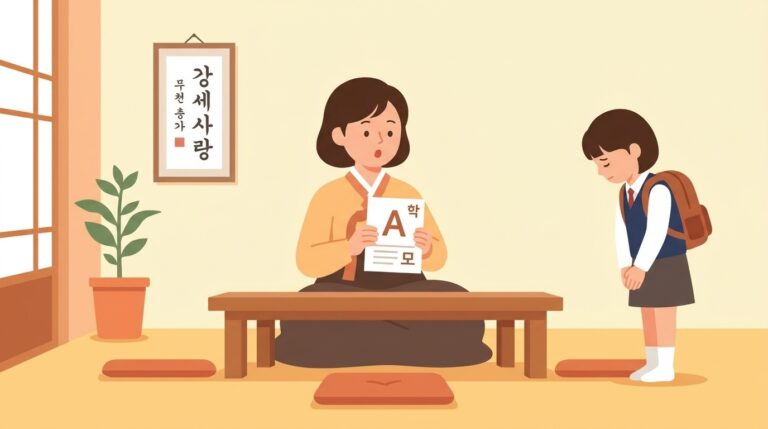
Picture this: You are watching a classic K-Drama. The intense background music starts playing. A mother, holding a crumpled piece of paper, glares at her teenager. She slams the paper on the living room table and shouts something rapid and fiery. The teenager just stares at their toes, completely silent. The subtitles simply read, “Why are your grades like this?”… but if you listen closely, there is an entire cultural history packed into that one scene.
Welcome to the world of South Korea’s “Education Fever” (교육열). Getting scolded by your parents after receiving a report card is practically a rite of passage in Korea. While you might not be a high school student in Seoul taking the CSAT (Suneung), understanding the vocabulary and cultural nuances around this situation will give you massive ‘insider’ points. You’ll finally understand why K-Drama parents react so intensely, and you’ll grasp the deep-rooted expectations in Korean society.
Note: This lesson is based on real questions from our intermediate learners who were fascinated (and a bit terrified!) by K-Drama family dynamics.
Phase 2: Deep Dive into Core Expressions
Let’s break down the most common phrases you’ll hear when the dreaded report card arrives.
1. 너 이번 성적이 이게 뭐야?
- Pronunciation: neo ibeon seongjeogi ige mwoya? [neo / e-beon / sung-jug-ee / ee-geh / mwo-ya?]
- Sound-alike guide: ‘mwo’ sounds like you are saying ‘mwa’ but with an ‘o’ at the end.
- Meaning: Literal: What is this grade this time? / Real nuance: How on earth did you get these terrible grades?
- K-Culture Moment: This is the universal opening line. Whether it’s a dramatic K-Drama like SKY Castle or a real-life living room, this is the rhetorical question that starts the lecture.
- Editor’s Insight: The speaker isn’t actually asking what the paper is. It’s an expression of disbelief and disappointment. The tone is usually elevated, and the emphasis is heavily placed on ‘이게’ (this).
- Situation Spectrum:
- Close Friends (Casual teasing): ✅
- Coworkers (Semi-formal): 🚫 (Never talk about performance this way)
- Elders/Bosses (Formal): 🚫
- 🤔 Think About It: Why is it phrased as a question (“What is this?”) rather than a direct statement (“Your grades are bad”)? Does your language use rhetorical questions to show disappointment?
2. 학원비가 얼만데!
- Pronunciation: hagwonbiga eolmande! [ha-gwon-bee-ga / ul-man-deh!]
- Sound-alike guide: ‘gwon’ sounds like ‘Gwen’ but with an ‘o’.
- Meaning: Literal: How much is the cram school fee! / Real nuance: Do you have any idea how much money we are sacrificing for your tutoring?!
- K-Culture Moment: Korean parents spend a massive portion of their income on Hagwons (cram schools). This phrase isn’t just about money; it’s about the parents’ sacrifice and love.
- Editor’s Insight: This phrase carries the weight of parental guilt trips. It’s often followed by a dramatic sigh.
- Situation Spectrum:
- Friends (Casual): 🚫
- Parents to children: ✅
- Formal situations: 🚫
- 🤔 Think About It: In Korea, investing heavily in a child’s education is seen as a parent’s ultimate duty. How does this compare to how education is funded or viewed in your home country?
3. 엄마 친구 아들은…
- Pronunciation: eomma chingu adeureun… [eom-ma / chin-goo / ah-deul-eun…]
- Sound-alike guide: ‘eom’ sounds like ‘um’ in ‘umbrella’.
- Meaning: Literal: My friend’s son… / Real nuance: The perfect kid next door who got 100% on everything.
- K-Culture Moment: This gave birth to the famous slang 엄친아 (Eom-chin-a), meaning “Mom’s friend’s son” (someone who is good at everything: smart, good-looking, polite).
- Editor’s Insight: Korean society is highly competitive, and comparisons are, unfortunately, a common motivational tactic used by parents.
- Situation Spectrum:
- Friends (Casual – joking about a perfect guy): ✅
- Formal situations: 🚫
- 🤔 Think About It: Does your culture have an equivalent to the “perfect kid next door”? Why do parents universally seem to use this comparison?
Phase 3: Textbook vs. Real Korean
When you are getting scolded, how you reply is crucial. Let’s look at the difference between what the textbook teaches and what actually happens.
[Situation 1: Saying Sorry to Your Parents]
* 📖 Textbook Korean: 어머니, 죄송합니다. 다음에는 더 열심히 공부하겠습니다. (Mother, I am sorry. I will study harder next time.)
* 🗣️ Real Korean: 엄마, 진짜 미안. 다음엔 진짜 잘할게… ㅠㅠ (Mom, I’m really sorry. I’ll really do better next time…)
* 💡 Why the difference?: While formal language (존댓말) is polite, using overly formal textbook language with your own parents can sound distant or robotic in modern Korean families. A slightly informal but desperate tone shows genuine intimacy and regret.
[Situation 2: Showing Determination]
* 📖 Textbook Korean: 저는 매일 도서관에 갈 것입니다. (I will go to the library every day.)
* 🗣️ Real Korean: 나 오늘부터 학원에서 살 거야! (I’m going to live at the cram school starting today!)
* 💡 Why the difference?: Exaggeration is a key part of conversational Korean! Saying you will “live” at the Hakwon shows the extreme level of your determination.
Bottom Note: For B1 learners, try mixing polite endings (해요체) with emotional intonations to sound natural, rather than stiff, formal (하십시오체) endings.
Phase 4: Cultural Context — K-Culture Deep Dive
4-1. Non-Verbal Elements: The Art of Staring at Your Toes
When getting scolded in Korea—whether by parents, teachers, or a boss—eye contact is a tricky thing. In many Western cultures, looking someone in the eye shows you are listening. In Korea, staring directly into an elder’s eyes while they are angry can be seen as defiant (대드는 것).
The ultimate survival tactic? Look down at the floor, keep your hands respectfully in front of you, and use your Nunchi (social sense) to know when to nod and softly say, “네…” (Yes…).
4-2. K-Drama Connection: The Famous “Deung-jjak Smashing”
If you’ve watched K-Dramas like Reply 1988, you know exactly what happens after the report card is revealed. The mother raises her hand and gives the child a sharp, loud smack on the back.
This is affectionately (and fearfully) known as 등짝 스매싱 (Deung-jjak smashing – a back smash). It’s a classic K-Drama trope representing a mother’s frustration combined with affection.
Critical Point: While this trope is used for comedy in media, modern Korean parenting is shifting rapidly, and physical scolding is becoming much less common in reality.
Phase 5: Real-Life Roleplay Scenario
Scenario A: The Host Family Report Card
- Setting: Friday night. The living room of your Korean host family in Seoul. The TV is playing the news. You just received your mid-term grades from your university Korean Language Program.
- Characters:
- YOU: An exchange student who is usually good at Korean, but totally bombed the grammar test.
- Host Mom (어머니 – 55 years old): Very warm, feeds you constantly, but takes your studies very seriously.
어머니: (Looking at the paper) OOO 학생… 이번 한국어 성적이 이게 뭐야?
(OOO haksaeng… ibeon hangugeo seongjeogi ige mwoya?)
[Translation: Student OOO… what is this Korean grade this time?]
(🎭 Stage Direction: She puts down her reading glasses and sighs dramatically)
YOU: 아… 어머니, 그게…
(A… eomeoni, geuge…)
[Translation: Ah… Mother, well…]
어머니: 내가 어제 밤에도 과일 깎아주면서 공부 열심히 하라고 했어, 안 했어?
(Naega eoje bamedo gwail kkakkajumyeonseo gongbu yeolsimhi harago haesseo, an haesseo?)
[Translation: Did I or did I not tell you to study hard while peeling fruit for you last night?]
🔀 Your Turn! How should you respond to survive?
– A) “제가 원래 문법에 약해요.” (I’m naturally weak at grammar.)
– B) “죄송해요 어머니. 다음엔 꼭 백점 맞을게요!” (I’m sorry Mother. I’ll definitely get 100 next time!)
– C) “미국에서는 성적이 중요하지 않아요.” (In America, grades aren’t important.)✅ Best Choice: B — Showing immediate regret and promising to do better is the fastest way to cool a Korean mom’s anger.
⚠️ Choice C Analysis: Absolutely do not say this! Arguing logic or cultural differences while someone is scolding you is considered talking back (말대꾸) and lacks Nunchi.
어머니: (Softening a bit) 에휴, 알았어. 배고프지? 밥 먹자.
(Ehyu, arasseo. Baegopeuji? Bap meokja.)
[Translation: Sigh, okay. You’re hungry, right? Let’s eat.]
Scenario B: Bonus K-Culture Scenario (The Fan Sign Event)
Imagine you are at a K-Pop Fan Sign event, joking with your favorite idol.
Idol: “Did you study for your exams, or did you just watch our music videos all night?”
You: “오빠 영상 보느라 성적이 이게 뭐야! 책임져요!” (Because I watched your videos, my grades are like this! Take responsibility!)
Pro-tip: Using the “이게 뭐야” structure playfully as a fan is a great way to show off your advanced Korean skills!
Phase 6: 10-Second Shadowing Drill
Practice making excuses like a real Korean teenager!
😢 엄마, / 진짜 미안해요. / 다음엔 / 정~~~말 잘할게요!
(eomma, / jinjja mianhaeyo. / daeumen / jeong~~~mal jalhalgeyo!)
[Mom, / I am really sorry. / Next time / I will reeeeeeally do better!]
Tips: Elongate the “정” in 정말 to show how earnest you are. Let your shoulders droop slightly for the full effect.
Phase 7: K-Culture Mini Dictionary
1. 눈치 (Nunchi)
* Romanization: nunchi
* English: Social sense / Situational awareness
* Context: The core of Korean social interactions. Knowing when to be quiet, when to apologize, or when to act without being told.
2. 학원 (Hagwon)
* Romanization: hagwon
* English: Cram school / Private academy
* Context: The driving force of Korea’s education fever. Students often attend multiple Hagwons until late at night.
3. 엄친아 / 엄친딸 (Eom-chin-a / Eom-chin-ttal)
* Romanization: eomchina / eomchinttal
* English: Mom’s friend’s son / Mom’s friend’s daughter
* Context: The mythical perfect child that parents always compare you to. Used as slang for a perfect person.
4. 수능 (Suneung)
* Romanization: suneung
* English: College Scholastic Ability Test (CSAT)
* Context: The most important exam in a Korean student’s life. The entire country literally pauses (flights are grounded) during the listening section.
Phase 8: Traveler’s Survival Kit (Study Cafe Edition)
Because education is so highly valued, Korea has an incredible network of Study Cafes (스터디 카페). If you are traveling or studying in Korea, you’ll definitely want to visit one! Here is what you need to know.
🆘 Survival Phrases for Study Cafes
– 🇰🇷 “여기 제일 조용한 자리가 어디예요?” (yeogi jeil joyonghan jariga eodiyeyo?)
– 🗣️ English: Where is the quietest seat here?
– 🇰🇷 “시간 연장할 수 있나요?” (sigan yeonjanghal su innayo?)
– 🗣️ English: Can I extend my time?
– 🇰🇷 “콘센트 자리 있어요?” (konsenteu jari isseoyo?)
– 🗣️ English: Is there a seat with an outlet?📌 Editor’s Travel Note
– Kiosk Kiosk: Most study cafes in Korea are unmanned! You will use a touch-screen kiosk to select your seat and pay.
– Silent Mode: Unlike normal cafes, Study Cafes are libraries. Eating crunchy snacks or talking loudly will get you serious glares (Nunchi fail!).
Phase 9: Critical Thinking Corner — “A Step Deeper”
Language & Power (언어와 권력)
Have you ever noticed that even when Korean children are crying, angry, or getting yelled at by their parents, they still use honorifics (존댓말) at the end of their sentences? In English, a heated argument usually removes social barriers—everyone yells at the same volume. However, the Korean language structurally enforces respect for hierarchy, regardless of emotional state. You can be sobbing out of frustration, but grammar rules dictate you still attach “~요” (yo) to the elder.
🧠 Think Deeper: The structure of Korean language ensures that the social hierarchy remains intact, even in moments of family chaos. Does your language maintain polite forms during heated arguments, or does politeness vanish when people get angry?
💬 Your Turn: How do teenagers in your culture speak to their parents when they are in trouble? Let us know in the comments!
Phase 10: FAQ & Avoiding Common Mistakes
Q: “Can I use the phrase ‘이게 뭐야’ (What is this?) to a waiter if my food is wrong?”
A: NO! 🚫 This phrase sounds incredibly condescending and aggressive. If your order is wrong, politely say, “저기요, 이거 제가 시킨 게 아닌데요.” (Excuse me, this isn’t what I ordered.)
Q: “If a Korean elder is scolding me, is it polite to explain my side of the story?”
A: MAYBE, but wait. In Korea, immediately explaining yourself is seen as “making excuses” (변명하다). The best approach is to apologize first, acknowledge their frustration, and then gently explain your side later when things cool down.
❌ Common Mistake #1: Smiling nervously when getting scolded.
✅ Do This Instead: In many Western cultures, a nervous smile is a reflex to break tension. In Korea, smiling while being reprimanded means you aren’t taking it seriously. Keep a serious, apologetic face!
Phase 11: Summary & Action Items
One-Liner Summary: When dealing with Korean education fever or getting scolded, apologies should be quick, respect must be maintained, and your Nunchi should be sharp!
Action Mission 3 Steps:
– 🥉 Bronze (Solo): Look in the mirror, lower your head slightly, and practice saying “엄마, 진짜 미안해요” with a sad face.
– 🥈 Silver (Online): Leave a comment below using the word “엄친아” to describe your favorite K-Pop idol!
– 🥇 Gold (Real World): Next time you mess up studying Korean, jokingly tell your tutor or language partner: “이번 성적이 이게 뭐야!” about yourself.
K-Culture Mission: Watch an episode of SKY Castle or Reply 1988 this week. Look for the scene where the parents see the report card. Watch the student’s body language!
Phase 12: Interactive Quiz
1. Situational Judgment: Your boss points out a mistake in your report and is clearly annoyed. What should you do?
– A) Look them straight in the eyes and smile to lighten the mood.
– B) Say “이게 뭐야?” jokingly.
– C) Look down slightly, apologize sincerely, and promise to fix it.
(Answer: C. A is a Nunchi fail, B will get you fired!)
2. Fill in the Blank:
Why are you comparing me again? Am I not as good as the kid next door?
“엄마! 자꾸 왜 비교해? 내가 ( )보다 못해?”
(Answer: 엄친아 – Eomchina)
3. True or False – K-Culture Edition:
When a Korean parent says “How much is the Hagwon fee!” they are strictly demanding a financial refund from the child.
(Answer: False. It is an expression of their sacrifice and a guilt-trip to motivate the child to study harder.)
Great job today! You survived the scolding. See you in the next lesson of Daily Hangul! 😊
Frequently Asked Questions (FAQ)
Q: What does "너 이번 성적이 이게 뭐야?" mean in Korean and how do you pronounce it?
A: In Korean, "너 이번 성적이 이게 뭐야?" is pronounced [neo ibeon seongjeogi ige mwoya? [neo / e-beon / sung-jug-ee / ee-geh / mwo-ya?] and means: Literal: What is this grade this time? / Real nuance: How on earth did you get these terrible grades?
Q: What does "학원비가 얼만데!" mean in Korean and how do you pronounce it?
A: In Korean, "학원비가 얼만데!" is pronounced [hagwonbiga eolmande! [ha-gwon-bee-ga / ul-man-deh!] and means: Literal: How much is the cram school fee! / Real nuance: Do you have any idea how much money we are sacrificing for your tutoring?!
Q: What does "엄마 친구 아들은..." mean in Korean and how do you pronounce it?
A: In Korean, "엄마 친구 아들은..." is pronounced [eomma chingu adeureun... [eom-ma / chin-goo / ah-deul-eun...] and means: Literal: My friend's son... / Real nuance: The perfect kid next door who got 100% on everything.







