

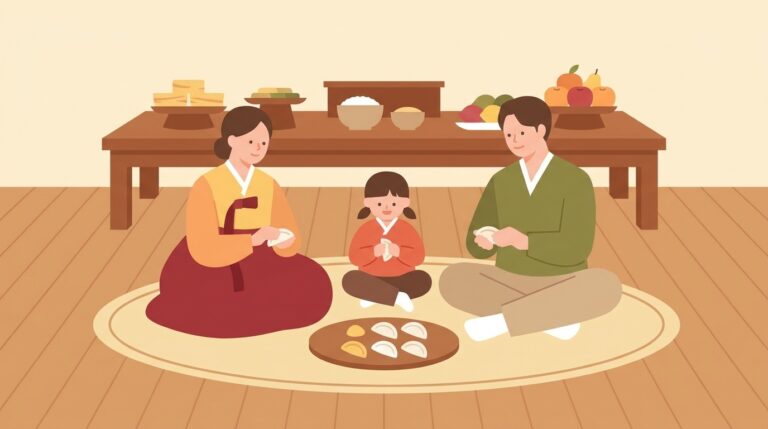
Phase 1: Empathy (Welcome to the Real Chuseok!)
Hello! Daily Hangul Editor here.
Picture this K-Drama scene: The female lead is sitting on the living room floor, frantically kneading dough and forming little half-moon shapes, while her mother-in-law intensely critiques her work. Or maybe you’ve seen a scene where a whole family, dressed in suits or traditional Hanbok, suddenly lines up and bows deeply in front of a table overflowing with food. Welcome to Chuseok (추석), the Korean Thanksgiving!
If you’re invited to a Korean friend’s home during this major traditional holiday, standard textbook greetings like “Have a bountiful holiday” won’t save you when grandma hands you a piece of dough or when it’s time for the ancestral rites. Knowing how to navigate making Songpyeon (송편, traditional rice cakes) and participating in Charye (차례, ancestral memorial service) transforms you from an awkward guest into an honorary family member.
This guide is packed with real-life experiences from my B2 students who survived—and thrived!—during the Korean holidays. Let’s dive in!
Phase 2: Core Expressions Deep Dive
1. 송편 예쁘게 빚으면 예쁜 딸 낳는대요.
- Pronunciation: songpyeon yeppeuge bijeumyeon yeppeun ttal nanneundaeyo.
- Meaning: (Literal) They say if you make pretty Songpyeon, you’ll have a pretty daughter. / (Real nuance) “Make sure you shape those rice cakes nicely!” (A classic, affectionate teasing from older relatives).
- K-Culture Moment: You’re sitting around the TV with your friend’s family, hands covered in sesame oil. When you make a perfectly shaped rice cake, an auntie will definitely drop this line with a big smile.
- Editor’s Insight: The verb ‘빚다’ (bitda) is specifically used for crafting things with your hands, like pottery, dumplings (만두), and Songpyeon. It feels much more traditional and careful than just ‘만들다’ (to make).
- Situation Spectrum:
- Casual with friends: ✅
- Family/Older relatives: ✅ (When they say it to you)
- Formal/Work: 🚫 (Too personal)
- 🤔 Think About It: Why does Korean culture connect cooking skills with having “pretty children”? How does this reflect the traditional agricultural society’s emphasis on family and domestic harmony?
2. 차례 지내게 상 좀 닦아 주세요.
- Pronunciation: charye jinaege sang jom dakka juseyo.
- Meaning: (Literal) Please wipe the table so we can hold the memorial service. / (Real nuance) “Time to set up for the ancestors, help clear the space!”
- K-Culture Moment: The morning of Chuseok. The chaotic kitchen suddenly gets organized. The elders start bringing out a massive wooden folding screen (병풍), and someone asks you to wipe the traditional low table (상).
- Editor’s Insight: Notice the use of ‘지내다’ (jinaeda) with 차례. We don’t “do” (하다) a memorial service; we “conduct/observe” (지내다) it. This verb is also used for spending time (잘 지내요).
- Situation Spectrum:
- Family/Relatives: ✅
- Co-workers: 🚫 (Only used within the home during holidays)
- Strangers: 🚫
- 🤔 Think About It: Even in our modern, fast-paced world, Koreans still meticulously prepare for ‘Charye’. What does this tell you about the Korean perspective on life, death, and respect for roots?
3. 명절 잘 보내셨어요?
- Pronunciation: myeongjeol jal bonaesyeosseoyo?
- Meaning: (Literal) Did you spend the holiday well? / (Real nuance) “How was your holiday? Did you survive the family stress?”
- K-Culture Moment: The first day back at the office or Korean class after the Chuseok break. You hand out some leftover snacks and say this to break the ice.
- Editor’s Insight: This is the ultimate, polite, post-holiday conversation starter. It uses the honorific ‘-시-‘ (보내셨어요), making it safe for anyone, including your boss or teacher.
- Situation Spectrum:
- Casual: ✅ (Drop the 요: 명절 잘 보냈어?)
- Semi-formal: ✅
- Formal: ✅
Phase 3: Textbook vs Real Korean
[Holiday Greetings]
* 📖 Textbook: 풍성한 한가위 되세요. (Have a bountiful Hangawi.)
* 🗣️ Real Korean: 맛있는 거 많이 드시고 푹 쉬세요! (Eat lots of delicious food and get some good rest!)
* 💡 Why it’s different: “Bountiful Hangawi” is strictly for written text messages, corporate banners, and news anchors. In real life, Koreans show affection by telling you to eat well and rest.
[Dodging Family Nagging (잔소리)]
* 📖 Textbook: 저는 아직 결혼/취업 계획이 없습니다. (I have no plans for marriage/employment yet.)
* 🗣️ Real Korean: 하하, 때가 되면 다 하겠죠~ 송편 하나 더 드실래요? (Haha, I’ll do it all when the time comes~ Would you like another Songpyeon?)
* 💡 Why it’s different: Direct refusal sounds rude to Korean elders. Using indirect deflection (and distracting them with food) is the ultimate survival skill.
Phase 4: Cultural Context — K-Culture Deep Dive
4-1. The Non-Verbal Magic: Bowing and Nunchi
When the Charye (memorial service) begins, words stop. The room gets quiet, and the men (and often women, depending on the family) perform a deep traditional bow called Jeol (절).
Pro Tip: For men, the left hand goes over the right. For women, the right hand goes over the left during a holiday bow.
Also, this is where your Nunchi (눈치) kicks in. Don’t wait to be asked to help. If you see an auntie carrying a heavy tray of Jeon (pancakes), quickly open the door or clear the table. Action speaks louder than fluent Korean here!
4-2. The “Jeon” Factory (K-Food Tie-in)
If you’ve watched Reply 1988, you know that Korean moms don’t cook for just one meal; they cook for an army. Making Jeon (savory pancakes fried in oil) takes hours. It’s a communal activity. You sit on newspaper spread on the floor, flipping pancakes, smelling like sesame oil for days. Why? Because Korean food culture is fundamentally rooted in 정 (Jeong – affection/bonding). Sharing the grueling labor of cooking is just as important as eating the food together.
Phase 5: Real-Life Roleplay Scenario
Setting: Chuseok eve, 4:00 PM. You are at your Korean friend Ji-su’s house. You are sitting cross-legged on the living room floor with Ji-su and her Grandmother (Halmeoni), surrounded by colorful rice dough and sweet sesame fillings.
Characters:
– YOU: A B2 Korean learner, eager to impress but clumsy with your hands.
– Ji-su: Your supportive Korean friend.
– Halmeoni: Ji-su’s grandmother. Warm, blunt, and thinks everyone is always hungry.
Dialogue:
Halmeoni: 아이고, 우리 지수 친구는 한국말도 잘하는데, 손재주도 좋네!
(aigo, uri jisu chinguneun hangungmaldo jaraneunde, sonjaejudo jonne!)
[Oh my, Ji-su’s friend speaks Korean so well, and is good with their hands too!]
YOU: 에이, 아니에요. 할머니. 송편은 처음 빚어봐서 너무 어려워요.
(ei, anieyo. halmeoni. songpyeoneun cheoeum bijeobwaseo neomu eoryeowoyo.)
[Oh, not at all, Grandmother. It’s my first time making Songpyeon, so it’s really hard.]
Ji-su: 야, 너 진짜 잘하는데? 송편 예쁘게 빚으면 예쁜 딸 낳는대잖아.
(ya, neo jinjja jaraneunde? songpyeon yeppeuge bijeumyeon yeppeun ttal nanneundaejana.)
[Hey, you’re actually doing great! You know they say you’ll have a pretty daughter if you make pretty Songpyeon.]
Halmeoni: 맞아! 옛날에는 송편 모양으로 며느리감도 고르고 그랬어. 자, 여기 꿀 다 들어갔으니까, 이제 입구를 꾹꾹 눌러봐.
(maja! yennareneun songpyeon moyangeuro myeoneurigamdo goreugo geuraesseo. ja, yeogi kkul da deureogasseunikka, ije ipgureul kkukkkuk nulleobwa.)
[That’s right! In the old days, they even chose daughters-in-law based on the shape of their Songpyeon. Now, the honey is all in, so press the opening firmly.]
(🎭 Stage Direction: Halmeoni demonstrates by pinching the edges of the dough together flawlessly.)
YOU: 꾹꾹… 이렇게요? 아, 옆구리가 터졌어요!
(kkukkkuk… ireokeyo? a, yeopguriga teojyeosseoyo!)
[Press firmly… like this? Oh, the side burst!]
Halmeoni: 껄껄, 괜찮아. 터진 건 쪄서 내가 먹으면 되지. 그나저나 배 안 고파? 방금 부친 전 좀 먹을래?
(kkeolkkeol, gwaenchana. teojin geon jjyeoseo naega meogeumyeon doeji. geunajeona bae an gopa? banggeum buchin jeon jom meogeullae?)
[Haha, it’s fine. I can just steam the burst one and eat it. By the way, aren’t you hungry? Do you want to eat some freshly fried Jeon?]
(🎭 Stage Direction: Halmeoni pushes a massive plate of greasy, delicious pancakes toward you.)
🔀 Your Turn! How do you respond?
– A) 아니요, 배 안 고파요. 안 먹을게요. (No, I’m not hungry. I won’t eat.)
– B) 우와! 감사합니다. 제가 다 먹을게요! (Wow! Thank you. I’ll eat it all!)
– C) 앗, 방금 밥 먹고 왔는데… 그래도 할머니가 주시는 거니까 한 개만 먹어볼게요! (Ah, I just ate before coming, but… since you’re offering, I’ll try just one!)✅ Best Choice: C — Why? Choice A is too direct and might hurt her feelings. Choice B is fine, but you will be force-fed 50 pancakes and might explode. Choice C shows appreciation, explains your situation, and accepts a small portion, which is the perfect display of cultural tact.
[Bonus K-Culture Scenario: Office After Chuseok]
Colleague: OO씨, 명절 잘 보내셨어요? 맛있는 거 많이 드셨고요?
(OO-ssi, myeongjeol jal bonaesyeosseoyo? masinneun geo mani deusyeotgoyo?)
[OO, did you have a good holiday? Did you eat lots of good food?]
YOU: 네! 송편을 너무 많이 먹어서 살이 찐 것 같아요. 대리님은요?
(ne! songpyeoneul neomu mani meogeoseo sari jjin geot gatayo. daerinimeunyo?)
[Yes! I ate so much Songpyeon, I think I gained weight. How about you, Assistant Manager?]
Colleague: 저도요. 전 부치느라 허리 끊어지는 줄 알았어요.
(jeodoyo. jeon buchineura heori kkeuneojineun jul arasseoyo.)
[Me too. I thought my back was going to break from frying pancakes.]
Phase 6: 10-Second Shadowing Drill
Listen to the rhythm of the language! Follow the pauses / and match the emotion.
😊 밝고 뿌듯하게 (Bright & Proud):
할머니! / 제가 빚은 송편 / 진짜 예쁘죠?
(halmeoni! / jega bijeun songpyeon / jinjja yeppeujyo?)
“Grandma! The Songpyeon I made is really pretty, right?”
Phase 7: K-Culture Mini Dictionary
1. 눈치 (Nunchi)
* Romanization: nunchi
* English: Social sense / Situational awareness
* Context: The quintessential Korean survival skill. It’s the ability to read the room. During holidays, having “good nunchi” means setting the table before being asked.
2. 차례 (Charye)
* Romanization: charye
* English: Ancestral memorial service
* Context: A key Confucian ritual held on the morning of Chuseok. Families prepare specific foods and bow to honor their ancestors.
3. 전 (Jeon)
* Romanization: jeon
* English: Savory Korean pancakes
* Context: The MVP of holiday food. Ingredients like meat, fish, or zucchini are coated in egg and flour and pan-fried. The phrase “전 부치다” (to fry jeon) is synonymous with holiday labor.
4. 잔소리 (Jansori)
* Romanization: jansori
* English: Nagging
* Context: What younger Koreans fear most during holidays. “Did you get a job?” “Did you lose weight?” Surviving jansori with a smile is a high-level communication skill.
Phase 8: Traveler’s Survival Kit
Even if you’re not visiting a family, Chuseok heavily impacts tourists!
🆘 Survival Phrases for the Holiday Traveler
– 🇰🇷 “추석 연휴에 문 여나요?” (chuseok yeonhue mun yeonayo?)
– 🗣️ English guide: Are you open during the Chuseok holiday?
– 📍 Where to use: Calling restaurants or asking shop owners.
– 💡 Pro Tip: Many family-owned shops close completely on the day of Chuseok and the day before/after.📌 Editor’s Travel Note
– The Great Migration: KTX (bullet train) tickets sell out months in advance. This is called ‘티켓팅 전쟁’ (ticketing war). If you plan to travel between cities during Chuseok, book early or take a flight!
– Where to eat?: If everything is closed, head to a Department Store food court, Hotel restaurants, or the trusty Convenience Store (편의점).
– Palaces are free!: Places like Gyeongbokgung Palace are usually free to enter during the Chuseok holiday, and you’ll see many people wearing Hanbok.
Phase 9: Critical Thinking Corner — “One Step Deeper”
🧠 Think Deeper: Food & Identity (음식과 정체성)
Making Songpyeon and frying Jeon isn’t just about preparing a meal; it’s a ritual of unity. Historically, Korea was an agrarian society where survival depended on village cooperation (품앗이). Even today, when most Koreans live in urban apartments as nuclear families, the holidays force everyone to return to communal labor. The sheer volume of food isn’t just for eating; it’s designed to be shared and packed into containers for relatives to take back home. In Korean culture, you are who you eat with—which is why the word for family, ‘식구’ (Sikgu), literally means ‘mouths that eat together.’💬 Your Turn: Does your culture have a specific food that requires the whole family to make together? Share your stories in the comments!
Phase 10: FAQ & Common Mistakes
Q: Can I post “풍성한 한가위 되세요” on my K-Pop idol’s fan cafe?
Yes! While it’s too formal for close friends, it’s the perfect, respectful greeting for public forums, celebrities, or your boss.
Q: Do I need to bring a gift if invited to a Korean home for Chuseok?
Yes! Never go empty-handed.
❌ Common Mistake #1: Showing up empty-handed.
✅ Do this instead: Buy a premium fruit box (apples/pears), a Korean beef (Hanwoo) set, or—surprisingly—a Spam & Cooking Oil gift set from the supermarket. Spam is a highly respected holiday gift in Korea!❌ Common Mistake #2: Touching or eating the Charye table food before the bowing ceremony is over.
✅ Do this instead: Wait until the adults announce “음복합시다” (Let’s consume the blessed food) or start handing out the food from the altar. The ancestors must “eat” first!
Phase 11: Summary & Action Items
One-Liner Summary: Surviving Chuseok is all about having the Nunchi to help out, surviving the Jansori with a smile, and actively participating in making Songpyeon and setting the Charye table!
Action Mission:
– 🥉 Bronze: Stand in front of a mirror and practice the phrase: “명절 잘 보내셨어요?” (Did you have a good holiday?)
– 🥈 Silver: Leave a comment in our Korean learner community using today’s shadowing drill.
– 🥇 Gold: Go to a local Korean mart, buy some Songpyeon or Jeon, and try sharing it with your friends!
K-Culture Mission:
Search “Reply 1988 Chuseok” or “Korean Charye vlog” on YouTube. Try to spot the folding screen (병풍), the Jeon frying process, and how the family bows. It will make total sense now!
Phase 12: Quiz — Interactive Challenge
1. Situational Judgment:
You are helping Ji-su’s mother in the kitchen. She drops a hint: “아이고, 상을 닦아야 차례를 지낼 텐데…” (Oh my, we need to wipe the table to hold the memorial service…)
What is your best response?
– A) “네, 어머니. 화이팅!” (Yes, Mother. Good luck!)
– B) “제가 행주로 상 닦을게요!” (I will wipe the table with a cloth!)
– C) “차례가 뭐예요?” (What is Charye?)
(Answer: B! This is peak ‘Nunchi’. You understood her indirect request and volunteered. A is polite but unhelpful. C is okay if you’re curious, but bad timing!)
2. True or False:
Spam is considered a cheap, bad gift for Chuseok in Korea. (T/F)
(Answer: False! Spam gift sets are incredibly popular and welcome gifts during major Korean holidays!)
3. Fill in the Blank:
“____ 예쁘게 빚으면 예쁜 딸 낳는대요.”
(Answer: 송편 – Songpyeon)
Great job! Have a fantastic learning week, and I’ll see you in the next Daily Hangul module! 화이팅! (Hwaiting!)
Frequently Asked Questions (FAQ)
Q: What does "송편 예쁘게 빚으면 예쁜 딸 낳는대요." mean in Korean and how do you pronounce it?
A: In Korean, "송편 예쁘게 빚으면 예쁜 딸 낳는대요." is pronounced [songpyeon yeppeuge bijeumyeon yeppeun ttal nanneundaeyo.] and means: (Literal) They say if you make pretty Songpyeon, you'll have a pretty daughter. / (Real nuance) "Make sure you shape those rice cakes nicely!" (A classic, affectionate teasing from older relatives).
Q: What does "차례 지내게 상 좀 닦아 주세요." mean in Korean and how do you pronounce it?
A: In Korean, "차례 지내게 상 좀 닦아 주세요." is pronounced [charye jinaege sang jom dakka juseyo.] and means: (Literal) Please wipe the table so we can hold the memorial service. / (Real nuance) "Time to set up for the ancestors, help clear the space!"
Q: What does "명절 잘 보내셨어요?" mean in Korean and how do you pronounce it?
A: In Korean, "명절 잘 보내셨어요?" is pronounced [myeongjeol jal bonaesyeosseoyo?] and means: (Literal) Did you spend the holiday well? / (Real nuance) "How was your holiday? Did you survive the family stress?"







