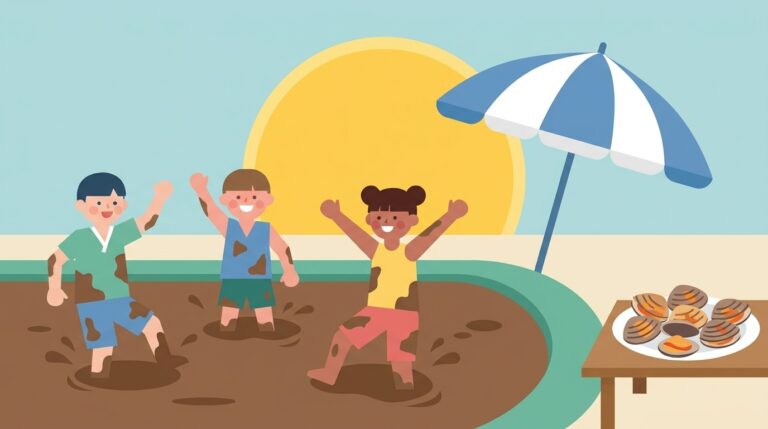
Phase 1: Empathy (Welcome to the Mud!)
Hello! I’m the Senior Editor at Daily Hangul.
Picture this: It’s mid-July in Korea. You are at Daecheon Beach. The sun is blazing, the K-Pop bass is thumping from giant speakers, and suddenly, a completely random stranger runs up to you with a bucket full of gray mud. You want to tell them to take it easy, or maybe you want to jump right in and ask if you can throw some back. But your brain freezes. You try to remember chapter 3 of your Korean textbook, but it’s too late—SPLAT!
Textbook Korean is great for the classroom, but when you’re at the Boryeong Mud Festival (보령 머드 축제), one of Korea’s most chaotic and fun global events, you need survival skills. You need the language of the streets (or in this case, the mud).
Today, we are going to learn how to navigate this incredible summer festival like a true local. By the end of this guide, you won’t just survive the mud—you’ll be the MVP of the party. Let’s dive in!
Phase 2: Core Expressions Deep Dive
Here are the top 3 expressions you need when the mud starts flying.
1. 살살해 주세요 (Please go easy on me!)
- Pronunciation: salsalhae juseyo [sal-sal-hae-joo-seh-yo]. The “sal-sal” part sounds like the soft, whispering hiss of a gentle breeze.
- Meaning: (Literal) Please do it gently. / (Real Nuance) Go easy on me! Don’t throw that mud too hard!
- K-Culture Moment: You’ve definitely seen this in K-Variety shows like Running Man. Right before a penalty (like getting hit with a water balloon), the cast member will put their hands together, look at the camera, and beg, “살살해 주세요!”
- Editor’s Insight: This phrase is perfect because it’s playful. It shows you’re participating in the game, but you’re just asking for a little mercy. It immediately breaks the ice and makes the other person laugh.
- Situation Spectrum:
- Friends (Casual): ✅ (Drop the ‘yo’: 살살해!)
- Strangers at a festival (Semi-formal): ✅
- Boss/Elders (Formal): 🚫 (Just don’t throw mud at your boss.)
- 🤔 Think About It: Why does Korean use repeated syllables like ‘살살’ (sal-sal, gently) or ‘빨리빨리’ (ppalli-ppalli, quickly)? These are called mimetic words, and they add vivid emotion to the language. Does your native language have sound-based emotion words?
2. 물품 보관함 다 찼어요? (Are the lockers all full?)
- Pronunciation: mulpum bogwanham da chaseoyo? [mool-poom bo-gwan-ham da cha-suh-yo?]. ‘Cha’ sounds exactly like the energetic Cha! you make when doing martial arts.
- Meaning: (Literal) Is the item storage box all filled? / (Real Nuance) Are there any lockers left?
- K-Culture Moment: Korea is famous for its “trust society”—you can leave a laptop on a cafe table and go to the restroom. But at a wild beach festival? Lock your phone and wallet in a 물품 보관함 (locker).
- Editor’s Insight: You will use this not only at festivals but at subway stations, saunas (Jjimjilbang), and amusement parks. It’s a B2-level lifesaver.
- Situation Spectrum:
- Friends (Casual): ✅ (다 찼어?)
- Staff/Clerks (Semi-formal): ✅
- Formal situations (Formal): ⚠️
- 🤔 Think About It: Festivals are a rare time when Koreans let their guard down completely. How does the concept of personal space change during a festival in your country compared to everyday life?
3. 저도 묻혀도 돼요? (Can I get mud on you too?)
- Pronunciation: jeodo muchyeodo dwaeyo? [juh-do moo-chyuh-do dway-yo?]. ‘Moo’ sounds like a cow, and ‘chyuh’ sounds like a sneeze.
- Meaning: (Literal) Is it okay if I smear it too? / (Real Nuance) Can I throw mud on you too? / Can I retaliate?
- K-Culture Moment: Even in the middle of a mud fight, Koreans still subconsciously check boundaries. It’s the ultimate display of Nunchi (눈치). You read the room, smile, and playfully ask for consent before attacking.
- Editor’s Insight: “~아/어도 돼요?” (Is it okay if I…?) is a grammar structure you must master. It shows politeness while being proactive.
- Situation Spectrum:
- Friends (Casual): ✅ (묻혀도 돼?)
- Strangers at a festival (Semi-formal): ✅
- Elders (Formal): 🚫
- 🤔 Think About It: Why is asking for permission so ingrained in Korean speech, even during wild games? It goes back to the deep-rooted cultural emphasis on maintaining social harmony.
Phase 3: Textbook vs Real Korean
Let’s see how language changes when you step out of the classroom and onto the muddy beach.
[Expressing that something is super fun]
* 📖 Textbook Korean: 정말 재미있습니다. (jeongmal jaemiitseumnida – It is very interesting.)
* 🗣️ Real Korean: 완전 꿀잼! (wanjeon kkuljaem! – Total honey-fun!) or 미쳤다! (michyeotda! – This is crazy!)
* 💡 Why the difference?: ‘꿀’ (honey) is used as a prefix for anything awesome. Young Koreans use ‘미쳤다’ (crazy) positively to express excitement, much like “insane” in English.
[Suggesting to wash up and leave]
* 📖 Textbook Korean: 샤워실에서 몸을 씻으세요. (syawosireseo momeul ssiseuseyo – Please wash your body in the shower room.)
* 🗣️ Real Korean: 대충 씻고 밥 먹으러 가자. (daechung ssitgo bap meogeureo gaja – Let’s just wash up roughly and go eat.)
* 💡 Why the difference?: At festivals, shower lines are long. ‘대충’ (roughly/quickly) perfectly captures the pragmatism of hungry festival-goers who just want to eat K-BBQ as soon as possible.
Phase 4: Cultural Context — K-Culture Deep Dive
4-1. Non-verbal cues in the Mud
In standard Korean culture, bowing and avoiding direct eye contact with strangers is polite. But at the Mud Festival? Eye contact and a huge smile are mandatory. If you throw mud while looking serious, people will think you’re actually angry. Always laugh, make playful eye contact, and use big hand gestures to show you surrender (hands up) when you’ve had enough!
4-2. K-Food Connection: The Legendary “Dwipuri” (After-party)
What happens when the mud washes off? The real Korean festival culture begins: 뒤풀이 (Dwipuri, the after-party).
If you go to Daecheon Beach for the festival, the golden rule is that you must eat 조개구이 (Jogaegui – Grilled Clams) afterward.
Imagine this: You are sitting at a round metal table on the beach, the sun is setting, you’re grilling fresh clams over a charcoal fire, and clinking glasses of Soju with people who were your “mud enemies” just an hour ago. In Korea, eating together is the ultimate way to turn strangers into Uri (us/our group). If someone at the festival says, “끝나고 조개구이에 소주 한잔 어때요?” (How about clams and soju after this?), you have officially been accepted as an insider.
Phase 5: Real-life Roleplay Scenario
Setting: Saturday afternoon at the Boryeong Mud Festival. You are standing near the giant inflatable mud slide. Suddenly, a local Korean guy slides down and accidentally splashes a massive amount of mud right onto your favorite sunglasses.
Characters:
– YOU: An expat having the time of your life, but currently blinded by mud.
– Min-ho (28): A friendly, energetic local who feels bad about splashing you.
Dialogue:
Min-ho: 헐! 죄송해요! 괜찮으세요? 💦
(heol! joesonghaeyo! gwaenchaneuseyo?)
[OMG! I’m so sorry! Are you okay?]
YOU: 아, 네! 괜찮아요. 축제잖아요! 😎
(a, ne! gwaenchanayo. chukjejanhayo!)
[Ah, yes! It’s fine. It’s a festival, after all!]
Min-ho: 다행이다. 눈에 들어간 거 아니죠?
(dahaengida. nune deureogan geo anijyo?)
[That’s a relief. It didn’t get in your eyes, right?]
YOU: 네, 선글라스 덕분에 살았어요.
(ne, seongeullaseu deokbune sarasseoyo.)
[No, I survived thanks to my sunglasses.]
Min-ho: 아하하. 근데 그쪽도 머드 좀 맞으셔야겠는데요?
(ahaha. geunde geujjokdo meodeu jom majeushyeoyagenneundeyo?)
[Hahaha. But it looks like you need to get hit with some mud too?]
(🎭 Stage Direction: Min-ho playfully picks up a handful of mud)
🔀 YOUR TURN! How do you reply?
– A) “안 돼요! 하지 마세요!” (No! Don’t do it!)
– B) “잠깐만요! 살살해 주세요!” (Wait! Please go easy on me!)
– C) “경찰 부를 거예요!” (I will call the police!)✅ Best Choice: B — It shows you have great nunchi and a good sense of humor. You are accepting the game but asking for playful mercy.
⚠️ Choice A & C Analysis: ‘안 돼요’ is too serious and might kill the mood unless you really mean it. Calling the police (C) is a buzzkill!
Min-ho: (Laughs) 알겠어요, 살살 던질게요!
(algesseoyo, salsal deonjilgeyo!)
[Got it, I’ll throw it gently!]
YOU: 좋아요! 저도 묻혀도 되죠?
(joayo! jeodo muchyeodo doejyo?)
[Great! I can get mud on you too, right?]
Min-ho: 당연하죠! 완전 꿀잼이네요!
(dangyeonhajyo! wanjeon kkuljaemineyo!)
[Of course! This is super fun!]
YOU: 끝나고 다 같이 조개구이 먹으러 갈래요?
(kkeutnago da gachi jogaegui meogeureo gallaeyo?)
[Want to go eat grilled clams together after this?]
Min-ho: 콜! 제가 맛집 알아요. 가자!
(kol! jega matjip arayo. gaja!)
[Deal (Call)! I know a great spot. Let’s go!]
Phase 6: 10-Second Shadowing Drill
Practice this out loud! Pay attention to the intonation slashes /.
😆 잠깐만요! / 앗, / 살살해 주세요! / 저도 / 묻혀도 돼요?
(jamkkanmanyo! / at, / salsalhae juseyo! / jeodo / muchyeodo dwaeyo?)
Emotion Tag: Laughing playfully, holding your hands up defensively.
Phase 7: K-Culture Mini Dictionary
1. 눈치 (Nunchi)
* Romanization: nunchi
* English: Social situational awareness / Emotional intelligence
* Context: The unspoken Korean art of reading the room. Even when throwing mud, you use nunchi to see if the person is open to playing or if they are tired.
2. 꿀잼 (Kkuljaem)
* Romanization: kkuljaem
* English: Super fun / Highly entertaining
* Context: A slang combination of ‘꿀’ (honey) and ‘잼’ (short for 재미, fun). Used to describe anything from a great K-Drama episode to a wild festival.
3. 조개구이 (Jogaegui)
* Romanization: jogaegui
* English: Grilled clams / Shellfish BBQ
* Context: The staple food of Korea’s west coast (where Boryeong is located). Eating this is a mandatory ritual after visiting the beach.
4. 뒤풀이 (Dwipuri)
* Romanization: dwipuri
* English: After-party / Post-event gathering
* Context: The Korean tradition of gathering for food and drinks after a big event, project, or festival to bond and celebrate.
Phase 8: Traveler’s Survival Kit
🆘 Boryeong Festival Survival Phrases
– 🇰🇷 “물품 보관함 어디예요?” (mulpum bogwanham eodiyeyo?)
– 🗣️ Meaning: Where are the lockers?
– 📍 Where to use: Looking for a place to store your dry clothes.
– 🇰🇷 “샤워장 줄 길어요?” (syawoljang jul gireoyo?)
– 🗣️ Meaning: Is the line for the shower long?
– 📍 Where to use: Trying to decide if you should wash now or wait.
– 🇰🇷 “방수팩 하나 주세요.” (bangsupaek hana juseyo.)
– 🗣️ Meaning: Please give me one waterproof phone pouch.
– 📍 Where to use: At a convenience store near the beach.📌 Editor’s Travel Note
– Getting Around: Taxis around Boryeong will NOT pick you up if you are covered in mud! You must wash off at the public showers before taking transit.
– Apps to Use: KakaoMap is much more accurate than Google Maps in Korea for finding local public shower facilities.
– Payment: Korea is cashless, but at beach festivals, it’s highly recommended to have some physical cash (10,000 KRW bills) sealed in a waterproof pouch for quick street food purchases.
Phase 9: Critical Thinking Corner — “A Step Deeper”
Food & Identity: The Magic of the “Dwipuri”
🧠 Think Deeper:
Why is the Mud Festival not truly “finished” until everyone eats Jogaegui (grilled clams) together? In Korean culture, shared meals are the foundation of identity and community. The concept of 식구 (Sikgu – family) literally translates to “mouths that eat together.” Getting dirty in the mud breaks down the formal social barriers (like age and job titles), but sitting around a warm grill, cooking food for each other, and sharing side dishes is what cements the new bond. It turns a temporary festival encounter into a lasting relationship.💬 Your Turn: Does your culture have a specific food or ritual that people must do after a big event to bond? Share it in the comments!
Phase 10: FAQ & Avoiding Misunderstandings
Q: Can I speak informally (반말 – Banmal) to strangers at the festival since it’s a party?
A: NO. Even if you are both covered in mud, you should still use standard polite Korean (요 form) when speaking to a stranger. You can say “완전 재밌어요!” (Super fun!), but don’t drop the ‘요’ until you agree to become friends.
Q: How do I refuse nicely if I don’t want to play anymore?
A: Smile warmly, wave your hands back and forth, and say, “아, 저는 이제 쉴게요!” (Ah, I’m going to rest now!). Koreans will instantly respect this boundary if you say it politely.
❌ Common Mistake #1: Saying “수고하셨습니다” (You worked hard) to a random person at the festival.
✅ Do this instead: That phrase is for colleagues after work. At a festival, say “재밌게 노세요!” (Have fun playing!) when saying goodbye to someone you met in the mud.
Phase 11: Summary & Action Items
One-Liner Summary: Survive the mud and make local friends by using playful phrases like “살살해 주세요” and mastering the art of the after-party!
Your Action Missions:
– 🥉 Bronze (Solo): Stand in front of your bathroom mirror and practice saying “살살해 주세요!” while pretending to block a water balloon.
– 🥈 Silver (Online): Go to YouTube, search “Boryeong Mud Festival Vlog,” and leave a comment in Korean: “완전 꿀잼이겠네요!” (Looks super fun!).
– 🥇 Gold (Real-world): If you visit Korea this summer, actually go to the festival, use a locker (“물품 보관함”), and eat grilled clams afterwards!
K-Culture Mission:
Search for “Running Man Water Penalty” on YouTube and see if you can hear the celebrities yelling “살살해 주세요!” before they get splashed. Listen to their intonation!
Phase 12: Interactive Challenge (Quiz)
1. Situational Judgment:
A friendly local throws a handful of mud at your legs. You want to join the fun but ask if you can throw some back. What do you say?
– A) 안 돼요! (No!)
– B) 저도 묻혀도 돼요? (Is it okay if I get some on you too?)
– C) 수고하셨습니다! (You worked hard!)
2. Fill in the Blank:
You are done with the mud and want to secure your phone. You walk up to the beach staff and ask:
“_________ 다 찼어요?” (Are the lockers all full?)
3. True or False – K-Culture Edition:
You can easily catch a taxi right outside the beach while you are still fully covered in wet mud. (T/F)
🚨 Click here for the answers!
1. B – It shows great Nunchi and keeps the fun going!
2. 물품 보관함 (mulpum bogwanham)
3. False – Taxi drivers will refuse you! You must use the 샤워장 (shower facilities) first.
Frequently Asked Questions (FAQ)
Q: What does "살살해 주세요 (Please go easy on me!)" mean in Korean and how do you pronounce it?
A: In Korean, "살살해 주세요 (Please go easy on me!)" is pronounced [salsalhae juseyo [sal-sal-hae-joo-seh-yo] and means: (Literal) Please do it gently. / (Real Nuance) Go easy on me! Don't throw that mud too hard!
Q: What does "물품 보관함 다 찼어요? (Are the lockers all full?)" mean in Korean and how do you pronounce it?
A: In Korean, "물품 보관함 다 찼어요? (Are the lockers all full?)" is pronounced [mulpum bogwanham da chaseoyo? [mool-poom bo-gwan-ham da cha-suh-yo?] and means: (Literal) Is the item storage box all filled? / (Real Nuance) Are there any lockers left?
Q: What does "저도 묻혀도 돼요? (Can I get mud on you too?)" mean in Korean and how do you pronounce it?
A: In Korean, "저도 묻혀도 돼요? (Can I get mud on you too?)" is pronounced [jeodo muchyeodo dwaeyo? [juh-do moo-chyuh-do dway-yo?] and means: (Literal) Is it okay if I smear it too? / (Real Nuance) Can I throw mud on you too? / Can I retaliate?