

Phase 1: Empathy (Immersion Open)
Hello there! Daily Hangul Editor here.
Imagine this: It’s 1:30 AM in Seoul. You just finished hanging out with your friends, maybe after a K-Pop concert or a late-night K-BBQ dinner. You walk down to the subway station, only to realize the gates are closed. The last train has left. Taxis are either too expensive or impossible to catch. Panic sets in. Where do you go?
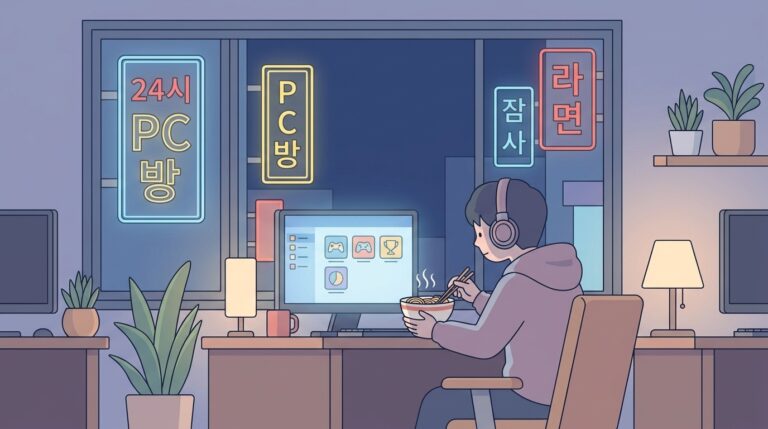
If you were in a K-Drama, this is the exact moment the main character points to a glowing, neon sign on the 3rd floor of a building that says: PC방 (PC-bang).
You might think, “An internet cafe? Just to browse the web?” Oh, no. A Korean PC bang is so much more than that. It’s a gamer’s paradise, a Michelin-worthy fast-food joint, and a safe, cheap haven for an all-nighter.
Today, we are going to dive deep into Korea’s 24-hour PC bang culture. If you don’t know the right phrases, you might end up paying double or missing out on the famous PC bang ramen. This guide is based on real struggles from my foreign students who thought they were just renting a computer, only to discover a whole new nighttime culture. Let’s get you ready for your first all-nighter!
Phase 2: Core Expressions Deep Dive
1. 밤새다 (bam-sae-da)
- Pronunciation: [bam-sae-da] / ‘bam’ sounds like ‘bomb’ but shorter, ‘sae’ sounds like ‘say’.
- Meaning: Literal: The night leaks/passes. Real nuance: To stay up all night.
- K-Culture Moment: You hear this in almost every college K-Drama when students are studying for midterms, or when gamers are about to launch a new raid. “우리 오늘 밤새는 거야?” (Are we staying up all night today?)
- Editor’s Insight: This word has a mix of exhaustion and excitement. When you say it, you are committing to seeing the sunrise.
- Situation Spectrum:
- Casual (Friends): ✅ (밤새자! / Let’s pull an all-nighter!)
- Semi-formal (Coworkers): ⚠️ (어제 밤샜어요. / I stayed up all night yesterday.)
- Formal (Boss/Elders): 🚫 (Use more formal expressions for working late)
- 🤔 Think About It: Why does a verb specifically meaning “to stay up all night” exist as a single word? Does the vibrant 24/7 culture of Korea make this word more essential than in cultures where shops close at 6 PM?
2. 야간 정액 (ya-gan jeong-aek)
- Pronunciation: [ya-gan jeong-aek] / ‘ya-gan’ means night-time. ‘jeong’ sounds like ‘jung’, ‘aek’ sounds like the ‘eck’ in neck.
- Meaning: Literal: Night fixed amount. Real nuance: Night flat-rate ticket (prepaid).
- K-Culture Moment: Usually starting from 10 PM until 8 AM, PC bangs offer a flat rate for staying the whole night. It’s incredibly cheap (sometimes just $5-$8 for 10 hours).
- Editor’s Insight: This is the magic password for a cheap all-nighter. If you pay hourly, it’s expensive. Asking for the ‘야간 정액’ instantly makes you look like a seasoned local.
- Situation Spectrum:
- Casual (Friends): ✅
- Semi-formal (Coworkers): ✅
- Formal (Boss/Elders): 🚫 (Bosses don’t usually go to PC bangs with you at 2 AM!)
- 🤔 Think About It: Flat rates encourage people to stay longer. How does this pricing model reflect Korea’s love for efficiency and “getting the most out of your money” (가성비 – gaseongbi)?
3. 선불 기계 (seon-bul gi-gye)
- Pronunciation: [seon-bul gi-gye] / ‘seon’ sounds like ‘sun’, ‘bul’ sounds like ‘bull’.
- Meaning: Literal: Prepay machine. Real nuance: Self-service payment kiosk.
- K-Culture Moment: Gone are the days when you hand cash to a person at the counter. Now, as soon as you enter a PC bang, you must find this glowing kiosk to buy your time.
- Editor’s Insight: ‘선불’ (prepaid) is a crucial word in Korea, not just for PC bangs, but for cafes and fast-food restaurants too.
- Situation Spectrum:
- Casual (Friends): ✅
- Semi-formal (Coworkers): ✅
- Formal (Boss/Elders): ✅
- 🤔 Think About It: Korea is heavily shifting towards an unmanned, automated society (kiosks everywhere). How does this affect social interactions compared to your home country?
Phase 3: Textbook vs Real Korean
[Situation 1: Declaring an All-Nighter]
* 📖 Textbook Korean: 저는 오늘 밤새도록 게임을 할 것입니다. (I will play games all night.)
* 🗣️ Real Korean: 오늘 밤샘 달린다! (Running the night today!)
* 💡 Why is it different?: Gamers love dynamic verbs. Using ‘달리다’ (to run) for drinking or gaming all night shows the high-energy internet culture.
[Situation 2: Asking to buy the night package]
* 📖 Textbook Korean: 밤 10시부터 아침까지 쓸 수 있는 요금제가 있습니까? (Do you have a plan I can use from 10 PM to morning?)
* 🗣️ Real Korean: 야간 정액 어떻게 끊어요? (How do I cut/buy the night flat rate?)
* 💡 Why is it different?: Koreans use the verb ‘끊다’ (to cut) when buying tickets or memberships, a relic from when physical tickets were literally torn or cut.
[Situation 3: Ordering Food]
* 📖 Textbook Korean: 여기 라면 한 그릇 주시겠어요? (Could I have a bowl of ramen here?)
* 🗣️ Real Korean: (Just clicking the ‘Order Food’ button on the PC screen silently)
* 💡 Why is it different?: PC bang culture is highly optimized. You don’t speak to order; the software on your computer sends the order directly to the kitchen, and they bring it to your desk.
Bottom Note: For B1 learners, using ‘야간 정액 어떻게 끊어요?’ is the perfect balance of sounding natural without using overly heavy slang.
Phase 4: Cultural Context — K-Culture Deep Dive
4-1. Non-Verbal Cues: The Art of Quiet Intensity
When you enter a PC bang, you will notice something strange. Despite hundreds of people playing intense games, it’s relatively quiet. This is where 눈치 (nunchi) comes in. While you can chat with your friends, shouting across the room or screaming into your mic is frowned upon. Keep your voice at a moderate level. Also, when the staff brings your food, a simple, quiet nod or a soft “감사합니다” (Thank you) is the standard etiquette.
4-2. K-Food Connection: The Real Reason We Go to PC Bangs
Let’s be honest. Half the people in a PC bang at 2 AM are not there for the games; they are there for the 먹방 (mukbang).
Modern Korean PC bangs have full restaurant-grade kitchens. You sit at your computer, click the “먹거리” (Food) menu on your screen, and an endless list of gourmet fast food appears: Spicy Shin Ramen topped with cheese and a hotdog, crispy sweet-and-sour pork, iced Americanos, and dumplings.
Why does a gaming center have such good food?
Because pulling an all-nighter requires fuel. It reflects the Korean communal eating culture; gaming with friends isn’t complete until you all sync up to order ramen at 3 AM. The clicking of the mouse perfectly harmonizes with the slurping of noodles.
Phase 5: Real-Life Roleplay Scenario
Setting: 11:30 PM. A massive, neon-lit PC Bang in Hongdae. Rows of glowing curved monitors, plush gaming chairs, and the faint, delicious smell of spicy ramen in the air. You and your Korean friend, Min-su, missed the last train and decided to stay here until morning.
Characters:
– YOU: A foreign traveler/student who has never pulled an all-nighter at a Korean PC bang.
– Min-su (28): Your energetic Korean friend. A veteran gamer.
Dialogue:
Min-su: 아, 막차 끊겼다. 우리 그냥 PC방에서 밤새자!
(A, makcha kkeunkyeotda. Uri geunyang PC-bang-eseo bamsaeja!)
(Ah, the last train is gone. Let’s just pull an all-nighter at the PC bang!)
(🎭 Stage Direction: Min-su points to a flashy sign across the street)
YOU: 밤새요? 아침까지 여기 있어요?
(Bamsaeyo? Achimkkaji yeogi isseoyo?)
(All night? We stay here until morning?)
Min-su: 응, 야간 정액 끊으면 엄청 싸. 10시간에 만원이야.
(Eung, yagan jeongaek kkeuneumyeon eomcheong ssa. 10-sigane man-won-iya.)
(Yeah, if we get the night flat rate, it’s super cheap. 10,000 won for 10 hours.)
YOU: 우와, 대박. 선불 기계에서 계산해요?
(Uwa, daebak. Seonbul gigye-eseo gyesanhaeyo?)
(Wow, awesome. Do we pay at the prepaid machine?)
Min-su: 맞아. 자리 먼저 잡고 번호 기억해서 기계로 가면 돼.
(Maja. Jari meonjeo japgo beonho gieokhaeseo gigye-ro gamyeon dwae.)
(Right. Just grab a seat first, remember the number, and go to the machine.)
(🎭 Stage Direction: You both sit at high-end computers. Min-su turns on his screen)
Min-su: 나 배고픈데, 라면 시킬까?
(Na baegopeunde, ramyeon sikilkka?)
(I’m hungry, should we order ramen?)
YOU: 네! 저도 먹을래요. 카운터로 가요?
(Ne! Jeodo meogeullaeyo. Kaunteo-ro gayo?)
(Yes! I want to eat too. Do we go to the counter?)
Min-su: 아니, 여기서 버튼만 누르면 자리로 가져다 주셔. 내가 쏠게! 골라봐.
(Ani, yeogiseo beoteun-man nureumyeon jari-ro gajyeoda jusyeo. Naega ssolge! Gollabwa.)
(No, if you just press the button here, they bring it to our seat. It’s my treat! Pick something.)
🔀 Your Turn! How do you reply to Min-su treating you?
– A) “아, 아닙니다. 제 것은 제가 낼게요.” (Ah, no. I will pay for mine.)
– B) “진짜요? 와~ 그럼 잘 먹겠습니다!” (Really? Wow~ Then I will eat well/Thank you!)
– C) “왜요? 돈 많아요?” (Why? Do you have a lot of money?)✅ Best Choice: B — Reason: While offering to split the bill (A) is polite, in close friendships, accepting the treat joyfully with “잘 먹겠습니다” is the best way to show appreciation. You can always say, “다음에 제가 커피 살게요!” (I’ll buy coffee next time!).
⚠️ Choice C Analysis: Direct translation of teasing. In Korean, this sounds a bit aggressive or rude, even among friends!
Phase 6: 10-Second Shadowing Drill
Read these sentences out loud to master the natural rhythm and emotion of a Korean speaker!
- 😊 밝게 (Brightly):
저희 / 야간 정액 / 어떻게 끊어요?
(jeo-hui / ya-gan jeong-aek / eo-tteo-ke kkeu-neo-yo?) - 😤 단호하게 (Determined):
오늘 무조건 / 밤샘 달린다!
(o-neul mu-jo-geon / bam-saem dal-lin-da!) - 🥺 애교 섞어서 (Cute/Polite):
여기 / 치즈 라면 하나 / 추가해 주세요~
(yeo-gi / chi-jeu ra-myeon ha-na / chu-ga-hae ju-se-yo~)
Phase 7: K-Culture Mini Dictionary
1. 눈치 (nunchi)
* Romanization: nunchi
* English: Social sense / reading the room
* Context: The essential Korean survival skill. In a PC bang, having “nunchi” means knowing not to scream when you lose a game, because others are trying to concentrate.
2. 먹방 (mukbang)
* Romanization: meokbang
* English: Eating broadcast / Food session
* Context: Derived from eating shows, people now use it in real life. “Let’s do a PC bang mukbang” means ordering a ton of delicious food while gaming.
3. 막차 (makcha)
* Romanization: makcha
* English: The last train/bus
* Context: The ultimate curfew setter in Seoul. Missing the makcha (around midnight) means you either pay for an expensive night taxi or hit the PC bang for a ‘밤샘’ (bamsaem).
4. 가성비 (gaseongbi)
* Romanization: gaseongbi
* English: Cost-effectiveness
* Context: PC bangs are the absolute peak of gaseongbi. Entertainment, shelter, heating/AC, and cheap food all for a few dollars an hour.
Phase 8: Traveler’s Survival Kit
Even if you aren’t a gamer, a PC bang is a lifesaver when you need to print a flight ticket, kill time before a red-eye flight, or simply escape the freezing winter/sweltering summer.
🆘 Survival Phrase #1: Finding the machine
– 🇰🇷 “선불 기계 어디 있어요?” (seonbul gigye eodi isseoyo?)
– 🗣️ English Guide: Where is the prepaid machine?
– 📍 Where to use: As soon as you walk into the PC bang.
– 💡 Pro Tip: Sometimes the machine only takes Korean cards. If you only have cash or an international card, go to the staff counter and say “외국인인데 카운터에서 계산해도 될까요?” (I am a foreigner, can I pay at the counter?).🆘 Survival Phrase #2: Asking for a seat
– 🇰🇷 “두 명 앉을 자리 있어요?” (du myeong anjeul jari isseoyo?)
– 🗣️ English Guide: Are there seats for two people?
– 📍 Where to use: Finding adjacent seats (커플석 – couple seats) on a crowded Friday night.📌 Editor’s Travel Note
– Useful Apps: Map apps won’t help inside the building. Look up. PC bangs are usually on the 2nd, 3rd, or basement floors. Look for signs that say ‘PC’.
– Log-in Trouble: PC bang computers require a login. If you don’t have a Korean ID to make an account, look for a “비회원” (Non-member) card at the counter or machine, which gives you a temporary ID to log in.
– Smoking: Smoking is strictly prohibited at the desks. There are designated, glass-enclosed “흡연실” (Smoking rooms) inside the PC bang.
Phase 9: Critical Thinking Corner — “One Step Deeper”
🧠 Think Deeper: Media vs Reality & Safe Nightlife
Why is staying up all night at a PC bang so common in Korea? It highlights a unique aspect of Korean society: highly secure nightlife and world-class public infrastructure. In many countries, roaming the streets or sitting in a 24-hour shop at 3 AM might feel unsafe. In Korea, the PC bang acts as a glowing sanctuary, deeply integrated into the youth culture. Furthermore, it reflects the Korean view of high-speed internet not just as a service, but almost as a basic human right. Everyone, regardless of income, can access top-tier gaming rigs and gigabit internet for the price of a cup of coffee.💬 Your Turn: In your home country, where do young people go if they miss the last train or want to stay out safely all night? Share in the comments!
Phase 10: FAQ & Avoiding Mistakes
Q: Do I need to tip the staff when they bring food to my computer?
No! There is absolutely no tipping culture in Korea. Tipping will actually confuse the staff. Just say “감사합니다” (Thank you).
Q: Can I sleep in a PC bang?
Yes and no. It’s not a hotel, but it’s very common to see people taking naps in those comfortable gaming chairs. Just don’t snore loudly, or someone might complain!
Q: Are there age restrictions for the night flat rate?
Yes! By Korean law, minors (under 19) are not allowed in PC bangs after 10 PM. If you look young, the staff will ask for your ID or passport.
❌ Common Mistake #1: Calling it a “PC Room” in English.
✅ Do this instead: Koreans use the Konglish word “PC방” (PC-bang). If you say “Internet cafe” or “PC room,” locals might not understand what you are looking for.
Phase 11: Summary & Action Items
- One-Liner Summary: A Korean PC bang is your 24-hour haven for cheap shelter, gaming, and gourmet food; just remember to find the prepaid machine (선불 기계) and buy the night flat-rate (야간 정액)!
-
Action Mission 3 Steps:
- 🥉 Bronze (Solo): Say “야간 정액 어떻게 끊어요?” out loud 3 times pretending you are exhausted at 1 AM.
- 🥈 Silver (Online): Leave a comment below telling us your favorite late-night snack in Korean.
- 🥇 Gold (Real World): Next time you visit Korea, skip the hotel for one night, find a PC bang, and order ramen directly from your computer screen!
- K-Culture Mission: Watch any college or gaming K-Drama (like Record of Youth or Bloodhounds). Spot the scene where characters are eating ramen in a PC bang. Notice how they interact with the computer to order!
Phase 12: Interactive Quiz Challenge
1. Situational Judgment:
You just entered a PC bang at 11 PM. You want to stay until 7 AM. What should you look for first?
A) The kitchen to order ramen.
B) The 선불 기계 (prepaid machine) to buy the 야간 정액 (night flat rate).
C) A bed to sleep in.
(Answer: B. Always pay for your time first!)
2. Fill in the Blank:
Friend: “Wow, look at the time! Subways are closed.”
You: “Let’s go to a PC bang and ______!” (stay up all night)
A) 눈치
B) 밤새다
C) 먹방
(Answer: B. 밤새다)
3. True or False – K-Culture Edition:
In a Korean PC bang, you must walk to the kitchen counter to order your food.
(Answer: False. You order everything with a few clicks on your computer screen, and it is delivered to your desk!)
4. Roleplay Consequence:
If you choose Choice C in our roleplay (“왜요? 돈 많아요?” – Why? Do you have a lot of money?) when your friend offers to pay for ramen, what will happen?
(Answer: Your friend will likely get slightly offended. It ruins the warm ‘정’ (jeong/affection) of treating a friend. Always accept graciously with “잘 먹겠습니다”!)
Frequently Asked Questions (FAQ)
Q: What does "밤새다 (bam-sae-da)" mean in Korean and how do you pronounce it?
A: In Korean, "밤새다 (bam-sae-da)" is pronounced [bam-sae-da] and means: Literal: The night leaks/passes. Real nuance: To stay up all night.
Q: What does "야간 정액 (ya-gan jeong-aek)" mean in Korean and how do you pronounce it?
A: In Korean, "야간 정액 (ya-gan jeong-aek)" is pronounced [ya-gan jeong-aek] and means: Literal: Night fixed amount. Real nuance: Night flat-rate ticket (prepaid).
Q: What does "선불 기계 (seon-bul gi-gye)" mean in Korean and how do you pronounce it?
A: In Korean, "선불 기계 (seon-bul gi-gye)" is pronounced [seon-bul gi-gye] and means: Literal: Prepay machine. Real nuance: Self-service payment kiosk.







