

Phase 1: Empathy (Welcome to the K-Golf Reality)
Hello! I’m your Daily Hangul Editor. Imagine this: You’re watching a classic K-Drama. The handsome CEO is on a breathtakingly green, perfectly manicured golf course. He effortlessly sinks a putt, turns to his rival, and says, “오늘 그린피는 제가 냅니다!” (I’ll pay the green fees today!). They shake hands, and a multi-million dollar merger is sealed.
Fast forward to reality. You’ve been invited to play a round of golf in Korea by your local friends or colleagues. You look up the ‘Green Fee’ (그린피) and think, “Okay, it’s a bit pricey, but manageable.” But at the end of the 18 holes, you are suddenly hit with a Cart Fee (카트비), a Caddie Fee (캐디피) that must be paid in cash, and a massive bill for the seafood pancake and beer you ate at the halfway house. Panic sets in. Who pays for what? Do you split it? Do you offer to pay?
Golf in Korea isn’t just a sport; it’s a complex social dance of etiquette, fashion, and most importantly, 눈치 (Nunchi) when the bill arrives. Today, as a B2 learner, we are going to decode the intricate language of Korean golf costs. This guide is based on real expats who ended up awkwardly fumbling for cash on the 18th hole. Let’s make sure that doesn’t happen to you!
Phase 2: Core Expressions Deep Dive
1. 오늘 그린피는 제가 낼게요 (I’ll pay the green fee today)
- Pronunciation: [oneul geurinpineun jega naelgeyo] + [oh-neul geu-rin-pee-neun jeh-gah nel-geh-yo]
- Meaning: Literal: I will pay the green fee today. / Real nuance: Today’s round is my treat, put your wallets away!
- K-Culture Moment: This is the ultimate “flex” phrase. In business golf (접대 골프), the host will almost always say this at the clubhouse front desk before anyone else can pull out their credit card.
- Editor’s Insight: The ending
-ㄹ게요is crucial here. It expresses a strong, voluntary intention while subtly seeking the listener’s acknowledgment. It sounds much more natural and polite than saying “제가 냅니다” (which sounds a bit like a robotic announcement).- Situation Spectrum:
- Casual (Friends): ✅ (Usually followed by “내가 쏠게!”)
- Semi-formal (Colleagues): ✅
- Formal (Boss/Elders): ⚠️ (Use “제가 모시겠습니다” – I will treat/escort you – for absolute elders).
- 🤔 Think About It: Why do Koreans often “fight” to pay the bill, even when it’s as expensive as a golf round? How does the concept of “정 (Jeong – affection/attachment)” tie into financial generosity in your culture?
2. 우리 N빵 해요 (Let’s split the bill)
- Pronunciation: [uri enppang haeyo] + [oo-ree en-bbang heh-yo] (‘bbang’ sounds like the start of ‘bang’ but with a sharp, tense ‘P’ sound)
- Meaning: Literal: Let’s do N-bread. / Real nuance: Let’s split the cost equally (Dutch pay).
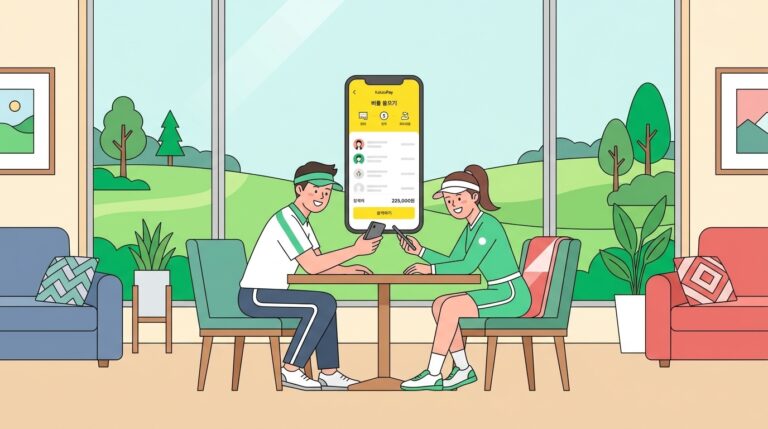
- K-Culture Moment: The MZ generation (Millennials and Gen Z) has completely taken over the Korean golf scene. Instead of one person treating everyone, young golfers strictly divide the massive costs using KakaoPay.
- Editor’s Insight: “N빵” comes from the mathematical concept of dividing by N (1/N). The “빵” part adds a slangy, rhythmic punch. It’s the most common way young people talk about splitting bills today.
- Situation Spectrum:
- Casual (Friends): ✅
- Semi-formal (Colleagues): ✅ (Among peers of similar age)
- Formal (Boss/Elders): 🚫 (Too informal; use “각자 계산하시죠”).
- 🤔 Think About It: Does your language have a math-based slang word for splitting costs? How has technology (like mobile banking) changed the way people offer to pay in your country?
3. 캐디피는 현금으로 드릴게요 (I will give the caddie fee in cash)
- Pronunciation: [kaedipineun hyeongeumeuro deurilgeyo] + [keh-dee-pee-neun hyun-geum-eu-roh deu-ril-geh-yo]
- Meaning: Literal: I will give the caddie fee in cash. / Real nuance: Here is the cash for our caddie.
- K-Culture Moment: You are standing by the golf cart after the final hole. The caddie cleans your clubs, and someone pulls out an envelope of crisp 50,000 won bills.
- Editor’s Insight: In hyper-digital Korea where credit cards are accepted for a $1 pack of gum, the Caddie Fee is the rare exception. It is almost exclusively paid in physical cash directly to the caddie after the round.
- Situation Spectrum:
- Casual (Friends): ✅
- Semi-formal (Colleagues): ✅
- Formal (Boss/Elders): ✅
- 🤔 Think About It: Why do you think caddie fees remain a strictly cash transaction in a cashless society?
Phase 3: Textbook vs. Real Korean
[Situation 1: Suggesting to split the golf costs]
* 📖 Textbook Korean: 각자 계산합시다. (Let’s calculate individually.)
* 🗣️ Real Korean: 우리 1/N(일분의 엔) 해요! or 카카오페이로 보낼게요. (Let’s do 1/N! or I’ll send it via KakaoPay.)
* 💡 Why is it different?: “각자 계산합시다” sounds like a cold instruction from a teacher. Modern Koreans use mobile apps to split costs down to the exact won, making app-based vocabulary the new standard.
[Situation 2: Someone paid the expensive Green Fee]
* 📖 Textbook Korean: 비용을 지불해 주셔서 감사합니다. (Thank you for paying the expenses.)
* 🗣️ Real Korean: 와, 대박! 그럼 그늘집은 저희가 쏘겠습니다! (Wow, awesome! Then we will treat you to the shade house!)
* 💡 Why is it different?: In Korean culture, if someone pays for the big item (Green Fee), it is basic Nunchi for the others to instantly offer to pay for the secondary items (meals/drinks) to show appreciation.
Phase 4: Cultural Context — K-Culture Deep Dive
4-1. The Non-Verbal Dance of “Nunchi” at the Counter
When the round is over, there is often a physical “Card Dance” at the front desk. Even if you know your boss or the host plans to pay, you must pretend to reach for your wallet. If they say “내가 낼게” (I’ll pay), you should softly protest once: “에이, 아닙니다. 같이 내요!” (Oh no, let’s pay together!). If they insist a second time, you gracefully step back and say, “그럼 감사히 잘 치겠습니다!” (Then I will thankfully enjoy the round!). Do not fight them to the death over the bill—letting an elder or host pay is a way of letting them save face (체면).
4-2. The “Geuneuljib” (그늘집) K-Food Connection
Korean golf courses have a unique feature: The Shade House (그늘집). After 9 holes, you have a mandatory 15-30 minute break. You don’t just sit there; you feast. Watermelon in summer, warm fish cake soup in winter, and almost always Haemul Pajeon (Seafood Pancake) and Makgeolli (Rice Wine).
Here’s the rule: The person paying the Green Fee should ideally not pay for the Geuneuljib. If your Korean friend paid the $200+ green fee, you must rush to the counter and say “이건 제가 계산할게요!” (I’ll pay for this one!) for the $40 pancake. It balances the relationship!
Phase 5: Real-Life Roleplay Scenario
Setting: Saturday, 2:00 PM. The luxurious marble lobby of a Country Club in Gyeonggi-do. You just finished an amazing 18-hole round with your Korean colleague, Min-su, and two other friends. You are walking toward the payment counter.
Characters:
– YOU (The Reader): An expat who loves golf but is still figuring out the payment etiquette.
– Min-su (35): Your Korean colleague. Generous, slightly competitive, and trying to be a good host.
Dialogue:
Min-su: 아, 오늘 날씨 진짜 좋았죠? 제가 가서 계산하고 올게요. 💳
(a, oneul nalssi jinjja joatjyo? jega gaseo gyesanhago olgeyo.)
[Ah, the weather was really great today, right? I’ll go and pay the bill.]
(🎭 Stage Direction: Min-su quickly pulls out his premium credit card and steps ahead of you)
YOU: 네? 4명 그린피를 전부 다요? 너무 비싼데요!
(ne? 4myeong geurinpi-reul jeonbu dayo? neomu bissandeyo!)
[What? All the green fees for 4 people? That’s too expensive!]
Min-su: 에이, 괜찮아요. 오늘 제가 초대했잖아요. 제가 쏩니다! 😊
(ei, gwaenchanayo. oneul jega chodaehaetjanayo. jega ssomnida!)
[Hey, it’s fine. I invited you today. I’m treating!]
🔀 Your Turn! How should you respond?
– A) “그래요? 와, 감사합니다! 땡큐!” (Accepts immediately without a second thought)
– B) “아닙니다, 민수 씨. 카트비랑 밥값은 저희가 N빵 할게요!” (Accepts the green fee but offers to split the rest)
– C) “절대 안 됩니다. 제 카드로 결제해 주세요!” (Physically blocks Min-su and hands your card to the cashier)✅ Best Choice: B — Reason: You acknowledge his generosity (saving his face as the host) but immediately use Nunchi to take care of the secondary costs (Cart fee & food). This is the golden rule of Korean golf!
⚠️ Choice A Analysis: Too fast. You missed the “Nunchi” window. He might secretly feel you are a bit ungrateful.
⚠️ Choice C Analysis: Too aggressive. In Western cultures, this might seem fair, but in Korea, aggressively rejecting a host’s treat can hurt their pride.
Bonus K-Culture Roleplay: The Olive Young Sun-Patch Run
(Before the golf trip, you are at an Olive Young store buying K-Beauty golf patches)
Clerk: 골프 패치 찾으세요? 이 제품이 요즘 제일 잘 나가요.
(golpeu paechi chajeuseyo? i jepumi yojeum jeil jal nagayo.)
[Are you looking for golf patches? This product sells the best these days.]
YOU: 아, 네! 자외선 차단 잘 되는 걸로 두 개 주세요.
(a, ne! jaoeseon chadan jal doeneun geollo du gae juseyo.)
[Ah, yes! Please give me two that have good UV protection.]
Phase 6: 10-Second Shadowing Drill
Practice this lifesaver sentence for when you want to treat the group to the halfway house meal!
😊 오늘 / 그린피는 / 민수 씨가 내셨으니까, / 😤 그늘집은 / 제가 쏠게요!
(oneul / geurinpi-neun / minsu ssi-ga naesyeosseunikka, / geuneuljib-eun / je-ga ssolgeyo!)
[Since Min-su paid the green fee today, I’ll treat us to the shade house!]
Phase 7: K-Culture Mini Dictionary
1. 골린이
* Romanization: Gollini
* English: Golf Beginner
* Context: A portmanteau of ‘Golf’ and ‘Orini’ (Child). Used affectionately to describe the massive wave of MZ generation beginners who care just as much about golf fashion as their swing.
2. 그늘집
* Romanization: Geuneuljib
* English: Shade House (Halfway Snack Bar)
* Context: The restaurant located around the 9th hole. You don’t pay here directly; you give your locker number, and it gets added to your final bill at the clubhouse.
3. 캐디피
* Romanization: Kaedipi
* English: Caddie Fee
* Context: The standard fee for the caddie (usually 140,000 ~ 150,000 KRW per group). It is strictly gathered by the players in physical cash and handed to the caddie at the end of the 18th hole.
4. 카트비
* Romanization: Kateubi
* English: Cart Fee
* Context: In Korea, walking the course is rare. You must rent a golf cart (driven by the caddie). This fee (usually around 100,000 KRW) is often split (N빵) at the front desk along with the green fee.
Phase 8: Traveler Survival Kit
Even if you’re just visiting Korea, getting invited to a screen golf (스크린 골프) or field round is highly likely if you do business here!
🆘 Survival Phrases TOP 3
– 🇰🇷 “카카오페이로 1/N (일분의 엔) 할까요?” (kakaopeiro il-bun-ui-en halkkayo?)
– 🗣️ Meaning: Shall we split it equally using KakaoPay?
– 📍 Where to use: Clubhouse counter, Screen golf counter, Restaurants.
- 🇰🇷 “현금 인출기(ATM) 어디에 있어요?” (hyeongeum inchulgi eodie isseoyo?)
- 🗣️ Meaning: Where is the ATM?
- 📍 Where to use: In the clubhouse lobby (Because you forgot cash for the caddie!)
🇰🇷 “카트비 포함인가요?” (kateubi pohamingayo?)
- 🗣️ Meaning: Is the cart fee included?
- 📍 Where to use: When checking the booking price online or at the desk.
📌 Editor’s Travel Note
– The Kakao Factor: If you live in Korea, you must have KakaoPay. When someone says “N빵,” they expect you to send your portion to their Kakao account instantly.
– Tipping Culture: Korea has absolutely NO tipping culture in restaurants or taxis. However, in golf, while the Caddie Fee is a fixed charge, if the caddie was exceptionally great (finding lost balls, reading greens perfectly), Koreans sometimes give a small extra tip (10,000~20,000 KRW), referred to as ‘버디값’ (Birdie money).
Phase 9: Critical Thinking Corner — “A Step Deeper”
Language & Power: The Generational Shift in Golf
Historically, golf in Korea was a symbol of immense wealth and corporate power. The language used was formal, and paying the $1,000+ bill for the group was a flex of status (접대 문화 – entertaining culture). However, as the MZ generation flooded the sport over the last five years, the language shifted. The rise of casual terms like “골린이” (Golf-rini) and “N빵” (Splitting) reflects a democratization of the sport. Young Koreans prioritize fairness and individual experience over rigid hierarchies. When a 25-year-old junior employee confidently says “각자 보낼게요!” (I’ll send my share!) to a senior manager on the golf course, it shows how modern banking tech and changing values are flattening traditional Korean power dynamics.
💬 Your Turn: Has a traditionally “wealthy” sport or hobby in your country been taken over by the younger generation recently? Did it change the etiquette? Let us know in the comments!
Phase 10: FAQ & Avoiding Mistakes
- Q: Can I use a credit card for the Caddie Fee?
- No. 99% of the time, it must be physical cash. This is why every clubhouse in Korea has an ATM in the lobby.
- Q: Should I pay for my own food at the Geuneuljib?
- Usually, no. One person provides their locker number and pays the whole food bill at the end, and then you either split it (N빵) later, or someone covers it as a “thank you” to the person who paid the green fee.
❌ Common Mistake #1: Trying to pay the Caddie directly with your personal credit card. You will hold up the group and create an awkward situation.
✅ Do this instead: Withdraw 50,000 KRW bills from the ATM before the round starts, pool it with your friends, and put it in a nice envelope provided at the front desk.
Phase 11: Summary & Action Items
- One-Liner Summary: Surviving Korean golf costs requires mastering “N빵” (splitting) with peers, preparing cash for the “캐디피” (caddie), and using “눈치” to balance who treats whom!
-
Action Mission 3 Steps:
- 🥉 Bronze: Say “그늘집은 제가 쏠게요!” (I’ll treat the shade house!) 3 times in front of the mirror with a confident smile.
- 🥈 Silver: Text a Korean friend or post in your learning community asking: “한국에서 골프 칠 때 진짜 N빵 많이 해요?” (Do people really split bills a lot when playing golf in Korea?)
- 🥇 Gold: Next time someone treats you to an expensive meal or activity in Korea, successfully use the phrase: “제가 커피 쏘겠습니다!” (I’ll treat us to coffee!)
- K-Culture Mission: Search for “한국 골프 브이로그” (Korean Golf Vlog) on YouTube. Skip to the end of the video and listen to how they divide the bill or thank each other at the counter!
Phase 12: Quiz — Interactive Challenge
1. Situational Judgment: Your boss just paid for everyone’s green fee, which cost over $800. What is the most culturally appropriate thing for you and your colleagues to do?
A) Say “Thank you” and go straight to the parking lot.
B) Insist on giving him cash for exactly your portion of the green fee.
C) Say “저희가 저녁 쏘겠습니다!” (We will treat you to dinner!) and pay for the post-golf meal.
(Answer: C. It shows gratitude without awkwardly rejecting their generosity.)
2. Fill in the Blank:
To split the cart fee equally with your friends, you should say:
“우리 카트비는 ____ 해요!”
(Answer: N빵 or 1/N)
3. True or False – K-Culture Edition:
“You can tip the caddie in Korea by just adding 10% to your credit card payment at the clubhouse front desk.”
(Answer: False! Caddie fees must be paid directly to the caddie in cash on the field.)”
Frequently Asked Questions (FAQ)
Q: What does "오늘 그린피는 제가 낼게요 (I'll pay the green fee today)" mean in Korean and how do you pronounce it?
A: In Korean, "오늘 그린피는 제가 낼게요 (I'll pay the green fee today)" is pronounced [oneul geurinpineun jega naelgeyo] and means: Literal: I will pay the green fee today. / Real nuance: Today's round is my treat, put your wallets away!
Q: What does "우리 N빵 해요 (Let's split the bill)" mean in Korean and how do you pronounce it?
A: In Korean, "우리 N빵 해요 (Let's split the bill)" is pronounced [uri enppang haeyo] and means: Literal: Let's do N-bread. / Real nuance: Let's split the cost equally (Dutch pay).
Q: What does "캐디피는 현금으로 드릴게요 (I will give the caddie fee in cash)" mean in Korean and how do you pronounce it?
A: In Korean, "캐디피는 현금으로 드릴게요 (I will give the caddie fee in cash)" is pronounced [kaedipineun hyeongeumeuro deurilgeyo] and means: Literal: I will give the caddie fee in cash. / Real nuance: Here is the cash for our caddie.







