

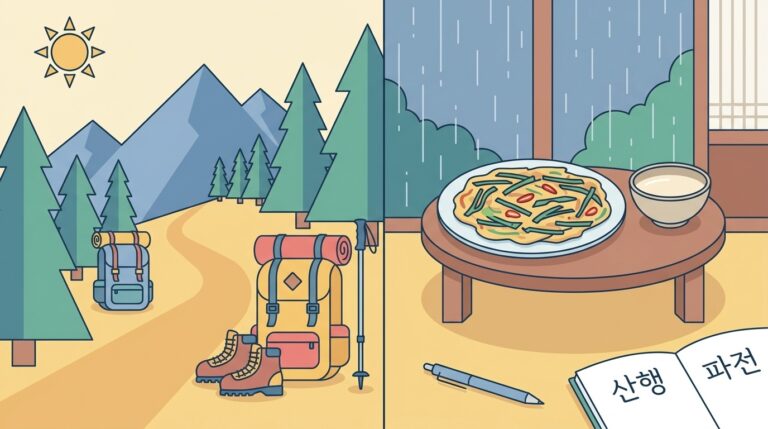
Phase 1: Empathy (Immersive Open)
Hello! I’m the lead editor of Daily Hangul, your local culture navigator here in Seoul.
Imagine this: You’ve been planning a weekend trip to Jeju Island, or maybe a scenic hike up Bukhansan (Bukhansan Mountain) in Seoul. You’ve bought the perfect colorful outdoor gear (because, let’s face it, Korean hikers take their fashion very seriously). But then, you check the Naver Weather app… and it shows a giant rain cloud. 🌧️
In K-Dramas, when plans get ruined by weather, people don’t just say, “Oh well, maybe next time.” They immediately pivot. You’ll hear them say: “If it rains, let’s just go eat Pajeon (scallion pancakes) and Makgeolli (rice wine)!”
If you don’t know how to express “if” or set conditions in Korean, your plans will hit a dead end the moment the weather changes. But if you master the magical grammar structure -(으)면 (if/when), you become an insider who can seamlessly navigate Korea’s unpredictable summer monsoon season (장마) like a true local.
(Note: This guide is based on real questions from expat students who learned the hard way that you always need a Plan B in Korea!)
Phase 2: Core Expression Deep Dive
Let’s break down the most essential phrases you need for making (and changing) plans.
1. 비가 안 오면 등산 가자
- Pronunciation: Biga an omyeon deungsan gaja [Sound-alike guide: “oh-myun” sounds like “Oh my! Un-believable!”]
- Meaning: (Literal) If rain doesn’t come, let’s go mountain climbing. -> (Real Nuance) Let’s go hiking if it doesn’t rain.
- K-Culture Moment: Hiking is practically the national pastime in Korea. On weekends, subway lines near mountains (like Line 3’s Gupabal Station) are packed with hikers. This phrase is the ultimate “Plan A” statement among friends looking forward to a weekend activity.
- Editor’s Insight: The ending -자 (ja) means “let’s.” It’s very casual and enthusiastic. But remember, -(으)면 attaches directly to the verb stem (오다 -> 오 + 면).
- Situation Spectrum:
- Casual (Friends): ✅
- Semi-formal (Close Co-workers): ⚠️ (Only if you are close and of similar rank)
- Formal (Boss/Elders): 🚫 (Too casual! Say “등산 가시죠” instead)
- 🤔 Think About It: Korea has four distinct seasons and a mountainous terrain (70% of the country!). How do you think this geographical reality shaped the way Koreans make weekend plans?
2. 만약에 비가 오면 파전 먹자
- Pronunciation: Manyage biga omyeon pajeon meokja
- Meaning: (Literal) If by chance rain comes, let’s eat Pajeon. -> (Real Nuance) If it rains, our backup plan is Pajeon.
- K-Culture Moment: This is the golden rule of Korean weather culture: Rain = Pajeon + Makgeolli. When the first drop of rain falls, Pajeon restaurants instantly fill up.
- Editor’s Insight: 만약에 (manyage) means “if by chance” or “what if.” You don’t strictly need it because -(으)면 already means “if,” but Koreans add it at the beginning of the sentence to strongly emphasize the hypothetical situation.
- Situation Spectrum:
- Casual (Friends): ✅
- Semi-formal (Close Co-workers): ✅
- Formal (Boss/Elders): 🚫
- 🤔 Think About It: Why do Koreans eat crispy pancakes on rainy days? (Hint: Think about the sound of rain hitting the window vs. the sound of sizzling oil in a pan!)
3. 날씨가 좋으면 한강에 갈래?
- Pronunciation: Nalssiga joeumyeon hangange gallae?
- Meaning: (Literal) If the weather is good, do you want to go to the Han River? -> (Real Nuance) Wanna hit the Han River if the weather’s nice?
- K-Culture Moment: The Han River (Hangang) is the ultimate dating and hangout spot in Seoul. Asking this is basically suggesting a picnic with fried chicken and beer (Chimaek).
- Editor’s Insight: -(으)ㄹ래? is a soft, friendly way to ask “Do you want to…?” It shows you care about the other person’s preference, making it perfect for a date or a casual hangout.
- Situation Spectrum:
- Casual (Friends): ✅
- Semi-formal (Close Co-workers): ⚠️
- Formal (Boss/Elders): 🚫
Phase 3: Textbook vs. Real Korean
Let’s see how Koreans actually speak when modifying plans.
[Suggesting a Backup Plan due to Rain]
* 📖 Textbook Korean: 만약 비가 온다면, 우리는 다른 계획을 세워야 합니다. (If it rains, we must make another plan.)
* 🗣️ Real Korean: 비 오면 딴 거 하자. (If it rains, let’s do something else.) / 비 오면 실내로 가자. (If it rains, let’s go indoors.)
* 💡 Why the difference?: Koreans value Ppalli-ppalli (efficiency). In casual conversation, we drop particles like 가/이 and shorten “다른 것” (another thing) to “딴 거”.
[Checking the Weather Condition]
* 📖 Textbook Korean: 내일 날씨가 어떻습니까? (How is the weather tomorrow?)
* 🗣️ Real Korean: 내일 비 온대? (Are they saying it’ll rain tomorrow?)
* 💡 Why the difference?: Instead of asking a broad question, Koreans often ask for confirmation of the forecast directly based on what they heard (-대 = I heard that / they say that).
Phase 4: Cultural Context — K-Culture Deep Dive
4-1. Non-verbal Communication & Nunchi
When making conditional plans based on weather, there is an unspoken rule of Nunchi (눈치). If someone suggests “비 오면 등산 가지 말자” (Let’s not go hiking if it rains), but they look slightly disappointed, a friend with good Nunchi will say, “그럼 등산복 입고 파전 먹으러 갈까?” (Then should we wear our hiking clothes and go eat Pajeon?). It’s all about reading the room and offering a comforting alternative!
4-2. The K-Food Connection: Rain, Sizzle, and Makgeolli
If you’ve watched K-Dramas like Hometown Cha-Cha-Cha or Hospital Playlist, you’ve probably seen characters rushing to a cozy pub when it rains. This isn’t a cliché; it’s real life!
The association between rain and Pajeon (파전) is deeply ingrained in Korean DNA. The sound of rain falling sounds exactly like the sizzling of pancake batter in hot oil. Moreover, on gloomy days, your body naturally craves the carbs and warmth of a freshly fried pancake and the sweet, tangy kick of Makgeolli. If you use the phrase “비 오면 파전 먹자” to a Korean friend, they will look at you with deep respect and think, “Wow, this person truly understands Korea.”
Phase 5: Real-World Roleplay Scenario
Setting: Friday evening, 6:00 PM. A trendy cafe in Yeonnam-dong. You and your Korean friend are looking at your phones, trying to finalize plans for Saturday.
Characters:
* YOU: An expat who really wants to hike Bukhansan this weekend.
* Jihoon (28): Your Korean friend who is an outdoor enthusiast but also a realist about the weather.
Dialogue:
Jihoon: 내일 북한산 갈 거지? ⛰️
(Naeil bukhansan gal geoji?)
[You’re going to Bukhansan tomorrow, right?]
YOU: 응! 기대돼. 근데 일기예보 봤어?
(Eung! Gidaedwae. Geunde ilgi-yebo bwasseo?)
[Yeah! I’m excited. But did you see the weather forecast?]
Jihoon: 어, 오후에 비 온대. ㅠㅠ
(Eo, ohue bi on-dae. TT_TT)
[Yeah, they say it’ll rain in the afternoon.]
YOU: 진짜? 아쉽다…
(Jinjja? Aswipta…)
[Really? What a bummer…]
Jihoon: 그럼… 만약에 아침부터 비가 오면 어떡할래?
(Geureom… manyage achimbuteo biga omyeon eotteok-hallae?)
[Then… what if it rains from the morning?]
🔀 Your Turn! How should you respond?
* A) “비가 오면 취소합시다.” (If it rains, let’s cancel.) – A bit stiff and textbook-like.
* B) “비 오면 등산 가지 말고, 막걸리 마시러 가자!” (If it rains, let’s not go hiking, and go drink Makgeolli!) – The ultimate K-Culture flex.
* C) “비 오면 집에서 잘래.” (If it rains, I wanna sleep at home.) – Honest, but maybe kills the weekend vibe.✅ Best Choice: B — Why? You are offering a culturally perfect alternative! Jihoon’s eyes will light up.
(Assuming you chose B)
Jihoon: 대박! 너 한국 사람 다 됐네! ㅋㅋㅋ
(Daebak! Neo hanguk saram da dwaenne! lol)
[Awesome! You’ve completely become Korean!]
YOU: 당연하지! 비 오면 파전 필수잖아.
(Dang-yeonhaji! Bi omyeon pajeon pilsujana.)
[Of course! Pajeon is a must if it rains.]
Jihoon: 콜! 그럼 내일 아침 9시에 다시 연락하자.
(Kol! Geureom naeil achim ahop-sie dasi yeollak-haja.)
[Deal/Call! Then let’s contact each other again tomorrow at 9 AM.]
YOU: 그래, 비 안 오면 등산 가고, 오면 파전 먹자!
(Geurae, bi an omyeon deungsan gago, omyeon pajeon meokja!)
[Okay, if it doesn’t rain let’s hike, if it comes let’s eat Pajeon!]
Phase 6: 10-Second Shadowing Drill
Practice speaking out loud! Pay attention to the pauses (/) and the intonation tags.
- 🥺 (A bit worried) 만약에 / 비가 오면 / 어떡할래?
(manyage / biga omyeon / eotteok-hallae?) - 😊 (Excitedly) 비가 안 오면 / 한강에 가자!
(biga an omyeon / hangange gaja!) - 😋 (Craving food) 비 오면 / 파전에 막걸리 / 콜?
(bi omyeon / pajeone makgeolli / kol?)
Phase 7: K-Culture Mini Dictionary
Here are some keywords related to weather and conditional plans in Korea!
1. 장마
* Romanization: Jangma
* English: Monsoon season / Rainy season
* Context: Usually from late June to mid-July. During this time, making flexible plans using “-(으)면” is absolutely critical.
2. 등산
* Romanization: Deungsan
* English: Mountain climbing / Hiking
* Context: Not just walking up a hill, but a full-blown lifestyle in Korea involving high-tech gear, summit photos, and eating afterwards.
3. 파전과 막걸리
* Romanization: Pajeon-gwa Makgeolli
* English: Scallion pancake and Rice wine
* Context: The iconic food duo reserved for rainy days.
4. 눈치 게임
* Romanization: Nunchi game
* English: The game of reading the room/situation
* Context: E.g., If the weather forecast says it might rain, people play the “Nunchi game” to guess if an amusement park (like Lotte World) will be empty or crowded.
Phase 8: Traveler Survival Kit
If you’re traveling in Korea and the weather turns bad, use these phrases to pivot your plans smoothly!
🆘 Survival Expression #1
* 🇰🇷 “비 오면 실내로 가자.” (bi omyeon sillaero gaja.)
* 🗣️ Meaning: If it rains, let’s go indoors.
* 📍 Where to use: Discussing plans with your travel buddies.🆘 Survival Expression #2
* 🇰🇷 “여기 근처에 파전 파는 곳 있어요?” (yeogi geuncheoe pajeon paneun got isseoyo?)
* 🗣️ Meaning: Is there a place that sells Pajeon near here?
* 📍 Where to use: Asking a local or a hotel receptionist when it starts raining.🆘 Survival Expression #3
* 🇰🇷 “우산 하나 주세요.” (usan hana juseyo.)
* 🗣️ Meaning: Please give me one umbrella.
* 📍 Where to use: Convenience stores (CU, GS25) when caught in a sudden downpour.📌 Editor’s Travel Note
* Best Indoor Spots: If your hiking trip gets canceled, pivot to COEX Mall, The Hyundai Seoul, or a Jjimjilbang (Korean bathhouse)!
* Umbrella Tip: Don’t spend a fortune on umbrellas. Just run to the nearest Daiso or convenience store. They sell cheap, durable clear umbrellas for about 3,000 to 5,000 KRW.
Phase 9: Critical Thinking Corner — “One Step Deeper”
Food & Identity: Why Do Koreans Share Everything?
🧠 Think Deeper:
Have you noticed that when Koreans make alternative plans for rain, the solution is almost always a shared meal like Pajeon? Korean food culture is deeply rooted in the concept of Jeong (정), a feeling of affection and community bond. Pajeon is never a single-serving dish; it’s cooked in a massive pan, placed in the center of the table, and everyone tears it apart with their chopsticks together. Pouring Makgeolli for each other (never for yourself!) reinforces social ties. So, saying “비 오면 파전 먹자” isn’t just about feeding your stomach—it’s a cultural invitation to strengthen your friendship while taking shelter from the rain.💬 Your Turn: Does your culture have a specific food or ritual you turn to when the weather is bad? Share it in the comments below!
Phase 10: FAQ & Avoiding Misunderstandings
- Q: Can I use “-(으)면” with elders or my boss?
- A: YES! The grammar itself is neutral. However, you must change the ending of the sentence. Instead of “비 오면 등산 가자” (casual), say “비가 오면 실내로 가시죠” (formal).
- Q: Can I just say “비 오면” instead of “비가 오면”?
- A: Absolutely. In spoken Korean, dropping the subject particle (가) is very natural and sounds more fluent.
- Q: Can I order ONE Pajeon just for myself at a restaurant?
- A: Maybe, but it’s tough. Most Jeon restaurants serve large portions meant for 2-3 people. It’s a social food!
❌ Common Mistake #1: Confusing -(으)면 (if) with -(으)면 좋겠다 (I wish).
✅ How to fix it: If you say “비가 안 오면 좋겠다,” it means “I wish it wouldn’t rain.” If you want to say “If it doesn’t rain, let’s go,” you must say “비가 안 오면 (어디 가자).”
Phase 11: Summary & Action Items
One-Liner Summary: To make flexible conditional plans in Korea, attach -(으)면 (if/when) to the verb, and remember that rain is the ultimate excuse to eat Pajeon!
Action Mission 3 Steps:
* 🥉 Bronze (Solo): Look out your window right now. If it’s sunny, say “날씨가 좋으면 한강에 가자!” out loud.
* 🥈 Silver (Online): Post a comment below or in your Korean study group: “(Your country/city)에서 비가 오면 _____ 먹자!” (If it rains in [Your City], let’s eat _____!)
* 🥇 Gold (Real Life): Check the Naver Weather app. Use the “-(으)면” structure to text a Korean friend or language exchange partner to make a tentative weekend plan.
K-Culture Mission: Next time it rains where you are, try making a simple scallion pancake at home, pour your drink of choice, and put on a K-Drama. Experience the vibe firsthand!
Phase 12: Quiz — Interactive Challenge
Let’s test your Nunchi and grammar skills!
1. Situational Judgment: You are texting your Korean coworker (who is slightly older than you but friendly). You want to say, “If the weather is good tomorrow, let’s drink coffee together.” What is the best choice?
* A) 낼 날씨 좋으면 커피 마실래?
* B) 내일 날씨가 좋으면 같이 커피 마시죠.
* C) 만약 비가 안 오면 커피 마십시다.
2. Fill in the Blank:
* “______ 비가 오면 어떡할래?” (What if it happens to rain?)
Hint: Emphasizes the “what if” condition.
3. True or False – K-Culture Edition:
* If it rains during a planned hike, Korean friends will usually just go home and sleep instead of meeting up. (T/F)
(Highlight below to reveal answers!)
Click to reveal answers!
1. B (A is too casual/반말, C sounds like a military order or textbook. B is perfectly polite yet friendly.)
2. 만약에 (manyage)
3. False (They will pivot the plan immediately and go eat Pajeon and Makgeolli!)
Frequently Asked Questions (FAQ)
Q: What does "비가 안 오면 등산 가자" mean in Korean and how do you pronounce it?
A: In Korean, "비가 안 오면 등산 가자" is pronounced [Biga an omyeon deungsan gaja [Sound-alike guide: "oh-myun" sounds like "Oh my! Un-believable!"] and means: (Literal) If rain doesn't come, let's go mountain climbing. -> (Real Nuance) Let's go hiking if it doesn't rain.
Q: What does "만약에 비가 오면 파전 먹자" mean in Korean and how do you pronounce it?
A: In Korean, "만약에 비가 오면 파전 먹자" is pronounced [Manyage biga omyeon pajeon meokja] and means: (Literal) If by chance rain comes, let's eat Pajeon. -> (Real Nuance) If it rains, our backup plan is Pajeon.
Q: What does "날씨가 좋으면 한강에 갈래?" mean in Korean and how do you pronounce it?
A: In Korean, "날씨가 좋으면 한강에 갈래?" is pronounced [Nalssiga joeumyeon hangange gallae?] and means: (Literal) If the weather is good, do you want to go to the Han River? -> (Real Nuance) Wanna hit the Han River if the weather's nice?







