

Phase 1: Empathy (Immersive Open)
Hello! I am the Head Editor of Daily Hangul, your veteran tutor and local cultural navigator.
Picture this: You are at an authentic K-BBQ restaurant in Seoul. The samgyeopsal (pork belly) is sizzling, the K-Pop hits are blasting, and the vibe is immaculate. But suddenly—oh no! A splash of spicy red kimchi stew lands right on your favorite white coat. In a K-Drama, this is the moment the handsome CEO magically hands you a new jacket. But in real life? You need to find a local Setakso (세탁소, Dry Cleaner) ASAP!
Many beginners freeze at the door of a Korean dry cleaner. They worry, “What if I say the wrong thing and they shrink my sweater?” Don’t worry! Knowing just a few simple A1-level survival phrases will not only save your clothes but also earn you a warm smile from the local Sajangnim (owner). This guide is based on real SOS calls from my past students. Let’s dive in!
Phase 2: Core Expressions Deep Dive
1. 이거 드라이해 주세요.
- Pronunciation: igeo deurauihae juseyo [EE-geo DEU-rai-hae JOO-se-yo]
- Meaning: Please dry clean this. (Literal: This dry please do.)
- K-Culture Moment: You will hear “드라이 (deuraui)” everywhere in Korea. It’s ‘Konglish’ (Korean-English) for dry cleaning. You don’t need to say the full word!
- Editor’s Insight: The magic word here is 이거 (igeo – this). If you forget all your Korean, just point and say “이거!” It’s the ultimate beginner’s lifeline.
- Situation Spectrum:
- Casual / To friends: 🚫 (You wouldn’t command a friend to wash your clothes!)
- To the dry cleaner owner: ✅ (Perfect and polite!)
- 🤔 Think About It: Why do Koreans use so much English (Konglish) for modern services like “Dry” or “Air Con”? How does your native language adapt foreign words?
2. 언제 돼요?
- Pronunciation: eonje dwaeyo? [UN-je DWAE-yo?]
- Meaning: When will it be ready? (Literal: When does it become?)
- K-Culture Moment: Korea is famous for its Ppalli-ppalli (hurry, hurry) culture. Sometimes, dry cleaning is done in just one day! This phrase is your key to planning your travel outfits.
- Editor’s Insight: It sounds a bit like “Un-jay.” It’s short, sweet, and gets straight to the point. Add an upward inflection at the end like a question!
- Situation Spectrum:
- To a friend asking when they will arrive: ✅
- To a service worker asking about timing: ✅
- 🤔 Think About It: Does the fast pace of Korean service culture surprise you?
3. 얼룩 지워주세요.
- Pronunciation: eolluk jiwojuseyo [ULL-look JEE-wo-joo-se-yo]
- Meaning: Please remove the stain.
- K-Culture Moment: Spilled tteokbokki sauce? The owner will usually inspect your clothes with eagle eyes. When they point at it, use this phrase.
- Editor’s Insight: Eolluk sounds like you are saying “All look!” at the stain. Pointing directly at the stain while saying this makes you look like a pro.
- Situation Spectrum:
- At a restaurant asking for a napkin: 🚫
- At the dry cleaner: ✅
- 🤔 Think About It: In Korean, we often add “~주세요” (please give/do for me) to verbs. It shows that you are requesting a favor, highlighting a culture of interdependence.
Phase 3: Textbook vs. Real Korean
[Asking for Dry Cleaning]
* 📖 Textbook Korean: 이 옷을 세탁해 주시겠습니까? (Would you please wash these clothes?)
* 🗣️ Real Korean: 사장님, 이거 드라이 부탁드려요! (Boss, dry cleaning for this please!)
* 💡 Why the difference?: Koreans prioritize efficiency and politeness combined. Calling them Sajangnim (Boss) sets a respectful tone immediately, and “이거” (this) is much faster than “these clothes.”
[Pointing out a problem]
* 📖 Textbook Korean: 여기에 더러운 것이 묻었습니다. (Something dirty got on here.)
* 🗣️ Real Korean: 여기 얼룩이요. (Here, a stain.)
* 💡 Why the difference?: In spoken Korean, we love dropping verbs! Just saying the noun (stain) + “요(yo)” to make it polite is totally enough.
Bottom Note: For A1 beginners, don’t worry about complex grammar. Pointing + Noun + “주세요 (juseyo)” is your golden formula!
Phase 4: Cultural Context — K-Culture Deep Dive
4-1. Non-Verbal Elements (The Art of Nunchi)
When you enter a Korean dry cleaner, don’t just toss your clothes on the counter. Make eye contact, bow slightly, and hand the clothes over with two hands. If there’s a specific stain, tap it gently with your finger. This is Nunchi (reading the room)—you’re saving them time by showing exactly what needs work!
4-2. The “Ppalli-Ppalli” Magic and the Neighborhood Ajumma
If you’ve watched K-Dramas like Reply 1988, you know the neighborhood Setakso is a magical place. They usually have a spinning blue-and-white sign outside. The owner (often a friendly Ajumma or Ajeossi) operates with incredible speed. Unlike some countries where dry cleaning takes a week, Korea’s Ppalli-ppalli (hurry, hurry) culture means you can often drop a suit off on Friday evening and wear it to a K-Pop concert on Saturday! However, always double-check by asking “언제 돼요?” (When will it be ready?).
Phase 5: Real-Life Roleplay Scenario
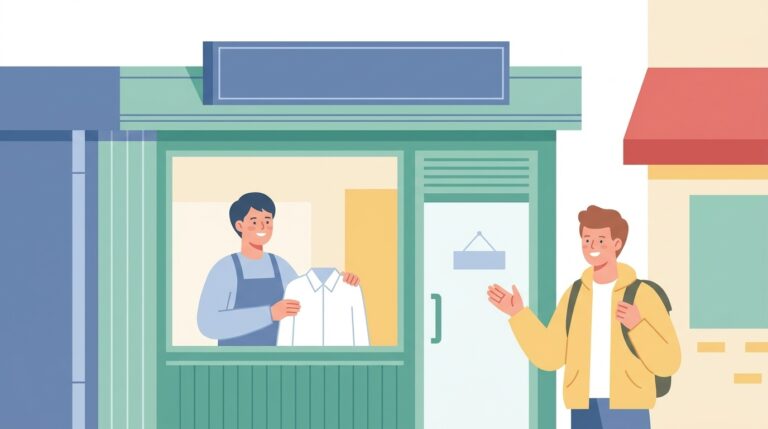
Setting: A small, warm dry cleaner shop in a Seoul neighborhood. The air smells like fresh steam and detergent. You spilled Kimchi stew on your favorite white shirt during lunch.
Characters:
– YOU: A traveler panicking about your favorite shirt.
– Sajangnim (Owner): A 50-something Korean man with measuring tape around his neck, looking professional.
Dialogue:
YOU: 안녕하세요! 🥺
(Annyeonghaseyo!)
[Hello!]
(🎭 Stage Direction: You walk in holding the stained shirt carefully)
Sajangnim: 어서 오세요~
(Eoseo oseyo~)
[Welcome~]
YOU: 사장님, 이거 드라이해 주세요.
(Sajangnim, igeo deurauihae juseyo.)
[Boss, please dry clean this.]
Sajangnim: 어디 볼까요? 아이고, 이게 뭐예요?
(Eodi bolkkayo? Aigo, ige mwoyeyo?)
[Let’s see? Oh my, what is this?]
(🎭 Stage Direction: He points at the giant red stain)
YOU: 김치찌개요… 여기 얼룩 지워주세요.
(Gimchijjigaeyo… yeogi eolluk jiwojuseyo.)
[Kimchi stew… please remove the stain here.]
Sajangnim: 김치는 잘 안 지워지는데… 해볼게요.
(Gimchineun jal an jiwojineunde… haebolgeyo.)
[Kimchi is hard to remove but… I’ll try.]
YOU: 감사합니다! 저… 언제 돼요?
(Gamsahamnida! Jeo… eonje dwaeyo?)
[Thank you! Um… when will it be ready?]
Sajangnim: 월요일에 오세요.
(Wollyoire oseyo.)
[Come on Monday.]
🔀 Your Turn! How do you reply? You need it by TOMORROW for a date!
– A) 빨리 주세요! (Give it fast!)
– B) 내일까지 돼요? (Can it be done by tomorrow?)
– C) 안 돼요! (No!)✅ Best Choice: B — It’s a polite way to ask if an earlier time is possible.
⚠️ Choice A & C Analysis: Choice A sounds like a demand, and Choice C sounds very aggressive to an elder!
YOU: 혹시… 내일까지 돼요?
(Hoksi… naeilkkaji dwaeyo?)
[By any chance… can it be done by tomorrow?]
Sajangnim: 내일요? 알았어요. 내일 저녁에 오세요.
(Naeillyo? Arasseoyo. Naeil jeonyeoge oseyo.)
[Tomorrow? Okay. Come tomorrow evening.]
Phase 6: 10-Second Shadowing Drill
Repeat this out loud to master the rhythm! Let’s practice with an earnest, pleading tone.
🥺 사장님, / 이거 / 드라이 / 해 주세요!
(Sa-jang-nim, / i-geo / deu-ra-ui / hae ju-se-yo!)
Phase 7: K-Culture Mini Dictionary
1. 세탁소
* Romanization: Setakso
* English: Dry cleaner / Laundromat
* Context: The local neighborhood laundry shop, often indicated by a spinning blue hanger sign.
2. 사장님
* Romanization: Sajangnim
* English: Boss / Owner
* Context: The most polite and common way to address a shop owner, restaurant owner, or taxi driver in Korea.
3. 빨리빨리
* Romanization: Ppalli-ppalli
* English: Hurry, hurry / Fast
* Context: The core philosophy of modern Korean society—from fast internet to overnight dry cleaning.
4. 얼룩
* Romanization: Eolluk
* English: Stain
* Context: Your worst enemy when eating Korean food. Always ask for an apron (앞치마 – apchima) at restaurants to avoid this!
Phase 8: Traveler Survival Kit
🆘 Survival Phrases at the Shop
– 🇰🇷 “이거 얼마예요?” (i-geo eol-ma-ye-yo?)
– 🗣️ English: How much is this?
– 📍 Where to use: Everywhere! Markets, cafes, dry cleaners.
– 💡 Pro Tip: If you can’t understand the numbers they say, hand them your phone with the calculator app open. They will type the price for you!📌 Editor’s Travel Note
– Finding a shop: Type “세탁소” (Setakso) in KakaoMap or Naver Map. If you want a self-service coin laundry to wash normal clothes, search for “코인빨래방” (Coin Ppal-lae-bang).
– Cash vs Card: Most dry cleaners accept cards, but very small, old-school neighborhood shops might prefer cash or bank transfer.
– Tipping: There is ZERO tipping culture in Korea! Don’t try to tip the dry cleaner; just say a warm “감사합니다 (Thank you).”
Phase 9: Critical Thinking — “One Step Deeper”
Language & Power (Respecting the Hustle)
Why do Koreans call a small dry cleaner operator “Sajangnim” (Boss)? In many Western cultures, a customer might simply say “Excuse me.” In Korea, using job titles is a profound sign of respect. By calling the owner Sajangnim, you acknowledge their hard work and authority over their space. It flattens the “customer is king” dynamic and builds an instant bridge of mutual respect.
🧠 Think Deeper:
Does your culture have a special title for small business owners, or do you use general greetings like “Sir” or “Ma’am”?💬 Your Turn: How would you get a shopkeeper’s attention in your country? Let us know in the comments!
Phase 10: FAQ & Avoiding Misunderstandings
- Q: Can I bargain the price at a dry cleaner?
- No! Unlike traditional street markets, dry cleaners have set prices. Bargaining here might make the owner uncomfortable.
- Q: Can I ask them to fix a missing button?
- Yes! Many dry cleaners also do alterations. You can point to the button and say “수선해 주세요 (Suseon-hae juseyo – Please alter/fix this).”
- Q: I’m shy. Do I have to say hello?
- Yes! Always say “안녕하세요 (Hello)” when entering. Ignoring the greeting is considered quite rude.
❌ Common Mistake #1: Pointing with one finger like you are scolding them.
✅ Do this instead: Use your whole hand to gesture toward the clothes, or hold the clothes with two hands when passing them over.
Phase 11: Summary & Action Items
- One-Liner Summary: Point to your clothes, call them Sajangnim, and say “이거 드라이해 주세요!” to save your favorite outfits.
-
Action Mission 3 Steps:
- 🥉 Bronze (Solo): Grab a shirt from your closet and practice saying “이거 드라이해 주세요” in front of a mirror.
- 🥈 Silver (Online): Write “사장님, 언제 돼요?” in your Korean study group or in our comment section!
- 🥇 Gold (Real Life): Next time you are in Korea, drop off a coat at a local Setakso and use these exact phrases.
- K-Culture Mission: Open KakaoMap or Google Street View, go to a random neighborhood in Seoul (like Hongdae), and try to spot a blue-and-white Setakso sign!
Phase 12: Quiz — Interactive Challenge
1. Situational Judgment: You dropped off your suit, but you want to know when you can pick it up. What should you ask?
A) 이거 얼마예요? (How much is this?)
B) 언제 돼요? (When will it be ready?)
C) 얼룩 지워주세요. (Please remove the stain.)
2. True or False – K-Culture Edition:
If the dry cleaner does a great job removing a tough Kimchi stain, you should leave a 15% tip to show your appreciation.
(Answers: 1: B. 2: False! Tipping is not practiced in Korea. A big smile and ‘감사합니다’ is the best tip!)
Frequently Asked Questions (FAQ)
Q: What does "이거 드라이해 주세요." mean in Korean and how do you pronounce it?
A: In Korean, "이거 드라이해 주세요." is pronounced [igeo deurauihae juseyo [EE-geo DEU-rai-hae JOO-se-yo] and means: Please dry clean this. (Literal: This dry please do.)
Q: What does "언제 돼요?" mean in Korean and how do you pronounce it?
A: In Korean, "언제 돼요?" is pronounced [eonje dwaeyo? [UN-je DWAE-yo?] and means: When will it be ready? (Literal: When does it become?)
Q: What does "얼룩 지워주세요." mean in Korean and how do you pronounce it?
A: In Korean, "얼룩 지워주세요." is pronounced [eolluk jiwojuseyo [ULL-look JEE-wo-joo-se-yo] and means: Please remove the stain.







