

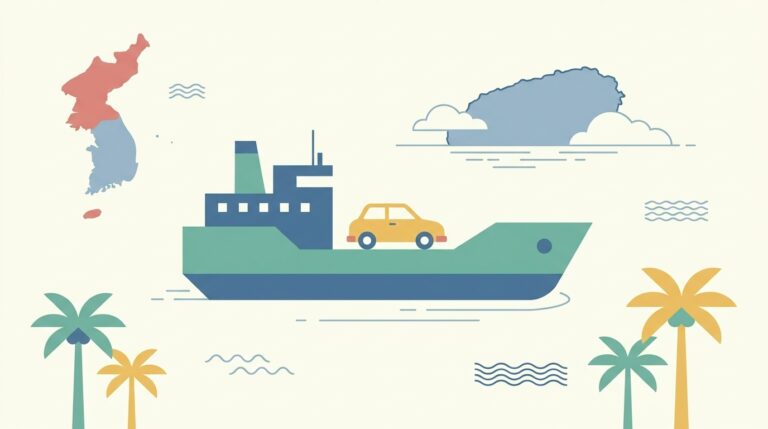
Phase 1: Empathy (Immersive Open)
Hello! Daily Hangul Editor here.
Imagine this: You are watching a K-Drama where the wealthy chaebol protagonist flies to Jeju Island for a spontaneous weekend getaway. They step out of Jeju International Airport, toss their sunglasses on, and effortlessly slip into a sleek, pre-arranged convertible rental car. It looks glamorous, right?
But for the rest of us living in the real world of Korean domestic travel, planning a Jeju trip during peak season (seongsugi) feels more like a survival game. You open a travel app to book a rental car, and your jaw drops—the rental fee is higher than your round-trip flight tickets!
You might be thinking, “Wait, isn’t Jeju supposed to be affordable?” Welcome to the reality of Jeju’s volatile peak-season pricing. Recently, as rental car prices have skyrocketed, savvy locals have turned to a brilliant alternative: ‘탁송’ (Taksong – vehicle consignment), which means putting your own car on a ferry from the mainland to Jeju.
If you want to plan a trip with your Korean friends, or just sound like an absolute local insider who knows the ins and outs of Korean travel economics, knowing how to express your frustration at high prices and suggest these clever workarounds is crucial. Let’s dive into the advanced, real-world Korean you need to survive Jeju’s rental car jungle!
(Note: This guide is crafted based on the actual rants and rave-reviews of expat learners and locals who have navigated the Jeju vacation planning process!)
Phase 2: Core Expressions Deep Dive
Let’s look at 3 advanced-level expressions that perfectly capture the nuance of navigating inflated travel costs.
1. 부르는 게 값이에요. (The price is whatever they call out.)
- Pronunciation: [bureuneun ge gabsieyo] / bu-reu-neun ge gap-shi-e-yo
- Sound-alike guide: ‘부 (bu)’ sounds like ‘boo’, ‘값 (gap)’ sounds like the English word ‘gap’ but with a sharp stop.
- Meaning: Literal: “Calling is the price.” Real nuance: “The price is skyrocketing/It’s a seller’s market/They are charging whatever they want.”
- K-Culture Moment: You are sitting in a cafe with your Korean coworkers trying to book a van for a company workshop in Jeju. The youngest employee refreshes the page and sighs, using this phrase to explain that because demand is so high, rental companies are just inventing prices.
- Editor’s Insight: This phrase isn’t just about things being “expensive.” It captures a sense of helplessness against aggressive dynamic pricing. It’s the perfect C2-level way to complain about inflation or monopoly pricing.
- Situation Spectrum:
- Friends (Casual): ✅ (부르는 게 값이네!)
- Coworkers (Semi-formal): ✅
- Boss/Elders (Formal): ⚠️ (Use cautiously; it sounds a bit cynical)
- 🤔 Think About It: In Korean culture, fixed prices (jeongchalje) are standard in modern retail, but in markets or peak-season tourism, the “seller’s market” prevails. Does your native language have an idiom for when sellers hold all the power?
2. 바가지를 쓰느니 차라리 탁송을 보낼게요.
- Pronunciation: [bagajireul sseuneuni charari taksongeul bonaelgeyo] / ba-ga-ji-reul sseu-neu-ni cha-ra-ri tak-song-eul bo-nael-ge-yo
- Meaning: Literal: “Rather than wearing a gourd, I will send consignment.” Real nuance: “Rather than getting ripped off, I’d rather just ship my own car.”
- K-Culture Moment: This is the ultimate “I’m not falling for it” declaration. Bagaji (gourd) combined with sseuda (to wear/put on) is the quintessential Korean idiom for being overcharged or scammed.
- Editor’s Insight: Using the grammar pattern
~느니 차라리(rather than A, I would completely prefer B) elevates your Korean to a highly advanced level. It shows strong preference and slight disdain for option A.- Situation Spectrum:
- Friends (Casual): ✅
- Coworkers (Semi-formal): ✅
- Boss/Elders (Formal): 🚫 (Too strong of an opinion for strict business settings)
- 🤔 Think About It: Why does “wearing a gourd” mean getting ripped off? Historically, in gambling games, people would hide items under gourds, and guessing wrong meant losing a lot of money. How do you describe “getting ripped off” in your country?
3. 탁송 업체 수배 중이에요.
- Pronunciation: [taksong eopche subae jungieyo] / tak-song eop-che su-bae jung-i-e-yo
- Meaning: Literal: “I am in the middle of a wanted search for a consignment company.” Real nuance: “I’m currently hunting down/tracking down a car shipping service.”
- K-Culture Moment: You use this when you are diligently calling multiple places, checking reviews, and comparing quotes.
- Editor’s Insight: Subae (수배) is originally a police term used for hunting down criminals (like a wanted poster). Using it metaphorically for finding a scarce item or service (like a PS5, a rare concert ticket, or a good rental car) makes you sound incredibly fluent and witty.
- Situation Spectrum:
- Friends (Casual): ✅
- Coworkers (Semi-formal): ✅
- Boss/Elders (Formal): ✅ (Often used in office environments when hunting down vendors!)
Phase 3: Textbook vs. Real Korean
Let’s compare what you learned in your language institute with what Koreans actually say when their wallets are hurting.
[Situation 1: Expressing shock at rental car prices]
* 📖 Textbook Korean: 렌터카가 너무 비쌉니다. (The rental car is too expensive.)
* 🗣️ Real Korean: 렌터카 가격 진짜 선 넘었네. (Rental car prices really crossed the line.)
* 💡 Why the difference?: “선 넘다” (crossing the line) is a wildly popular modern slang phrase originating from internet culture, used when someone or something (even a price tag) behaves outrageously beyond acceptable social norms.
[Situation 2: Deciding to bring your own car via ferry]
* 📖 Textbook Korean: 제 자동차를 배로 가져가겠습니다. (I will take my car by ship.)
* 🗣️ Real Korean: 그냥 내 차 탁송 부르는 게 개이득이야. (It’s just way more beneficial to call consignment for my car.)
* 💡 Why the difference?: Adding ‘개’ (gae – dog) as a prefix to ‘이득’ (ideuk – benefit) is a slightly casual slang way to say “a huge advantage/win.” It shows you are actively calculating cost-efficiency (가성비), a core Korean trait.
Bottom Note: For C2 learners, instead of using ‘개이득’ in formal settings, use “탁송이 훨씬 경제적이네요” (Consignment is much more economical) to maintain a sophisticated tone.
Phase 4: Cultural Context — K-Culture Deep Dive
4-1. Non-verbal Nuances & Nunchi
When discussing seongsugi (peak season) prices, non-verbal cues are essential. You don’t just say “It’s expensive.” You inhale sharply through your teeth (the classic Korean “Tsk / Sseeee” sound of sympathetic pain), widen your eyes, and shake your head. This shows you have the Nunchi to understand the collective financial pain of domestic travel. If your Korean friend says they are going to Jeju in late July, give them a look of pity before asking about their car rental.
4-2. K-Travel Connection: The ‘Jeju Premium’ Dilemma
Jeju Island is often dubbed the “Hawaii of Korea.” It’s the top destination for honeymoons, family trips, and MTs (Membership Training). Because Jeju is an island, you must rent a car or take taxis to get around. Local businesses know this, leading to the infamous “Jeju Premium.”
Recently, this has sparked a cultural shift. Millennials and Gen Z travelers, armed with comparison apps, refuse to be victims of Bagaji (rip-offs). This birthed the popularity of ‘탁송’ (Taksong). You hire a driver to take your car to a port (like Mokpo or Yeosu), load it onto a massive ferry, and pick it up at Jeju port. It sounds complicated, but for a one-week stay, it can save hundreds of dollars. Understanding this “workaround culture” shows you deeply grasp the Korean consumer mindset.
Phase 5: Real-Life Roleplay Scenario
Scenario A: The Main Roleplay
- Setting: Friday night, 8 PM. A trendy but slightly noisy izakaya in Yeonnam-dong, Seoul. You are planning a 5-day summer trip to Jeju with your close Korean friend.
- Characters:
- YOU: An expat who has lived in Korea for 3 years, proud of your Korean skills, but shocked by travel logistics.
- Minji (29): Your Korean friend, a pragmatic planner who hates wasting money.
Minji: 야, 우리 제주도 비행기는 끊었는데, 렌터카 어떡할래?
(Ya, uri jejudo bihaengineun kkeunheonneunde, renteoka eotteokhallae?)
[Hey, we booked our flights to Jeju, but what should we do about the rental car?]
(🎭 Stage Direction: Minji takes a sip of her highball, looking stressed.)
YOU: 내가 아까 제주패스 들어가서 봤는데, 가격이 미쳤어.
(Naega akka jejupaeseu deureogaseo bwanneunde, gagyeogi micheosseo.)
[I went on Jeju Pass earlier and looked, the prices are crazy.]
Minji: 성수기라 부르는 게 값일걸? 하루에 얼마래?
(Seongsugira bureuneun ge gapsilgeol? Harue eolmarae?)
[It’s peak season, so they’re probably charging whatever they want, right? How much per day?]
YOU: 아반떼가 하루에 15만 원이래.
(Abanttega harue siboman wonirae.)
[They said an Avante is 150,000 won a day.]
Minji: 헐, 선 넘네. 5일이면 75만 원? 그 돈이면 차라리 일본을 가겠다!
(Heol, seon neomne. Oilimyeon chilsiboman won? Geu donimyeon charari ilboneul gagetda!)
[Wow, that crosses the line. 750,000 won for 5 days? For that money, I’d rather go to Japan!]
YOU: 그러니까. 진짜 바가지 제대로 씌우네.
(Geureonikka. Jinjja bagaji jedaero ssiune.)
[Exactly. They are seriously ripping people off.]
Minji: 야, 안 되겠다. 그냥 내 차 탁송 보내자. 내가 탁송 업체 수배해 볼게.
(Ya, an doegetda. Geunyang nae cha taksong bonaeja. Naega taksong eopche subaehae bolge.)
[Hey, this won’t do. Let’s just consign my car. I’ll hunt down a consignment company.]
🔀 Your Turn! How do you respond to Minji’s idea?
– A) “탁송이 뭐야? 배로 가는 거야?” (What is taksong? Does it go by ship?) – A bit basic, but safe.
– B) “오, 탁송? 그거 완전 개이득 아니야? 탁송비 반반 내자!” (Oh, taksong? Isn’t that a massive win? Let’s split the consignment fee!) – Shows high cultural understanding and fairness.
– C) “아니야, 내가 렌터카 그냥 쏠게!” (No, I’ll just treat us to the rental car!) – Generous, but Minji might feel burdened by the crazy price.✅ Best Choice: B — Reason: You instantly validate her clever travel hack using casual slang (‘개이득’) and offer to split the cost (‘반반’ – ban-ban, half and half), which is the golden rule of Korean friendships and travel.
Phase 6: 10-Second Shadowing Drill
Practice speaking like a frustrated but savvy traveler. Pay attention to the pauses (/) and the emotional tags!
😤 렌터카 가격이 / 부르는 게 값이네. (renteoka gagyeogi / bureuneun ge gapsine.)
😊 차라리 / 내 차를 / 탁송 보내는 게 / 낫겠다! (charari / nae chareul / taksong bonaeneun ge / natgetda!)
😎 내가 당장 / 업체 / 수배해 볼게. (naega dangjang / eopche / subaehae bolge.)
Phase 7: K-Culture Mini Dictionary
1. 탁송 (Taksong)
* Romanization: taksong
* English: Vehicle consignment / Shipping a vehicle
* Context: The process of hiring a driver/company to transport your personal vehicle to a port and putting it on a ferry to Jeju. A life-saving travel hack for long stays.
2. 바가지요금 (Bagaji-yogeum)
* Romanization: bagaji-yogeum
* English: Rip-off pricing / Extortionate charges
* Context: The inflated prices specifically targeting tourists during vacation seasons. Koreans despise this and will actively boycott locations known for bagaji.
3. 성수기 / 비수기 (Seongsugi / Bisugi)
* Romanization: seongsugi / bisugi
* English: Peak season / Off-peak season
* Context: Essential terms for Korean travel. Late July to early August is “극성수기” (geuk-seongsugi – extreme peak season) when prices double or triple.
4. 자차 보험 (Jacha boheom)
* Romanization: jacha boheom
* English: Own vehicle damage insurance (Collision Damage Waiver)
* Context: When renting a car in Korea, you must know “일반 자차” (standard insurance with a deductible) vs. “완전 자차” (Super CDW / full coverage). Always get 완전 자차 in Jeju!
Phase 8: Traveler Survival Kit
If you find yourself having to navigate transportation rentals in Korea, keep these in your back pocket:
🆘 Survival Expressions for Car Rentals
– 🇰🇷 “완전 자차 포함된 가격인가요?” (wanjeon jacha pohamdoen gagyeogingayo?)
– 🗣️ English: Is full coverage insurance included in this price?
– 📍 Where to use: Rental car counters, phone inquiries.
- 🇰🇷 “기스 난 곳은 미리 사진 찍어둘게요.” (giseu nan goseun miri sajin jjigeodulgeyo.)
- 🗣️ English: I will take pictures of the scratched areas in advance.
- 📍 Where to use: During the vehicle inspection. (‘기스’ is a common slang derived from Japanese ‘kizu’ meaning scratch. Very naturally used in Korea).
📌 Editor’s Travel Note
– Must-have Apps: Download ‘SOCAR’ (쏘카) or ‘GreenCar’ (그린카) for hourly rentals. For Jeju specifically, ‘Jeju Pass’ (제주패스) aggregates local rental companies.
– License: You CANNOT rent a car in Korea without a valid International Driving Permit (IDP) stamped for the correct vehicle class, along with your physical passport. Digital copies won’t work!
– License Plates: Did you know? All rental cars in Korea have license plates containing one of three syllables: 하 (ha), 허 (heo), or 호 (ho). If someone cuts you off in Jeju and has a ‘하’ plate, locals just sigh and say, “Ah, another tourist.”
Phase 9: Critical Thinking — “One Step Deeper”
Language & Economics: The Death of Domestic Travel?
Let’s analyze the phrase: “그 돈이면 차라리 일본을 가겠다!” (For that money, I’d rather go to Japan!). This phrase has become a massive meme in Korean society. It reflects a growing resentment toward the Bagaji (rip-off) culture of domestic tourist spots like Jeju Island. As low-cost carriers (LCCs) made flights to Osaka, Fukuoka, or Southeast Asia incredibly cheap, Korean consumers began comparing the inflated peak-season costs of domestic travel (like 150,000 KRW for a daily rental car) against the cost of international travel.
This shift isn’t just about money; it’s about the feeling of being “scammed” by your own country’s vendors. The rise of ‘Taksong’ (consignment) is a direct, innovative consumer rebellion against this dynamic. It shows how Korean society rapidly adapts to economic pain points, sharing hacks and creating entire new service industries almost overnight to bypass perceived unfairness.
🧠 Think Deeper:
Does your home country have a specific domestic destination that locals feel has become “too expensive for locals”? How does language or slang reflect the economic frustrations of tourists in your culture?💬 Your Turn: Have you ever experienced Bagaji while traveling? Share your story in the comments!
Phase 10: FAQ & Avoiding Mistakes
Q: Can I yell “바가지요금!” (Rip-off!) directly at a merchant?
– A: NO! 🚫 This is highly offensive and confrontational. Use this term only when complaining to your friends or writing a review after the fact.
Q: Is ‘탁송’ safe? Will my car get damaged?
– A: Generally, it is very safe and highly regulated. Companies take detailed videos of your car before and after transit. However, always ensure the company provides comprehensive insurance (탁송 보험) for the journey.
❌ Common Mistake #1: Assuming “자차” (jacha) means you are completely covered.
✅ How to fix it: Rental companies have ‘일반 자차’ (Standard) where you still pay a deductible if you crash. Always ask for ‘완전 자차’ (Full/Super coverage) or even ‘수퍼 자차’ to ensure zero out-of-pocket costs.❌ Common Mistake #2: Translating “calling a rental car” literally as 렌터카를 부르다.
✅ How to fix it: In Korean, you rent a car (렌터카를 빌리다 / 예약하다). You only “call” (부르다) a taxi or a designated driver (대리기사).
Phase 11: Summary & Action Items
- One-Liner Summary: Beat the Jeju Island ‘Bagaji’ (rip-off) rental prices by suggesting ‘Taksong’ (consignment) like a true travel insider!
-
Action Mission 3 Steps:
- 🥉 Bronze (Solo): Say “바가지를 쓰느니 차라리 탁송을 보낼게요” out loud three times, channeling your inner frustrated travel planner.
- 🥈 Silver (Online): Go to a Korean travel forum or Reddit and drop the phrase “요즘 제주도 렌터카 부르는 게 값이네요” to see how locals react.
- 🥇 Gold (Real World): The next time a Korean friend complains about high prices for anything (tickets, hotels), sympathize by saying “진짜 선 넘었네!” (That really crossed the line!).
- K-Culture Mission: Go to YouTube and search “제주도 탁송 브이로그” (Jeju Island Taksong Vlog). Watch how locals hand over their cars at the port and pick them up at Jeju airport. It’s a fascinating look into modern Korean travel logistics!
Phase 12: Quiz — Interactive Challenge
1. Fill in the Blank:
You are shocked at the hotel prices for the summer weekend.
“와, 이번 여름 방값 진짜 ( _________ ) 게 값이네.”
A) 말하는 (talking)
B) 부르는 (calling)
C) 원하는 (wanting)
2. True or False — K-Culture Edition:
“If you rent a car in Korea with a ‘허’ (Heo) license plate, locals will immediately know it is a rental car.”
3. Situational Judgment:
Your friend suggests paying $200 a day for an old compact car in Jeju. You want to suggest shipping your own car instead because you feel it’s a rip-off. What is the most natural, C2-level response?
A) 렌터카가 비쌉니다. (The rental car is expensive.)
B) 우리 바가지 쓰는 것 같아. 탁송 업체 수배해 볼까? (I think we are getting ripped off. Should we hunt down a consignment company?)
C) 당신은 사기꾼입니다. (You are a scammer.)
Click to reveal the answers!
1. B) 부르는 (부르는 게 값이다 – The price is whatever they call out.)
2. True! Rental cars in Korea use ‘하, 허, 호’ (Ha, Heo, Ho) syllables on their plates.
3. B is the perfect balance of using the ‘Bagaji’ idiom and the advanced vocabulary ‘Subae’ (hunting down/arranging). A is too textbook, and C will get you into a fight!
Happy travels, and stay smart out there in the rental jungle!
Frequently Asked Questions (FAQ)
Q: What does "부르는 게 값이에요. (The price is whatever they call out.)" mean in Korean and how do you pronounce it?
A: In Korean, "부르는 게 값이에요. (The price is whatever they call out.)" is pronounced [bureuneun ge gabsieyo] and means: a key conversational Korean expression covered in this lesson.
Q: What does "바가지를 쓰느니 차라리 탁송을 보낼게요." mean in Korean and how do you pronounce it?
A: In Korean, "바가지를 쓰느니 차라리 탁송을 보낼게요." is pronounced [bagajireul sseuneuni charari taksongeul bonaelgeyo] and means: Literal: "Rather than wearing a gourd, I will send consignment." Real nuance: "Rather than getting ripped off, I'd rather just ship my own car."
Q: What does "탁송 업체 수배 중이에요." mean in Korean and how do you pronounce it?
A: In Korean, "탁송 업체 수배 중이에요." is pronounced [taksong eopche subae jungieyo] and means: Literal: "I am in the middle of a wanted search for a consignment company." Real nuance: "I'm currently hunting down/tracking down a car shipping service."







