

Phase 1: Empathy (Immersive Cold Open)
Hello! I’m the lead editor of Daily Hangul, and your personal local culture navigator.
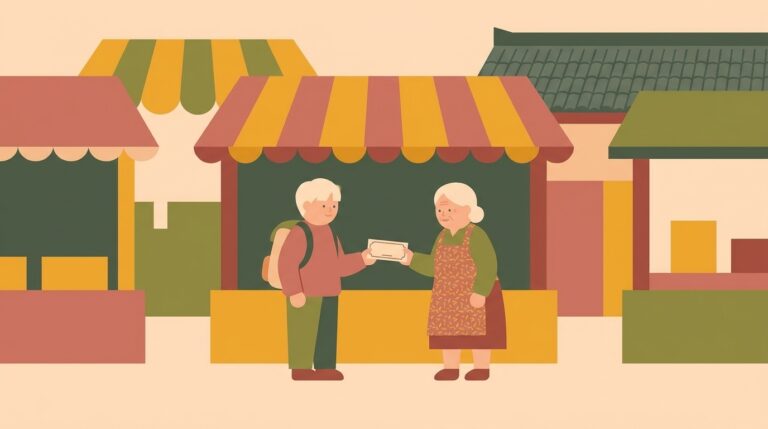
Imagine this: You’re standing in the middle of Mangwon Market. The smell of freshly fried hotteok (sweet pancakes) and spicy tteokbokki fills the air. It’s vibrant, loud, and delightfully chaotic—just like a scene straight out of a K-Drama. You reach into your wallet and pull out an ‘Onnuri Gift Certificate’ (온누리 상품권), a special voucher you bought at a discount to use at traditional markets.
But as the line behind you grows longer, panic sets in. Do they accept paper vouchers here? What about the mobile app version? How do I ask without holding up the line?
Don’t worry. As an advanced (C1) Korean learner living in or visiting Korea, you already know the basics. Today, we are going to upgrade your market survival skills to ‘Local Insider’ status. We’ll master the exact phrases, the social nunchi (tact), and the unwritten rules of using Onnuri vouchers. Let’s dive in!
Phase 2: In-Depth Analysis of Core Expressions
1. 사장님, 혹시 온누리 상품권 받으세요?
- Pronunciation: sajangnim, hokshi onnuri sangpumgwon badeuseyo?
- Sound Analogy: ‘혹시’ (hokshi) sounds like a polite, sharp intake of breath. The ‘으’ (eu) in ‘받으세요’ sounds like the noise you make when stepping in something sticky.
- Meaning: (Literal) Boss, by any chance do you receive Onnuri gift certificates? / (Real Nuance) Excuse me, do you accept Onnuri vouchers here?
- K-Culture Moment: You’ll hear ‘사장님’ (Sajangnim) everywhere in Korea. Even if the vendor is a cute grandmother running a tiny stall, calling her ‘President/Boss’ is the ultimate sign of respect in the marketplace.
- Editor’s Insight: The magic word here is 혹시 (hokshi). At a C1 level, you know it means ‘by any chance’, but culturally, it acts as a linguistic cushion. It shows you acknowledge that they might not accept it, softening the request so the vendor doesn’t feel awkward if they have to say no.
- Situation Spectrum:
- Casual Stalls/Street Food: ✅
- Established Market Restaurants: ✅
- Large Chain Supermarkets outside the market: 🚫 (They usually don’t accept them!)
- 🤔 Think About It: Why do Koreans use ‘혹시’ so often, even when asking simple questions? How does this reflect the Korean cultural emphasis on not imposing a burden on others?
2. 잔돈은 현금으로 주시나요?
- Pronunciation: jandoneun hyeongeumeuro jushinayo?
- Sound Analogy: ‘잔’ (jan) sounds like ‘John’ but with a shorter, sharper ‘a’.
- Meaning: (Literal) Do you give the change in cash? / (Real Nuance) If I pay with this voucher, will I get my change in cash?
- K-Culture Moment: This is crucial ‘Adulting’ in Korea. According to Onnuri voucher rules, if you spend 60% or more of the voucher’s face value, you get the remaining change in real cash. It’s a great way to break vouchers into liquid money!
- Editor’s Insight: Using the honorific ‘주시나요?’ (jushinayo) instead of just ‘줘요?’ (jwoyo) elevates your Korean from ‘tourist’ to ‘well-mannered resident’.
- Situation Spectrum:
- Close Friends (Casual): 🚫 (You wouldn’t use this with friends)
- Market Vendors (Polite/Formal): ✅
- 🤔 Think About It: In many Western countries, gift cards don’t give cash back. What does this 60% cash-back rule say about the Korean government’s strategy to encourage spending in traditional markets?
3. 모바일 결제도 되죠?
- Pronunciation: mobail gyeoljedo dwejyo?
- Sound Analogy: ‘결제’ (gyeolje) sounds like ‘gyeol’ (rhymes with Seoul) + ‘je’ (like jelly).
- Meaning: (Literal) Mobile payment also works, right? / (Real Nuance) You take the mobile QR Onnuri app here, right?
- K-Culture Moment: Korea is incredibly digital. You’ll see QR codes hanging from strings at 50-year-old fruit stands.
- Editor’s Insight: The ending ‘~죠’ (~jyo) expects agreement. It creates a friendly, conversational tone rather than a stiff inquiry. It sounds like you are a regular!
- Situation Spectrum:
- To a young vendor: ✅
- To an elderly vendor: ⚠️ (Make sure you hold up your phone so they have a visual cue of what ‘mobile’ means.)
Phase 3: Textbook vs. Real Korean
[Situation 1: Asking to use the voucher]
* 📖 Textbook Korean: 온누리 상품권으로 지불하겠습니다. (I will pay with an Onnuri gift certificate.)
* 🗣️ Real Korean: 사장님, 온누리 되죠? (Boss, Onnuri works, right?)
* 💡 Why the difference?: Textbook Korean uses the formal ‘지불하다’ (to pay), which sounds like you are at a corporate bank. In a bustling market, brevity and friendliness (‘되죠?’) are prioritized over strict formality.
[Situation 2: Asking for a tax deduction receipt]
* 📖 Textbook Korean: 현금 영수증을 발급해 주시겠습니까? (Would you please issue a cash receipt?)
* 🗣️ Real Korean: 현금 영수증 해주세요. 번호 누를게요. (Cash receipt, please. I’ll type in my number.)
* 💡 Why the difference?: At the C1 level, you know about the year-end tax settlement (연말정산). Market vendors are busy; offering to type your phone number directly on the keypad (‘번호 누를게요’) saves time and shows great nunchi.
(Bottom Note for C1 Learners: Always gauge the age of the vendor. While ‘온누리 되죠?’ is natural, adding a slight bow of the head makes it foolproof polite.)
Phase 4: Cultural Context — K-Culture Deep Dive
4-1. Non-Verbal Elements: The Art of Nunchi
When handing over a paper Onnuri voucher, always use two hands (or support your right arm with your left hand). This isn’t just about language; it’s about respect. Also, exercise Nunchi (situational awareness): if a vendor is selling a 1,000 won item, don’t hand them a 10,000 won voucher expecting 9,000 won in cash. The unwritten ‘60% rule’ applies both legally and socially!
4-2. K-Food Connection: The Generosity of the Market
Traditional markets in Korea are the epicenter of 정 (Jeong)—a unique concept of warmth, connection, and generosity. If you politely ask, “온누리 받으세요?” (Do you accept Onnuri?), the vendor might not only say yes, but also throw in an extra dumpling or a handful of strawberries. This is called 덤 (Deom – extra freebies). K-Drama protagonists always eat at these markets when they need comfort because the food represents this exact unconditional warmth.
Phase 5: Real-Life Roleplay Scenario
Setting: Saturday afternoon at Gwangjang Market. The narrow alleys are packed. You just ordered a large plate of Bindaetteok (mung bean pancake) for 15,000 won. You have two 10,000 won Onnuri vouchers.
Characters:
– YOU (The Reader): An expat living in Seoul, treating yourself to a weekend market run.
– Halmeoni (Grandma Vendor): Busy, flipping pancakes on a massive oiled grill.
Dialogue:
Halmeoni: 다 드셨어? 만 오천 원이에요~ 🥞
(da deusyeosseo? man ocheon wonieyo~)
[Finished eating? That’ll be 15,000 won~]
YOU: 네, 너무 맛있어요! 사장님, 혹시 온누리 상품권 받으세요?
(ne, neomu mashisseoyo! sajangnim, hokshi onnuri sangpumgwon badeuseyo?)
[Yes, it was so delicious! Boss, do you accept Onnuri vouchers by any chance?]
Halmeoni: 아이구, 당연히 받지. 종이로 된 거?
(aigu, dangyeonhi batji. jongiro dwen geo?)
[Oh my, of course I do. The paper ones?]
YOU: 네, 여기 2만 원이요.
(ne, yeogi iman woniyo.)
[Yes, here is 20,000 won.]
(🎭 Stage Direction: You hand over the vouchers with two hands.)
Halmeoni: 아이고, 잔돈 오천 원은 현금으로 줄게. 영수증 필요해?
(aigo, jandon ocheon woneun hyeongeumeuro julge. yeongsujeung piryohae?)
[Alright, I’ll give you the 5,000 won change in cash. Do you need a receipt?]
🔀 Your Turn! How do you reply?
– A) “아니요, 괜찮습니다. 수고하십시오.” (No, it’s fine. Keep up the good work.)
– B) “네, 현금 영수증 해주세요. 번호 누를게요.” (Yes, cash receipt please. I’ll type my number.)
– C) “대박! 잔돈 주셔서 감사합니다!” (Daebak! Thanks for the change!)✅ Best Choice: B — At the C1 level, you know that Onnuri cash change can still be registered for a cash receipt! It’s the ultimate local move. A is also perfectly fine if you don’t care about tax deductions.
⚠️ Choice C Analysis: ‘Daebak’ is too casual for an elderly vendor, even if she is friendly. Keep your reactions respectful.
Phase 6: 10-Second Shadowing Drill
Let’s practice the rhythm! Pay attention to the pauses (/) and the emotion tags.
😊 Polite & Friendly:
사장님! / 혹시 / 온누리 상품권 / 받으세요?
(sajangnim! / hokshi / onnuri sangpumgwon / badeuseyo?)
🥺 Asking for a favor:
잔돈은 / 현금으로 / 주시나요?
(jandoneun / hyeongeumeuro / jushinayo?)
Phase 7: K-Culture Mini Dictionary
1. 정 (Jeong)
* Romanization: jeong
* English: Emotional connection / affection / generosity
* Context: The underlying social fabric of Korean traditional markets. It’s why vendors give you extra food or round down the price.
2. 덤 (Deom)
* Romanization: deom
* English: Extra / freebie
* Context: The tangible expression of Jeong. When you buy 10 apples, the vendor gives you 11. That 1 extra apple is the deom.
3. 시장 인심 (Sijang Insim)
* Romanization: sijang insim
* English: Market generosity
* Context: A phrase used to describe the warm, generous atmosphere and big portions you only find at traditional markets compared to modern supermarkets.
4. 연말정산 (Yeonmal Jeongsan)
* Romanization: yeonmal jeongsan
* English: Year-end tax settlement
* Context: Why every adult in Korea asks for a ‘현금 영수증’ (cash receipt). Using Onnuri vouchers actually gives you a massive 40% tax deduction rate!
Phase 8: Traveler Survival Kit
Even if you aren’t a resident worrying about taxes, navigating the market requires these essentials.
🆘 Survival Expressions for the Market
– 🇰🇷 “이거 온누리 결제 되나요?” (igeo onnuri gyeolje dwenayo?)
– Can I pay for this with Onnuri?
– 🇰🇷 “포장해 주세요.” (pojanghae juseyo)
– Please pack this to go.
– 🇰🇷 “조금만 덜 맵게 해주실 수 있나요?” (jogeumman deol maepge haejushil su innayo?)
– Could you make it a little less spicy?📌 Editor’s Travel Note
– Mobile App Magic: If you use the ‘비플페이’ (B-ple Pay) or ‘Z-Pay’ app, you can buy mobile Onnuri vouchers at a 10% discount straight from your bank account. It’s an instant 10% off everything in the market!
– Cash is King (Sometimes): While Korea is a card-heavy society, having some physical 1,000 won bills is still handy for tiny street food stalls that might be too busy to process an app payment for a $1 item.
Phase 9: Critical Thinking — “A Step Deeper”
🧠 Think Deeper: Modernization vs. Tradition (Media vs. Reality)
If you watch K-Dramas, traditional markets are often depicted as loud, purely cash-based, and old-fashioned. However, the reality is much more hybridized. The government introduced the “Onnuri Gift Certificate” (both paper and mobile QR) specifically to protect these historical hubs from being wiped out by giant mega-marts and delivery apps. By digitizing market currency (Mobile Onnuri) and offering tax incentives, Korea is attempting to preserve the cultural heartbeat of Jeong (정) while adapting to a hyper-digital society. The voucher isn’t just money; it’s a social policy wrapped in paper and pixels.
💬 Your Turn: Does your home country have government subsidies or special vouchers to protect traditional businesses from modernization? Share your thoughts in the comments!
Phase 10: FAQ & Avoiding Misunderstandings
Q: Can I use Onnuri vouchers at convenience stores (CU, GS25)?
No. Onnuri vouchers are strictly for registered traditional markets and designated small businesses to promote local economies. Convenience stores are usually franchises of large corporations.
Q: Can I bargain (깎아주세요 – please give a discount) when using Onnuri vouchers?
Maybe, but read the room. At a C1 level, you should know that modern Korean markets have mostly fixed prices. Furthermore, since you already bought the voucher at a 5-10% discount from the bank, asking the vendor to lower the price even more is considered bad nunchi.
❌ Common Mistake #1: Handing over a 50,000 won Onnuri voucher for a 3,000 won skewer and expecting 47,000 won back in cash.
✅ Do this instead: Remember the 60% rule! You must spend at least 60% of the voucher’s face value to get cash change. Carry smaller denominations (5,000 or 10,000 won vouchers) for street food.
Phase 11: Summary & Action Items
One-Liner Summary: Soften your request with “사장님, 혹시…” and confidently use your Onnuri vouchers to get the true, warm Jeong of a Korean traditional market.
Your Action Missions:
– 🥉 Bronze (Solo): Stand in front of a mirror and practice asking “사장님, 혹시 온누리 상품권 받으세요?” with a friendly smile.
– 🥈 Silver (Online): Find a Korean market tour video on YouTube. Every time you see a vendor, pretend you are buying something and say the phrase out loud.
– 🥇 Gold (Real World): Go to Gwangjang or Mangwon Market, buy a mobile or paper Onnuri voucher, and successfully purchase your favorite street food!
K-Culture Mission:
Next time you watch a K-Drama scene set in a market, look closely at the vendor stalls in the background. Spot the yellow and green “온누리 상품권 가맹점” (Onnuri Affiliate Store) stickers attached to the food carts!
Phase 12: Interactive Quiz
1. Situational Judgment: You want to buy 4,000 won worth of Tteokbokki. You only have a 10,000 won Onnuri voucher. What is the most culturally appropriate action?
– A) Hand it to the vendor and demand 6,000 won in cash change.
– B) Ask: “혹시 이거 만 원짜리로 결제하고 잔돈 받을 수 있나요?” (Can I pay with this 10k voucher and get change?)
– C) Buy an extra 2,000 won of fried snacks to hit the 6,000 won (60%) minimum, then hand over the voucher.
2. True or False – K-Culture Edition:
“Korean market vendors expect you to tip them if the food is good.”
3. Fill in the Blank:
When asking if mobile payment is accepted, you should say: “모바일 ________도 되죠?”
(Scroll down for answers!)
Answers:
1. C is the smartest local move! By hitting the 60% threshold, you legally guarantee your cash change and support the vendor without making things awkward. (B is okay, but C shows elite Nunchi).
2. False. There is no tipping culture in Korea. Tipping might confuse or even offend the vendor. If you love the food, just say “너무 맛있어요!” (It’s so delicious!) or buy more to take home.
3. 결제 (gyeolje – payment).
Frequently Asked Questions (FAQ)
Q: What does "사장님, 혹시 온누리 상품권 받으세요?" mean in Korean and how do you pronounce it?
A: In Korean, "사장님, 혹시 온누리 상품권 받으세요?" is pronounced [sajangnim, hokshi onnuri sangpumgwon badeuseyo?] and means: (Literal) Boss, by any chance do you receive Onnuri gift certificates? / (Real Nuance) Excuse me, do you accept Onnuri vouchers here?
Q: What does "잔돈은 현금으로 주시나요?" mean in Korean and how do you pronounce it?
A: In Korean, "잔돈은 현금으로 주시나요?" is pronounced [jandoneun hyeongeumeuro jushinayo?] and means: (Literal) Do you give the change in cash? / (Real Nuance) If I pay with this voucher, will I get my change in cash?
Q: What does "모바일 결제도 되죠?" mean in Korean and how do you pronounce it?
A: In Korean, "모바일 결제도 되죠?" is pronounced [mobail gyeoljedo dwejyo?] and means: (Literal) Mobile payment also works, right? / (Real Nuance) You take the mobile QR Onnuri app here, right?







