

Phase 1: Empathy (The K-Culture Cold Open)
Hello, learners! I’m the Lead Editor at Daily Hangul, your veteran tutor and local culture navigator.
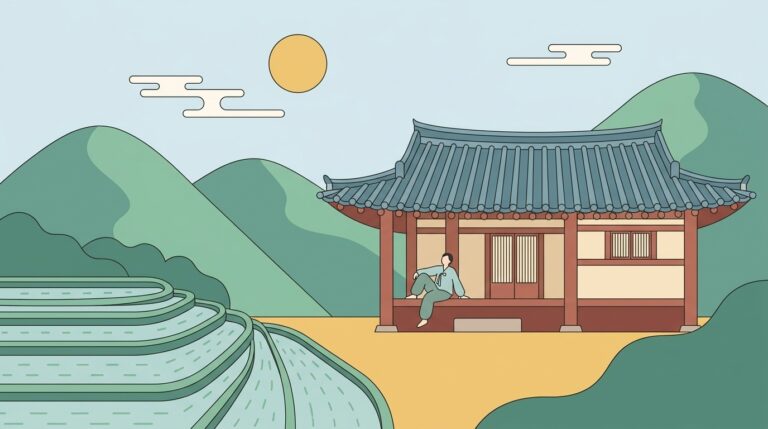
Picture this: You’ve just finished a marathon of Hometown Cha-Cha-Cha or BTS’s In the Soop. You step out of a bustling Seoul subway station, hop on a KTX train, and an hour later, you’re surrounded by lush green rice paddies, the sound of crickets, and a sky full of stars.
You want to express this magical feeling. You open your translator app, and it gives you: “아름답습니다” (It is beautiful). Sure, it’s correct. But does it capture that deep, soul-cleansing sigh of relief? Not quite.
When Koreans escape the neon lights of the city, we don’t just see ‘beauty’—we experience ‘healing’. In this unit, we’re going to explore how to describe the peaceful Korean countryside, not like a textbook, but like a true local seeking peace of mind. Let’s dive into the vocabulary of the Korean countryside!
Phase 2: Core Expressions Deep Dive
1. 풍경이 너무 평화로워요. (The scenery is so peaceful.)
- Pronunciation: punggyeong-i neomu pyeonghwarowoyo.
- Tip: ‘pung’ rhymes with ‘hung’, ‘gyeong’ rhymes with ‘young’ (add a ‘gy’ sound). ‘Pyeong’ sounds like the start of Pyeongchang (the Olympic city).
- Meaning: The countryside view is peaceful.
- K-Culture Moment: Imagine sitting on the daecheongmaru (wooden porch) of a traditional Hanok cafe in Gyeongju. You sip your iced Omija tea, look out at the silent mountains, and say this. It shows you appreciate the quietness.
- Editor’s Insight: ‘풍경’ (punggyeong) means scenery, and ‘평화롭다’ (pyeonghwaropda) means peaceful. This isn’t just about what you see; it’s about how the view makes your heart slow down.
- Situation Spectrum:
- Friends (Casual): ✅ (풍경 진짜 평화롭다)
- Coworkers (Semi-formal): ✅ (평화롭네요)
- Elders/Bosses (Formal): ✅ (평화롭습니다)
- 🤔 Think About It: Why do you think modern Koreans value ‘peacefulness’ so much when traveling, sometimes even more than ‘exciting’ activities?
2. 공기가 진짜 맑네요. (The air is really fresh.)
- Pronunciation: gonggiga jinjja malgneyo.
- Tip: ‘mal’ sounds like ‘mall’, but shorter. Because of pronunciation rules, ‘맑네요’ is actually pronounced [망네요 – mang-ne-yo].
- Meaning: Literal: The air is clear. Real nuance: The air is so fresh and crisp!
- K-Culture Moment: This is the mandatory first sentence every Korean says when they step out of the car in the countryside. They will stretch their arms out, take a massive deep breath, and say, “Ah~ Gonggiga malta!”
- Editor’s Insight: In Seoul, people often check the ‘fine dust’ (미세먼지) levels. So, clear air in the countryside is a luxury worth celebrating out loud.
- Situation Spectrum:
- Friends (Casual): ✅ (공기 맑다!)
- Coworkers/Elders (Semi-formal/Formal): ✅ (공기가 맑네요)
3. 와, 제대로 힐링돼요. (Wow, this is truly healing.)
- Pronunciation: wa, jedaero hillingdwaeyo.
- Meaning: I feel so relaxed / This is curing my stress.
- K-Culture Moment: K-Pop idols say this all the time on reality shows when they are cooking outdoors or staring at a campfire (불멍 – ‘bul-meong’, spacing out looking at fire).
- Editor’s Insight: Yes, ‘힐링’ (healing) is a Konglish word! But it doesn’t mean medical healing. In Korea, anything that gives you a break from the stressful “Pali-Pali” (hurry up) lifestyle is “healing.”
- Situation Spectrum:
- Friends (Casual): ✅
- Coworkers (Semi-formal): ✅
- Elders/Bosses (Formal): ⚠️ (Slightly too trendy/casual for strict formal settings)
Phase 3: Textbook vs. Real Korean
[Describing a slow-paced town]
* 📖 Textbook Korean: 이 마을은 아주 조용합니다. (This village is very quiet.)
* 🗣️ Real Korean: 와, 여기 진짜 여유롭다. (Wow, it’s so relaxed/chill here.)
* 💡 Why it’s different: ‘조용하다’ just means there is no noise. ‘여유롭다’ (to have room/leisure) captures the emotional freedom of having no urgent deadlines.
[Expressing you are happy with the trip]
* 📖 Textbook Korean: 저는 기분이 좋습니다. (I feel good.)
* 🗣️ Real Korean: 아, 제대로 힐링하고 가네~ (Ah, I’m getting properly healed before leaving~)
* 💡 Why it’s different: ‘제대로’ (properly/fully) is a favorite intensifier among younger Koreans, emphasizing that the experience met all their expectations.
Bottom Note: At a B1 level, incorporating Konglish words like ‘힐링’ (healing) naturally in your sentences will instantly make you sound like someone who genuinely understands Korean pop culture and daily life.
Phase 4: Cultural Context — K-Culture Deep Dive
4-1. Non-verbal Communication
When you say “공기가 맑네요” (The air is fresh), you shouldn’t just stand still. The non-verbal ‘Korean’ way to do this is to physically stretch your arms open, close your eyes, and inhale deeply through your nose. It’s an interactive experience with nature. Also, the concept of Nunchi (reading the room) applies here: if your companions are enjoying the silence, don’t fill it with loud chatter. Share the silence.
4-2. The “Choncance” (촌캉스) Trend
If you watch Korean variety shows or YouTube vlogs, you might have seen the word 촌캉스 (Choncance). It’s a mix of ‘촌’ (Chon – countryside/rural village) and ‘바캉스’ (Vacance – vacation).
Instead of going to a luxury hotel, young Koreans are flocking to old rural houses. They wear colorful floral ‘ajumma’ (middle-aged women) pants, cook pork belly over a wood fire, and do absolutely nothing. It is a direct cultural rebellion against the hyper-competitive, fast-paced city life. In K-Dramas like Summer Strike (아무것도 하고 싶지 않아), the protagonist literally drops everything in Seoul to do exactly this.
Phase 5: Real-Life Roleplay Scenario
Setting: Saturday afternoon, 3 PM. You are visiting a quiet village in Gangwon-do with your Korean language exchange partner. You two are sitting on the porch of a small cafe facing a vast, green rice field. There are no tall buildings in sight.
Characters:
– YOU: An international resident in Seoul, taking your first weekend trip to the countryside.
– Minji (28): Your Korean friend who planned the trip. She works a stressful corporate job in Gangwon.
Dialogue:
Minji: 서울 떠나서 여기 오니까 어때? 좀 심심하지 않아?
(seoul tteonaseo yeogi onikka eottae? jom simsimhaji ana?)
[Translation: How is it being here away from Seoul? Isn’t it a bit boring?]
YOU: 아니야, 전혀! (Looking at the view) [Your Turn!]
(aniya, jeonhyeo!)
[Translation: No, not at all!]
🔀 Your Turn! How will you respond?
– A) 건물들이 없어서 참 좋네요. (Geonmuldeuri eopseoseo cham jonneyo. – It’s nice because there are no buildings.)
– B) 풍경이 너무 평화롭고 진짜 힐링돼. (Punggyeong-i neomu pyeonghwaropgo jinjja hillingdwae. – The scenery is so peaceful, it’s truly healing.)
– C) 와이파이가 잘 안 터져서 답답해. (Waipaiga jal an teojyeoseo dapdaphae. – It’s frustrating because the Wi-Fi is bad.)✅ Best Choice: B — This perfectly captures the essence of escaping the city. You acknowledge the peacefulness and use the local buzzword “healing.”
⚠️ Choice A Analysis: A bit too literal and sounds like a textbook.
❌ Choice C Analysis: Even if it’s true, it ruins the vibe! (Though it’s a very realistic Gen-Z complaint!).
Minji: 그치? 나도 이 맛에 시골 온다니까.
(geuchi? nado i mase sigol ondanikka.)
[Translation: Right? This is exactly why I come to the countryside.]
(🎭 Stage Direction: Minji takes a deep breath.)
Minji: 아~ 여기 공기 진짜 맑다!
(A~ yeogi gonggi jinjja makda!)
[Translation: Ah~ The air here is so fresh!]
YOU: 맞아요. 서울 미세먼지 다 잊어버렸어요.
(majayo. seoul misemeonji da ijeobeoryeosseoyo.)
[Translation: You’re right. I’ve completely forgotten about Seoul’s fine dust.]
Phase 6: 10-Second Shadowing Drill
Read this out loud and imagine you are stretching your arms in a beautiful green field. Follow the pauses (/) and the emotion!
😌 와~ / 여기 공기가 / 진짜 맑네요! / 제대로 힐링돼요~
(Wa~ / yeogi gonggiga / jinjja mang-neyo! / jedaero hillingdwaeyo~)
(Emotion: Take a deep breath, sound deeply relieved and relaxed!)
Phase 7: K-Culture Mini Dictionary
1. 촌캉스
* Romanization: choncance
* English: Countryside vacation
* Context: A modern trend where city dwellers vacation in old, rustic countryside houses to experience slow living.
2. 힐링
* Romanization: hilling (healing)
* English: Relaxation / Stress-relief
* Context: Used for anything that gives you peace of mind—a quiet cafe, a cute dog, or eating good food.
3. 여유
* Romanization: yeoyu
* English: Leisure / Spare time / Emotional room
* Context: The ultimate luxury in Korean society. “여유가 없다” means you are too busy or stressed to enjoy life.
4. 시골 인심
* Romanization: sigol insim
* English: Countryside generosity
* Context: The cultural stereotype that people in rural areas are warmer, give larger food portions, and are more welcoming than city folks.
Phase 8: Traveler Survival Kit (Rural Edition)
Traveling to the Korean countryside requires slightly different survival skills than navigating the Seoul subway!
🆘 Survival Phrases Top 3
– 🇰🇷 “이 버스 터미널 가는 거 맞나요?” (i beoseu teomineol ganeun geo mannayo?)
– 🗣️ Pronunciation: Ee bus terminal ga-neun geo mat-na-yo?
– 📍 Meaning: Does this bus go to the terminal?
– 🇰🇷 “여기서 사진 한 장만 찍어주시겠어요?” (yeogiseo sajin han jangman jjigeojusigesseoyo?)
– 📍 Meaning: Could you take a picture for me here? (Perfect for those scenic spots!)
– 🇰🇷 “여기 근처에 택시 잡기 쉬운가요?” (yeogi geuncheoe taeksi japgi swiungayo?)
– 📍 Meaning: Is it easy to catch a taxi around here?📌 Editor’s Travel Note
– Transportation Apps: KakaoMap and Naver Map are your best friends. Google Maps does NOT work well for rural bus routes in Korea!
– Rural Buses: In very small towns, bus schedules can change, and buses might not announce every stop. Always politely ask the bus driver: “기사님, [Destination] 도착하면 알려주실 수 있나요?” (Driver, could you let me know when we arrive at [Destination]?)
– Cards vs. Cash: Even rural Korea is heavily card-based, but if you visit a traditional 5-day market (오일장 – oiljang), bringing some cash (won) is a smart move!
Phase 9: Critical Thinking — “One Step Deeper”
Language & Lifestyle: Why is “Healing” so important?
🧠 Think Deeper:
Look closely at the words Koreans use to describe the countryside: healing, yeoyu (leisure), pyeonghwa (peace). These words are the exact opposites of the daily vocabulary used in Seoul: pali-pali (hurry), yageun (overtime), gyeongjaeng (competition). The Korean language beautifully reflects its society’s intense pressures by elevating ‘peace and quiet’ to the ultimate form of luxury. To speak Korean well is to understand this cultural fatigue and the deep craving for a slow-paced refuge.💬 Your Turn: Does your culture have a specific word or trend for escaping city life? How do people in your country describe the feeling of getting away from it all? Share in the comments!
Phase 10: FAQ & Avoiding Misunderstandings
Q: Can I use the word “촌스럽다” (chon-seu-reop-da) to describe a peaceful countryside town?
A: NO! 🚫 “촌” means rural village, but “촌스럽다” means “tacky,” “outdated,” or “uncool.” If you say a cafe is “촌스럽다,” you are insulting their interior design! Stick to “평화롭다” (peaceful) or “정겹다” (warm/affectionate).
Q: Is it okay to use “힐링돼요” (healing-dwaeyo) in a business meeting?
A: Maybe. If you are doing small talk with clients about their weekend trip, it’s fine. But don’t use it to describe the result of a business project!
❌ Common Mistake: Confusing “조용하다” (quiet) with “심심하다” (boring).
✅ How to fix it: If you tell a local host “여기는 참 심심하네요” (It’s very boring here), they will feel terrible! Make sure to say “여기는 참 조용해서 좋네요” (It’s nice because it’s quiet here).
Phase 11: Summary & Action Items
- One-Liner Summary: To praise the Korean countryside like a local, focus on the “healing” energy, fresh air, and peacefulness rather than just saying it looks beautiful.
Action Mission 3 Steps:
– 🥉 Bronze (Solo): Look out your window and say out loud: “오늘 공기가 맑네요.” (The air is fresh today.)
– 🥈 Silver (Online): Find a YouTube vlog about “촌캉스” and leave a comment saying: “보기만 해도 힐링돼요~” (Just watching this is healing~)
– 🥇 Gold (Real-world): Next time you visit a quiet park or cafe with a Korean friend, stretch your arms, take a deep breath, and use all three expressions from Phase 2!
K-Culture Mission: Search for the show Hometown Cha-Cha-Cha or Three Meals a Day. Notice how the camera lingers on the wind blowing through trees or the sound of the ocean. That is the visual definition of ‘여유’ (yeoyu)!
Phase 12: Quiz — Interactive Challenge
1. Situational Judgment: You arrive at a beautiful Hanok stay in the countryside after a 3-hour stressful drive from Seoul. You step out of the car. What is the most natural “local” thing to say?
– A) 아주 예쁩니다.
– B) 아~ 공기 진짜 맑다! 제대로 힐링되네.
– C) 여기는 심심해요.
2. True or False – K-Culture Edition: “When traveling in rural Korea, Google Maps will give you the most accurate local bus schedules.”
– (T / F)
3. Fill in the Blank:
The trendy concept of taking a vacation in an old rural house to do absolutely nothing is called ______________ (Countryside + Vacance).
(Scroll down for answers!)
Click to see answers
1. B – Stretching and praising the fresh air/healing is the ultimate local move.
2. False – Always use KakaoMap or Naver Map in Korea. Google Maps has limited data for rural public transit.
3. 촌캉스 (Choncance)
Frequently Asked Questions (FAQ)
Q: What does "풍경이 너무 평화로워요. (The scenery is so peaceful.)" mean in Korean and how do you pronounce it?
A: In Korean, "풍경이 너무 평화로워요. (The scenery is so peaceful.)" is pronounced [punggyeong-i neomu pyeonghwarowoyo.] and means: a key conversational Korean expression covered in this lesson.
Q: What does "공기가 진짜 맑네요. (The air is really fresh.)" mean in Korean and how do you pronounce it?
A: In Korean, "공기가 진짜 맑네요. (The air is really fresh.)" is pronounced [gonggiga jinjja malgneyo.] and means: a key conversational Korean expression covered in this lesson.
Q: What does "와, 제대로 힐링돼요. (Wow, this is truly healing.)" mean in Korean and how do you pronounce it?
A: In Korean, "와, 제대로 힐링돼요. (Wow, this is truly healing.)" is pronounced [wa, jedaero hillingdwaeyo.] and means: I feel so relaxed / This is curing my stress.







