

Phase 1: Empathy (Welcome to the K-Shopping Jungle!)
Hello! Daily Hangul Editor here.
Imagine this: It’s 11 PM. You just saw your favorite K-Pop idol holding a glowing lip tint on a live stream, or maybe you watched a K-Drama where the lead actress uses a magic serum. You immediately download a Korean shopping app like Olive Young or Coupang. You type the name in English and… nothing.
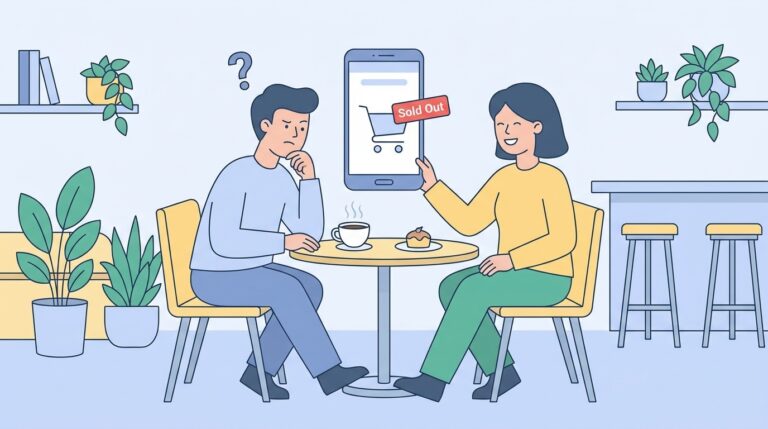
You translate it to Hangul, finally find the page, but there’s a big red text blocking the buy button. What does it mean? Welcome to the wild, ultra-fast world of Korean online shopping!
Shopping online in Korea is a cultural experience itself. If you don’t know the right words, you might miss out on the best K-Beauty deals or limited-edition K-Pop merch. But don’t worry! Today, we are going to learn the essential A2-level Korean expressions to help you search and shop like a true local.
(Note: This guide is based on real struggles from my foreign students who just wanted to buy a simple face mask online!)
Phase 2: Core Expressions Deep Dive
1. 검색해 보세요 (Please search for it)
- Pronunciation: geom-saek-hae bo-se-yo [geom-sek-he bo-se-yo]
- Meaning: Please search for it. (Literal: Try searching)
- K-Culture Moment: You are at a cafe, and a friend recommends a viral K-Beauty toner. Instead of giving you a link, they just say, “검색해 봐!” (Just search for it!). In Korea, searching is the first step to everything.
- Editor’s Insight: The word 검색 (search) is used everywhere. You’ll hear it when looking for products, restaurants, or even subway routes. It feels very helpful and action-oriented.
- Situation Spectrum:
- Close friends (Casual – 검색해 봐): ✅
- Colleagues (Semi-formal – 검색해 보세요): ✅
- Boss/Elders (Formal – 검색해 보시겠어요?): ⚠️
- 🤔 Think About It: Koreans love to do things quickly. Why do you think “searching” is preferred over “asking” in modern Korean culture? Does your culture rely more on asking people or searching online?
2. 품절이에요 (It’s sold out)
- Pronunciation: pum-jeol-i-e-yo [poom-juhl-ee-eh-yo] (‘eu’ sounds like the disgusted sound you make when stepping in gum, ‘uh’ is a short sound)
- Meaning: It is sold out / out of stock.
- K-Culture Moment: The most heartbreaking word for a K-Pop fan buying concert tickets, or when trying to buy the viral ‘Dubai Chocolate’ on a delivery app. If a celebrity is seen wearing a jacket, it will be “품절” in 5 minutes.
- Editor’s Insight: This word carries a feeling of deep disappointment but also hype. If something is “품절,” it means it’s trendy!
- Situation Spectrum:
- Close friends (Casual – 아, 품절이야): ✅
- Colleagues (Semi-formal – 품절이에요): ✅
- Boss/Elders (Formal – 품절되었습니다): 🚫 (Too direct, use formal version)
- 🤔 Think About It: Why does Korea have such a fast trend cycle where items sell out in minutes?
3. 안 나와요 (It’s not showing up)
- Pronunciation: an na-wa-yo [ahn nah-wah-yo]
- Meaning: It’s not coming out / It’s not showing up in the search results.
- K-Culture Moment: You type “Laneige” in the Korean app, but nothing happens. You show your screen to a Korean friend and say, “안 나와요!” They will laugh and tell you to type it in Hangul (라네즈).
- Editor’s Insight: Koreans use the verb 나오다 (to come out) for almost everything electronic. Music coming out of a speaker, search results coming out on a screen, or water coming out of a tap.
- Situation Spectrum:
- Close friends (Casual – 안 나와): ✅
- Colleagues (Semi-formal – 안 나와요): ✅
- Boss/Elders (Formal – 안 나옵니다): ✅
- 🤔 Think About It: In English, we say “I can’t find it.” In Korean, we say “It doesn’t come out.” Notice how the subject changes from “I” to “The item”?
4. 장바구니에 담아요 (Put it in the shopping cart)
- Pronunciation: jang-ba-gu-ni-e da-ma-yo [jahng-bah-goo-nee-eh dah-mah-yo]
- Meaning: Add to cart. (Literal: Put it in the shopping basket)
- K-Culture Moment: It’s 11:30 PM. You and your friends are looking at the Coupang app because if you order before midnight, it arrives tomorrow morning! “장바구니에 담아! 빨리!” (Add it to the cart! Hurry!)
- Editor’s Insight: 장바구니 originally means a traditional woven market basket. It’s charming how this traditional word is now the most clicked button on high-tech apps.
- Situation Spectrum:
- Close friends (Casual – 담아!): ✅
- Colleagues (Semi-formal – 담아요): ✅
- Boss/Elders (Formal – 담으세요): ⚠️
Phase 3: Textbook vs Real Korean
[When you can’t find a product]
* 📖 Textbook Korean: 검색 결과가 없습니다. (There are no search results.)
* 🗣️ Real Korean: 안 나와요. (It’s not coming out.) / 없어요. (It’s not here.)
* 💡 Why the difference?: Textbooks teach app-interface language. In real life, Koreans prefer the shortest, most efficient way to express frustration.
[Checking what others think]
* 📖 Textbook Korean: 사용자 평가가 좋습니다. (User evaluations are good.)
* 🗣️ Real Korean: 후기 대박이에요. (The reviews are awesome.) / 리뷰 완전 좋아요. (Reviews are totally good.)
* 💡 Why the difference?: ‘후기’ (reviews) is a massive part of Korean culture. Adding ‘대박’ (awesome/jackpot) adds the emotional hype needed for shopping.
(Bottom Note: For A2 beginners, stick to “리뷰 좋아요” (Reviews are good) – it makes you sound incredibly natural without using overly heavy slang!)
Phase 4: Cultural Context — K-Culture Deep Dive
4-1. Non-verbal UX Culture: The Art of “Ppal-i Ppal-i”
Korean shopping apps look incredibly cluttered to foreigners. There are banners, flashing discounts, and a million buttons. This is the visual representation of 빨리빨리 (Ppal-i Ppal-i / Hurry up) culture. Instead of clicking through menus, Koreans want everything on the first screen. When shopping, don’t get overwhelmed—just look for the magnifying glass icon (검색) and type!
4-2. The Power of “Hugi” (Reviews) in K-Food and K-Beauty
In Korea, no one buys a product without checking the 후기 (hugi – reviews). This is tied to Nunchi (reading the room). Koreans want to know the collective consensus before making a decision.
If you buy K-Food on a delivery app (like Baemin), you will see people writing 3-paragraph essays about how crispy the fried chicken was. If you buy K-Beauty, users upload high-quality photos of their pores before and after. Always check the star ratings!
Phase 5: Interactive Roleplay Scenario
Scenario A: The Midnight K-Beauty Haul
- Setting: Friday night, 11:45 PM. You are having a sleepover with your Korean friend, Min-ji. You both are wearing pajamas, eating spicy tteokbokki, and looking at smartphones.
- Characters:
- YOU: A foreigner living in Seoul, obsessed with a viral lip tint you saw on Instagram.
- Min-ji (28): Your Korean best friend. A K-Beauty expert who lives for online shopping discounts.
Min-ji: 야, 올리브영 세일 내일까지야! 살 거 없어? 💄
(Ya, Ollibeuyeong seil naeilkkajiya! Sal geo eopseo?)
[Hey, the Olive Young sale is until tomorrow! Do you have anything to buy?]
(🎭 Stage Direction: Min-ji aggressively scrolls through her app.)
YOU: 나 그 유명한 립틴트 사고 싶어.
(Na geu yumyeonghan riptinteu sago sipeo.)
[I want to buy that famous lip tint.]
Min-ji: 이름이 뭔데? 앱에서 검색해 볼까?
(Ireumi mwonde? Aebeseo geomsaekhae bolkka?)
[What is the name? Shall we search on the app?]
YOU: (Types on phone) 어? 이상하다. 결과가 안 나와요.
(Eo? Isanghada. Gyeolgwaga an nawayo.)
[Huh? Strange. It’s not showing up.]
Min-ji: 너 영어로 검색했지? 한국 앱은 한글로 쳐야 해. 내가 찾아줄게.
(Neo yeongeoro geomsaekhaetji? Hanguk aebeun hangeullo chyeoya hae. Naega chajajulge.)
[You searched in English, right? For Korean apps, you have to type in Hangul. I will find it for you.]
YOU: 우와, 고마워!
(Uwa, gomawo!)
[Wow, thanks!]
Min-ji: 찾았다! 헐… 근데 이거 품절이야.
(Chajatda! Heol… geunde igeo pumjeoriya.)
[Found it! Oh my… but this is sold out.]
YOU: 진짜? 아쉽다…
(Jinjja? Aswipta…)
[Really? What a shame…]
Min-ji: 잠깐만, 쿠팡에는 있다! 내일 아침에 도착한대. 내 장바구니에 담을게! 너 팩도 필요해?
(Jamkkanman, Kupangeneun itda! Naeil achime dochakhandae. Nae jangbagunie dameulge! Neo paekdo piryohae?)
[Wait, it’s on Coupang! They say it arrives tomorrow morning. I’ll put it in my cart! Do you need face masks too?]
🔀 Your Turn! How should you reply to Min-ji?
– A) “아니, 괜찮아.” (No, it’s okay.) – Safe and polite.
– B) “응! 마스크팩도 장바구니에 담아줘!” (Yes! Put the mask pack in the cart too!) – Enthusiastic and natural.
– C) “내가 결제할게!” (I will pay!) – Generous!✅ Best Choice: B — Why? In Korean friendships, combining shipping is very common! Saying “장바구니에 담아줘” (Add it to the cart for me) shows you are comfortable with her.
Scenario B: Bonus K-Travel Offline Moment
- Setting: Next day at a physical Olive Young store in Myeongdong.
- YOU: 저기요, 이거 온라인에는 품절이던데, 혹시 매장에 있나요?
(Jeogiyo, igeo onraineneun pumjeorideonde, hoksi maejange innayo?)
[Excuse me, this was sold out online, do you happen to have it in the store?] - Staff: 아, 확인해 볼게요. 네, 방금 들어왔어요!
(A, hwaginhae bolgeyo. Ne, banggeum deureowasseoyo!)
[Ah, I will check. Yes, it just came in!]
Phase 6: 10-Second Shadowing Drill
Practice your tone! Use the / to pause slightly.
- 😊 부탁할 때 (Asking a favor):
이거 / 장바구니에 / 담아주세요!
(igeo / jangbagunie / damajuseyo!) - 😢 슬플 때 (When sad):
아… / 벌써 / 완전 / 품절이에요.
(A… / beolsseo / wanjeon / pumjeorieyo.) - 😤 답답할 때 (When frustrated):
이름을 / 쳤는데 / 안 나와요!
(Ireumeul / chyeonneunde / an nawayo!)
Phase 7: K-Culture Mini Dictionary
1. 장바구니 (Jangbaguni)
* Romanization: jang-ba-gu-ni
* English: Shopping cart
* Context: Literally “market basket.” It’s the universal cart icon on all Korean apps.
2. 품절 (Pumjeol)
* Romanization: pum-jeol
* English: Sold out
* Context: A word you will see a lot in K-Pop ticketing and limited food collaborations.
3. 후기 (Hugi)
* Romanization: hu-gi
* English: Review
* Context: Reading “hugi” is essential in Korea. Many people sort products by “후기 많은 순” (Most reviewed).
4. 무배 (Mu-bae)
* Romanization: mu-bae
* English: Free shipping (Slang)
* Context: Short for 무료 배송 (Mu-ryo bae-song). If an item has “무배,” it goes straight into the cart!
Phase 8: Traveler’s Survival Kit
Even if you are visiting Korea as a tourist and can’t use online apps easily, you will still need these expressions when showing staff a screenshot from your phone!
🆘 Survival Expressions for Shopping
– 🇰🇷 “이거 혹시 품절이에요?” (igeo hoksi pumjeorieyo?)
– 🗣️ English: Is this sold out by any chance?
– 📍 Where to use: Convenience stores, Olive Young, K-Pop merch stores.
– 💡 Pro Tip: Show them the picture on your phone! It saves so much time.📌 Editor’s Travel Note
– Using Apps: Apps like Coupang and Kurly require a Korean phone number and Alien Registration Card (ARC). As a tourist, it’s easier to ask a Korean friend to order for you and pay them in cash!
– Store Pickup: Olive Young has an “오늘드림” (Today’s Dream) service where you buy online and pick it up at a nearby store.
Phase 9: Critical Thinking — “One Step Deeper”
🧠 Think Deeper: Ppal-i Ppal-i and the “Next-Day Delivery” Miracle
Why is “장바구니에 담기” (putting in the cart) at midnight so thrilling in Korea? It’s tied to the global phenomenon of Korean delivery systems. Companies like Coupang (Rocket Delivery) and Kurly (Dawn Delivery) guarantee that if you order before midnight, the package will be at your door before 7 AM the next day. This reflects Korea’s hyper-efficient, fast-paced society. While it offers incredible convenience for consumers, it also raises questions about the intense labor required to sustain this speed.💬 Your Turn: Does your country have next-day or dawn delivery? How long are you willing to wait for an online purchase? Let us know in the comments!
Phase 10: FAQ & Avoiding Mistakes
Q: Can I type English brand names in the search bar?
Maybe, but usually no! Korean apps are optimized for Hangul. Always try to translate the brand name phonetically into Hangul (e.g., Apple -> 애플, Nike -> 나이키) to get accurate results.
Q: Is it rude to say “안 나와요” to a store clerk?
No, it’s very natural! Just make sure to use “요” at the end to keep it polite.
❌ Common Mistake #1: Pronouncing 장바구니 (Jangbaguni) as “Jang-ba-gun-ni” with a harsh double N. Keep the syllables smooth and flowing.
✅ Do this instead: Sing it slightly: jang-ba-gu-ni.
Phase 11: Summary & Action Items
- One-Liner Summary: To survive Korean online shopping, remember to search (검색), check if it’s sold out (품절), and add to cart (장바구니)!
-
Action Mission:
- 🥉 Bronze: Stand in front of a mirror and say “아, 품절이에요!” with a sad face 3 times.
- 🥈 Silver: Download the Olive Young Global app, search for a K-Beauty item, and find the word “Review” in Korean.
- 🥇 Gold: Next time you are in a Korean store, show a picture of an item and ask, “이거 품절이에요?” (Is this sold out?)
- K-Culture Mission:
Go to Weverse Shop or any K-Pop merchandise site. Click on an old concert merchandise item. Can you spot the word 품절 (Sold Out)? Take a screenshot!
Did you ever struggle to find a product in Korea? What was it? Share your funny shopping stories in the comments below! 👇
Phase 12: Quiz — Interactive Challenge
1. Situational Judgment: You want to buy a BTS album online, but there is no “Buy” button. There is only a red box with two Korean letters. What does it say?
– A) 검색 (Search)
– B) 무배 (Free shipping)
– C) 품절 (Sold out)
2. Fill in the Blank:
You want your friend to add a spicy noodle pack to her Coupang order.
“야, 이거 네 _________에 담아줘!” (Hey, put this in your _______!)
3. True or False — K-Culture Edition:
In Korea, it is common to read at least 10 “후기” (reviews) before adding an item to your cart. (T/F)
(Answers: 1. C / 2. 장바구니 / 3. True! Koreans rely heavily on collective reviews.)
Frequently Asked Questions (FAQ)
Q: What does "검색해 보세요 (Please search for it)" mean in Korean and how do you pronounce it?
A: In Korean, "검색해 보세요 (Please search for it)" is pronounced [geom-saek-hae bo-se-yo [geom-sek-he bo-se-yo] and means: Please search for it. (Literal: Try searching)
Q: What does "품절이에요 (It's sold out)" mean in Korean and how do you pronounce it?
A: In Korean, "품절이에요 (It's sold out)" is pronounced [pum-jeol-i-e-yo [poom-juhl-ee-eh-yo] and means: It is sold out / out of stock.
Q: What does "안 나와요 (It's not showing up)" mean in Korean and how do you pronounce it?
A: In Korean, "안 나와요 (It's not showing up)" is pronounced [an na-wa-yo [ahn nah-wah-yo] and means: It's not coming out / It's not showing up in the search results.
Q: What does "장바구니에 담아요 (Put it in the shopping cart)" mean in Korean and how do you pronounce it?
A: In Korean, "장바구니에 담아요 (Put it in the shopping cart)" is pronounced [jang-ba-gu-ni-e da-ma-yo [jahng-bah-goo-nee-eh dah-mah-yo] and means: Add to cart. (Literal: Put it in the shopping basket)






