

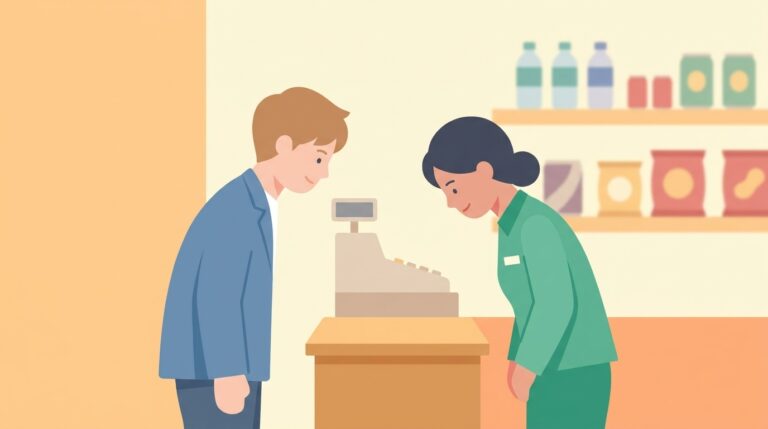
Phase 1: Empathy & Immersion
Hello! I’m your Daily Hangul Editor.
Have you ever watched a K-Drama where the main character meets their strict boss or future in-laws, and suddenly, they fold themselves in half like a flip phone? Or maybe you’ve walked into a Korean restaurant, and all the staff yell out a cheerful greeting while slightly bowing their heads?
For many of my A1-level students, the Korean bow is a huge source of anxiety. “Do I have to bow to everyone?” “How deep should I go?” “What if I just wave?”
In Western cultures, looking someone directly in the eye and giving a firm handshake is the ultimate sign of respect. But in Korea, the head-bow (인사, insa) is the physical embodiment of politeness. If you don’t bow at the right time, you might accidentally come across as rude. But if you master just the basic head nod, you’ll instantly earn the “insider” respect from locals.
This guide is based on real questions from my students who survived their first trip to Seoul. Don’t worry, you won’t need to fold in half for every cup of coffee you buy!
Phase 2: Deep Dive into Core Expressions
When we bow, we usually say something. Here are the top three expressions you will use while bowing.
1. 안녕하세요 (Hello)
- Pronunciation: annyeonghaseyo [Ahn-nyuhng-ha-se-yo]
- Meaning: (Literal) Are you in peace? / (Real) Hello.
- K-Culture Moment: You walk into a cozy Hanok cafe. The barista smiles and says “Annyeonghaseyo!” while dipping their head. You should reply with the same phrase and a slight nod.
- Editor’s Insight: This is the ultimate safe word. When in doubt, say this. But remember, the bow completes the word. Saying it while standing completely stiff feels a bit robotic to Koreans.
- Situation Spectrum:
- Casual (Friends): 🚫 (Use ‘안녕’ annyeong without bowing)
- Semi-formal (Store clerks, colleagues): ✅ (15-degree bow)
- Formal (Boss, elders): ✅ (45-degree bow)
- 🤔 Think About It: Why does the Korean “hello” literally ask about “peace”? Historically, Korea went through many hardships. Asking if someone had a peaceful night was a genuine check on their well-being! Do you have a greeting in your culture with a hidden historical meaning?
2. 감사합니다 (Thank you)
- Pronunciation: gamsahamnida [Gahm-sah-ham-ni-dah]
- Meaning: (Literal) I do gratitude / (Real) Thank you.
- K-Culture Moment: You receive your sizzling Korean BBQ. The waiter places it on your table. A quick head nod (목례, mongnye) and a “gamsahamnida” shows you are a polite traveler.
- Editor’s Insight: You don’t need a deep bow here if you are sitting down. A simple, polite head nod while sitting is perfectly fine and highly appreciated.
- Situation Spectrum:
- Casual (Friends): 🚫 (Use ‘고마워’ gomawo)
- Semi-formal (Restaurants, Taxis): ✅ (Slight head nod)
- Formal (Receiving a gift from a boss): ✅ (30-degree bow)
- 🤔 Think About It: Notice how formal words end in “~nida”? It sounds very structured and rhythmic. How does your language change its sound when speaking to someone older?
3. 죄송합니다 (I am sorry)
- Pronunciation: joesonghamnida [Jway-song-ham-ni-dah]
- Meaning: (Literal) I feel guilt / (Real) I am sincerely sorry.
- K-Culture Moment: You are in a crowded Seoul subway station, and you accidentally step on someone’s foot. A quick “joesonghamnida” with a small bow defuses the situation instantly.
- Editor’s Insight: The deeper the mistake, the deeper the bow. For bumping into someone, a 15-degree nod is fine. If you broke your boss’s laptop, prepare for a 90-degree bow!
- Situation Spectrum:
- Casual (Friends): 🚫 (Use ‘미안해’ mianhae)
- Semi-formal (Strangers): ✅ (15-degree bow)
- Formal (Huge mistake at work): ✅ (45 to 90-degree bow)
- 🤔 Think About It: In some cultures, apologizing too quickly is seen as admitting legal guilt. In Korea, apologizing is about restoring social harmony. Which approach makes more sense to you?
Phase 3: Textbook vs. Real Korean
Let’s see how bowing and speaking actually happen in the wild.
[Situation 1: Meeting a friend you haven’t seen in a while]
* 📖 Textbook Korean: 안녕. (Bowing 15 degrees politely)
* 🗣️ Real Korean: 어! 왔어? (Eo! Wasseo?) / Raising eyebrows, smiling, maybe a small hand wave or a slight chin lift (the “bro nod”).
* 💡 Why the difference?: Bowing is for creating a respectful distance. Between close friends, you want zero distance! Bowing to a best friend feels unnatural and awkward.
[Situation 2: Grabbing coffee at a busy convenience store]
* 📖 Textbook Korean: 감사합니다. (Full 45-degree bow, waiting for a reply)
* 🗣️ Real Korean: 감사합니다. (A very quick 1-second head nod while already walking towards the door).
* 💡 Why the difference?: “Palli-palli” (hurry-hurry) culture! In busy spots, efficiency is key. A full traditional bow slows down the line.
Bottom Note: For A1 beginners, always stick to the 15-degree head nod (목례) with strangers. It’s the perfect middle ground!
Phase 4: Cultural Context — K-Culture Deep Dive
4-1. The Non-Verbal Secret: Where do I look?
If there’s one thing you take away from this lesson, let it be this: Do not make intense eye contact while bowing.
In Western cultures, keeping eye contact during a handshake means “I am honest and confident.” In Korea, keeping your eyes locked on someone while bending your body looks slightly aggressive—like a martial artist preparing for an attack!
When you bow, let your eyes naturally look down at the floor or their shoes. Once you rise, resume soft eye contact.
4-2. The K-Drama Connection: The 90-Degree “Folder Bow”
If you love K-Dramas, you’ve seen the “Folder Bow” (폴더 인사, poldeo insa). This is when a character folds exactly at a 90-degree angle. You usually see this in two scenarios:
1. A gang of tough guys greeting their boss.
2. A young employee desperately apologizing to an angry CEO.
Critical View: As a traveler or expat, you rarely need to do a 90-degree bow. It’s very dramatic! If you do a 90-degree bow to a barista just for handing you an Americano, they will probably panic and wonder if they accidentally saved your life. Keep it casual with a 15-degree nod!
Phase 5: Real-Life Roleplay
Scenario A: The First Encounter
– Setting: A bustling Korean BBQ restaurant in Gangnam. You are sitting with your Korean friend, Min-su.
– Characters:
– YOU: A traveler visiting Korea for the first time.
– Min-su: Your friendly Korean local guide.
– Mr. Park: Min-su’s father, who just walked into the restaurant to say hi.
Min-su: 오, 우리 아빠 왔어! (O, uri appa wasseo!)
[Translation] Oh, my dad is here!
(🎭 Stage Direction: Mr. Park walks up to your table with a warm smile.)
Mr. Park: 어서 와요. 한국은 처음이죠? (Eoseo wayo. Hangugeun cheoeumijyo?)
[Translation] Welcome. Is it your first time in Korea?
🔀 Your Turn! How do you react?
– A) Stay seated, smile, wave your hand, and say “Hello!”
– B) Stand up immediately, make a 30-degree bow, and say “안녕하세요 (Annyeonghaseyo)!”
– C) Stand up, offer a firm handshake while maintaining intense eye contact.✅ Best Choice: B — Reason: Standing up for elders is Rule #1 in Korean etiquette. Combining standing with a bow and the formal greeting is perfect.
⚠️ Choice A Analysis: Waving at an elder while sitting is considered quite rude in Korea.
⚠️ Choice C Analysis: Handshakes are mostly for business, usually initiated by the older person.
Scenario B: The Convenience Store Survivor
– Setting: CU Convenience store at 11 PM.
– Cashier: 2,000원입니다. (I-cheon-won imnida. – That’s 2,000 won.)
– YOU: (Handing over your card with two hands) 여기요. (Yeogiyo. – Here you go.)
– Cashier: (Handing the card back) 감사합니다. (Gamsahamnida. – Thank you.)
– YOU: (Give a quick 15-degree head nod) 수고하세요! (Sugohaseyo! – Keep up the good work!)
Phase 6: 10-Second Shadowing Drill
Let’s practice the rhythm of a polite greeting. Read this out loud, focusing on the pauses!
😊 안 / 녕 / 하 / 세 / 요! (ahn / nyuhng / ha / se / yo!)
(Action: Dip your head slightly on the ‘ha’ syllable)
🙏 감 / 사 / 함 / 니 / 다. (gam / sa / ham / ni / da.)
(Action: Smile and do a quick head nod)
Phase 7: K-Culture Mini Dictionary
1. 눈치
* Romanization: nunchi
* English: Reading the room / Social sense
* Context: Knowing when to bow and how deep to bow requires good nunchi. It’s the Korean superpower of assessing the social hierarchy in seconds.
2. 목례
* Romanization: mongnye
* English: Eye-bow / Head nod
* Context: A light 15-degree nod. Used in tight spaces like elevators, passing coworkers in the hallway, or at cafes.
3. 폴더 인사
* Romanization: poldeo insa
* English: Folder bow
* Context: A 90-degree bow. Used for extreme apologies or showing the highest level of respect to a V.I.P.
4. 존댓말
* Romanization: jondaetmal
* English: Formal/Polite language
* Context: The language of bowing. If you are bowing, you must be speaking in Jondaetmal (words ending in ~yo or ~nida).
Phase 8: Traveler Survival Kit
Bowing often happens when you are asking for help or buying things. Here is your cheat sheet!
🆘 Survival Phrases (Combine all with a slight head nod!)
– 🇰🇷 “안녕하세요!” (Annyeonghaseyo!) = Hello! (Use when entering a store)
– 🇰🇷 “이거 얼마예요?” (Igeo eolmayeyo?) = How much is this?
– 🇰🇷 “감사합니다!” (Gamsahamnida!) = Thank you! (Use when leaving)📍 Where to use: Markets, convenience stores, taxis, cafes.
💡 Pro Tip: In traditional markets (like Gwangjang Market), combining a big smile, a polite nod, and “Annyeonghaseyo” might even get you extra food (서비스, service)!
📌 Editor’s Travel Note
– Hands in pockets: Never bow with your hands in your pockets. It looks very arrogant! Keep your hands by your sides, or lightly clasped in front of you.
– The Two-Hand Rule: If you are giving a credit card while bowing, try to use two hands, or support your right arm with your left hand.
Phase 9: Critical Thinking — “One Step Deeper”
🧠 Think Deeper: Language & Power
In Korean culture, language and physical gestures (like bowing) are deeply tied to social hierarchy. The depth of your bow and the ending of your verbs automatically establish who is older or holds more power. Unlike English, where everyone is “you,” Korean forces speakers to constantly acknowledge the other person’s status. It creates a society built on mutual respect and order, but it can also feel rigid to outsiders.💬 Your Turn: How does your culture show respect to elders or bosses? Is it through words, physical actions, or something else? Share in the comments!
Phase 10: FAQ & Avoiding Misunderstandings
Q: Should I bow to my Korean friends?
No! If you do a polite bow to a friend of the same age, they will think you are mad at them or acting weirdly formal.
Q: What if someone wants to shake my hand? Can I shake and bow?
Yes! In Korean business culture, people often combine the Western handshake with a Korean bow. You’ll see politicians do this all the time: shaking right hands while bowing the head.
❌ Common Mistake #1: Staring into the cashier’s eyes while bowing.
✅ Do this instead: Look at their collar or the counter as your head goes down.❌ Common Mistake #2: Doing a 90-degree bow to everyone.
✅ Do this instead: Stick to the “mongnye” (목례, 15-degree head nod) for 90% of your daily interactions.
Phase 11: Summary & Action Items
- One-Liner Summary: A simple 15-degree head nod with a cheerful “Annyeonghaseyo” is your golden ticket to being loved by locals in Korea.
-
Action Mission:
- 🥉 Bronze (Solo): Stand in front of a mirror. Practice saying “Annyeonghaseyo” while dipping your head 15 degrees, keeping your hands out of your pockets.
- 🥈 Silver (Online): Find a K-Drama clip on YouTube where someone apologizes. Guess how many degrees their bow is!
- 🥇 Gold (Real Life): Visit a local Korean restaurant or grocery store, and use the bow + “Gamsahamnida” when you get your receipt.
- K-Culture Mission: Next time you watch your favorite K-Pop idol on a music show, watch how they greet the senior MCs. You’ll see the exact “Folder Bow” in action!
How did your first bowing experience go? Did you feel like a K-Drama character? Let me know below! 👇
Phase 12: Interactive Challenge Quiz
1. Situational Judgment: You are leaving a cafe. The barista yells “안녕히 가세요!” (Goodbye!). What is the best action?
– A) Yell “안녕!” and give a peace sign.
– B) Give a 15-degree head nod and say “감사합니다!”
– C) Stop, turn around, put your hands on your knees, and bow 90 degrees.
👉 Click to see the answer!
Answer: B. A simple head nod and thank you is the perfect, polite way to leave a cafe. A is too casual, and C is too dramatic!
2. True or False – K-Culture Edition: When bowing in Korea, it is considered polite to maintain intense, direct eye contact with the person the whole time.
👉 Click to see the answer!
Answer: False. Looking directly into someone’s eyes while bowing can seem aggressive. Let your eyes naturally drop as your head goes down!
Frequently Asked Questions (FAQ)
Q: What does "안녕하세요 (Hello)" mean in Korean and how do you pronounce it?
A: In Korean, "안녕하세요 (Hello)" is pronounced [annyeonghaseyo [Ahn-nyuhng-ha-se-yo] and means: (Literal) Are you in peace? / (Real) Hello.
Q: What does "감사합니다 (Thank you)" mean in Korean and how do you pronounce it?
A: In Korean, "감사합니다 (Thank you)" is pronounced [gamsahamnida [Gahm-sah-ham-ni-dah] and means: (Literal) I do gratitude / (Real) Thank you.
Q: What does "죄송합니다 (I am sorry)" mean in Korean and how do you pronounce it?
A: In Korean, "죄송합니다 (I am sorry)" is pronounced [joesonghamnida [Jway-song-ham-ni-dah] and means: (Literal) I feel guilt / (Real) I am sincerely sorry.







