

Hello! I am the Lead Editor of Daily Hangul.
Have you ever seen a K-Drama where the main character casually leaves their brand-new laptop or smartphone on a cafe table to go to the restroom? You probably thought, ‘Wait, aren’t they worried it’ll get stolen?’
Korea is famous for its incredible safety. People joke that if you leave your wallet on a table, nobody will touch it. But what happens if you genuinely misplace your bag on the busy Seoul Metro or leave it in the trunk of a taxi? Panic sets in!
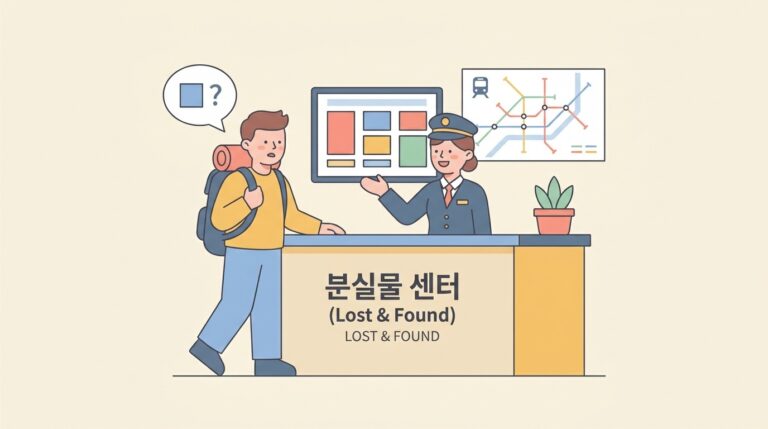
Don’t worry. Korea has an amazing Lost and Found (분실물 센터) system. However, to get your precious belongings back, you need to know how to describe them—especially the color. Today, we are going to learn how to describe your bag’s color and get your items back safely. This guide is based on real SOS messages from my expat students who lost their favorite eco-bags and backpacks in Seoul!
Phase 2: Core Expressions Deep Dive
Here are the top 3 lifesaver phrases you need when you visit the Lost and Found.
1. [색깔] 가방을 잃어버렸어요.
- Pronunciation: [saek-kkal] gabang-eul ileobeoryeosseoyo.
- Meaning: I lost a [color] bag.
- K-Culture Moment: Imagine running into the subway station office, out of breath. The station attendant (역무원) asks what’s wrong. You deliver this line, and they instantly start typing on their computer to check the nationwide lost-and-found database.
- Editor’s Insight: ‘잃어버렸어요’ comes from the verb ‘잃어버리다’ (to lose). It sounds like you are saying it with a sigh of despair. Put a little sadness in your voice when you say it!
- Situation Spectrum:
- Casual with friends: ✅ (가방 잃어버렸어!)
- Station Staff/Police: ✅ (가방을 잃어버렸어요.)
- 🤔 Think About It: In English, we simply say ‘I lost it.’ In Korean, ‘잃어’ means ‘lost’ and ‘버렸어요’ implies ‘it is completely gone / an irreversible action.’ Does your language emphasize the ‘regret’ of losing something grammatically?
2. 까만색 백팩이에요.
- Pronunciation: kka-man-saek baek-paek-i-e-yo.
- Meaning: It’s a black backpack.
- K-Culture Moment: You are filling out a form or describing the bag. Koreans use loanwords (Konglish) a lot for modern items like ‘backpack’ (백팩) and ‘eco-bag’ (에코백).
- Editor’s Insight: While the textbook teaches ‘검은색’ (Black), native Koreans use ‘까만색’ just as often in spoken language. It sounds slightly softer and more natural in casual conversation.
- Here are the essential A2 Colors:
- Black: 까만색 (kka-man-saek) / 검은색 (geom-eun-saek)
- White: 하얀색 (ha-yan-saek) / 흰색 (huin-saek)
- Red: 빨간색 (ppal-gan-saek)
- Blue: 파란색 (pa-ran-saek)
- Situation Spectrum:
- Casual with friends: ✅
- Station Staff/Police: ✅
- Formal written report: ⚠️ (Use 검은색 for official police reports)
- 🤔 Think About It: Why do Koreans have two different sets of color words (native Korean vs. Sino-Korean)? It shows the rich history of the language!
3. 안에 여권이 있어요.
- Pronunciation: an-e yeo-gwon-i isseoyo.
- Meaning: My passport is inside.
- K-Culture Moment: This is the magic phrase. If you say this to a Korean police officer or station attendant, they will take your case very seriously because they know how critical a passport is for a foreigner.
- Editor’s Insight: ‘안에’ (inside) is crucial here. You can swap ‘여권’ (passport) with ‘지갑’ (wallet) or ‘노트북’ (laptop).
- Situation Spectrum:
- Any situation where you need help finding your bag: ✅
Phase 3: Textbook vs. Real Korean
Let’s see how real Koreans speak compared to your textbook.
[Describing your backpack]
* 📖 Textbook Korean: 저는 흑색 배낭을 분실했습니다. (I lost a black rucksack.)
* 🗣️ Real Korean: 까만색 백팩 잃어버렸어요. (I lost a black backpack.)
* 💡 Why the difference?: ‘배낭’ is usually reserved for huge hiking or backpacking bags. For everyday use, everyone says ‘백팩’ (Backpack). Also, ‘분실하다’ is too formal for speaking; ‘잃어버리다’ is standard.
[Describing a Tote/Shopping Bag]
* 📖 Textbook Korean: 하얀색 천 가방입니다. (It is a white cloth bag.)
* 🗣️ Real Korean: 하얀색 에코백이에요. (It’s a white eco-bag.)
* 💡 Why the difference?: K-Culture loves ‘에코백’ (Eco-bags). You see college students and hipsters in Hongdae carrying them everywhere. It’s the universal term for a canvas tote bag.
Bottom Note: Stick to words like 백팩 (backpack), 에코백 (eco-bag), and 캐리어 (suitcase) instead of traditional textbook vocabulary. It makes you sound like a local!
Phase 4: Cultural Context — K-Culture Deep Dive
4-1. Non-verbal Communication
When visiting a Lost and Found (분실물 센터), showing an anxious but polite demeanor is key.
– Use two hands when handing over your ID or receiving your bag back.
– Use Nunchi (눈치): If the station attendant is dealing with an emergency train issue, wait patiently on the side until they make eye contact with you.
4-2. K-Travel Connection: The Magic of ‘LOST112’
If you leave your bag on a Seoul bus, taxi, or subway, do not lose hope! Korea has a highly integrated national lost and found database called LOST112 (managed by the National Police Agency). Often, kind citizens will hand in a lost bag to the driver or a station attendant.
– Survival Tip: Always ask for the receipt if you pay for a taxi with a credit card. The receipt has the taxi’s license plate and company number! If you leave your bag in the trunk, that receipt is your golden ticket to getting it back.
Phase 5: Real-Life Roleplay Scenario
Setting: It is 10 PM. You are at the Customer Service Center (고객안내센터) at Gangnam Station. You left your bag on the subway train. You are stressed but trying to stay calm.
Characters:
– YOU: A traveler who just bought souvenirs and lost them.
– Station Attendant (역무원 – Mr. Kim): Professional, typing fast on his keyboard, willing to help.
Dialogue:
Mr. Kim: 어서 오세요. 무엇을 도와드릴까요?
(eoseo oseyo. mueoseul dowadeurilkkayo?)
(Welcome. How can I help you?)
YOU: 저기요… 지하철에 가방을 잃어버렸어요. 😭
(jeogiyo… jihaecheol-e gabang-eul ileobeoryeosseoyo.)
(Excuse me… I lost my bag on the subway.)
Mr. Kim: 아고, 언제 내리셨어요?
(ago, eonje naerisyeosseoyo?)
(Oh no, when did you get off?)
YOU: 한 10분 전에요.
(han sip-bun jeon-eyo.)
(About 10 minutes ago.)
Mr. Kim: 네, 확인해 볼게요. 가방 무슨 색이에요?
(ne, hwagin-hae bolgeyo. gabang museun saek-i-e-yo?)
(Okay, I’ll check. What color is the bag?)
🔀 Your Turn! How should you reply?
– A) “My bag is black color.” (In English)
– B) “까만색 백팩이에요.”
– C) “흑색 배낭을 분실했습니다.”✅ Best Choice: B — “까만색 백팩이에요.” (It’s a black backpack.) It’s natural, specific, and helps him search the database efficiently.
⚠️ Choice C Analysis: It sounds like a news anchor reporting a crime. It’s too stiff!
YOU: 까만색 백팩이에요.
(kka-man-saek baek-paek-i-e-yo.)
(It’s a black backpack.)
Mr. Kim: 혹시 가방 안에 귀중품이 있나요?
(hoksi gabang an-e gwijungpum-i innayo?)
(By any chance, are there valuables inside?)
YOU: 네, 제 여권하고 지갑이 있어요!
(ne, je yeo-gwon-hago jigap-i isseoyo!)
(Yes, my passport and wallet are in there!)
(🎭 Stage Direction: Mr. Kim’s eyes widen. He makes a quick phone call to the next station.)
Mr. Kim: 찾았습니다! 다음 역에 보관되어 있어요.
(chajatseumnida! da-eum yeok-e bogwan-doe-eo isseoyo.)
(We found it! It’s kept at the next station.)
YOU: 진짜요? 정말 감사합니다!!
(jinjjayo? jeongmal gamsahamnida!!)
(Really? Thank you so much!!)
Phase 6: 10-Second Shadowing Drill
Practice these lines out loud. Pay attention to the pauses (/) and the mood!
- 😢 (Panicked): 저기요 / 가방을 / 잃어버렸어요. (jeogiyo / gabang-eul / ileobeoryeosseoyo.)
- 😐 (Descriptive): 제 가방은 / 파란색 / 에코백이에요. (je gabang-eun / pa-ran-saek / eko-baek-i-e-yo.)
- 🥺 (Desperate): 안에 / 여권이 / 있어요! (an-e / yeo-gwon-i / isseoyo!)
Phase 7: K-Culture Mini Dictionary
Here are some keywords related to losing items in Korea:
1. 유실물센터 / 분실물센터
* Romanization: yusilmul-senteo / bunsilmul-senteo
* English: Lost and Found Center
* Context: Major subway lines have specific transfer stations acting as a hub for lost items.
2. 역무원
* Romanization: yeok-mu-won
* English: Station Attendant
* Context: The helpful staff at train and subway stations wearing uniforms. They are your first point of contact.
3. 캐리어
* Romanization: kae-ri-eo
* English: Suitcase / Luggage
* Context: A prime example of Konglish. If you say “suitcase,” some older Koreans might not understand, but “carrier” is universally understood.
4. 파출소 / 경찰서
* Romanization: pa-chul-so / gyeong-chal-seo
* English: Police Substation / Police Station
* Context: If you lose something on the street, go to a small local police box (파출소) rather than a large station.
Phase 8: Traveler Survival Kit
Losing an item while traveling is terrifying. Keep these phrases in your back pocket!
🆘 Survival Phrase #1
– 🇰🇷 “이거 여기 있었어요?” (igeo yeogi isseosseoyo?)
– 🗣️ Pronunciation: [i-geo yeo-gi i-sseo-sseo-yo?]
– 📍 Where to use: Running back to a cafe table or a taxi to ask “Was this here?”🆘 Survival Phrase #2
– 🇰🇷 “경찰서가 어디에 있어요?” (gyeong-chal-seo-ga eodi-e isseoyo?)
– 🗣️ Pronunciation: [gyeong-chal-seo-ga eo-di-e i-sseo-yo?]
– 📍 Where to use: Asking a local for directions to the nearest police box.
📌 Editor’s Travel Note:
– Helpful Apps: Use Papago (for translation) and type “I left my bag in a taxi.” It will translate perfectly to show the driver.
– The Korean Conscience: If you lose your phone or wallet in a cafe, 99% of the time, someone gave it to the cafe staff. Always ask the counter first!
Phase 9: Critical Thinking — “One Step Deeper”
Trust and Safety in Korea: The Laptop vs. Umbrella Paradox
🧠 Think Deeper:
Korea is globally praised for its safety. You can leave a $2,000 laptop on a Starbucks table, go to the bathroom, and return to find it untouched. This high level of societal trust comes from a culture of surveillance (CCTV is everywhere) and a strong moral emphasis on not touching others’ personal belongings. However, there is a funny cultural paradox: Umbrellas! On a rainy day, if you leave your cheap umbrella in an umbrella stand at a convenience store, someone might ‘accidentally’ take it. Laptops are sacred, but umbrellas are treated like public property during heavy rain!💬 Your Turn: Have you ever lost something in your country? Did you get it back? Let us know in the comments how the Lost and Found culture differs in your hometown!
Phase 10: FAQ & Avoiding Mistakes
Q: “Can I just point to a color on my phone instead of speaking?”
Yes! If you are panicking, showing a photo of the bag (or a similar color on your screen) is highly effective. But saying “파란색이에요” (It’s blue) while showing the picture makes you sound like a pro.
Q: “What if I don’t know the exact shade?”
Just stick to the basics. Dark blue, light blue, navy—just saying ‘파란색’ (Blue) is enough for them to start searching the system.
❌ Common Mistake #1: Saying ‘가방이 없어졌어요’ (My bag disappeared) implies someone might have stolen it or it magically vanished.
✅ Do this instead: Use ‘잃어버렸어요’ (I lost it) to take responsibility, which is the standard way to report a lost item.
Phase 11: Summary & Action Items
One-Liner Summary: To report a lost bag, combine the color (까만색, 하얀색, 빨간색, 파란색) with the bag type (백팩, 에코백) and say “잃어버렸어요!”
Action Mission 3 Steps:
– 🥉 Bronze (Solo): Look at your current bag. Say its color and type in Korean out loud. (e.g., “까만색 백팩이에요.”)
– 🥈 Silver (Online): Leave a comment below describing your favorite bag using today’s Korean phrases!
– 🥇 Gold (Real World): Next time you watch a K-Drama, spot the moment someone leaves their bag or phone behind. Shout “가방 잃어버렸어요!” at the screen.
K-Culture Mission:
Take a quick look at the LOST112 website (it has an English option). See how detailed the system is—it’s a fascinating peek into Korean administrative efficiency!
Phase 12: Quiz — Interactive Challenge
1. Fill in the Blank:
You lost your red eco-bag. You go to the station attendant and say:
“( ) 에코백을 잃어버렸어요.”
A) 파란색
B) 하얀색
C) 빨간색
2. True or False – K-Culture Edition:
“If you leave your wallet on a table in a Korean cafe, it will likely be stolen within 5 minutes.”
3. Situational Judgment:
You lost your backpack, and you have your passport inside. Which phrase is the most important to add to your description?
A) 안에 김밥이 있어요. (My gimbap is inside.)
B) 안에 여권이 있어요. (My passport is inside.)
C) 안에 에코백이 있어요. (My eco-bag is inside.)
(Answers: 1. C / 2. False! It is usually very safe. / 3. B)
Did you enjoy today’s Daily Hangul lesson? Save this post before your next trip to Korea, just in case! Safe travels!
Frequently Asked Questions (FAQ)
Q: What does "[색깔] 가방을 잃어버렸어요." mean in Korean and how do you pronounce it?
A: In Korean, "[색깔] 가방을 잃어버렸어요." is pronounced [saek-kkal] and means: I lost a [color] bag.
Q: What does "까만색 백팩이에요." mean in Korean and how do you pronounce it?
A: In Korean, "까만색 백팩이에요." is pronounced [kka-man-saek baek-paek-i-e-yo.] and means: It's a black backpack.
Q: What does "안에 여권이 있어요." mean in Korean and how do you pronounce it?
A: In Korean, "안에 여권이 있어요." is pronounced [an-e yeo-gwon-i isseoyo.] and means: My passport is inside.







