

Phase 1: Empathy & Immersion (Cold Open)
Hello! I’m the lead editor at Daily Hangul.
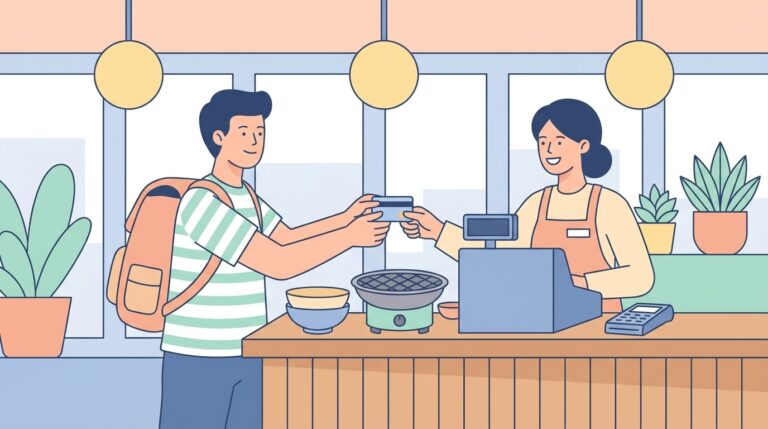
Picture this: You’ve just finished a fantastic Korean BBQ dinner. The table is a masterpiece of empty soju glasses, sizzling grill marks, and remaining lettuce leaves. You walk up to the counter, pull out your Visa card, and suddenly… your mind goes blank.
The cashier is looking at you. A line of hungry people is forming behind you. You want to simply ask, “Do you take cards?” but all you can remember is the dramatic tear-jerking “I’m sorry” (미안해) from the K-Drama you watched last night. Should you just bow and hand it over? What if it’s a cash-only place?
Don’t worry. You’re not alone! Knowing how to navigate the payment counter is the ultimate test of a traveler’s street smarts. In this guide, created from the real sweat and tears of my A1 beginner students, we’re going to learn exactly how to pay like a local, avoid awkward stares, and maybe even earn a warm smile from the restaurant owner.
Phase 2: Core Expressions Deep Dive
1. 카드 되나요? (Can I pay with a card?)
- Pronunciation: kadeu doenayo? [kah-duh dway-nah-yo?]
- kah-duh: Sounds like “car” + “duh” (like when you say “duh!”).
- dway-nah-yo: Sounds like “way” with a D in front + “nah” + “yo” (like a friendly yo!).
- Meaning:
- Literal: Does card become/work?
- Real nuance: Do you accept credit cards here?
- K-Culture Moment: You’ll hear this a lot at underground shopping malls or tiny street food stalls (포장마차) where card machines might be hiding. It’s the magical phrase that saves you from running to an ATM!
- Editor’s Insight: Notice there is no “I” or “You” in this sentence? Koreans love efficiency. We don’t say “Can I pay you with a card?” We just ask the universe: “Card works?” It’s simple, polite, and gets straight to the point.
- Situation Spectrum:
- Casual with friends: ⚠️ (Friends don’t usually run businesses you buy from!)
- Restaurant staff / Cashiers: ✅ (Perfect!)
- Formal / Bosses: 🚫 (Not applicable in this context)
- 🤔 Think About It: Why does Korean drop the subjects (“I” and “You”) so often? Because in high-context cultures like Korea, the situation already explains who is talking to whom. Does your native language require you to always state the subject?
2. 영수증 주세요 (Receipt, please)
- Pronunciation: yeongsujeung juseyo [young-soo-jung joo-say-yo]
- yeong-su-jeung: Sounds like “young” + “sue” + “jung” (rhymes with lung).
- ju-se-yo: “Juice” without the ‘ce’ + “say” + “yo”.
- Meaning:
- Literal: Give receipt.
- Real nuance: Could I get the receipt, please?
- K-Culture Moment: Often, cashiers will ask you first, “영수증 드릴까요?” (Shall I give you the receipt?). In Korea, many people decline receipts to save paper, so you have to actively ask for it if you need it for your travel budget tracking!
- Editor’s Insight: “주세요” (juseyo) is your ultimate survival word. Attach it to any noun, and you instantly become a polite customer. Water please? “물 주세요” (Mul juseyo).
- Situation Spectrum:
- Casual with friends: 🚫
- Restaurant staff / Cashiers: ✅
- Formal / Bosses: 🚫
- 🤔 Think About It: In many countries, the receipt is automatically handed to you. In Korea, asking if you want it is a standard step. How does this reflect the modern, fast-paced Korean lifestyle?
Phase 3: Textbook vs. Real Korean
Let’s see how the textbook differs from the vibrant streets of Seoul.
[Situation: Asking to pay with a card]
* 📖 Textbook Korean: 신용카드로 결제할 수 있습니까? (sin-yong-ka-deu-ro gyeol-je-hal su it-seum-ni-kka?) – “Is it possible to make a payment using a credit card?”
* 🗣️ Real Korean: 카드 되나요? (ka-deu doe-na-yo?) – “Card works?”
* 💡 Why the difference?: The “빨리빨리” (Palli-palli / Hurry-hurry) culture rules the checkout line. Dropping unnecessary grammar makes the transaction lightning fast while staying perfectly polite thanks to the “요” (yo) at the end.
[Situation: Handling the receipt]
* 📖 Textbook Korean: 영수증을 주시겠습니까? (yeong-su-jeung-eul ju-si-get-seum-ni-kka?)
* 🗣️ Real Korean: 영수증 주세요 (yeong-su-jeung ju-se-yo) OR 영수증 버려주세요 (yeong-su-jeung beo-ryeo-ju-se-yo – Throw away the receipt please)
* 💡 Why the difference?: Efficiency again! Real life favors shorter verbs. Koreans often just ask the cashier to throw it away immediately to keep their wallets thin.
Bottom Note: For an A1 (Beginner) learner, always stick to the “Noun + 되나요?” or “Noun + 주세요” structures. They are polite, natural, and super easy to memorize!
Phase 4: Cultural Context — K-Culture Deep Dive
4-1. Non-verbal Cues: The Two-Handed Rule
When you hand your credit card over to the cashier, do not just slide it across the counter with one hand. In Korea, handing things (especially money or cards) with two hands is a basic sign of respect.
- Pro Tip: If using two hands feels awkward, lightly support your right elbow or right forearm with your left hand while extending the card. You’ll instantly look like a well-mannered local!
4-2. The K-Drama “Battle of the Bill”
Have you ever watched a K-Drama where two middle-aged men physically wrestle at the counter, shouting, “내가 살게!” (I will buy/treat!)?
While Dutch pay (splitting the bill) is becoming very common among young people, treating others to a meal is still a massive part of Korean culture. It’s tied to 정 (Jeong)—a deep sense of affection and connection. Paying for the group is a way of saying, “I care about you,” or “Thank you for your hard work.” So if a Korean friend insists on paying, let them win after a little polite resistance, and just offer to buy the coffee afterward!
Phase 5: Real-Life Roleplay Scenario
Setting: Friday, 7:30 PM. A lively, smoke-filled Samgyeopsal (pork belly) restaurant near Gangnam Station. Sizzling meat, clinking soju glasses, and loud chatter fill the air. You are out with your Korean colleagues.
Characters:
* YOU: A foreign employee on your 3rd day of a business trip to Seoul.
* Minsu (32): Your Korean coworker. Friendly, energetic, and slightly tipsy.
Dialogue:
Minsu: 아~ 배부르다! 오늘 고기는 제가 쏠게요! 🥩
(A~ baebureuda! oneul gogineun jega ssolgeyo!)
[Ah~ I’m full! Today’s meat, I’ll treat!]
(🎭 Stage Direction: Minsu grabs the bill from the table and stands up proudly)
YOU: 네? 안 돼요! 저도 낼게요. 얼마예요?
(Ne? an dwaeyo! jeodo naelgeyo. eolmayeyo?)
[What? No way! I’ll pay too. How much is it?]
Minsu: 에이~ 한국에서는 첫 회식은 무조건 선배가 사는 거예요.
(Ei~ hangugeseoneun cheot hoesigeun mujogeon seonbaega saneun geoyeyo.)
[Hey~ In Korea, the senior colleague always buys the first company dinner.]
🔀 Your Turn! How should you respond?
* A) “아, 알겠습니다. 안녕히 계세요.” (Ah, understood. Goodbye.)
* B) “진짜요? 그럼 잘 먹겠습니다! 2차 커피는 제가 살게요!” (Really? Then I will eat well! I’ll buy the coffee for round 2!)
* C) “더치페이 해요! 여기 제 카드요.” (Let’s Dutch pay! Here is my card.)✅ Best Choice: B — Why? Refusing too aggressively (Choice C) can reject their Jeong (affection). Accepting graciously and offering to buy dessert or coffee is the ultimate polite, culturally savvy move!
⚠️ Choice A Analysis: Saying “Goodbye” at the table is super awkward! You’re still leaving the restaurant together.
(🎭 You all walk to the counter. Minsu takes out his card.)
Minsu (to Cashier): 여기 계산할게요. 카드 되나요?
(yeogi gyesanhalgeyo. kadeu doenayo?)
[I’ll pay here. Can I use a card?]
Cashier: 네, 됩니다. 영수증 드릴까요?
(ne, doemnida. yeongsujeung deurilkkayo?)
[Yes, it works. Shall I give you the receipt?]
Minsu: 아니요, 버려주세요.
(aniyo, beoryeojuseyo.)
[No, please throw it away.]
Phase 6: 10-Second Shadowing Drill
Let’s practice the flow of the sentence. Speak out loud with the emotion tags!
- 😊 Politely asking:
카/드/ 되/나/요?
(ka/deu / doe/na/yo?) - 🥺 When handing over the card (with two hands):
여/기 / 있/습/니/다.
(yeo/gi / it/seum/ni/da) -> Here it is. - 😤 Proudly offering to pay to your friends:
오/늘/은 / 제/가 / 쏠/게/요!
(o/neu/reun / je/ga / ssol/ge/yo!) -> I am treating today!
Phase 7: K-Culture Mini Dictionary
1. 눈치 (Nunchi)
* Romanization: nunchi
* English: Emotional intelligence / reading the room.
* Context: At the checkout, having good nunchi means having your card ready before you reach the front of the line so you don’t hold up the “Palli-palli” Koreans behind you!
2. 회식 (Hoesik)
* Romanization: hoesik
* English: Company dining/drinking gathering.
* Context: A core part of Korean corporate life. Usually, the company card (법인카드 – beob-in-ka-deu) or the highest-ranking boss pays the bill.
3. 더치페이 (Dutch Pay)
* Romanization: deochipei
* English: Splitting the bill.
* Context: Very popular among young people and friends. Rather than splitting the bill at the register (which takes too long), one person pays the whole amount, and friends instantly wire their share via banking apps like KakaoPay.
4. 쏘다 (Ssoda)
* Romanization: ssoda
* English: To treat / To shoot.
* Context: Literally means “to shoot” (like a gun), but slang for “treating someone to a meal.” If someone says “내가 쏜다!” (Naega ssonda!), cheer for free food!
Phase 8: Traveler Survival Kit
If you are traveling in Korea, the payment counter is a daily battlefield. Here is your cheat sheet!
🆘 Survival Phrases TOP 3
1. 🇰🇷 “이거 얼마예요?” (igeo eolmayeyo?)
– 🗣️ Pronunciation: [ee-guh ohl-mah-yay-yo?]
– 📍 Meaning: How much is this?
2. 🇰🇷 “카드 되나요?” (kadeu doenayo?)
– 🗣️ Pronunciation: [kah-duh dway-nah-yo?]
– 📍 Meaning: Do you take cards?
3. 🇰🇷 “영수증 주세요.” (yeongsujeung juseyo.)
– 🗣️ Pronunciation: [young-soo-jung joo-say-yo]
– 📍 Meaning: Receipt, please.
📌 Editor’s Travel Note
* Cash vs. Card: Korea is a “card heaven.” You can buy a 1,000 won ($0.80) bottle of water with a credit card at convenience stores, and no one will blink an eye. However, you must carry cash for street food vendors (like Tteokbokki stalls) and reloading your T-Money transit card!
* Tipping Culture: DO NOT TIP. There is absolutely no tipping culture in Korea. If you leave money on the table, the waiter will likely run down the street chasing you, thinking you forgot your change!
Phase 9: Critical Thinking Corner — “A Step Deeper”
🧠 Think Deeper: Food & Identity (The Culture of Treating)
In many Western cultures, calculating exactly what you ate and splitting the bill evenly is considered fair and respectful. However, in traditional Korean culture, strictly dividing the bill can sometimes feel “cold” or “calculating.” Paying for the whole table is viewed as an expression of Jeong (warm affection) and a promise of an ongoing relationship. The unwritten rule is: “I pay for dinner today, you pay for coffee tomorrow, and next time we meet, it’s your turn to buy dinner.” It creates a beautiful cycle of giving and sharing.
💬 Your Turn: How do people handle the bill in your country? Is there a “battle to pay,” or is splitting the bill via apps the absolute norm? Share your culture in the comments!
Phase 10: FAQ & Mistake Prevention
Q: Can I use “카드 되나요?” to an older restaurant owner?
Yes! The “~요” (yo) at the end makes it polite (존댓말). It’s perfectly respectful to use with anyone serving you.
Q: Do I pay at the table or at the door?
In K-BBQ or casual Korean restaurants, you almost always take your table number or the bill (계산서) to the counter near the exit to pay. You do not wait for the server to bring a card machine to your table.
❌ Common Mistake #1: Leaving cash/card on the table and walking out.
✅ Do this instead: Always bring your payment to the cashier counter near the front door.❌ Common Mistake #2: Tipping the waiter for excellent service.
✅ Do this instead: Express your gratitude verbally! Say “맛있게 잘 먹었습니다!” (Masitge jal meogeotseumnida! – I ate very well/It was delicious!) as you walk out. This is the best “tip” you can give in Korea!
Phase 11: Summary & Action Items
One-Liner Summary: To smoothly pay in Korea, ask “카드 되나요?” (Card works?), use two hands, and remember that tipping is a big no-no!
Action Mission:
* 🥉 Bronze (Solo): Stand in front of your mirror, hold a piece of plastic with both hands, and politely ask your mirror self, “카드 되나요?” 3 times.
* 🥈 Silver (Online): Drop a comment below using the word “쏘다” (to treat) to tell us who you want to treat to a meal!
* 🥇 Gold (Real World): Next time you visit a Korean restaurant or grocery store in your country, try saying “영수증 주세요” (Receipt please) at the checkout!
🎬 K-Culture Mission: Watch any K-Drama episode involving an office worker. Pay close attention to the end of a dinner scene. Who pays? Do they argue over the bill? You’ll start noticing the Hoesik (company dinner) payment dynamics immediately!
Phase 12: Interactive Quiz
1. Situational Judgment: You are buying a cute pair of socks at a street market in Myeongdong. You don’t see a card terminal. What should you say?
* A) 영수증 버려주세요. (Throw away the receipt.)
* B) 카드 되나요? (Can I pay with a card?)
* C) 내가 쏠게요! (I’ll treat!)
2. True or False – K-Culture Edition:
“You had amazing service at a Korean BBQ place, so you should leave a 15% tip on the table before leaving.”
* True or False?
3. Fill in the Blank:
You want to kindly ask for the receipt to track your travel expenses.
“영수증 _________” (yeong-su-jeung _________)
(Answers below!)
Click to reveal answers!
1. B – It’s the perfect polite way to check if a small stall accepts cards before handing over your plastic.
2. False – Korea has no tipping culture! Just say “Thank you, it was delicious!” (감사합니다, 잘 먹었습니다).
3. 주세요 (juseyo) – Meaning “please give me.”
Frequently Asked Questions (FAQ)
Q: What does "카드 되나요? (Can I pay with a card?)" mean in Korean and how do you pronounce it?
A: In Korean, "카드 되나요? (Can I pay with a card?)" is pronounced [kadeu doenayo? [kah-duh dway-nah-yo?] and means: a key conversational Korean expression covered in this lesson.
Q: What does "영수증 주세요 (Receipt, please)" mean in Korean and how do you pronounce it?
A: In Korean, "영수증 주세요 (Receipt, please)" is pronounced [yeongsujeung juseyo [young-soo-jung joo-say-yo] and means: a key conversational Korean expression covered in this lesson.






