

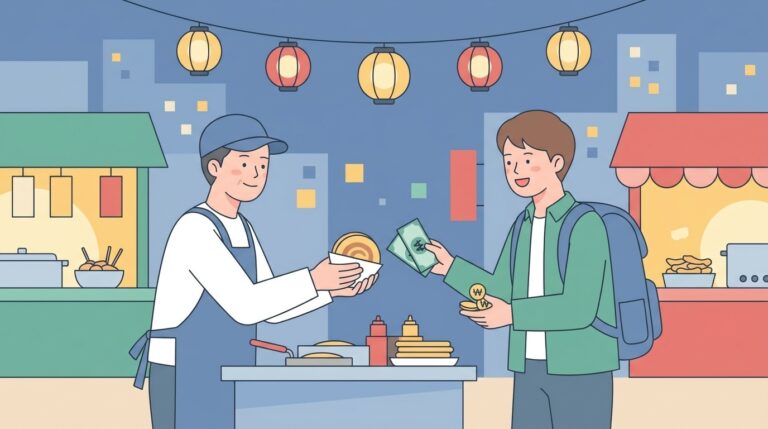
Phase 1: Empathy & The “Myeongdong Panic”
Hello! It’s your Daily Hangul Editor.
Imagine this: You are walking through the bustling streets of Myeongdong or Gwangjang Market. The air is thick with the sweet, buttery smell of Hotteok (sweet pancakes) and the spicy, savory steam of Tteokbokki. You spot a food stall, point to a delicious-looking skewer, and proudly pull out your sleek travel credit card.
Suddenly, the friendly Ajumma (vendor lady) crosses her arms in an “X” shape and shakes her head. “No card!” she says.
Panic sets in. You have some colorful Korean won bills in your pocket, but how do you ask if cash is okay? How do you ask for the price?
Korea is known as a hyper-digital, cashless society where you can pay for a pack of gum with a smartwatch. But Street Food? That is the magical exception. Knowing how to handle cash transactions at a street stall is the ultimate “Insider” survival skill.
Don’t worry! As someone who has eaten her weight in street food over 10 years in Seoul, I’m going to teach you the absolute basics. This guide is based on the exact moments my A1 beginner students freeze up. Let’s dive in!
Phase 2: Core Phrases Deep Dive
Here are the 3 lifesaver phrases you need to survive any Korean street food alley.
1. 이거 얼마예요?
- Pronunciation: igeo eolmayeyo? [EE-geo uhl-MAH-yeh-yo?]
- Meaning: (Literal) This how much? -> (Real nuance) How much is this?
- K-Culture Moment: You point at a giant twisted donut (Kkwabaegi) that doesn’t have a price tag. You lock eyes with the vendor and drop this phrase.
- Editor’s Insight: You don’t need to know the names of the food! Just point your finger, say “igeo” (this), and ask “eolmayeyo?” It’s the most powerful spell in Korean shopping.
- Situation Spectrum:
- Casual (Street stalls): ✅
- Semi-formal (Cafes/Restaurants): ✅
- Formal (High-end boutiques): ⚠️ (Better to use the full item name)
- 🤔 Think About It: Why do Koreans use “this (igeo)” so much instead of the specific noun? Korean is a high-context language; if both people can see what you’re pointing at, there’s no need to repeat the long name!
2. 현금 돼요?
- Pronunciation: hyeongeum dwaeyo? [HYUN-geum DWEH-yo?]
Sound tip: ‘eu’ sounds like the disgusted sound you make when you step in gum!- Meaning: (Literal) Cash becomes? -> (Real nuance) Do you take cash? / Is cash okay?
- K-Culture Moment: The vendor waves away your credit card. You pull out a 10,000 won bill and ask this with a hopeful smile.
- Editor’s Insight: “돼요? (dwaeyo?)” literally means “does it work?” or “is it acceptable?”. It is the ultimate survival word. You can put almost any noun in front of it!
- Situation Spectrum:
- Casual/Street: ✅
- Office/Coworkers: ⚠️
- Formal: 🚫 (Use “현금 결제 가능할까요?” instead)
- 🤔 Think About It: “돼요?” focuses on whether the situation allows it, not on you or me. Korean language often removes the “I” or “You” to sound softer and less confrontational.
3. 카드 돼요?
- Pronunciation: kadeu dwaeyo? [KAH-deu DWEH-yo?]
- Meaning: (Literal) Card becomes? -> (Real nuance) Do you take credit cards?
- K-Culture Moment: You’ve run out of cash after eating 5 skewers of fish cakes. You nervously hold up your Visa card and ask this.
- Editor’s Insight: Many street vendors now have tiny card machines hidden away. It never hurts to ask! But be prepared for a polite refusal.
- Situation Spectrum:
- Casual: ✅
- Semi-formal: ✅
- Formal: 🚫
Phase 3: Textbook vs. Real Korean
Let’s see how textbooks complicate things and how real Koreans actually speak on the streets.
[Situation 1: Asking for the price]
* 📖 Textbook Korean: 이것은 얼마입니까? (igeoseun eolmaimnikka?)
* 🗣️ Real Korean: 이거 얼마예요? (igeo eolmayeyo?)
* 💡 Why the difference?: The “~imnikka?” ending is used by news anchors or soldiers. On the street, “~yo” is perfectly polite and much friendlier!
[Situation 2: Handing over the cash]
* 📖 Textbook Korean: 여기 현금 있습니다. (yeogi hyeongeum itseumnida. – Here is the cash.)
* 🗣️ Real Korean: 여기요. (yeogiyo. – Here you go.)
* 💡 Why the difference?: Efficiency! Koreans love speed (빨리빨리 – ppalli-ppalli). Just saying “Here (yeogi)” with the polite “yo” is all you need when handing over money.
Bottom Note: As an A1 learner, don’t worry about complex grammar. Pointing, smiling, and using short phrases with “~yo” is the secret to sounding like a local!
Phase 4: Cultural Context — K-Culture Deep Dive
4-1. Non-Verbal Magic: The Two-Handed Rule
Language isn’t just words. When you hand cash to the vendor (who is usually older than you), do not just toss it on the counter with one hand.
Pass the money using both hands, or use your right hand to give the money while your left hand lightly supports your right wrist/elbow. This shows deep respect, and the Ajumma will instantly love you and might even give you extra food (서비스 – Service)!
4-2. K-Food Connection: The “Account Transfer” Phenomenon
If you watch recent Korean Vloggers eating street food, you might notice they don’t hand over cards OR cash. They pull out their phones!
Many street food stalls have signs that say 계좌이체 (Bank Transfer) with a bank account number. Locals just transfer the money via their banking apps in 3 seconds. Since tourists usually can’t use local bank apps, having crisp 1,000 and 5,000 won bills is your ultimate superpower.
Phase 5: Real-Life Roleplay Scenario
Setting: 8:00 PM. A lively food alley in Gwangjang Market. The steam from the dumplings is making you hungry. You are standing in front of a busy vendor.
Characters:
– YOU: A hungry traveler who only knows a little Korean.
– Imo-nim (이모님): The warm, energetic stall owner (Auntie).
Dialogue:
YOU: (Pointing at the sweet pancake) 이거 얼마예요? 🥞
(igeo eolmayeyo?)
[How much is this?]
Imo-nim: 호떡? 이천 원이에요~
(hotteok? icheon wonieyo~)
[Hotteok? It’s 2,000 won~]
YOU: (Pulling out a credit card) 아… 카드 돼요? 💳
(a… kadeu dwaeyo?)
[Ah… do you take cards?]
Imo-nim: (Smiling but shaking her head) 아이고, 카드는 안 돼. 현금 없어요?
(aigo, kadeuneun an dwae. hyeongeum eopseoyo?)
[Oh my, cards don’t work. Do you not have cash?]
YOU: (Checking your wallet) 있어요! 현금 돼요.
(itseoyo! hyeongeum dwaeyo.)
[I have it! Cash works.]
Imo-nim: 그래, 오천 원 줘요.
(geurae, ocheon won jwoyo.)
[Okay, give me the 5,000 won.]
🔀 Your Turn! How do you hand her the 5,000 won bill?
– A) Slide it across the table with one hand.
– B) Hand it to her using both hands while slightly bowing your head.
– C) Toss it playfully to show you are friendly.✅ Best Choice: B — Respect for elders is everything in Korea. Two hands = Instant respect.
⚠️ Choice A & C Analysis: Doing this might seem casual in Western cultures, but in Korea, handing things to older people with one hand is considered rude.
YOU: (Handing it with two hands) 여기요! 💵
(yeogiyo!)
[Here you go!]
Imo-nim: (Giving you coins) 자, 잔돈 삼천 원. 맛있게 먹어요!
(ja, jandon samcheon won. masitge meogeoyo!)
[Here, 3,000 won change. Eat deliciously!]
YOU: 감사합니다!
(gamsahamnida!)
[Thank you!]
Imo-nim: 또 와요~
(tto wayo~)
[Come again~]
Phase 6: 10-Second Shadowing Drill
Practice out loud! Pay attention to the pauses (/) and emotions.
- 🥺 (Curiously) 이거 / 얼마예요?
(i-geo / uhl-mah-yeh-yo?) -
😊 (Politely asking) 혹시 / 현금 / 돼요?
(hok-shi / hyun-geum / dweh-yo?)
(“Hok-shi” means “by any chance”, making you sound incredibly natural!)
Phase 7: K-Culture Mini Dictionary
1. 포장마차 (Pojangmacha)
* Romanization: pojangmacha
* English: Street food tent / cart
* Context: Literally “covered wagon.” You’ll see these orange or red tents everywhere in K-Dramas where characters drink Soju and eat udon after a breakup.
2. 이모님 (Imo-nim)
* Romanization: imo-nim
* English: Auntie (Respectful)
* Context: Used to affectionately call female restaurant staff or vendors. It’s much friendlier than “Excuse me!”
3. 잔돈 (Jandon)
* Romanization: jandon
* English: Change (coins or small bills)
* Context: When you pay with a 10,000 won bill for a 2,000 won snack, the money you get back is jandon.
4. 길거리 음식 (Gilgeori Eumsik)
* Romanization: gilgeori eumsik
* English: Street food
* Context: The heart of Korean food culture! From egg bread (Gyeran-ppang) in winter to twisted donuts.
Phase 8: Traveler Survival Kit
🆘 Survival Phrases TOP 3 for Markets
– 🇰🇷 “이거 얼마예요?” (igeo eolmayeyo?) – How much is this?
– 🇰🇷 “현금 돼요?” (hyeongeum dwaeyo?) – Do you take cash?
– 🇰🇷 “영수증 주세요.” (yeongsujeung juseyo.) – Receipt please. (Note: Street stalls rarely give receipts, but good for normal shops!)📌 Editor’s Travel Note
– The 1,000 Won Rule: Always carry around 10,000 to 20,000 won in 1,000 won bills (천 원). Street food is usually cheap, and handing a vendor a 50,000 won bill for a 2,000 won snack can make them grumpy because they might run out of change!
– Tipping Culture: Korea has NO tipping culture. Do not leave your change on the counter. The vendor will literally chase you down the street to give your money back!
Phase 9: Critical Thinking Corner — “A Step Deeper”
🧠 Think Deeper: Media vs Reality
If you watch K-Dramas, you see rich CEOs swiping black credit cards without looking, or teenagers paying for convenience store snacks with a beep of their phones. It makes Korea look 100% cashless. While that’s mostly true for big stores, traditional markets preserve a different Korea. Why? It’s about community and survival. Many elderly vendors aren’t tech-savvy, and credit card machines charge fees that eat into their tiny profits from selling cheap snacks. Using cash isn’t just a transaction here; it’s a way of supporting the local aunts and grandmas who keep Korea’s traditional flavors alive.💬 Your Turn: In your home country, is cash still king at street markets, or has everything gone digital? Share your experience in the comments!
Phase 10: FAQ & Common Mistakes
Q: Can I bargain/haggle for street food using cash?
A: Usually, NO. Unlike night markets in some other Asian countries, food prices in Korea are generally fixed. 3,000 won is 3,000 won. However, if you are buying a lot of clothes at Dongdaemun Market with cash, you can ask for a small discount (“깎아주세요” – kkakka-juseyo).
Q: What if I only have a 50,000 won bill?
A: Ask first: “잔돈 있어요?” (jandon itseoyo? – Do you have change?).
❌ Common Mistake #1: Leaving a “tip” because the food was cheap and delicious.
✅ Do This Instead: Just say a bright and loud “맛있어요! 감사합니다!” (It’s delicious! Thank you!). That is the best tip you can give in Korea.
Phase 11: Summary & Action Items
- One-Liner Summary: To survive Korean street food alleys, point, ask “이거 얼마예요?” and proudly hand over your cash with two hands!
-
Action Mission 3 Steps:
- 🥉 Bronze (Solo): Stand in front of your mirror with a piece of paper (acting as cash), hand it over with two hands, and say “현금 돼요?”
- 🥈 Silver (Online): Comment below: What Korean street food do you want to buy with cash? (Tteokbokki? Hotteok?)
- 🥇 Gold (Real Life): Next time you are in Korea (or a local Korean mart), try paying for a small item in cash and say “여기요!” (Here you go!).
- K-Culture Mission: Go to YouTube and search for “Korean Street Food Walking Tour.” Watch a vendor taking payment. Notice how the locals hand over the money or scan QR codes!
Phase 12: Quiz — Interactive Challenge
1. You are at a Hotteok stall. You want to pay with cash. What is the most natural way to ask?
A) 이것은 현금입니까? (igeoseun hyeongeumimnikka?)
B) 현금 돼요? (hyeongeum dwaeyo?)
C) 나는 현금을 좋아해요. (naneun hyeongeumeul joahaeyo.)
2. True or False: If the street food is 2,000 won and you give the vendor 5,000 won, you should let them keep the 3,000 won as a tip because the food was so good.
A) True
B) False
3. Fill in the blank: To ask “How much is this?” you point and say: “이거 _______?”
A) 맛있어요? (masitseoyo?)
B) 얼마예요? (eolmayeyo?)
(Answers: 1: B, 2: False – No tipping in Korea!, 3: B)
Frequently Asked Questions (FAQ)
Q: What does "이거 얼마예요?" mean in Korean and how do you pronounce it?
A: In Korean, "이거 얼마예요?" is pronounced [igeo eolmayeyo? [EE-geo uhl-MAH-yeh-yo?] and means: (Literal) This how much? -> (Real nuance) How much is this?
Q: What does "현금 돼요?" mean in Korean and how do you pronounce it?
A: In Korean, "현금 돼요?" is pronounced [hyeongeum dwaeyo? [HYUN-geum DWEH-yo?] and means: (Literal) Cash becomes? -> (Real nuance) Do you take cash? / Is cash okay?
Q: What does "카드 돼요?" mean in Korean and how do you pronounce it?
A: In Korean, "카드 돼요?" is pronounced [kadeu dwaeyo? [KAH-deu DWEH-yo?] and means: (Literal) Card becomes? -> (Real nuance) Do you take credit cards?







