

Phase 1: Empathy (Immersive Open)
Hello! I am your Daily Hangul editor.
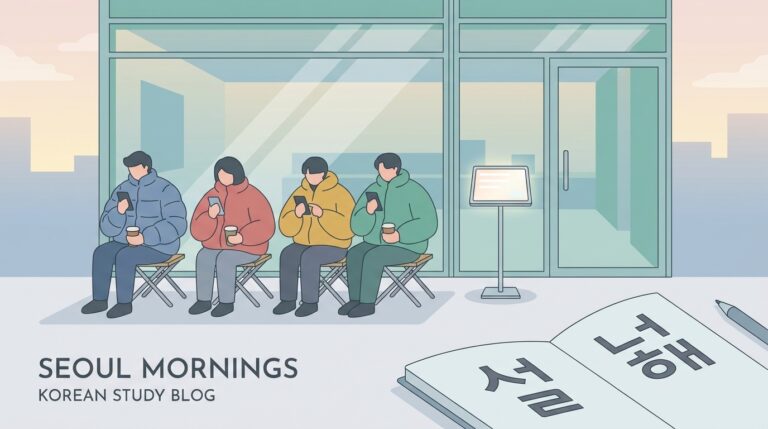
Imagine this: It’s 5:30 AM on a freezing Friday in Seongsu-dong, Seoul. The sun hasn’t even risen, but there is already a line of thirty people huddled in padded jackets, sitting on tiny foldable camping chairs, clutching hot Americanos. The pop-up store they are waiting for doesn’t open until 11:00 AM. In the K-Drama Celebrity, you might have seen influencers fighting over limited-edition luxury bags, but in reality, Koreans will do this for a viral bagel, a limited-edition sneaker, or even a cute plushie keyring.
Welcome to the hyper-competitive world of the ‘Open Run’ (오픈런).
At a C2 proficiency level, you already know how to say “I am waiting in line” (줄을 서고 있어요). But to truly understand modern Korean society—its intense consumer culture, FOMO (Fear of Missing Out), and trend-chasing speed—you need to understand the sociology and the highly specific slang surrounding the Open Run. If you don’t know these terms, you won’t just miss the context of Twitter trends or YouTube vlogs; you might literally lose your spot in line.
This guide isn’t just about vocabulary; it’s a sociological deep dive into modern Korea, based on the real (and often exhausting) experiences of expat residents and locals alike.
Phase 2: Deep Dive into Core Expressions
1. 오픈런 뛰다 (To ‘run’ an Open Run)
- Pronunciation: [opeulleon ttwida] – ‘ttwi’ sounds like a sharp, tight ‘twee’ in ‘tweet’, but with no breath expelled.
- Meaning: (Literal) To run an open run. (Real nuance) To actively participate in the grueling process of waiting before a store opens to secure a highly sought-after item.
- K-Culture Moment: You’re at a Friday night company dinner (회식), and a junior colleague declines a second round of drinks, saying, “내일 아침에 런던베이글 오픈런 뛰어야 해서 먼저 가보겠습니다” (I have to go run an open run for London Bagel tomorrow morning, so I’ll leave first). It shows dedication that transcends mere shopping.
- Editor’s Insight: Notice the verb 뛰다 (to run/jump). Koreans don’t just do an open run (하다); they run it (뛰다). This implies physical exhaustion, strategy, and treating the act like a competitive sport or a tactical mission.
- Situation Spectrum:
- Casual with friends: ✅
- Semi-formal with colleagues: ✅ (Widely accepted as a cultural norm)
- Formal to a senior/boss: ⚠️ (Depends on the boss’s vibe, might sound a bit too slangy)
- 🤔 Think About It: Why does Korean language use dynamic, physical verbs like ‘뛰다’ for activities like shopping or attending a fan meeting (덕질 뛰다)? What does this reveal about the intensity of Korean hobby culture?
2. 품절 대란 (Sold-out Chaos)
- Pronunciation: [pumjeol daeran] – ‘dae’ sounds like ‘de’ in ‘deck’, ‘ran’ sounds like ‘ron’ in ‘Ronald’.
- Meaning: (Literal) Sold-out great rebellion/chaos. (Real nuance) A massive national shortage of a viral item, causing a frenzy.
- K-Culture Moment: Remember the ‘Honey Butter Chip’ craze of 2014, or the ‘Pokemon Bread’ revival? News anchors would seriously report on the “품절 대란,” showing empty convenience store shelves across the nation.
- Editor’s Insight: This is a high-level, almost journalistic term that has bled into everyday speech. Using “대란” (crisis/chaos) for snacks or sneakers highlights how consumer trends in Korea often escalate to the level of national events.
- Situation Spectrum:
- Casual: ✅
- Semi-formal: ✅
- Formal/Written: ✅
- 🤔 Think About It: Korea is highly trend-sensitive. How does the densely populated, hyper-connected urban environment of Seoul amplify a simple ‘sold-out’ status into a ‘daeran’ (chaos)?
3. 현타 오다 (To have a reality check / Feel a sudden sense of futility)
- Pronunciation: [hyeonta oda] – ‘hyeon’ sounds like ‘hyun’ in ‘Hyundai’, ‘ta’ like ‘ta’ in ‘taco’.
- Meaning: (Literal) ‘Realization time’ comes. (Real nuance) The sudden, depressing realization of reality after doing something intense, obsessive, or slightly embarrassing.
- K-Culture Moment: You waited 4 hours in the freezing cold for a popup store, spent $200 on merchandise, and while riding the subway home with frozen toes, you look at your bank account. That profound sigh you let out? That’s 현타 hitting you.
- Editor’s Insight: Originally a gaming/internet slang term (현실 자각 타임 – Reality Awareness Time), it is now universally understood. It perfectly encapsulates the psychological hangover of hyper-consumerism.
- Situation Spectrum:
- Casual: ✅
- Semi-formal: ⚠️ (Use cautiously, mostly with close peers)
- Formal: 🚫
- 🤔 Think About It: Does your language have a word for the specific emotional crash that follows intense, trend-driven consumption?
Phase 3: Textbook vs. Real Korean
[Waiting for a store to open]
* 📖 Textbook: 가게가 문을 열 때까지 줄을 서서 기다릴 거예요. (I will stand in line and wait until the store opens.)
* 🗣️ Real Korean: 내일 아침에 오픈런 뛸 거예요. (I’m going to run an open run tomorrow morning.)
* 💡 Why the difference?: Efficiency. “오픈런 뛰다” condenses a 15-syllable sentence into 5 syllables while adding the cultural nuance of competition.
[Scalping / Reselling for profit]
* 📖 Textbook: 원래 가격보다 더 비싸게 팝니다. (Selling it more expensively than the original price.)
* 🗣️ Real Korean: 플미(프리미엄) 붙여서 팔아요. OR 리셀해요. (Selling with a premium / Reselling.)
* 💡 Why the difference?: The sneaker and luxury boom created a massive secondary market. “플미” (premium) has a slightly negative nuance, while “리셀” (resell) is treated almost as a legitimate investment strategy (리셀테크).
[Registering for the queue]
* 📖 Textbook: 대기 명단에 이름을 적어주세요. (Please write your name on the waiting list.)
* 🗣️ Real Korean: 캐치테이블/테이블링 걸어두셨어요? (Did you put it on CatchTable/Tabling?)
* 💡 Why the difference?: In modern Seoul, physical lines are often replaced by digital kiosk apps. The app name itself has become the verb.
Phase 4: Cultural Context — K-Culture Deep Dive
4-1. The Non-Verbal ‘Nunchi’ of the Queue
In an Open Run, Nunchi (눈치) is survival. If you leave a folding chair and a hot pack on the ground, does that count as holding your spot? In Korean Open Run culture, leaving your belongings (자리 맡기) is a highly debated topic. Usually, if you step away for 5 minutes for the restroom, it’s accepted. If you leave for 2 hours to sleep in your car, you will face the wrath of the queue. The non-verbal cue of acknowledging the person in front and behind you is crucial.
4-2. The Digital Shift: K-Food and K-Travel
The physical Open Run has evolved into the “Digital Open Run.” At popular cafes in Bukchon or Seongsu, you won’t see a long line outside. Why? Because everyone ran to the tablet kiosk by the door at 9:00 AM to register their phone number, and then left to wait in a nearby PC cafe or another coffee shop. If you are a traveler looking for K-Food, you must know how to say, “대기 등록은 어디서 해요?” (Where do I register for the wait?). Waiting blindly without putting your number in the kiosk is the biggest mistake foreigners make.
Phase 5: Real-Life Roleplay Scenario
Setting: It’s 9:45 AM on a Saturday outside a highly anticipated streetwear pop-up store in Hannam-dong. The line is already wrapped around the block. You are standing with Ji-hoon, a Korean friend who is a massive sneakerhead.
Characters:
– YOU: An expat who agreed to join the Open Run for the experience, but your toes are freezing.
– Ji-hoon (29): Your passionate friend. He has an app tracking resell prices.
Dialogue:
Ji-hoon: 와, 우리 새벽 6시에 왔는데도 앞에 50명이나 있네. 진짜 품절 대란이긴 한가 보다.
(Wa, uri saebyeok yeseot-sie wanneundedo ape osip-myeong-이나 inne. jinjja pumjeol daeran-igin han-ga boda.)
[Wow, we got here at 6 AM and there are still 50 people in front of us. I guess the sold-out chaos is real.]
(🎭 Stage Direction: Ji-hoon aggressively refreshes a reselling app on his phone.)
YOU: 이러다 우리 차례 오기 전에 한정판 다 나가는 거 아니야?
(Ireoda uri charye ogi jeone hanjeongpan da naganeun geo aniya?)
[At this rate, won’t the limited editions be all gone before it’s our turn?]
Ji-hoon: 설마… 근데 진짜 못 사면 나 완전 현타 올 것 같아.
(Seolma… geunde jinjja mot samen na wanjeon hyeonta ol geot gata.)
[No way… But if we really can’t buy it, I think I’ll get a massive reality check/feel devastated.]
YOU: 지훈아, 너 이거 신으려고 사는 거야? 아니면 리셀하려고?
(Ji-hoon-a, neo igeo sineullyeogo saneun geoya? animyeon risel-haryeogo?)
[Ji-hoon, are you buying these to wear? Or to resell?]
Ji-hoon: 솔직히 말하면… 내 사이즈 없으면 플미 붙여서 팔아야지. 요즘 이게 금값이거든.
(Soljikhi malhamyeon… nae saijeu eopseumyeon peulmi butyeoseo parayaji. Yojeum ige geumgapsigeodeun.)
[Honestly… if they don’t have my size, I’ll have to sell it with a premium. These are worth their weight in gold these days.]
(🎭 Stage Direction: A guy walks up to you both, looking sketchy.)
Sketchy Guy: 저기요, 혹시 그 자리 10만 원에 파실 생각 있으세요?
(Jeogiyo, hoksi geu jari simman won-e pasil saenggak isseuseyo?)
[Excuse me, do you have any intention of selling your spot in line for 100,000 won?]
🔀 Your Turn! How do you respond?
– A) “네? 자리를 팔아요? 안 돼요!” (Polite but a bit too formal for this street interaction.)
– B) “에이, 저희 밤샜어요. 안 팔아요.” (Casual, natural, showing you know the struggle.)
– C) “경찰 부를 거예요!” (Too aggressive, spot-selling is frowned upon but not highly illegal in a street line context.)✅ Best Choice: B — “에이~” (Ei~) is the ultimate native filler word for light rejection or disbelief. It naturally diffuses the tension while firmly stating you stayed up all night (밤샜어요) and won’t sell.
⚠️ Choice A Analysis: While grammatically flawless, it sounds like a textbook recording. Street interactions require a bit more natural flow.
Phase 6: 10-Second Shadowing Drill
Practice the emotional highs and lows of the Open Run:
😤 Determined: 내일 아침에 / 무조건 / 오픈런 뛸 거야!
(naeil achime / mujogeon / opeulleon ttwil geoya!)
[I am absolutely running the open run tomorrow morning!]
🥺 Desperate: 제발… / 제 앞에서 / 품절되지 않게 해주세요.
(jebal… / je apeseo / pumjeoldoeji an-ge haejuseyo.)
[Please… just don’t let it sell out right in front of me.]
😢 Defeated (현타): 4시간 기다렸는데 / 품절이라니… / 하아… 진짜 현타 온다.
(ne-sigan gidaryeonneunde / pumjeorirani… / ha-a… jinjja hyeonta onda.)
[I waited 4 hours and it’s sold out… Sigh I’m getting a massive reality check.]
Phase 7: K-Culture Mini Dictionary
1. 득템 (Deuk-tem)
* Romanization: deuk-tem
* English: Getting a rare item / A lucky catch
* Context: A compound of Hanja ‘득’ (to obtain) and English ‘item’. The ultimate goal of any Open Run.
2. 한정판 (Hanjeong-pan)
* Romanization: hanjeong-pan
* English: Limited edition
* Context: The magic word that strips Koreans of their sleep. Whether it’s Starbucks winter planners or Nike sneakers, ‘한정판’ triggers the Open Run instinct.
3. 웨이팅 걸다 (Waiting geolda)
* Romanization: weiting geolda
* English: To put one’s name on the waiting list
* Context: You don’t just ‘do’ waiting; you ‘hang’ (걸다) it. Usually done via a tablet kiosk. “웨이팅 걸어놨어?” is the most common phrase at hot restaurants.
4. 플미충 (Peulmi-chung)
* Romanization: peulmi-chung
* English: Premium bug (Derogatory term for scalpers)
* Context: Combines ‘Premium’ and ‘Chung’ (bug/insect). Used to express deep disdain for people who buy limited goods strictly to exploit real fans by reselling at absurd prices.
Phase 8: Traveler’s Survival Kit
For travelers, the “Open Run” usually happens at viral restaurants, cafes, or exclusive pop-ups in places like Seongsu, Hongdae, or Apgujeong. You will need to interact with digital systems.
🆘 Survival Expression #1: Navigating the Kiosk
– 🇰🇷 “여기 웨이팅 기계 어디 있어요?” (yeogi weiting gigye eodi isseoyo?)
– 🗣️ English: Where is the waiting machine here?
– 📍 Where to use: Any trendy restaurant or cafe with a crowd outside.
– 💡 Pro Tip: If you see people standing around but no visible line, DO NOT just stand there. Look for an iPad on a stand near the door immediately.🆘 Survival Expression #2: Foreigner Registration Issue
– 🇰🇷 “제가 한국 번호가 없는데, 어떻게 대기하나요?” (jega hanguk beonhoga eomneunde, eotteoke daegihanayo?)
– 🗣️ English: I don’t have a Korean phone number, how do I wait?
– 📍 Where to use: When the tablet requires a Korean number (010) to send a KakaoTalk notification.
– 💡 Pro Tip: Many modern apps (like CatchTable Global) allow email sign-ups now, but smaller shops might just handwrite your name or give you a physical buzzer if you explain you have no local number.📌 Editor’s Travel Note
– Must-have Apps: Download ‘CatchTable’ (캐치테이블) and ‘Tabling’ (테이블링) before your trip. You can sometimes “remote queue” before even arriving at the restaurant!
– Line Etiquette: Cutting lines (새치기) is heavily despised. If you are joining a friend who was holding the spot, expect dirty looks unless you do it very discreetly or communicate politely with those behind you.
Phase 9: Critical Thinking — “One Step Deeper”
🧠 Think Deeper: Consumption Culture & Identity
The Open Run phenomenon in Korea isn’t merely about loving a product; it’s a fascinating reflection of hyper-competitiveness manifesting in leisure and consumption. In a society where major milestones (buying a house, securing a top-tier job) feel increasingly out of reach for the younger generation, securing a ‘limited edition’ item or tasting the trendiest dessert offers a micro-victory. It is a tangible, achievable success. Furthermore, successfully completing an Open Run and posting it on Instagram acts as social currency—it proves you have the time, dedication, and trend-awareness to stay ahead of the curve.💬 Your Turn: In your home country, what do people willingly wait hours in line for? Is it driven by passion, resale value, or the desire to show off on social media? Share your thoughts below!
Phase 10: FAQ & Avoiding Misunderstandings
Q1. Can I say “플미충” in public?
No. While “플미충” is very common online and among close friends, “-충” is a highly derogatory suffix. If you want to complain about scalpers politely, use “리셀러” (resellers) or say “플미가 너무 심해요” (The premium is too severe).
Q2. Do I have to stay exactly at the store entrance after I register on the tablet?
No! That’s the beauty of the Korean tablet system. The app will message you via KakaoTalk (e.g., “There are 5 teams ahead of you”). You can go shop elsewhere, but you MUST return within usually 3 to 5 minutes of your final call, or your spot is instantly canceled.
❌ Common Mistake #1: Assuming a lack of a physical line means there’s no wait.
✅ Do this instead: Always ask, “지금 대기 있나요?” (Is there a wait right now?) or look for the tablet.❌ Common Mistake #2: Translating “I had a reality check” literally as “현실을 체크했어요.”
✅ Do this instead: Say “완전 현타 왔어요” to sound like a true local.
Phase 11: Summary & Action Items
- One-Liner Summary: Surviving Korea’s “Open Run” requires not just endurance, but mastering the vocabulary of digital queues (웨이팅 걸다), navigating the chaos (품절 대란), and managing the emotional aftermath (현타).
-
Action Mission 3 Steps:
- 🥉 Bronze (Solo): Say “아, 런던베이글 오픈런 뛰고 싶다!” (Ah, I want to do an open run for London Bagel!) out loud 3 times.
- 🥈 Silver (Online): Find an Instagram post about a Korean pop-up store and leave a comment: “여기 웨이팅 심한가요?” (Is the wait bad here?)
- 🥇 Gold (Real-world): If you are in Korea, go to a famous cafe, find the kiosk, and successfully register your queue without speaking English.
- K-Culture Mission: Download the ‘CatchTable’ app, switch the language to Korean, and look up the waiting numbers for the top 3 trending restaurants in Seoul right now. Prepare to be shocked by the numbers!
Phase 12: Quiz — Interactive Challenge
1. Situational Judgment:
You spent 3 hours waiting for a limited-edition keyboard, but the person right in front of you bought the last one. You turn to your friend and sigh. Which expression is the most natural to use here?
– A) “저 사람 플미충이네요.”
– B) “진짜 품절 대란이네요.”
– C) “아… 완전 현타 와요.”
2. True or False – K-Culture Edition:
“If you arrive at a famous Seongsu cafe and see no line outside, you can just walk right in and take a seat.”
– True or False?
3. Fill in the Blank:
가게 도착하자마자 기계에 [ _______ ]부터 걸어두세요. (As soon as you arrive at the store, put down the [ _______ ] on the machine first.)
👀 Click here for answers!
1. C (You feel the emotional crash of wasted effort. A is an assumption, B is too objective for your personal pain.)
2. False (You must check if there is a digital queue tablet inside or by the door. Invisible lines are everywhere!)
3. 웨이팅 (waiting)
Frequently Asked Questions (FAQ)
Q: What does "오픈런 뛰다 (To 'run' an Open Run)" mean in Korean and how do you pronounce it?
A: In Korean, "오픈런 뛰다 (To 'run' an Open Run)" is pronounced [opeulleon ttwida] and means: (Literal) To run an open run. (Real nuance) To actively participate in the grueling process of waiting before a store opens to secure a highly sought-after item.
Q: What does "품절 대란 (Sold-out Chaos)" mean in Korean and how do you pronounce it?
A: In Korean, "품절 대란 (Sold-out Chaos)" is pronounced [pumjeol daeran] and means: (Literal) Sold-out great rebellion/chaos. (Real nuance) A massive national shortage of a viral item, causing a frenzy.
Q: What does "현타 오다 (To have a reality check / Feel a sudden sense of futility)" mean in Korean and how do you pronounce it?
A: In Korean, "현타 오다 (To have a reality check / Feel a sudden sense of futility)" is pronounced [hyeonta oda] and means: (Literal) 'Realization time' comes. (Real nuance) The sudden, depressing realization of reality after doing something intense, obsessive, or slightly embarrassing.







