

Phase 1: Empathy & K-Culture Cold Open
Hello! I’m the Lead Editor at Daily Hangul.
Picture this: You’re watching your favorite K-Drama. The main characters have just had a huge argument, or maybe they’re on a quirky, budget-friendly date. Suddenly, the scene cuts to them sitting in a heated, wooden room. They are wearing identical, oversized T-shirts and shorts. But the most striking detail? They both have what looks like Princess Leia buns made entirely out of fluffy towels sitting on their heads.
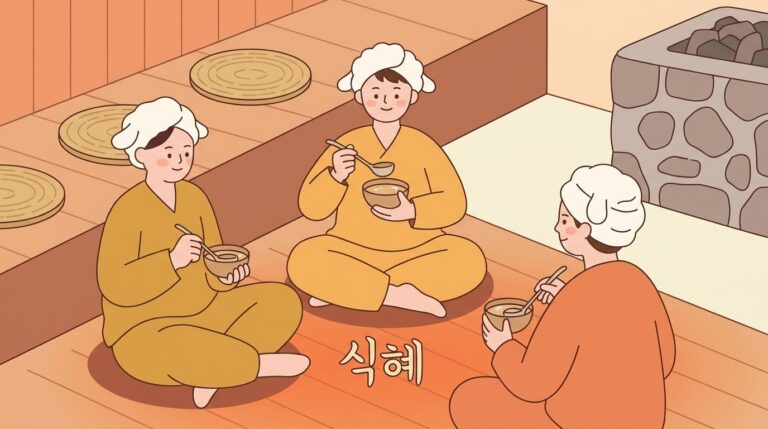
Welcome to the Korean Jjimjilbang (찜질방)—the ultimate cultural hub of relaxation, gossip, and snacking. And that iconic towel crown? That’s the Yangmyeori (양머리), or ‘Sheep Head’ towel.
I’ve seen so many of my students visit a Korean sauna, only to wander around awkwardly, struggling to figure out how to fold the towel, or freezing up when trying to order the mandatory sauna snacks. Today, we’re not just going to teach you the vocabulary; we’re going to give you the ultimate ‘insider’ guide to surviving and thriving in a Jjimjilbang. Let’s make you look (and sound) like a local!
Phase 2: Core Expressions Deep Dive
Let’s break down the most essential expressions you’ll need when making your Yangmyeori and enjoying the Jjimjilbang.
1. 수건 하나만 더 주실 수 있어요?
- Pronunciation: sugeon hanaman deo jusil su isseoyo? [soo-gun ha-na-man duh joo-shil soo is-suh-yo?]
- Meaning: Can I get just one more towel, please?
- K-Culture Moment: Usually, when you pay at the front desk, the Ahjumma (auntie) gives you exactly two towels. But to make a Yangmyeori, you need a dry towel! If you used both after your shower, you’re out of luck. This is the polite way to ask for a spare.
- Editor’s Insight: The magic word here is ‘만’ (man), meaning ‘just’ or ‘only’. Adding it makes your request sound softer and less demanding than simply saying “Give me another towel.”
- Situation Spectrum:
- Close Friends (Casual): 🚫 (You wouldn’t ask your friend for the sauna’s towel)
- Staff/Strangers (Polite/Standard): ✅
- Formal/Elders (Highly Formal): ⚠️ (Acceptable, but you might use ‘주시겠어요?’ for extra politeness)
- 🤔 Think About It: Why do Koreans often add words like ‘좀’ (a little) or ‘만’ (just) when asking for favors? How does this reflect the culture of softening requests to avoid burdening the listener?
2. 양머리 어떻게 만들어요?
- Pronunciation: yangmyeori eotteoke mandeureoyo? [yang-myeo-ri uh-tuh-keh man-deu-ruh-yo?]
- Meaning: How do you make the sheep head?
- K-Culture Moment: You’re sitting in the common area, struggling to fold the towel. You finally give up and ask the friendly Korean sitting next to you. It’s a great icebreaker!
- Editor’s Insight: The verb ‘만들다’ (to make) is used here. Notice how we drop the subject (I/You)? In Korean, if the context is obvious, subjects vanish. It makes the language incredibly efficient!
- Situation Spectrum:
- Close Friends (Casual): ✅ (양머리 어떻게 만들어? – drop the ‘요’)
- Strangers/Staff (Semi-formal): ✅
- Boss/Elders (Formal): 🚫 (You probably aren’t making towel hats with your CEO)
3. 식혜랑 구운 계란 주세요.
- Pronunciation: sikhyerang guun gyeran juseyo. [shee-kyeh-rang goo-woon gyeh-ran joo-seh-yo?]
- Meaning: Sikhye (sweet rice drink) and baked eggs, please.
- K-Culture Moment: The absolute holy trinity of the Jjimjilbang: Yangmyeori on your head, icy Sikhye in one hand, and a brown baked egg in the other. If you don’t order this, did you even go to a Jjimjilbang?
- Editor’s Insight: ‘혜’ sounds like a sharp ‘hyeh’. The ‘랑’ (rang) means ‘and’. It’s the most natural, conversational way to link two nouns when ordering food.
- Situation Spectrum:
- Anywhere you buy things (Polite): ✅
Phase 3: Textbook vs Real Korean
Let’s see how textbooks teach Jjimjilbang Korean versus what you’ll actually hear echoing in the sauna halls.
[Situation 1: Expressing the Heat]
* 📖 Textbook Korean: 이곳은 매우 뜨겁습니다. (This place is very hot.)
* 🗣️ Real Korean: 아, 시원하다~ (Ah, siwonhada~ / Ah, it’s refreshing!)
* 💡 Why the difference?: Older Koreans often say “It’s refreshing” when stepping into a boiling hot sauna or drinking hot soup. It refers to the physical relief of sweating out toxins and muscle tension, rather than the literal temperature.
[Situation 2: Asking a friend to help you fold the towel]
* 📖 Textbook Korean: 양머리를 접는 것을 도와주시겠습니까? (Would you assist me in folding the sheep head?)
* 🗣️ Real Korean: 야, 이거 좀 접어줘. (Ya, igeo jom jeobeojwo. / Hey, fold this for me.)
* 💡 Why the difference?: Between close friends, textbook Korean sounds robotic and oddly distant. Using ‘야’ (Hey) and ‘어/아 주다’ (do something for me) establishes intimacy.
Bottom Note: For B2 (Intermediate) learners, understanding the gap between literal translations (hot vs refreshing) is key to sounding like a local. Don’t be afraid to sigh “Ah, siwonhada~” in the 90°C salt room!
Phase 4: Cultural Context — K-Culture Deep Dive
4-1. Non-verbal Elements & Nunchi
The Jjimjilbang is a shared public space, which means it runs purely on Nunchi (눈치)—the Korean art of reading the room. While the snack area is loud and chatty, the sleeping caves and hotter sauna rooms demand absolute silence. When making your Yangmyeori, do it in the main hall. And when cracking your baked egg, don’t smash it too loudly if people are napping nearby!
4-2. The K-Drama Trope: The Egg Crack
If you’ve watched K-Dramas like Crash Landing on You or classic rom-coms, you know the drill. A character grabs a baked egg and smashes it against their friend’s (or lover’s) forehead to crack the shell.
Critical Point: This is hilarious on TV, but those baked Jjimjilbang eggs (Maekbanseok Gyeran) have surprisingly hard shells because they are slow-cooked on heated stones. If you hit someone’s head too hard, it actually really hurts! Real Koreans do it as a joke, but usually play Rock-Paper-Scissors first. The loser gets the egg smashed on their head!
Phase 5: Interactive Roleplay Scenario
Setting: A massive, multi-level Jjimjilbang in Yongsan, Seoul. It’s 8 PM on a Saturday. Families are lounging on mats, the TV is playing a variety show, and the smell of toasted eggs fills the air. You’ve just come out of the shower and changed into your orange uniform.
Characters:
– YOU: An international student, proud to be surviving your first Jjimjilbang trip.
– Minji (26): Your Korean language exchange partner. Energetic and a bit mischievous.
Dialogue:
Minji: 수건 가져왔지? 내가 양머리 만드는 거 알려줄게!
(sugeon gajyeowatji? naega yangmyeori mandeuneun geo allyeojulge!)
[You brought your towel, right? I’ll show you how to make the sheep head!]
(🎭 Stage Direction: Minji pats the floor next to her, gesturing for you to sit cross-legged)
YOU: 네, 여기요. 근데 이거 진짜 머리에 써야 돼요?
(ne, yeogiyo. geunde igeo jinjja meorie sseoya dwaeyo?)
[Yes, here. But do I really have to wear this on my head?]
Minji: 당연하지! 찜질방 필수템이야. 자, 수건을 3등분으로 접어봐.
(dangyeonhaji! jjimjilbang pilsutemiya. ja, sugeoneul sam-deungbuneuro jeobeobwa.)
[Of course! It’s a Jjimjilbang must-have. Now, fold the towel into thirds.]
YOU: 이렇게요? 그다음은요?
(ireokeyo? geudaumeunyo?)
[Like this? What’s next?]
Minji: 양쪽 끝을 양말 접듯이 돌돌 말아. 짠! 완성!
(yangjjok kkeuteul yangmal jeopdeusi doldol mara. jjan! wanseong!)
[Roll both ends tightly like folding socks. Ta-da! Done!]
YOU: 오, 귀여운데요? 아, 목말라요. 우리 매점 가요!
(o, gwiyeoundeyo? a, mongmallayo. uri maejeom gayo!)
[Oh, it’s cute! Ah, I’m thirsty. Let’s go to the snack bar!]
Minji: 좋아! 아줌마, 식혜 두 잔이랑 구운 계란 주세요!
(joa! ajumma, sikhye du janirang guun gyeran juseyo!)
[Great! Ma’am, two glasses of Sikhye and baked eggs, please!]
(🎭 Minji grabs an egg and looks at your forehead with a sneaky smile)
Minji: 계란은 머리에 깨야 제맛이지! 가만히 있어봐!
(gyeraneun meorie kkaeya jemasiji! gamanhi isseobwa!)
[Eggs taste best when cracked on the head! Stay still!]
🔀 Your Turn! How do you respond?
– A) “아파요! 절대 하지 마세요!” (It hurts! Absolutely do not do it!)
– B) “잠깐! 가위바위보 해서 진 사람 머리에 깨기 어때요?” (Wait! How about we play rock-paper-scissors, and crack it on the loser’s head?)
– C) “네, 마음껏 깨세요.” (Yes, crack it as much as you want.)✅ Best Choice: B — This shows you understand the Korean playful culture! Proposing ‘Gawi-Bawi-Bo’ (Rock-Paper-Scissors) turns a potential headache into a fun game.
⚠️ Choice A Analysis: While technically correct if you are scared, it sounds a bit too serious and might kill the fun mood.
Phase 6: 10-Second Shadowing Drill
Practice speaking with the right intonation and pauses. Remember, Korean is all about rhythm!
😊 아~ / 시원하다! / 우리 매점 가서 / 식혜 마실까요?
(a~ / siwonhada! / uri maejeom gaseo / sikhye masilkkayo?)
(Ah~ / That’s refreshing! / Should we go to the snack bar / and drink Sikhye?)
Tip: Drag out the “아~” (Ah~) with a deep sigh of relief for maximum local flavor!
Phase 7: K-Culture Mini Dictionary
Here are 4 keywords to master your sauna experience:
1. 눈치 (Nunchi)
* Romanization: nunchi
* English: Social sense / Reading the room
* Context: Knowing when to keep your voice down in the Jjimjilbang sleeping areas without anyone telling you.
2. 찜질방 (Jjimjilbang)
* Romanization: jjimjilbang
* English: Korean public bathhouse and sauna
* Context: More than a sauna, it’s a 24-hour entertainment complex with baths, hot rooms, arcades, and restaurants.
3. 때밀이 (Ttaemiri)
* Romanization: ttaemiri
* English: Korean body scrub
* Context: The intense, highly satisfying process where a professional uses a rough towel to scrub dead skin off your body. Not for the faint of heart, but highly recommended!
4. 락커키 (Rakkeoki)
* Romanization: rakkeoki
* English: Locker key bracelet
* Context: The electronic bracelet you get at the entrance. You wear it on your wrist or ankle, and you use it to tap and pay for EVERYTHING inside (snacks, massages). You pay the final bill when you leave.
Phase 8: Traveler Survival Kit
Going to a Jjimjilbang by yourself? Keep these phrases handy!
🆘 Survival Phrases TOP 3
– 🇰🇷 “찜질방복 어디서 받아요?” (jjimjilbangbok eodiseo badayo?)
– 🗣️ Pronunciation: [jjim-jil-bang-bok uh-dee-suh ba-da-yo?]
– 📍 Meaning: Where do I get the sauna clothes?
- 🇰🇷 “결제는 나갈 때 하나요?” (gyeoljeneun nagal ttae hanayo?)
- 🗣️ Pronunciation: [gyul-jeh-neun na-gal ttaeh ha-na-yo?]
- 📍 Meaning: Do I pay when I leave? (For the snacks/services)
🇰🇷 “여탕/남탕 어디예요?” (yeotang/namtang eodiyeyo?)
- 🗣️ Pronunciation: [yuh-tang / nam-tang uh-dee-yeh-yo?]
- 📍 Meaning: Where is the women’s/men’s bath?
📌 Editor’s Travel Note
– Cash vs Card: Leave your wallet in your locker! Modern saunas use your smart locker key bracelet to tally up your purchases. You just settle the bill with your credit card at the front desk before you exit.
– Towels: In the men’s locker room, towels are usually stacked freely. In the women’s room, you are usually handed exactly two at the front desk (to prevent theft/overuse).
Phase 9: Critical Thinking Corner — “한 발 더 깊이”
🧠 Think Deeper: Media vs Reality (미디어와 현실)
Because of K-Dramas and variety shows, many foreigners assume that everyone in a Jjimjilbang wears a Yangmyeori. But if you actually go to a local sauna, you might notice something surprising: mostly, it’s just young children, teenagers, couples on dates, or foreign tourists wearing them! Older Korean adults (the Ahjussis and Ahjummas) rarely wear the sheep head; they usually just wrap a towel flat around their neck to wipe away sweat. Media amplifies the cute, visual elements of culture to make it iconic.💬 Your Turn: Have you ever visited a country and realized that a famous “cultural stereotype” from TV was actually just for kids or tourists? Share your experience in the comments!
Phase 10: FAQ & Common Mistakes
Q: Do I wear my underwear under the Jjimjilbang orange clothes?
Yes! The bathing area (gender-segregated) is strictly nude. But before you enter the common Jjimjilbang area (mixed gender) where the hot saunas and snack bars are, you MUST put on your underwear and the provided uniform.
Q: “Can I take pictures of my cute Yangmyeori?”
In the common area (with the snack bar), taking selfies is perfectly fine! But NEVER take your phone into the locker rooms or the naked bathing areas.
❌ Common Mistake #1: Losing your locker key bracelet.
✅ How to fix it: Treat that bracelet like your passport. Wear it around your wrist or your ankle securely. If you lose it, not only is there a hefty replacement fee, but someone else could buy endless snacks on your tab!
Phase 11: Summary & Action Items
One-Liner Summary: A trip to the Jjimjilbang isn’t complete without politely asking for a towel, folding a Yangmyeori, and sipping Sikhye after a hearty ‘시원하다~’!
Your Action Missions:
– 🥉 Bronze: Stand in front of your bathroom mirror, grab a towel, and try following a YouTube tutorial to make a Yangmyeori while saying “양머리 완성!” (Sheep head complete!).
– 🥈 Silver: Write a post in your Korean language community: “찜질방에서 식혜 먹고 싶어요.” (I want to eat Sikhye at the Jjimjilbang.)
– 🥇 Gold: Next time you visit Korea, go to a Jjimjilbang, make the towel hat, and successfully order “식혜랑 구운 계란 주세요!”
🇰🇷 K-Culture Mission:
Search “찜질방 양머리 접는 법” (How to fold Jjimjilbang sheep head) on YouTube or TikTok and try making one out of your own bath towel tonight!
Phase 12: Quiz — Interactive Challenge
1. Situational Judgment: You step out of the 80°C salt room, covered in sweat, and sit down on the cool wooden floor. What is the most natural, “local” thing to say?
– A) 너무 춥습니다. (It is too cold.)
– B) 아~ 시원하다! (Ah~ It’s refreshing!)
– C) 수건 주세요. (Give me a towel.)
2. True or False – K-Culture Edition:
“In the shared, mixed-gender Jjimjilbang area where the snack bars are, everyone is completely naked.”
3. Fill in the Blank:
You want to politely ask the Ahjumma at the counter for one extra towel to make a hat.
“수건 하나만 더 _______ 수 있어요?”
– A) 만들 (make)
– B) 주실 (give)
– C) 먹을 (eat)
(Answers: 1: B – Remember, heat relief is expressed as ‘refreshing’. / 2: False! The mixed areas require the orange/pink uniform. Only the gender-segregated baths are nude. / 3: B – jusil)
Ready to sweat out your stress and practice your Korean? Let us know in the comments if you’ve ever tried a Jjimjilbang egg!
Frequently Asked Questions (FAQ)
Q: What does "수건 하나만 더 주실 수 있어요?" mean in Korean and how do you pronounce it?
A: In Korean, "수건 하나만 더 주실 수 있어요?" is pronounced [sugeon hanaman deo jusil su isseoyo? [soo-gun ha-na-man duh joo-shil soo is-suh-yo?] and means: Can I get just one more towel, please?
Q: What does "양머리 어떻게 만들어요?" mean in Korean and how do you pronounce it?
A: In Korean, "양머리 어떻게 만들어요?" is pronounced [yangmyeori eotteoke mandeureoyo? [yang-myeo-ri uh-tuh-keh man-deu-ruh-yo?] and means: How do you make the sheep head?
Q: What does "식혜랑 구운 계란 주세요." mean in Korean and how do you pronounce it?
A: In Korean, "식혜랑 구운 계란 주세요." is pronounced [sikhyerang guun gyeran juseyo. [shee-kyeh-rang goo-woon gyeh-ran joo-seh-yo?] and means: Sikhye (sweet rice drink) and baked eggs, please.







