

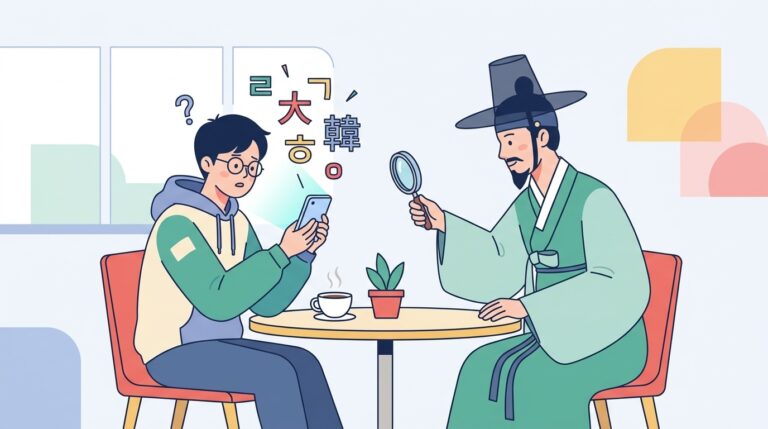
Phase 1: Empathy (The Cold Open)
Hello, everyone! It’s your Senior Editor at Daily Hangul.
Picture this: You are scrolling through a K-Pop idol’s official fan cafe. The agency has just posted an official statement regarding a delayed concert. The notice ends with: “심심한 사과를 드립니다” (We offer our profound apologies). Suddenly, the comment section explodes. Angry fans are typing, “Are you kidding me? A ‘bored’ apology? Are you not taking this seriously?!”
Wait, what just happened? Did the agency really say they were ‘bored’ while apologizing? Not at all.
Welcome to one of the most heated debates in modern South Korea: the crisis of 문해력 (munhaeryeok), or literacy and reading comprehension. Korea boasts one of the highest basic literacy rates in the world thanks to the scientific design of Hangul. But recently, functional literacy—the ability to understand complex texts, context, and Hanja-based vocabulary—has been plummeting, largely fueled by the dominance of K-Shorts, TikToks, and webtoons.
If you are an advanced (C2) learner of Korean, mastering these linguistic nuances isn’t just about passing the TOPIK II exam. It’s about reading the room, understanding social phenomena, and becoming an absolute insider in Korean society. Let’s dive into the fascinating world of Korean reading comprehension!
Phase 2: Deep Dive into Key Expressions
1. 심심한 사과를 드립니다
- Pronunciation: simsimhan sagwareul deurimnida [shim-shim-han sa-gwa-reul deu-rim-nee-da]
- Meaning: Literal: I give you a profound apology / Real nuance: We offer our deepest and most sincere apologies.
- K-Culture Moment: This expression caused a massive nationwide controversy a few years ago. The word 심심(深甚) here comes from Hanja, meaning “deep and profound.” However, teenagers and young adults, accustomed to pure Korean, mistook it for 심심하다 (to be bored). When agencies or companies use this in official statements, it is the ultimate form of formal corporate apology.
- Editor’s Insight: This phrase is strictly for written or highly formal public apologies. Never use this when you accidentally step on your friend’s foot!
- Situation Spectrum:
- Casual with friends: 🚫
- Co-workers (Semi-formal): ⚠️ (Only in official emails)
- Boss/Public (Formal): ✅
- 🤔 Think About It: Why does Korean have so many homonyms (words that sound the same but mean different things)? How does the gradual removal of Hanja (Chinese characters) from daily education impact the younger generation’s reading comprehension?
2. 세 줄 요약 좀
- Pronunciation: se jul yoyak jom [seh jool yo-yak johm]
- Meaning: Literal: Give me a three-line summary / Real nuance: TL;DR (Too Long; Didn’t Read). Just give me the bottom line.
- K-Culture Moment: If you post a long, emotional essay or a complex news article on a Korean online community (like Reddit or Blind), the top comment will inevitably be “세 줄 요약 좀.” It reflects the “Pali-pali” (hurry up) culture applied to reading.
- Editor’s Insight: It’s slightly sarcastic but incredibly common. It highlights the modern reluctance to read anything that takes longer than 15 seconds to consume.
- Situation Spectrum:
- Casual with friends: ✅
- Co-workers (Semi-formal): ⚠️ (Depends on the office culture, better to say “요약해 주시겠어요?”)
- Boss/Public (Formal): 🚫
- 🤔 Think About It: Is the demand for “three-line summaries” an evolution of efficient communication, or the death of deep analytical thinking?
3. 행간을 읽다
- Pronunciation: haengganeul ikda [haeng-gan-eul eek-da]
- Meaning: Literal: To read the space between the lines / Real nuance: To read between the lines; to understand the hidden meaning.
- K-Culture Moment: In K-Dramas featuring intense corporate politics (like Misaeng), a mentor might scold a rookie for taking a client’s words literally: “텍스트만 보지 말고 행간을 읽으라고!” (Don’t just look at the text, read between the lines!)
- Editor’s Insight: This is the ultimate goal of “문해력” (literacy). It’s about Nunchi (눈치) applied to reading.
- Situation Spectrum:
- Casual with friends: ✅
- Co-workers (Semi-formal): ✅
- Boss/Public (Formal): ✅
- 🤔 Think About It: Does your native language have an equivalent idiom for understanding unwritten context?
Phase 3: Textbook vs. Real Korean
[Situation 1: Expressing a deep apology in writing]
* 📖 Textbook Korean: 정말 죄송합니다. (Jeongmal joesonghamnida.)
* 🗣️ Real Korean: 심심한 사과의 말씀을 전합니다. (Simsimhan sagwaui malsseumeul jeonhamnida.)
* 💡 Why the difference?: Textbooks teach emotional apologies, but official Korean corporate or institutional culture requires formal, Hanja-rooted vocabulary to show objective, profound gravity.
[Situation 2: Asking for the main point of a long text]
* 📖 Textbook Korean: 이 글의 요점이 무엇인가요? (I geurui yojeomi mueosingayo?)
* 🗣️ Real Korean: 그래서 세 줄 요약하면 뭔데? (Geuraeseo se jul yoyakhamyeon mwonde?)
* 💡 Why the difference?: Internet culture values extreme efficiency. Time is gold, and attention spans are short!
Phase 4: Cultural Context — K-Culture Deep Dive
4-1. Non-verbal Nunchi and “Reading” People
In Korea, reading comprehension isn’t just about books; it’s about reading people. We call this 눈치 (Nunchi). When a Korean boss says, “This proposal is… interesting,” you need the “literacy” to read between the lines (행간을 읽다) to know they actually mean, “Rewrite this immediately.”
4-2. The K-Drama Connection: The Irony of “SKY Castle”
If you’ve watched the mega-hit K-Drama SKY Castle, you’ve seen the dark side of Korea’s education fever. High schoolers memorize massive textbooks to score 100% on reading comprehension tests, yet they fail to comprehend the emotions of their own families.
This highlights the modern critique of Korean education: We train students to find the “author’s intent” in a multiple-choice question within 60 seconds, but we aren’t fostering the patience required for true “독서” (reading for pleasure and empathy). The high scores are an illusion hiding a decline in actual literacy.
Phase 5: Real-world Roleplay Scenario
Setting: 2:00 PM on a Tuesday. A trendy café in Pangyo (Korea’s Silicon Valley). You and your Korean coworker, Minho, are reviewing a 20-page market research report for a new project. Minho looks exhausted.
Characters:
– YOU: A foreign professional working in Korea, diligent and detail-oriented.
– Minho (29): Your Korean colleague. Smart, but heavily addicted to YouTube Shorts. Hates long texts.
Dialogue:
Minho: 아, 이 보고서 진짜 너무 길다. 눈에 하나도 안 들어와요.
(A, i bogoseo jinjja neomu gilda. Nune hanado an deureowayo.)
[Translation: Ah, this report is seriously too long. I can’t take any of it in.]
(🎭 Stage Direction: Minho drops the report on the table and rubs his eyes.)
YOU: 그래도 중요한 내용이 많던데요. 특히 3페이지부터요.
(Geuraedo jungyohan naeyongi manteondeyo. Teukhi sampeijibuteoyo.)
[Translation: Still, there’s a lot of important information. Especially from page 3.]
Minho: 아… 현기증 나요. OO씨, 이거 세 줄 요약 좀 해줄 수 있어요?
(A… hyeongijeung nayo. OO ssi, igeo se jul yoyak jom haejul su isseoyo?)
[Translation: Ah… I’m getting dizzy. OO, could you give me a three-line summary of this?]
🔀 Your Turn! How do you respond to Minho?
– A) “네, 알겠습니다. 제가 요약해 드릴게요.” (Yes, understood. I will summarize it for you.)
– B) “에이, 민호 씨. 문해력 떨어지는 소리 하지 마시고 같이 행간을 읽어봐요!” (Come on, Minho. Stop sounding like someone with declining literacy, let’s read between the lines together!)
– C) “저도 싫어요. 안 읽을래요.” (I hate it too. I won’t read it.)✅ Best Choice: B — Reason: Since you are colleagues of similar age/status, choice B uses witty, trending social critiques (문해력 떨어지다) playfully. It shows you completely grasp current Korean societal debates while encouraging him to do the work!
⚠️ Choice A Analysis: Safe and polite, but you end up doing all the work. Not ideal for survival in a Korean corporate environment!
Phase 6: 10-Second Shadowing Drill
Let’s practice a phrase you can use when encouraging a friend to read carefully!
😤 긴 글을 / 피하지 말고, / 텍스트의 / 행간을 / 읽어보세요!
(gin geureul / pihaji malgo, / tekseuteu-ui / haengganeul / ilgeoboseyo!)
[Translation: Don’t avoid long texts; try to read between the lines of the text!]
Phase 7: K-Culture Mini Dictionary
1. 문해력
* Romanization: munhaeryeok
* English: Literacy / Reading Comprehension
* Context: Currently a buzzword in Korean news, often used negatively as in “문해력 저하” (the decline of literacy) among the younger generation.
2. 세 줄 요약
* Romanization: se jul yoyak
* English: 3-line summary (TL;DR)
* Context: The cultural demand for extreme brevity in online communities.
3. 한자어
* Romanization: hanja-eo
* English: Sino-Korean words (words of Chinese origin)
* Context: Makes up about 60% of the Korean vocabulary. The lack of Hanja education is often blamed for the modern literacy crisis (e.g., the “심심한 사과” debate).
4. 사흘
* Romanization: saheul
* English: Three days
* Context: Another famous literacy controversy! Many young Koreans thought “사흘” meant four days because it sounds like “사” (4), when it actually means three days.
Phase 8: Traveler’s Survival Kit (Literacy Edition)
Even if you aren’t debating educational policy, you need practical reading comprehension when traveling in Korea, especially when faced with complex museum plaques, long menu descriptions, or confusing subway notices.
🆘 Survival Expressions: When the text is too confusing
– 🇰🇷 “죄송한데, 이게 무슨 뜻인가요?” (Joesonghande, ige museun tteusingayo?)
– 🗣️ English: I’m sorry, but what does this mean?
– 📍 Use it at: Museums, historical sites, reading complex kiosk menus.
- 🇰🇷 “쉽게 설명해 주실 수 있나요?” (Swipge seolmyeonghae jusil su innayo?)
- 🗣️ English: Could you explain it simply?
- 💡 Pro Tip: Koreans are usually very eager to help foreigners who ask politely. Don’t be afraid to ask for a “세 줄 요약” verbally!
📌 Editor’s Travel Note
– If you face a long Korean notice (like a sudden train delay or a restaurant’s complex waiting system), the Papago App‘s image translation feature is your best friend.
– Beware of “Konglish” (Korean-English) signs. Sometimes translating them literally makes less sense than reading the Korean text contextually!
Phase 9: Critical Thinking Corner — “One Step Deeper”
🧠 Think Deeper: Global Era & The Irony of Korean Literacy
Korea is globally celebrated for creating Hangul, arguably the most logical writing system in the world. King Sejong invented it so that “even a foolish person can learn it in ten days.” Consequently, Korea’s basic illiteracy rate is near 0%. However, reading the letters and comprehending the meaning are two different realms.
As the Korean language evolves in the digital global era—mixing pure Korean, English loanwords, internet slang, and traditional Hanja roots—the generational gap in “functional literacy” is widening. The youth are lightning-fast at processing short-form visual data, while older generations cling to long-form text. Is this a true “crisis of intelligence,” or simply the painful birth of a new, digital-first communication style?
💬 Your Turn: How is the rise of TikTok and short-form content affecting literacy and education in your home country? Do you have your own version of the “Simsimhan apology” controversy? Share in the comments!
Phase 10: FAQ & Avoiding Misunderstandings
Q: Can I use “심심한 사과” to my close friends as a joke?
A: Yes, but only ironically! If you bump into a friend and say, “심심한 사과를 드립니다,” they will probably burst out laughing because it sounds like a CEO issuing a press release for stepping on a shoe.
Q: How do I tell someone I’m actually “bored” without sounding like I’m apologizing?
A: Just use the adjective simply: “아, 너무 심심하다!” (Ah, I’m so bored!). Context is everything.
❌ Common Mistake #1: Assuming that because you know the alphabet (Hangul), you can understand advanced documents. Advanced Korean heavily relies on Sino-Korean roots (Hanja). For C2 learners, studying basic Hanja meanings (like 심 = deep, 학 = learn, 생 = life) is the ultimate cheat code for boosting your 문해력!
Phase 11: Summary & Action Items
- One-Liner Summary: True Korean literacy (문해력) isn’t just about reading Hangul; it’s about navigating the generational divide between Hanja-based formality and short-form efficiency (세 줄 요약).
Action Mission 3 Steps:
– 🥉 Bronze (Solo): Read a long Korean text today (a news article or blog post) and write your own “세 줄 요약” (3-line summary) in Korean.
– 🥈 Silver (Online): Go to a Korean YouTube video about a serious topic. Try to “read between the lines” (행간을 읽다) of the top comments.
– 🥇 Gold (Real-world): Next time a Korean friend tells you a long story, jokingly say, “그래서 세 줄 요약하면?” (So, what’s the 3-line summary?) and watch their reaction!
🇰🇷 K-Culture Mission:
Search “심심한 사과 논란” (Simsimhan apology controversy) on a Korean search engine like Naver. Read the articles. Try to understand why the public reacted the way they did. It’s the ultimate test of your advanced cultural literacy!
Phase 12: Quiz — Interactive Challenge
1. Situational Judgment: You are writing an email to a VIP client to apologize for a major shipping delay. Which closing is most appropriate?
– A) 미안해요. ㅠㅠ
– B) 세 줄 요약해서 죄송합니다.
– C) 불편을 드려 심심한 사과의 말씀을 전합니다.
(Answer: C. This is the exact formal scenario where “심심한 사과” is expected and respected.)
2. True or False – K-Culture Edition:
“Because Hangul is easy to read, young Koreans have absolutely no problems understanding any text written in Korean.”
(Answer: False. The “문해력 저하” (decline in functional literacy) is a major social issue because understanding complex Hanja-based vocabulary and reading long texts is becoming difficult for generations raised on short-form media.)
Frequently Asked Questions (FAQ)
Q: What does "심심한 사과를 드립니다" mean in Korean and how do you pronounce it?
A: In Korean, "심심한 사과를 드립니다" is pronounced [simsimhan sagwareul deurimnida [shim-shim-han sa-gwa-reul deu-rim-nee-da] and means: Literal: I give you a profound apology / Real nuance: We offer our deepest and most sincere apologies.
Q: What does "세 줄 요약 좀" mean in Korean and how do you pronounce it?
A: In Korean, "세 줄 요약 좀" is pronounced [se jul yoyak jom [seh jool yo-yak johm] and means: Literal: Give me a three-line summary / Real nuance: TL;DR (Too Long; Didn't Read). Just give me the bottom line.
Q: What does "행간을 읽다" mean in Korean and how do you pronounce it?
A: In Korean, "행간을 읽다" is pronounced [haengganeul ikda [haeng-gan-eul eek-da] and means: Literal: To read the space between the lines / Real nuance: To read between the lines; to understand the hidden meaning.







