

Phase 1: Empathy (The K-Culture Cold Open)
Hello! It’s your Daily Hangul Editor.
Picture this: You are standing in the middle of Bukchon Hanok Village. You rented a beautiful Hanbok, the lighting is golden hour perfect, and you want that perfect Instagram shot. But… your arms are too short for a full-body selfie. You spot a friendly-looking Korean couple walking by. You know you need to ask them for a photo, but your mind goes blank. Do I just shove my phone at them? What’s the Korean word for ‘picture’?
If you’ve watched K-Dramas, you might have seen scenes where friends take 100 photos of each other from crazy angles, squatting on the ground just to make the other person’s legs look longer. Koreans take their photography very seriously. It’s almost a national sport!
Knowing how to politely ask for a photo—and how to ask for the right angle—will not only save you from taking blurry, awkward selfies, but it will also instantly make locals smile. This guide is based on real SOS messages from our students who traveled to Seoul. Let’s dive into the magical phrases that will get you the ultimate Insaeng-shot (photo of a lifetime)!
Phase 2: Core Expressions Deep Dive
1. 사진 좀 찍어주시겠어요?
- Pronunciation: sajin jom jjigeojusigesseoyo? [sah-jin johm jjee-geo-joo-shee-geh-suh-yo?]
- Meaning: (Literal) Would you mind taking a photo a little? / (Real nuance) Could you please take a picture for me?
- K-Culture Moment: You are at a trendy cafe in Seongsu-dong. Everyone is snapping away. You approach a stranger, gently holding your phone with two hands, and softly ask this. It’s the golden standard of politeness.
- Editor’s Insight: The magic word here is 좀 (jom). It literally means “a little,” but Koreans use it to soften a request. Without “jom,” it sounds like a command. With “jom,” you sound polite, respectful, and very natural!
- Situation Spectrum:
- Casual (Friends): ⚠️ (Too formal, just say “사진 찍어줘 – sajin jjigeojwo”)
- Semi-formal (Strangers on street): ✅
- Formal (Elders/Boss): ✅
- 🤔 Think About It: Why do Koreans soften their requests with words like “a little” (jom)? How does your culture make requests sound less demanding?
2. 길게 찍어주세요.
- Pronunciation: gilge jjigeojuseyo. [geel-geh jjee-geo-joo-seh-yo]
- Meaning: (Literal) Please take it long. / (Real nuance) Please take the photo so my legs look long / I look tall.
- K-Culture Moment: This is the ultimate insider phrase! If you ask a young Korean person to take your photo and playfully add this, they will laugh, nod with absolute understanding, and immediately drop into a wide-legged squat to get that low-angle shot.
- Editor’s Insight: Korean beauty standards love a small face and long legs. Taking a photo “gilge” is the ultimate compliment to the subject.
- Situation Spectrum:
- Casual (Friends): ✅
- Semi-formal (Strangers your age): ✅ (Shows you know Korean culture!)
- Formal (Elders): 🚫 (They might not understand the slangy context.)
- 🤔 Think About It: Photography styles reflect cultural values. What is the “must-have” photo aesthetic in your country?
3. 잘 나왔어요?
- Pronunciation: jal nawasseoyo? [jahl nah-wah-suh-yo?]
- Meaning: (Literal) Did it come out well? / (Real nuance) Does the picture look good?
- K-Culture Moment: The moment the “photographer” hands your phone back. You look at the screen, and they awkwardly wait for your approval. You ask this to break the ice and show excitement.
- Editor’s Insight: The verb 나오다 (to come out) is used for photos, food coming out of the kitchen, and even results of an exam. It’s an essential A2 verb!
- Situation Spectrum:
- Casual (Friends): ✅ (Drop the ‘yo’: jal nawasseo?)
- Semi-formal (Strangers): ✅
- Formal (Elders): ✅
- 🤔 Think About It: Instead of asking “Do I look good?”, Koreans ask “Did the photo come out well?” What does this subtle shift in the subject say about the language?
Phase 3: Textbook vs. Real Korean
[Asking a stranger for a photo]
* 📖 Textbook Korean: 이 사진을 찍어 주시겠습니까? (i sajineul jjigeo jusigesseumnikka? – Will you take this picture?)
* 🗣️ Real Korean: 저기요~ 혹시 사진 좀 부탁드려도 될까요? (jeogiyo~ hoksi sajin jom butakdeuryeodo doelkkayo? – Excuse me, by any chance, could I ask for a photo favor?)
* 💡 Why the difference?: Adding “저기요” (Excuse me to get attention) and “혹시” (by any chance) acts as a social bumper, showing hesitation so you don’t seem entitled to their time.
[Saying “Cheese!”]
* 📖 Textbook Korean: 웃으세요! (useuseyo! – Please smile!)
* 🗣️ Real Korean: 하나, 둘, 셋! (hana, dul, set! – 1, 2, 3!) followed by 김치~ (Kimchi~)
* 💡 Why the difference?: Just like “Cheese” stretches the mouth into a smile, the “ee” sound at the end of “Kimchi” naturally forms a bright smile!
Phase 4: Cultural Context — K-Culture Deep Dive
4-1. Non-Verbal Cues: The Art of the Handover
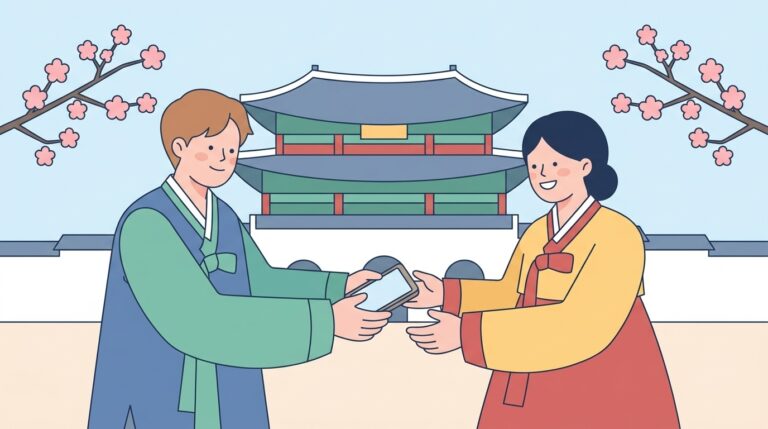
When asking a stranger for a photo, do not just shove the phone into their hand. Approach with a slight bow of the head. When handing over your phone, use two hands, or support your right elbow with your left hand. This shows respect. Also, remember Nunchi (눈치)—if the person looks like they are rushing to catch a bus, read the room and ask someone else!
4-2. K-Travel & K-Drama Connection: The “Insaeng-shot” Obsession
Have you noticed in K-Dramas how characters on a date take dozens of pictures of each other? In reality, Koreans are known worldwide for being the best strangers to ask for photos. If you ask a Korean to take your photo, they won’t just take one. They will likely press the shutter 20 times in 3 seconds, adjusting the angle, telling you to move left or right. They are genuinely invested in giving you an 인생샷 (Insaeng-shot: photo of a lifetime). Enjoy the impromptu photoshoot!
Phase 5: Real-World Roleplay Scenario
Setting: Saturday afternoon at Gyeongbokgung Palace. You are wearing a rented Hanbok. The sky is perfectly blue. You see a friendly Korean local who just finished taking a photo of his friend. You approach him.
Characters:
* YOU: A traveler exploring Seoul, excited but a bit shy about speaking Korean.
* Minwoo (28): A local Seoulite. Very friendly, has the “Korean photographer” instinct in his blood.
Dialogue:
YOU: 저기요… 혹시 사진 좀 찍어주시겠어요?
(jeogiyo… hoksi sajin jom jjigeojusigesseoyo?)
[Excuse me… could you take a picture for me by any chance?]
(🎭 Stage Direction: You bow slightly and hold out your phone with both hands)
Minwoo: 아, 네! 핸드폰 주세요.
(a, ne! haendeupon juseyo.)
[Ah, yes! Please give me your phone.]
YOU: 감사합니다. 전신 다 나오게 찍어주세요.
(gamsahamnida. jeonsin da naoge jjigeojuseyo.)
[Thank you. Please take it so my whole body is in the shot.]
Minwoo: 네, 알겠습니다. 저기 나무 옆으로 가보세요.
(ne, algetseumnida. jeogi namu yeopeuro gaboseyo.)
[Yes, understood. Try going over there next to the tree.]
(🎭 Stage Direction: Minwoo squats down low to get a good angle)
Minwoo: 자, 찍을게요! 하나, 둘, 셋!
(ja, jjigeulgeyo! hana, dul, set!)
[Okay, I’m taking it! One, two, three!]
(Click, click, click, click!)
YOU: 다 됐어요?
(da dwaesseoyo?)
[Is it all done?]
Minwoo: 네! 확인해 보세요. 잘 나왔어요?
(ne! hwaginhae boseyo. jal nawasseoyo?)
[Yes! Please check it. Did it come out well?]
YOU: 우와, 진짜 길게 나왔네요!
(uwa, jinjja gilge nawanneyo!)
[Wow, I really came out looking tall!]
🔀 Your Turn! Decision Point: Minwoo did a great job, but your eyes were closed in the best picture. How do you respond?
– A) “다시 찍어!” (Take it again!)
– B) “아, 눈을 감았네요. 한 장만 더 부탁드려도 될까요?” (Ah, I closed my eyes. Could I ask for just one more?)
– C) “괜찮아요. 안녕히 가세요.” (It’s okay. Goodbye.)✅ Best Choice: B — Korean locals are very generous with taking photos! Asking nicely for one more shot using “한 장만 더” (han jangman deo – just one more) is totally acceptable and polite.
⚠️ Choice A Analysis: This is casual/impolite (banmal) and sounds like a harsh command. The stranger will be very offended!
K-Culture Bonus Roleplay: The Reverse Request
What if the tables turn, and a Korean asks YOU to take their photo?
Korean stranger: 저기요, 사진 좀 부탁드려도 될까요?
[Excuse me, could we ask for a photo?]
YOU: 네, 찍어드릴게요. 하나, 둘, 셋! 김치~
(ne, jjigeodeurilgeyo. hana, dul, set! gimchi~)
[Yes, I’ll take it for you. 1, 2, 3! Kimchi~]
Korean stranger: 감사합니다!
[Thank you!]
Phase 6: 10-Second Shadowing Drill
Practice out loud! Pay attention to the pauses (/) and the emotion tags.
🥺 Politely asking: 저기요, / 사진 좀 / 찍어주시겠어요?
(jeo-gi-yo, / sa-jin jom / jji-geo-ju-si-ge-sseo-yo?)
😊 Giving instructions: 전신 다 / 나오게 / 찍어주세요!
(jeon-sin da / na-o-ge / jji-geo-ju-se-yo!)
🤩 Happy with the result: 우와! / 사진 / 너~무 잘 나왔어요! / 감사합니다!
(u-wa! / sa-jin / neo~mu jal na-wa-sseo-yo! / gam-sa-ham-ni-da!)
Phase 7: K-Culture Mini Dictionary
1. 인생샷
* Romanization: insaeng-syat
* English: Photo of a lifetime
* Context: A combination of 인생 (life) and 샷 (shot). It means the best photo you’ve ever taken in your life. Everyone in Korea is on a quest for their insaeng-shot.
2. 눈치
* Romanization: nunchi
* English: Situational awareness / reading the room
* Context: When you are at a famous cafe’s photo zone, you need good nunchi. Take your photos efficiently and move out of the way, because there is likely a line of people waiting with “laser eyes” behind you.
3. 셀카
* Romanization: selka
* English: Selfie
* Context: Short for 셀프 카메라 (Self Camera). If you are using a selfie stick, it’s called a 셀카봉 (selkabong).
4. 브이
* Romanization: beui
* English: V-sign (Peace sign)
* Context: The default Korean photo pose! Try the “Gyaru Peace” (upside-down V) or the “Finger Heart” (crossing your thumb and index finger) to look like a true K-Pop idol!
Phase 8: Traveler Survival Kit
Taking photos usually happens while traveling! Here are the survival phrases you need.
🆘 Survival Phrases: Photo Edition
– 🇰🇷 “여기서 사진 찍어도 돼요?” (yeogiseo sajin jjigeodo dwaeyo?)
– 🗣️ Pronunciation: yeo-gi-seo sa-jin jji-geo-do dwae-yo?
– 📍 When to use: Asking for permission inside a store, museum, or cafe.
– 💡 Meaning: Is it okay to take photos here?
- 🇰🇷 “같이 사진 찍을래요?” (gachi sajin jjigeullaeyo?)
- 🗣️ Pronunciation: ga-chi sa-jin jji-geul-lae-yo?
- 📍 When to use: When you make a new Korean friend and want a selfie together.
- 💡 Meaning: Do you want to take a picture together?
📌 Editor’s Travel Note
– Shutter Sound: In Korea, all smartphones (even iPhones) make a loud shutter sound by law to prevent illegal photography. Don’t be surprised if your phone suddenly clicks loudly!
– The “3-Grid” Rule: If a Korean hands you their phone, the camera is probably set with a 3×3 grid. They will expect you to put their feet at the very bottom line of the grid. This is the secret to making legs look long!
Phase 9: Critical Thinking Corner — “A Step Deeper”
🧠 Think Deeper: Media vs Reality – The Pressure of the Perfect Shot
If you look at Korean social media, everyone seems to have professional-level photos, flawless skin, and perfect cafe aesthetics. This stems from a highly visual culture where “showing your best side” is important. However, this has also sparked conversations among young Koreans about “Instagram fatigue.” While K-Dramas show picture-perfect lives, many locals are now embracing more candid, unfiltered photo dumps to escape the pressure of the perfect insaeng-shot. The camera lens captures culture, but it rarely captures the whole truth.
💬 Your Turn: Does your culture place a high value on taking aesthetically perfect photos for social media, or is it more casual? Share your thoughts in the comments!
Phase 10: FAQ & Avoiding Misunderstandings
Q: Can I just say “사진 (sajin)” and point at my phone?
A: While they will understand you, it comes across as very blunt, almost rude. Taking an extra second to say “사진 좀 부탁드려요” (sajin jom butakdeuryeoyo – Please I ask a photo favor) makes a world of difference.
Q: What if I hand my expensive phone to a stranger and they run away?
A: Korea is famous for its safety. You can leave a laptop on a cafe table for an hour, and nobody will touch it. Your phone is completely safe in a stranger’s hands!
❌ Common Mistake #1: Saying “당신 사진 찍어” (dangsin sajin jjigeo) translating to “You take photo.”
✅ Do this instead: “당신(You)” is rarely used in spoken Korean and sounds aggressive. Always omit the “you” and just ask the verb politely: “사진 좀 찍어주시겠어요?”
Phase 11: Summary & Action Items
One-Liner Summary: Soften your request with ‘좀(jom)’, hand your phone with two hands, and ask for an ‘Insaeng-shot’ to instantly bond with a Korean local!
Action Mission:
– 🥉 Bronze (Solo): Stand in front of your mirror, hold out your phone, and practice saying “사진 좀 찍어주시겠어요?” three times.
– 🥈 Silver (Online): Find an old travel photo of yourself, post it on your study group or social media, and caption it: “이거 내 인생샷! (This is my insaeng-shot!)”
– 🥇 Gold (Real World): Next time you are at a Korean restaurant or visiting Korea, ask a local to take your photo using today’s expressions!
K-Culture Mission: Open Instagram or TikTok, search the hashtag #인생샷, and look at the poses. Notice how the photographer positions the camera!
Phase 12: Quiz — Interactive Challenge
1. Situational Judgment:
You are at a beautiful palace and want a picture of your whole outfit. What should you say after handing over your phone?
* A) 얼굴만 찍어주세요. (eolgulman jjigeojuseyo)
* B) 전신 다 나오게 찍어주세요. (jeonsin da naoge jjigeojuseyo)
* C) 빨리 찍어주세요. (ppalli jjigeojuseyo)
👉 Click to see the answer
Answer: B. It means “Please take it so my whole body comes out.” A means “only my face,” and C means “take it quickly” (which is rude!).
2. True or False – K-Culture Edition:
In Korea, it is polite to hold your phone with one hand and casually toss it to the person taking your photo.
👉 Click to see the answer
Answer: False. Always use two hands (or support your arm) when handing over an object to someone you don’t know well. It shows respect!
3. Fill in the Blank:
You check the photo and it looks amazing. You want to ask the photographer, “Did it come out well?” as a conversation starter.
“잘 (_______)?”
👉 Click to see the answer
Answer: 나왔어요 (nawasseoyo). “jal nawasseoyo?”
Frequently Asked Questions (FAQ)
Q: What does "사진 좀 찍어주시겠어요?" mean in Korean and how do you pronounce it?
A: In Korean, "사진 좀 찍어주시겠어요?" is pronounced [sajin jom jjigeojusigesseoyo? [sah-jin johm jjee-geo-joo-shee-geh-suh-yo?] and means: (Literal) Would you mind taking a photo a little? / (Real nuance) Could you please take a picture for me?
Q: What does "길게 찍어주세요." mean in Korean and how do you pronounce it?
A: In Korean, "길게 찍어주세요." is pronounced [gilge jjigeojuseyo. [geel-geh jjee-geo-joo-seh-yo] and means: (Literal) Please take it long. / (Real nuance) Please take the photo so my legs look long / I look tall.
Q: What does "잘 나왔어요?" mean in Korean and how do you pronounce it?
A: In Korean, "잘 나왔어요?" is pronounced [jal nawasseoyo? [jahl nah-wah-suh-yo?] and means: (Literal) Did it come out well? / (Real nuance) Does the picture look good?







