

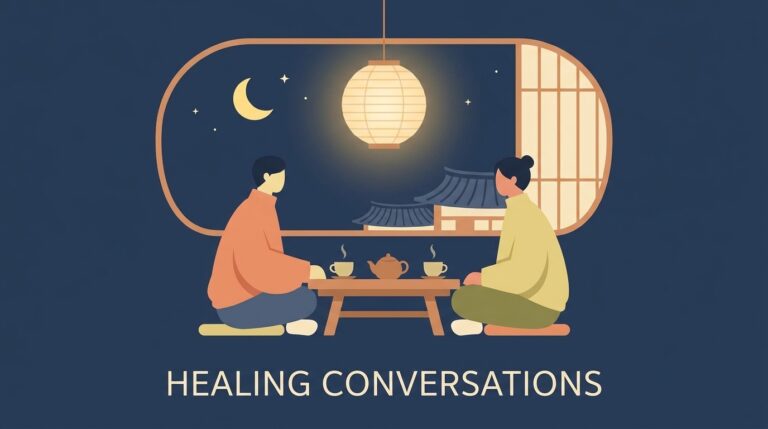
Phase 1: Empathy (Dive into the Moment)
Hello! I’m your Daily Hangul Editor. Imagine watching a K-Drama. The protagonist is sitting at a pojangmacha (street tent) with a friend, pouring a shot of soju, and sighing deeply. The subtitle simply says “I’m having a hard time,” but if you listen closely, there’s so much more weight to it.
For a long time in Korea, mental health (정신 건강) was a taboo subject. Showing emotional struggle was often mistaken for a “lack of willpower.” But today? Thanks to courageous K-Pop idols taking breaks for their well-being and hit healing K-Dramas like Daily Dose of Sunshine, the MZ generation is actively breaking the stigma. Counseling clinics are no longer hidden secrets.
Today, we’re going to learn how Koreans really talk about mental exhaustion, burnout, and seeking help. Because learning Korean isn’t just about ordering coffee—it’s about being that genuine friend who understands the cultural weight behind a sigh.
Phase 2: Core Expressions Deep Dive
1. 마음이 너무 지쳤어요.
- Pronunciation: [ma-eumi neomu jichyeosseoyo] (The ‘eu’ in maeum sounds like the disgusted sound you make when stepping in gum.)
- Meaning: Literal: My mind/heart is too exhausted. / Real nuance: I’m completely emotionally drained.
- K-Culture Moment: In a healing drama, this is the exact phrase the strong, independent main character uses when they finally drop their facade and confess to their best friend or therapist.
- Editor’s Insight: We use ma-eum (마음), which translates to mind, heart, or spirit. In Korea, emotional pain is deeply connected to this ma-eum. It’s softer, more poetic, and less clinical than saying “I’m depressed.”
- Situation Spectrum:
- Casual (Friends): ✅ (Say: 마음이 너무 지쳤어)
- Semi-formal (Co-workers): ⚠️ (Only to close colleagues)
- Formal (Boss/Elders): 🚫
- 🤔 Think About It: Why do Koreans use the word “마음” (heart/mind) to describe both physical exhaustion and emotional depression? What word does your native language use?
2. 저 요즘 번아웃 온 것 같아요.
- Pronunciation: [jeo yojeum beonaut on geot gatayo]
- Meaning: Literal: I think burnout has come to me lately. / Real nuance: I think I’ve hit burnout recently.
- K-Culture Moment: You’ll hear this constantly among young office workers in Gangnam or Yeouido over an iced Americano. It’s the modern Korean worker’s anthem.
- Editor’s Insight: Koreans love adopting English words that perfectly capture modern struggles. “Burnout” is used almost daily in Korea’s fast-paced Ppalli-ppalli (hurry up) society.
- Situation Spectrum:
- Casual (Friends): ✅
- Semi-formal (Co-workers): ✅
- Formal (Boss/Elders): ⚠️
- 🤔 Think About It: “Burnout has come to me” (온 것 같아요). Notice how Koreans often describe emotions as things that arrive from the outside, rather than things they “are”?
3. 상담받는 거 부끄러운 거 아니야.
- Pronunciation: [sangdambanneun geo bukkeureoun geo aniya]
- Meaning: Literal: Receiving counseling is not a shameful thing. / Real nuance: There is no shame in getting therapy.
- K-Culture Moment: This is the ultimate supportive line a true friend drops when someone hesitates to seek professional help due to social stigma.
- Editor’s Insight: The word bukkeureopda (부끄럽다) means shameful or embarrassed. Addressing the “shame” directly is crucial in Korean culture, where worrying about how others view you is deeply ingrained.
- Situation Spectrum:
- Casual (Friends): ✅
- Semi-formal (Co-workers): ⚠️ (Use polite form: 부끄러운 거 아니에요)
- Formal (Boss/Elders): 🚫
- 🤔 Think About It: How does your culture view therapy? Is it considered a routine health check-up, or is there still a lingering stigma like in parts of Korean society?
Phase 3: Textbook vs. Real Korean
[Expressing Extreme Stress]
* 📖 Textbook Korean: 저는 스트레스를 많이 받습니다. (I receive a lot of stress.)
* 🗣️ Real Korean: 나 요즘 완전 멘붕이야. (I’m in a total mental breakdown these days.)
* 💡 Why the difference?: “멘붕” (Men-bung) is a portmanteau of Mental + Collapse. It’s the go-to slang for younger generations when they feel overwhelmed, showing how Koreans love efficient, punchy abbreviations.
[Suggesting Professional Help]
* 📖 Textbook Korean: 정신과 병원에 가보세요. (Please go to a psychiatric hospital.)
* 🗣️ Real Korean: 심리 상담 한번 받아보는 거 어때? (How about trying psychological counseling?)
* 💡 Why the difference?: The word “정신과” (Psychiatric clinic) historically carried a heavy stigma. “심리 상담” (Psychological counseling) feels much softer, like a wellness activity rather than a severe medical emergency.
Bottom Note: For B2 learners, using “심리 상담” (psychological counseling) shows a high level of cultural tact. It proves you understand the delicate nuances of Korean society!
Phase 4: Cultural Context — K-Culture Deep Dive
4-1. Non-verbal elements: The Power of Nunchi
When someone opens up about their mental health, Korean Nunchi (눈치) dictates that you don’t immediately offer toxic positivity. Instead of a loud “Cheer up!” (힘내!), quiet listening, pouring them a drink, or gently handing them a warm cup of tea says a thousand words. Empathy in Korea is often silent and action-oriented.
4-2. K-Pop and Breaking the Stigma
If you’ve been in a K-Pop fandom for a while, you might have seen official agency statements announcing an idol’s temporary hiatus due to “panic disorder” (공황장애) or “anxiety symptoms” (불안 증세). In the past, celebrities hid these issues completely. Now, idols openly prioritizing their mental health has sparked a massive cultural shift. It taught fans that it’s okay to pause when your “멘탈” (mental state) is shaking. Fans now flood comment sections with “건강이 최우선이에요” (Health is the top priority) rather than demanding constant performances.
Phase 5: Real-life Roleplay Scenario
Setting: Friday night, 8 PM. A quiet, dimly lit Izakaya in Yeonnam-dong. You are having highballs with your Korean coworker, Minji, who has been working overtime for three weeks straight.
Characters:
– YOU: A supportive expat colleague who noticed Minji looking pale and exhausted.
– Minji (28): Your hardworking, usually cheerful Korean colleague.
Dialogue:
Minji: 하아… 요즘 진짜 잠을 못 자겠어. 😔
(Haa… yojeum jinjja jameul mot jagesseo.)
[Sigh… I really can’t sleep these days.]
YOU: 민지 씨, 괜찮아요? 안색이 너무 안 좋아요.
(Minji ssi, gwaenchanayo? ansaegi neomu an joayo.)
[Minji, are you okay? You don’t look well at all.]
Minji: 그냥… 마음이 너무 지쳐서 그래. 완전 번아웃 온 것 같아.
(Geunyang… maeumi neomu jichyeoseo geurae. wanjeon beonaut on geot gata.)
[It’s just… my mind is so exhausted. I think I’ve hit a total burnout.]
(🎭 Stage Direction: Minji stirs her drink, avoiding eye contact.)
YOU: 혼자 참지 마요. 심리 상담 한번 받아보는 거 어때요?
(Honja chamji mayo. simni sangdam hanbeon badaboneun geo eottaeyo?)
[Don’t endure it alone. How about trying psychological counseling?]
Minji: 상담? 에이, 내가 무슨 상담을 받아… 남들 시선도 있고.
(Sangdam? ei, naega museun sangdameul bada… namdeul siseondo itgo.)
[Counseling? Oh please, why would I get counseling… what would people think.]
🔀 Your Turn! How should you respond?
– A) “에이, 힘내요! 긍정적으로 생각해요!” (Aw, cheer up! Think positively!)
– B) “요즘 상담받는 거 감기 병원 가는 거랑 똑같아요. 부끄러운 거 아니에요.” (Getting counseling these days is like going to a clinic for a cold. It’s not something to be ashamed of.)
– C) “한국은 왜 이렇게 눈치를 봐요? 그냥 가요!” (Why do Koreans care so much about what others think? Just go!)✅ Best Choice: B — Reason: It directly addresses her fear of social stigma (남들 시선) by normalizing the experience using a widely accepted modern Korean analogy (the common cold).
⚠️ Choice A Analysis: Telling a burnt-out Korean to “Cheer up” (힘내) can severely backfire, making them feel guilty for not being “strong enough.”
Phase 6: 10-Second Shadowing Drill
Speak along with the emotion!
🥺 친근하고 다정하게 (Warmly and affectionately):
상담받는 거 / 절대 / 부끄러운 거 / 아니야!
(sangdambanneun geo / jeoldae / bukkeureoun geo / aniya!)
Phase 7: K-Culture Mini Dictionary
1. 눈치
* Romanization: nunchi
* English: Social awareness / Reading the room
* Context: The quintessential Korean social skill. In mental health, fearing others’ nunchi used to stop people from seeking professional help.
2. 멘탈
* Romanization: mental
* English: Mental state / Emotional resilience
* Context: Adopted from English, Koreans use this daily to describe emotional strength. (e.g., “멘탈이 강하다” = has a strong mentality, “멘탈 털렸다” = mental state is shaken).
3. 번아웃
* Romanization: beonaut
* English: Burnout
* Context: A highly relatable concept in Korea’s fast-paced, highly competitive corporate and academic society.
4. 힐링
* Romanization: hilling
* English: Healing
* Context: Any activity that relieves stress. Going to a cute cafe, listening to a quiet song, or taking a walk in the park is often proudly called “힐링 타임” (healing time).
Phase 8: Traveler’s Survival Kit
Even as a traveler having a great time, you might experience anxiety, panic, or stress-induced headaches in a bustling mega-city like Seoul. Here is your pharmacy survival guide!
🆘 Survival Expression #1
– 🇰🇷 “두통약 / 소화제 주세요.” (dutongnyak / sohwaje juseyo)
– 🗣️ Pronunciation Guide: [doo-tong-nyak / so-hwa-jeh joo-seh-yo]
– 📍 Where to use: 약국 (Yakguk / Pharmacy)
– 💡 Pro Tip: Stress often leads to headaches or indigestion in Korea. Korean pharmacists are brilliant at giving you a customized combo of pills for stress-related physical symptoms!📌 Editor’s Travel Note
– Useful App: “Papago” is essential if you need to explain complex mental or physical symptoms to a pharmacist or doctor.
– Buying Meds Late at Night: Convenience stores (CU, GS25, 7-Eleven) sell basic painkillers like Tylenol late at night when pharmacies are closed. Just look for the “안전상비의약품” (Safe Over-the-Counter Drugs) sign.
– English Clinics: If you face a severe panic attack or need an English-speaking doctor in Seoul, the Itaewon International Clinic is a well-known expat spot.
Phase 9: Critical Thinking Corner — “One Step Deeper”
🧠 Think Deeper: Media vs. Reality
K-Dramas like It’s Okay to Not Be Okay beautifully depict mental health professionals and psychiatric wards as warm, deeply healing spaces. While these dramas have done wonders for destigmatizing mental health globally and locally, a gap with reality remains. In highly competitive corporate environments, many Koreans still hesitate to use their national health insurance for therapy, fearing it might leave a “medical record” that employers could somehow see (though legally, they cannot!). The media shows a fully progressive, open society, but the reality is still in a transitional phase where the older and younger generations clash over the definition of “mental fortitude.”💬 Your Turn: How is mental health portrayed in your country’s media compared to the reality of getting treatment? Share your thoughts in the comments!
Phase 10: FAQ & Mistake Prevention
- “Can I ask my Korean boss if they’ve ever tried therapy?”
Absolutely NOT. While younger friends might openly share their therapy journeys over coffee, asking an elder or a boss about mental health is considered highly invasive and crosses the line of professional respect in Korea. -
“If my favorite K-Pop idol goes on hiatus for anxiety, can I write to them saying I understand?”
Yes! Korean fans often leave supportive, polite messages. A great phrase to use is: “천천히 쉬고 와요” (Take your time resting and come back).
❌ Common Mistake #1: Using the word “정신병” (Mental illness) casually to describe feeling down.
✅ Do This Instead: “정신병” carries a heavy, sometimes derogatory tone in daily chat. Use “마음이 아프다” (the heart/mind is sick) or “번아웃이 왔다” (burnout has arrived) for a much safer, socially acceptable, and respectful approach.
Phase 11: Summary & Action Items
- One-Liner Summary: Korean mental health culture is rapidly evolving from silent endurance to open healing; use “마음이 지쳤어요” and “번아웃” to express your struggles safely and respectfully.
-
Action Mission 3 Steps:
- 🥉 Bronze (Solo): Say “마음이 너무 지쳤어요” in front of the mirror 3 times with a dramatic K-Drama sigh.
- 🥈 Silver (Online): Post a supportive comment on your favorite K-Pop idol’s video using “건강이 최우선이에요!” (Health is the top priority!).
- 🥇 Gold (Real World): Next time your Korean language exchange partner looks exceptionally tired, ask them gently, “요즘 번아웃 온 것 같아요?”
- K-Culture Mission: Watch one episode of a “Healing K-Drama” (like Daily Dose of Sunshine or My Liberation Notes) and observe how the characters use silence, rather than loud cheering, to comfort each other.
Phase 12: Quiz — Interactive Challenge
1. Situational Judgment: Your Korean friend confesses they are feeling totally overwhelmed and want to try counseling. What is the BEST Korean response?
A) “의지력이 부족해서 그래요.” (It’s because you lack willpower.)
B) “상담받는 거 부끄러운 거 아니야. 같이 병원 알아봐 줄까?” (Counseling isn’t shameful. Want me to help you look for a clinic?)
C) “힘내! 술이나 마시자!” (Cheer up! Let’s just drink!)
2. Fill in the Blank: “I’ve been working too much lately. I think I have…”
-> “저 요즘 ( ) 온 것 같아요.”
3. True or False: Mental health counseling is still 100% taboo and never talked about by young Koreans in cafes.
(Scroll down for answers!)
Click to reveal answers
1. B (A is the old toxic stereotype, C dismisses their feelings by just offering alcohol).
2. 번아웃 (Burnout)
3. False. Thanks to K-Pop and media, the MZ generation is actively embracing “심리 상담” (psychological counseling).
Frequently Asked Questions (FAQ)
Q: What does "마음이 너무 지쳤어요." mean in Korean and how do you pronounce it?
A: In Korean, "마음이 너무 지쳤어요." is pronounced [ma-eumi neomu jichyeosseoyo] and means: Literal: My mind/heart is too exhausted. / Real nuance: I'm completely emotionally drained.
Q: What does "저 요즘 번아웃 온 것 같아요." mean in Korean and how do you pronounce it?
A: In Korean, "저 요즘 번아웃 온 것 같아요." is pronounced [jeo yojeum beonaut on geot gatayo] and means: Literal: I think burnout has come to me lately. / Real nuance: I think I've hit burnout recently.
Q: What does "상담받는 거 부끄러운 거 아니야." mean in Korean and how do you pronounce it?
A: In Korean, "상담받는 거 부끄러운 거 아니야." is pronounced [sangdambanneun geo bukkeureoun geo aniya] and means: Literal: Receiving counseling is not a shameful thing. / Real nuance: There is no shame in getting therapy.







