

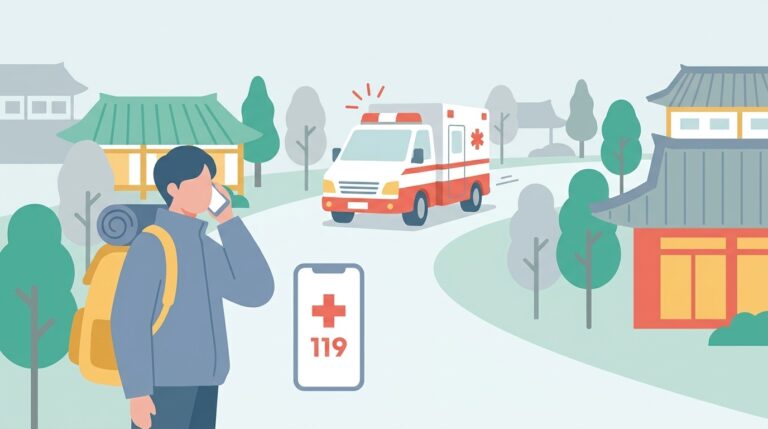
Phase 1: Empathy & Immersion
Greeting! Daily Hangul Editor here.
Imagine this: You are watching an intense medical K-Drama. The lead character is walking down a rainy street in Seoul, and suddenly, someone collapses. The hero dramatically slides to the ground, looks up at the crowd, and screams a rapid-fire phrase. Sirens immediately wail in the background.
Or, picture a more realistic scenario: You’re enjoying late-night street food in Myeongdong, and your friend suddenly has a severe allergic reaction. Panic sets in. Your brain goes blank. You remember how to order a latte, but how on earth do you ask for an ambulance?
In an emergency, you don’t have time to conjugate complex grammar. You need short, sharp survival phrases. This guide is built from the real anxieties of travelers and expats in Korea. We’re going to learn exactly what to say to get help fast—because knowing these words might just save a life.
Phase 2: Core Expressions Deep Dive
1. 구급차 좀 불러주세요. (Please call an ambulance.)
- Pronunciation: gugeupcha jom bulleojuseyo. [goo-goop-cha johm bool-luh-joo-seh-yo]
- Meaning: Literal (Ambulance a little call please) vs Real (Please call an ambulance).
- K-Culture Moment: You’ll hear this exact phrase in almost every K-Drama accident scene. The character usually shouts it while pointing at a specific bystander to snap them out of the shock.
- Editor’s Insight: Gugeupcha means ambulance. But look at the word jom (좀). It literally means ‘a little’. Why add ‘a little’ to an emergency? In Korean, jom softens a command, making it sound more like a plea rather than a bossy order. It’s the secret ingredient to sounding perfectly natural, even when panicking.
- Situation Spectrum:
- Casual (To a friend): ⚠️ (Use ‘불러줘’ instead)
- Semi-formal/Strangers: ✅
- Formal/Elders: ✅
- 🤔 Think About It: Even in a life-or-death situation, Koreans instinctively use polite endings (요 – yo) and softening words (좀 – jom). What does this tell you about the deeply ingrained polite culture in Korea?
2. 119에 신고해 주세요. (Please report it to 119.)
- Pronunciation: il-il-gu-e singohae juseyo. [eel-eel-goo-eh sheen-go-heh joo-seh-yo]
- Meaning: Literal (To 119 report please) vs Real (Please call 119).
- K-Culture Moment: If you watch Korean news, you always hear the term ‘119’ (il-il-gu). In Korea, 119 is for fire and medical emergencies, while 112 is for the police. The ambulances have a very distinct two-tone siren that echoes through the Seoul high-rises.
- Editor’s Insight: Notice that we read the numbers individually: one-one-nine (il-il-gu), not one-nineteen (baek-sip-gu). The verb singohada (to report) is used for calling emergency services.
- Situation Spectrum:
- Casual: ⚠️
- Semi-formal/Strangers: ✅
- Formal/Elders: ✅
- 🤔 Think About It: Is your home country’s emergency number 911, 999, or 112? Memorizing ‘119’ is step one of Korean survival!
3. 사람이 쓰러졌어요! (Someone collapsed!)
- Pronunciation: sarami sseureojyeosseoyo! [sah-rahm-ee sseu-ruh-jyuh-suh-yo]
- Meaning: Literal/Real (A person collapsed!)
- K-Culture Moment: Picture a crowded Seoul subway station. A gasp ripples through the crowd, and someone shouts this phrase. Instantly, people pull out their phones or rush to help.
- Editor’s Insight: Saram means person, and sseureojyeosseoyo means collapsed or fainted. It sounds like a mouthful, but the ‘sseu’ sounds like the hissing noise of a deflating tire. Say it loudly and with urgency!
- Situation Spectrum:
- Casual: ✅
- Semi-formal: ✅
- Formal: ✅
- 🤔 Think About It: Why not say “My friend collapsed”? In emergencies, Koreans tend to state the objective fact (“A person collapsed”) to grab universal attention first.
Phase 3: Textbook vs. Real Korean
[Asking for Medical Help]
* 📖 Textbook Korean: 저는 병원에 가야 합니다. (I must go to the hospital. – Too robotic and slow)
* 🗣️ Real Korean: 119 불러주세요! (Please call 119!)
* 💡 Why the difference?: Textbooks teach you how to calmly explain a schedule. In an emergency, Koreans drop the pronouns (“I”) and use immediate action verbs.
[Expressing Pain]
* 📖 Textbook Korean: 저는 배가 매우 아픕니다. (My stomach aches very much.)
* 🗣️ Real Korean: 아! 너무 아파요! (Ah! It hurts so much!)
* 💡 Why the difference?: Pain is universal. A sharp “Ah!” followed by “apayo” (it hurts) is the fastest way to communicate distress.
Phase 4: Cultural Context — K-Culture Deep Dive
4-1. Non-verbal Communication
When shouting for help in Korea, don’t just yell to the open air. The “Bystander Effect” happens everywhere. Korean CPR training specifically teaches people to point at a specific person: “You, the ajusshi in the blue shirt, call 119!” Also, waving your arms above your head in a big ‘X’ motion is a universally recognized signal for “Stop/Emergency” in Korea.
4-2. K-Travel Link: The ‘Ppalli-Ppalli’ (Hurry Up) Miracle
Korea is famous for its Ppalli-Ppalli (hurry, hurry) culture. This can be stressful when waiting for coffee, but in an emergency? It’s a lifesaver. Korean emergency response times are incredibly fast. If you are a traveler and call 119, they actually have real-time foreign language interpreters on standby. So, don’t be afraid to dial if you need to!
Phase 5: Real-Life Roleplay Scenario
Setting: A Friday night at a bustling Samgyeopsal (Korean BBQ) restaurant in Hongdae. The air is thick with the smell of roasting meat and the chatter of college students. You are having dinner with your Korean friend, Min-su. Suddenly, a customer at the next table grabs his chest and falls over.
Characters:
– YOU: An expat who knows basic Korean, panicking but wanting to help.
– Min-su (28): Your Korean friend.
– Restaurant Owner (Ajumma): Grilling meat nearby.
Dialogue:
Min-su: (Looking shocked) 어? 저 사람 왜 저래?
(eo? jeo saram wae jeorae?)
[Huh? What’s wrong with that guy?]
YOU: 민수야, 사람이 쓰러졌어!
(minsu-ya, sarami sseureojyeosseo!)
[Min-su, someone collapsed!]
Min-su: 어떡해, 어떡해! (Looking around frozen in panic)
(eotteokhae, eotteokhae!)
[What do we do, what do we do!]
YOU: 119에 신고해 줘!
(il-il-gu-e singohae jwo!)
[Call 119!]
(🎭 Stage Direction: You turn to the Restaurant Owner)
🔀 Your Turn! How do you address the owner to ask for an ambulance?
– A) “아줌마! 구급차 좀 불러주세요!” (Ajumma! Please call an ambulance!)
– B) “사장님! 구급차 좀 불러주세요!” (Boss! Please call an ambulance!)
– C) “저기요! 병원에 가야 합니다!” (Excuse me! Must go to hospital!)✅ Best Choice: B — In a restaurant setting, calling the owner ‘Sajang-nim’ (Boss) is the most respectful and effective way to get their attention.
⚠️ Choice A Analysis: ‘Ajumma’ (middle-aged woman) can sometimes sound rude. ‘Sajang-nim’ is always safe and respectful!
Owner: 네! 지금 119 부를게요!
(ne! jigeum il-il-gu bureulgeyo!)
[Yes! I will call 119 right now!]
Phase 6: 10-Second Shadowing Drill
Let’s practice reading these with the right emotion and pauses. Follow the slashes (/) for natural breaks.
- 🚨 긴급하게 (Urgently): 사장님! / 구급차 좀 / 불러주세요! (sajang-nim! / gugeupcha jom / bulleojuseyo!)
- 🚨 단호하게 (Firmly): 여기 / 119에 / 신고해 주세요! (yeogi / il-il-gu-e / singohae juseyo!)
- 😭 다급하게 (Desperately): 도와주세요! / 사람이 / 쓰러졌어요! (dowajuseyo! / sarami / sseureojyeosseoyo!)
Phase 7: K-Culture Mini Dictionary
1. 119
* Romanization: il-il-gu
* English: Emergency Medical & Fire Service
* Context: The most important number in Korea. Do not dial 911!
2. 구급차
* Romanization: gugeupcha
* English: Ambulance
* Context: The word consists of ‘gu’ (rescue), ‘geup’ (urgent), and ‘cha’ (car).
3. 응급실
* Romanization: eunggeupsil
* English: Emergency Room (ER)
* Context: If you take a taxi in an emergency, say “Eunggeupsil gajuseyo” (Take me to the ER).
4. 빨리빨리
* Romanization: ppalli-ppalli
* English: Hurry, hurry
* Context: Korea’s speed-obsessed culture, which becomes a superpower during medical emergencies.
Phase 8: Traveler’s Survival Kit
🆘 Survival Phrases TOP 3
– 🇰🇷 1. “도와주세요!” (dowajuseyo! / Please help!)
– 🇰🇷 2. “여기가 너무 아파요.” (yeogiga neomu apayo. / It hurts a lot right here.)
– 🇰🇷 3. “영어 할 줄 아세요?” (yeongeo hal jul aseyo? / Do you speak English?)
– 📍 Where to use: Anywhere on the street, in a pharmacy (약국), or on the subway.📌 Editor’s Travel Note
– Is the ambulance free? YES! If it’s a genuine medical emergency, calling 119 and riding the ambulance is completely free in South Korea, even for foreigners.
– Interpretation: When you call 119, just say “English please.” They will patch in a 3-way call with a translator immediately.
Phase 9: Critical Thinking Corner — “One Step Deeper”
🧠 Think Deeper: Social Responsibility and “Jeong (정)”
While the ‘bystander effect’ exists globally, Korea has a unique cultural concept called Jeong (정)—a deep sense of collective connection and empathy. Even in massive, bustling cities like Seoul, if someone falls on the street, you will often see strangers instantly rallying together. One person calls 119, another shields the person from traffic, and someone else massages their limbs. Learning how to ask for help in Korean isn’t just about vocabulary; it’s tapping into this communal safety net.
💬 Your Turn: How do strangers react to public emergencies in your home country? Would they hesitate, or jump right in? Let us know in the comments!
Phase 10: FAQ & Mistake Prevention
- Q: Do I really need to use polite forms (요 – yo) in a life-or-death emergency?
- A: Yes and No. Instinctively, dropping the ‘yo’ and screaming “도와줘!” (Help me!) is perfectly fine when you are the victim. However, if you are asking a bystander to call an ambulance, adding the ‘yo’ (불러주세요) secures their cooperation much faster because it shows respect.
- Q: Can I text 119 if I can’t speak?
- A: YES! In Korea, you can send an SMS text message to 119. You can send a picture of the location, or just type “Ambulance please” and your address.
❌ Common Mistake #1: Shouting “911! (Gu-il-il)”
✅ Do this instead: Shouting “119! (Il-il-gu)”. Most Koreans know what 911 means from movies, but in a panic, their brains are wired to hear “119”.
Phase 11: Summary & Action Items
- One-Liner Summary: In a Korean emergency, forget the complex grammar and shout “119 불러주세요!” (Il-il-gu bulleojuseyo!).
-
Action Mission:
- 🥉 Bronze (Solo): Stand in front of your mirror and urgently say “도와주세요!” 3 times.
- 🥈 Silver (Online): Write the number ‘119’ and the word ‘구급차’ in your travel notes app right now.
- 🥇 Gold (K-Culture Mission): Next time you watch a medical or police K-Drama, listen closely for the words il-il-gu or gugeupcha. You’ll notice them everywhere now!
Phase 12: Quiz — Interactive Challenge
1. Situational Judgment: Your friend eats a peanut and can’t breathe. You run to the convenience store clerk. What is the BEST thing to say?
– A) 저는 구급차가 좋아요. (I like ambulances.)
– B) 119에 신고해 주세요! (Please report to 119!)
– C) 경찰을 부르세요! (Call the police!)
2. True or False – K-Culture Edition:
– Calling 119 for an ambulance in an emergency will cost you a very expensive fee in Korea. (T/F)
(Answers: 1. B – ‘A’ means you like them, ‘C’ is for the police which is 112. / 2. False! Emergency ambulances are free in Korea.)
Frequently Asked Questions (FAQ)
Q: What does "구급차 좀 불러주세요. (Please call an ambulance.)" mean in Korean and how do you pronounce it?
A: In Korean, "구급차 좀 불러주세요. (Please call an ambulance.)" is pronounced [gugeupcha jom bulleojuseyo. [goo-goop-cha johm bool-luh-joo-seh-yo] and means: Literal (Ambulance a little call please) vs Real (Please call an ambulance).
Q: What does "119에 신고해 주세요. (Please report it to 119.)" mean in Korean and how do you pronounce it?
A: In Korean, "119에 신고해 주세요. (Please report it to 119.)" is pronounced [il-il-gu-e singohae juseyo. [eel-eel-goo-eh sheen-go-heh joo-seh-yo] and means: Literal (To 119 report please) vs Real (Please call 119).
Q: What does "사람이 쓰러졌어요! (Someone collapsed!)" mean in Korean and how do you pronounce it?
A: In Korean, "사람이 쓰러졌어요! (Someone collapsed!)" is pronounced [sarami sseureojyeosseoyo! [sah-rahm-ee sseu-ruh-jyuh-suh-yo] and means: Literal/Real (A person collapsed!)







