

Phase 1: Empathy (The K-Culture Cold Open)
Hello! I am the Lead Editor of Daily Hangul, your veteran tutor and local Korean culture navigator.
Imagine this: You are in Seoul. The autumn breeze is perfectly chilly, and you are getting ready for a highly anticipated K-Pop concert or a romantic walk along the Han River. You put on your absolute favorite jacket, pull the zipper up, and… Snap. The zipper breaks. It won’t go up, it won’t go down. It’s stuck.
Panic sets in. Are you going to freeze tonight? Do you have to throw the jacket away?
Relax! Korea is the absolute land of convenience. Tucked into almost every residential street is a small, magical place called a 세탁소 (Setakso – Dry Cleaners/Alteration Shop). But how do you ask them to fix it when you only know how to say “Hello” and “Kimchi”?
In today’s lesson, I will teach you the ultimate survival phrases to save your favorite clothes. By the end of this guide, you will be able to walk into any neighborhood Setakso and handle the situation like a true local!
Phase 2: Core Expressions Deep Dive
Here are the only phrases you need to memorize. They are short, sweet, and highly effective for A1 beginners.
1. 지퍼가 고장 났어요 (The zipper is broken)
- Pronunciation: jipeo-ga gojang nasseoyo [ji-puh-gah go-jahng nah-so-yo]
- Tip: ‘jipeo’ sounds almost exactly like the English word ‘zipper’ without the hard ‘r’ at the end.
- Meaning: The zipper is broken.
- K-Culture Moment: You will hear “gojang nasseoyo” (is broken) all the time in Korea! The coffee machine at your office? Gojang nasseoyo. The subway escalator? Gojang nasseoyo.
- Editor’s Insight: You don’t need to explain how it broke. Just point at the zipper with a slightly sad face and say this. The owner will immediately understand your pain.
- Situation Spectrum:
- Casual (Friends): ⚠️ (Friends use “gojang nasseo” without the ‘yo’)
- Semi-formal (Shop owners): ✅ Perfect!
- Formal (Boss): ✅ Polite and clear.
- 🤔 Think About It: In Korean, we say the zipper “broke out” or “occurred a breakdown” (gojang nasseoyo). We focus on the event that happened to the object, rather than who did it. Do you say “I broke it” or “It broke” in your language?
2. 고쳐 주세요 (Please fix it)
- Pronunciation: gochyeo juseyo [go-chuh joo-seh-yo]
- Meaning: Please fix it. (Literal: Fix it and give it to me)
- K-Culture Moment: If you watch K-Dramas, you’ve definitely heard “~juseyo” (please give). Here, you are asking them to give you the favor of fixing it.
- Editor’s Insight: This is a magic formula. [Action] + 주세요(juseyo). It’s polite, respectful, and gets things done.
- Situation Spectrum:
- Casual: ⚠️ (Say “gochyeo jweo” to friends)
- Semi-formal/Formal: ✅ Highly recommended!
- 🤔 Think About It: Why do Koreans use the word “give” (juseyo) when asking for a repair service? It reflects the culture of considering services as favors between humans, not just cold business transactions.
3. 언제 돼요? (When will it be ready?)
- Pronunciation: eonje dwaeyo? [uhn-jeh dweh-yo?]
- Meaning: When can it be done? / When is it ready?
- K-Culture Moment: Koreans love 빨리빨리 (Ppalli-ppalli / hurry hurry) culture. If you drop it off today, there’s a high chance they can fix it by tomorrow!
- Editor’s Insight: This is an incredible A1 survival phrase. You can use it anywhere. Waiting for food? “Eonje dwaeyo?” Waiting for a taxi? “Eonje dwaeyo?”
- Situation Spectrum:
- Casual: ⚠️
- Semi-formal: ✅
- 🤔 Think About It: Notice we don’t say “When will YOU finish it?” We simply ask “When does IT become ready?” Korean often drops the subject (I/You) to sound less aggressive.
Phase 3: Textbook vs. Real Korean
Let’s see how real life differs from your language textbook.
[Explaining the Problem]
* 📖 Textbook Korean: 이 재킷의 지퍼를 수선해 주시겠습니까? (Would you please mend the zipper of this jacket?)
* 🗣️ Real Korean: 사장님, 이거 지퍼 고장 났어요. (Boss, this zipper is broken.)
* 💡 Why the difference?: Calling the shop owner 사장님 (Sajangnim – Boss) is the ultimate friendly icebreaker in Korea. It shows respect and instantly builds rapport!
[Asking for the timeline]
* 📖 Textbook Korean: 수선은 언제 완료됩니까? (When will the alteration be completed?)
* 🗣️ Real Korean: 이거 언제 돼요? (When is this ready?)
* 💡 Why the difference?: Everyday Korean is all about efficiency. Dropping complex words like ‘completed’ and just using ‘dwaeyo’ (become/ready) sounds much more natural.
Phase 4: Cultural Context — K-Culture Deep Dive
4-1. Non-Verbal Communication (The Art of Nunchi)
When you hand your jacket to the Sajangnim (owner), use both hands. In Korea, handing over items (especially to someone older than you) with one hand is considered a bit rude. Also, don’t just toss it on the counter; gently point to the exact broken spot with your whole hand (not just one pointing finger) so they can assess the damage quickly.
4-2. The Magic of the Neighborhood ‘Setakso’
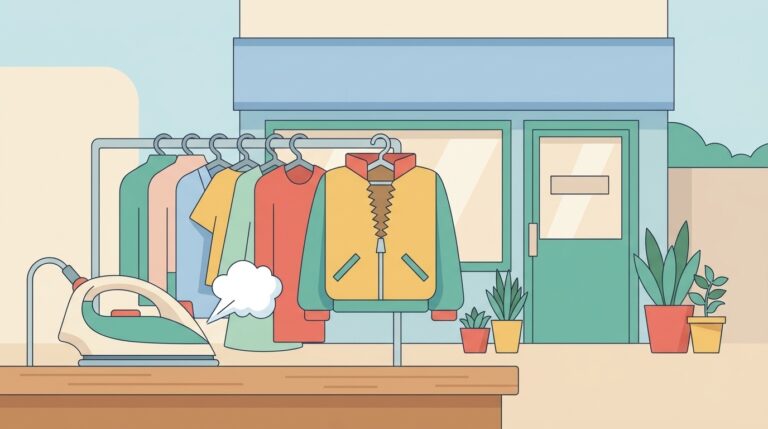
In Korean dramas, you often see characters fighting, gossiping, or falling in love right in front of a neighborhood dry cleaner. Look for signs that say 세탁 (Setak) or have a little steam iron icon. They are usually run by an older couple.
Because of Korea’s amazing Ppalli-ppalli (fast-paced) culture, fixing a zipper or hemming pants is incredibly quick. In many Western countries, this might take a week. In Korea? It might take 24 hours. Sometimes, if you look desperate enough, they might fix it while you wait!
Phase 5: Real-Life Roleplay Scenario
Setting: It’s 10:00 AM. You are in a small, cozy Setakso near your Airbnb in Hongdae. The shop smells like warm steam and fresh laundry. Clothes are hanging everywhere in plastic wrap. Behind the counter is a friendly-looking older man.
Characters:
– YOU: A traveler whose favorite jacket just broke.
– Sajangnim (Owner, 60s): The master of repairs, wearing a tape measure around his neck.
Dialogue:
Sajangnim: 어서 오세요! (eoseo oseyo!)
[English] Welcome!
(🎭 Stage Direction: He looks up from a pair of pants he is ironing.)
YOU: 사장님, 안녕하세요. (sajangnim, annyeonghaseyo.)
[English] Hello, Boss.
Sajangnim: 네, 수선하시게요? (ne, suseon-hasigeyo?)
[English] Yes, do you need an alteration/repair?
YOU: 네. 이거 지퍼가 고장 났어요. (ne. igeo jipeo-ga gojang nasseoyo.)
[English] Yes. This zipper is broken.
(🎭 Stage Direction: You hand the jacket to him with both hands, pointing at the zipper.)
Sajangnim: 아이고, 지퍼가 완전히 나갔네. (aigo, jipeo-ga wanjeonhi naganne.)
[English] Oh my, the zipper is completely gone.
YOU: 고쳐 주세요. 얼마예요? (gochyeo juseyo. eolmayeyo?)
[English] Please fix it. How much is it?
Sajangnim: 만 원이에요. (man won-ieyo.)
[English] It is 10,000 won.
🔀 Your Turn! How do you ask when it will be ready?
– A) 빨리 하세요! (ppalli haseyo! – Hurry up!)
– B) 언제 돼요? (eonje dwaeyo? – When will it be ready?)
– C) 내일? (naeil? – Tomorrow?)✅ Best Choice: B — “언제 돼요?” is the most natural and polite way to ask.
⚠️ Choice A Analysis: NEVER say this! “빨리 하세요” sounds like an angry boss giving an order to an employee. It is extremely rude to an older shop owner.
YOU: 언제 돼요? (eonje dwaeyo?)
[English] When will it be ready?
Sajangnim: 내일 저녁에 오세요. (naeil jeonyeok-e oseyo.)
[English] Come tomorrow evening.
YOU: 네, 감사합니다! (ne, gamsahamnida!)
[English] Yes, thank you!
Phase 6: 10-Second Shadowing Drill
Practice this sentence until it rolls off your tongue! Read aloud and follow the emotional tags.
🥺 사장님, / 이거 / 고쳐 주세요.
(sajangnim, / igeo / gochyeo juseyo.)
(Tone: Slightly helpless, polite, asking for a hero to save you)
🤔 이거 / 언제 / 돼요?
(igeo / eonje / dwaeyo?)
(Tone: Curious, polite, slightly raising the pitch at the end)
Phase 7: K-Culture Mini Dictionary
1. 세탁소 (Setakso)
* Romanization: setakso
* English: Dry cleaners / Alteration shop
* Context: They do everything from dry cleaning winter coats to fixing zippers and shortening jeans.
2. 사장님 (Sajangnim)
* Romanization: sajangnim
* English: Boss / Shop Owner
* Context: You use this to respectfully call the staff or owner in restaurants, cafes, and local shops.
3. 수선 (Suseon)
* Romanization: suseon
* English: Alteration / Repair (for clothes)
* Context: You will often see the word “옷수선” (ot-suseon / clothes repair) printed in big red letters on shop windows.
4. 빨리빨리 (Ppalli-ppalli)
* Romanization: ppalli-ppalli
* English: Hurry, hurry / Quick
* Context: The underlying heartbeat of modern Korean society. Things get done fast here!
Phase 8: Traveler’s Survival Kit
🆘 Survival Phrases for the Setakso
– 🇰🇷 “이거 얼마예요?” (igeo eolmayeyo?) – How much is this?
– 🇰🇷 “내일 올게요.” (naeil olgeyo) – I will come tomorrow.
– 🇰🇷 “영수증 주세요.” (yeongsujeung juseyo) – Receipt, please.📌 Editor’s Travel Note
– Finding a shop: Search “세탁소” or “옷수선” on KakaoMap or Naver Map.
– Cash vs. Card: While Korea is a “card-only” paradise, small, older neighborhood alteration shops sometimes prefer cash or bank transfers (계좌이체) for small repairs like a zipper (usually around 10,000 KRW to 15,000 KRW). It’s always good to carry a 10,000 won bill just in case!
– Tickets: They might give you a small paper ticket. Don’t lose it! You need it to pick up your jacket.
Phase 9: Critical Thinking — “One Step Deeper”
Language & Power: The Culture of ‘Jeong’ (정)
When you ask to fix something in English, it is often a direct command disguised as a polite request (“Please fix this”). But in Korean, we use the verb 주다 (juda – to give), as in gochyeo juseyo (Please give me the fix).
Why? Because Korean language is built on relationships. By asking someone to give you their service, you are acknowledging their skill and asking for a favor. This builds 정 (Jeong)—a unique Korean concept of warmth, connection, and affection. The Setakso owner isn’t just a business person; in that moment, they are the neighborhood elder taking care of your clothes.
💬 Your Turn: Does your language have a way to make a business transaction sound more like a friendly favor? Share in the comments!
Phase 10: FAQ & Avoiding Mistakes
Q: Can I just say “고쳐 (gochyeo)” without “주세요 (juseyo)”?
No! Dropping “주세요” makes it Banmal (casual/informal language). If you say “gochyeo” to an older shop owner, they will be very shocked and might think you are incredibly rude.
Q: Can I negotiate the price here like in traditional markets?
Usually, no. The prices for repairs are quite standard and already very affordable. Just pay the requested amount with a smile!
❌ Common Mistake #1: Leaving the shop without asking when to pick it up.
✅ Do this instead: Always ask “언제 돼요? (eonje dwaeyo?)” before you walk out the door!
Phase 11: Summary & Action Items
One-Liner Summary: If your zipper breaks, find a Setakso, point to the problem, and politely say: “사장님, 지퍼 고장 났어요. 고쳐 주세요!”
Your Mission for Today:
– 🥉 Bronze (Solo): Stand in front of your mirror, hold a jacket, and say “igeo jipeoga gojang nasseoyo” 3 times out loud.
– 🥈 Silver (Online): Find your favorite jacket in your closet. Take a photo, post it on your social media or our community, and caption it: “If this breaks in Seoul, I know what to say! #DailyHangul”
– 🥇 Gold (Action): Open Naver Map or Google Maps, type in “세탁소”, and see how many pop up around your favorite neighborhood in Seoul!
K-Culture Mission:
The next time you watch a K-Drama, look at the backgrounds when characters are walking through narrow neighborhood streets. I guarantee you will spot a dry cleaner sign (세탁) within the first 3 episodes!
Phase 12: Quiz — Interactive Challenge
1. Situational Judgment:
You walk into a repair shop. How should you get the owner’s attention politely?
* A) “Hello!”
* B) “야! (Ya!)”
* C) “사장님! (Sajangnim!)”
(Answer: C. Calling them ‘Sajangnim’ is polite and standard.)
2. Fill in the Blank:
사장님, 이거 지퍼 ________ 났어요. 고쳐 ________. (Boss, this zipper is broken. Please fix it.)
(Answer: 고장 (gojang), 주세요 (juseyo))
3. True or False – K-Culture Edition:
In a small Korean neighborhood repair shop, it’s always best to pay with a high-limit credit card even if the repair is only $5.
(Answer: False. While cards are accepted almost everywhere, small local shops deeply appreciate cash for very small amounts!)
Frequently Asked Questions (FAQ)
Q: What does "지퍼가 고장 났어요 (The zipper is broken)" mean in Korean and how do you pronounce it?
A: In Korean, "지퍼가 고장 났어요 (The zipper is broken)" is pronounced [jipeo-ga gojang nasseoyo [ji-puh-gah go-jahng nah-so-yo] and means: a key conversational Korean expression covered in this lesson.
Q: What does "고쳐 주세요 (Please fix it)" mean in Korean and how do you pronounce it?
A: In Korean, "고쳐 주세요 (Please fix it)" is pronounced [gochyeo juseyo [go-chuh joo-seh-yo] and means: Please fix it. (Literal: Fix it and give it to me)
Q: What does "언제 돼요? (When will it be ready?)" mean in Korean and how do you pronounce it?
A: In Korean, "언제 돼요? (When will it be ready?)" is pronounced [eonje dwaeyo? [uhn-jeh dweh-yo?] and means: When can it be done? / When is it ready?







