

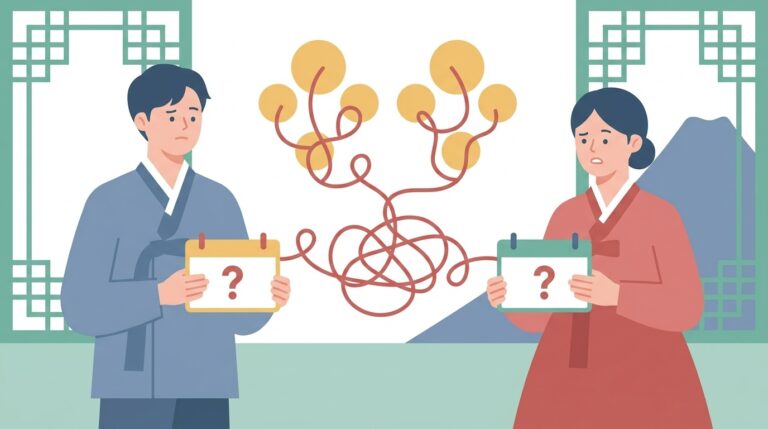
Phase 1: Empathy (The Social GPS of Korea)
Hello! I’m the Senior Editor of Daily Hangul.
Imagine this: You are watching a K-Drama. The main characters are sitting at a Pocha (tent bar), taking shots of Soju. Suddenly, one glares at the other and shouts, ‘How old are you?!’ (몇 살이야?!). The subtitles might say something simple, but the tension is thick enough to cut with a knife. Why? Because in Korea, age is not just a number—it is your social GPS.
If you have ever met Koreans, you know they will ask your age within five minutes of meeting you. But sometimes, even after asking, things get confusing. You hear them say, ‘Oh, I am an early 93, so I am friends with 92s…’ And suddenly, everyone is scratching their heads figuring out who is the ‘Hyung’ (older brother) and who is the ‘Dongsaeng’ (younger sibling).
We call this 족보 꼬임 (Jokbo Kkoim – Tangled Family Tree). It happens because of the 빠른 년생 (Ppareun Nyeonsaeng – Early Birth Year) system. If you do not understand this, you might accidentally disrespect someone or feel left out of the group dynamic. But once you get it? You will instantly upgrade from ‘a foreigner who speaks Korean’ to an absolute Insider. Let’s untangle this web together!
Phase 2: Core Expressions Deep Dive
1. 몇 년생이세요?
- Pronunciation: myeon nyeonsaeng-iseyo? [Sounds like: myeon-nyeon-saeng-ee-se-yo?]
- Meaning: What year were you born? (Literal: What birth year are you?)
- K-Culture Moment: You will hear this at college orientation parties or office dinners. Instead of asking ‘How old are you?’ (which changes depending on the calendar), Koreans prefer asking the birth year. It is the most bulletproof way to establish the hierarchy!
- Editor’s Insight: Think of this as scanning a barcode. You are not asking for a number; you are asking for their social category.
- Situation Spectrum:
- Casual (Friends): ✅ (Usually dropped to ‘몇 년생이야?’)
- Semi-formal (Co-workers): ✅
- Formal (Bosses/Elders): ⚠️ (Use with caution; usually you don’t ask elders their age directly.)
- 🤔 Think About It: Why do Koreans need to know your exact birth year right away? How does knowing someone’s age change the way you speak in your native language?
2. 저 빠른 OO년생이에요.
- Pronunciation: jeo ppareun OO(gong-gong)-nyeonsaeng-ieyo. [Sounds like: jo ppa-reun OO-nyun-saeng-ee-eh-yo.]
- Meaning: I have an early birth year (born in Jan/Feb of that year).
- K-Culture Moment: In K-Pop groups, this is the ultimate source of playful arguments! A member born in January 1995 might insist that a member born in December 1994 treats them as a ‘same-age friend’ because they went to school together.
- Editor’s Insight: Until 2009, the Korean school year started in March. So, babies born in Jan/Feb went to school with kids born the previous year. If someone says ‘I am an early 94’, it means they function socially as a 93!
- Situation Spectrum:
- Casual (Friends): ✅
- Semi-formal (Co-workers): ✅
- Formal (Bosses/Elders): 🚫 (Elders don’t care about this technicality!)
- 🤔 Think About It: Does your culture have any unique rules about school grades and age?
3. 우리 그냥 족보 꼬이니까 친구 해요.
- Pronunciation: uri geunyang jokbo kkoinikka chingu haeyo.
- Meaning: Our age hierarchy is getting tangled, so let’s just be friends.
- K-Culture Moment: You are at a language exchange café. You find out you are a 95, but the other person is an ‘early 96’. Technically they are younger, but they went to school with 95s. To avoid awkwardness, someone will suggest this phrase to wipe the slate clean.
- Editor’s Insight: ‘Jokbo’ means family genealogy book. Saying ‘the Jokbo is tangled’ is a witty way to say ‘this age math is too complicated, let’s just be casual.’ It shows great Nunchi (social tact).
- Situation Spectrum:
- Casual (Friends): ✅
- Semi-formal (Co-workers): ⚠️ (Only if you are close!)
- Formal (Bosses/Elders): 🚫
- 🤔 Think About It: Why is it so important to establish who is a ‘friend’ (chingu) in Korea? (Hint: ‘Friend’ in Korean strictly means ‘someone of the exact same age’!).
Phase 3: Textbook vs. Real Korean
[Figuring Out Age]
* 📖 Textbook: 나이가 어떻게 되세요? (How old are you?)
* 🗣️ Real Korean: 몇 년생이세요? (What year were you born?)
* 💡 Why the difference?: Due to the traditional ‘Korean Age’ (which made everyone 1 year older on Jan 1st), asking for the birth year became the only mathematically accurate way to sort out the hierarchy.
[Suggesting to Drop the Formalities]
* 📖 Textbook: 우리 친하게 지냅시다. (Let us get along well.)
* 🗣️ Real Korean: 그냥 말 놓을까요? / 친구 하자! (Shall we drop the honorifics? / Let’s be friends!)
* 💡 Why the difference?: ‘Dropping the words’ (말을 놓다) means switching from formal to casual speech (Banmal). It is a major milestone in Korean relationships!
Bottom Note: For B1 learners, using ‘몇 년생이세요?’ is the safest and most natural way to sound like a local without being overly casual.
Phase 4: Cultural Context — K-Culture Deep Dive
4-1. Non-verbal Elements: The Art of Nunchi
When someone explains they are a ‘Ppareun’ (early) birth year, do not just nod! Lean in slightly and go, ‘Ah~ (아~)’ with a tone of realization. This shows you possess Nunchi (the ability to read the room). Also, when asking someone’s age for the first time, avoid aggressive eye contact. A slight head nod makes the question feel polite rather than interrogative.
4-2. K-Pop Connection: The Jokbo Breakers
If you are a K-Pop fan, you have definitely seen the ‘Jokbo Breaker’ dynamic. Idols who are born early in the year often cause hilarious confusion in the group. For example, if Idol A is born in Jan 1997, Idol B is born in Dec 1996, and Idol C is born in Dec 1997. Idol A acts like a friend to B, but demands Idol C calls them ‘Hyung/Unni’!
Fans love analyzing these dynamics. When attending a fan meeting or writing a fan letter, you can use this to your advantage. If you are older than the idol, you can playfully write, ‘내가 누나지만 빠른 년생이니까 친구 할까?’ (I am older, but since I am an early birth year, shall we be friends?). It shows you deeply understand their culture!
Phase 5: Real-life Roleplay Scenario
Setting: Friday night, 7 PM. A lively Korean BBQ restaurant in Gangnam. Smoke fills the air, and Soju bottles line the table. You are out with your Korean language exchange group.
Characters:
– YOU: A B1-level Korean learner, born in January 1994.
– Minsu (29): A friendly Korean guy, born in 1993.
– Jiwon (28): A bright Korean girl, born in 1994.
Dialogue:
Minsu: 지원 씨는 몇 년생이에요? 🥩
(jiwon ssineun myeon nyeonsaeng-ieyo?)
[What year were you born, Jiwon?]
(🎭 Stage Direction: Minsu flips the pork belly with tongs)
Jiwon: 아, 저는 94년생이에요! 민수 씨는요?
(a, jeoneun gusa-nyeonsaeng-ieyo! minsu ssineunyo?)
[Ah, I am a 94! What about you, Minsu?]
Minsu: 저는 93년생이에요. 제가 오빠네요! 하하. YOU 씨는요?
(jeoneun gusam-nyeonsaeng-ieyo. jaega oppaneyo! haha. YOU ssineunyo?)
[I am a 93. I guess I am the older brother! Haha. How about YOU?]
🔀 Your Turn! How should you respond?
– A) 저는 94년생이에요. 지원 씨랑 동갑이네요.
– B) 저는 빠른 94년생이에요. 그래서 민수 씨랑 친구예요!
– C) 나이 비밀이에요!✅ Best Choice: B — Reason: Since you are born in January 1994, you are a ‘Ppareun 94’. In the Korean school system, you would be in the same grade as Minsu (1993). Claiming your ‘Ppareun’ status makes you look like an absolute cultural genius!
⚠️ Choice A Analysis: It is not wrong, but you lose the chance to flex your K-Culture knowledge.
Minsu: 오, 진짜요? 그럼 우리 말 놓을까요?
(o, jinjjayo? geureom uri mal noeulkkayo?)
[Oh, really? Then shall we drop the honorifics?]
YOU: 네, 좋아요! 지원 씨, 족보 꼬였지만 우리 그냥 다 같이 친구 해요!
(ne, joayo! jiwon ssi, jokbo kkoyeotjiman uri geunyang da gachi chingu haeyo!)
[Yes, sounds good! Jiwon, the family tree is tangled, but let’s all just be friends!]
Jiwon: 대박! YOU 씨 한국 패치 완벽하네요!
(daebak! YOU ssi hanguk paechi wanbeokaneyo!)
[Awesome! YOU’s ‘Korean patch’ (localization) is perfect!]
Phase 6: 10-Second Shadowing Drill
Practice this sentence to sound like a native trying to solve an age puzzle!
😊 아! / 저는 / 빠른 93년생이라서 / 92년생이랑 / 친구예요!
(a! / jeo-neun / ppa-reun gusam-nyeonsaeng-i-raseo / gu-i-nyeonsaeng-i-rang / chin-gu-ye-yo!)
Tone Check: Say it brightly with a little ‘Ah!’ of realization at the beginning, bouncing slightly on ‘Ppa-reun’.
Phase 7: K-Culture Mini Dictionary
1. 족보 (Jokbo)
* Romanization: jokbo
* English: Genealogy book / Family tree
* Context: Originally a book recording a clan’s history. Slang-wise, it refers to the social hierarchy among friends or colleagues based on age.
2. 빠른 년생 (Ppareun nyeonsaeng)
* Romanization: ppareun nyeonsaeng
* English: Early birth year
* Context: People born in January or February who entered school a year early. The ultimate disruptors of the Korean age hierarchy!
3. 눈치 (Nunchi)
* Romanization: nunchi
* English: Social sense / Reading the room
* Context: The vital Korean skill of sensing others’ moods and figuring out complex social dynamics (like age differences) without being explicitly told.
4. 회식 (Hoesik)
* Romanization: hoesik
* English: Company dinner / Group gathering
* Context: The prime battleground where titles, ages, and ‘Jokbo’ are finally sorted out over grilled meat and drinks.
Phase 8: Traveler Survival Kit
Even as a traveler, you will encounter the age question—especially if you stay at guesthouses, join tours, or go to language exchange meetups!
🆘 Survival Phrases for Socializing
– 🇰🇷 ‘몇 년생이세요?’ (myeon nyeonsaeng-iseyo?) – What year are you?
– 🇰🇷 ‘저는 OO년생이에요.’ (jeo-neun OO-nyeonsaeng-ieyo.) – I was born in OO.
– 🇰🇷 ‘그냥 편하게 부르세요.’ (geunyang pyeonhage bureuseyo.) – Just call me comfortably. (A polite way to avoid age drama!)📌 Editor’s Travel Note
– The Foreigner Free Pass: As a foreigner, Koreans will often give you a ‘pass’ on strict age rules. However, if you initiate the ‘Ppareun’ or ‘Jokbo’ conversation, they will be deeply impressed and treat you like a close local friend.
– Numbers: Make sure you know how to read your birth year in Sino-Korean numbers (e.g., 1995 = Cheon-gu-baek-gu-sip-o).
Phase 9: Critical Thinking Corner — ‘One Step Deeper’
Language & Power: The Architecture of Korean Society
🧠 Think Deeper:
Have you ever wondered why Korean language has such complex honorifics (Jondaemal) and casual speech (Banmal)? In Korea, language is a direct reflection of power and social relationships. Finding out someone’s exact age is not just small talk; it is the process of building the social architecture. The ‘Ppareun’ birth year causes a ‘glitch’ in this matrix because it forces a choice: Do we respect biological age, or do we respect the social grade level? By agreeing to ‘just be friends’ (족보 꼬이니까 친구 해요), Koreans are actively negotiating power and choosing equality over hierarchy.💬 Your Turn: Does your language change depending on the age of the person you are talking to? Share your thoughts in the comments!
Phase 10: FAQ & Avoiding Mistakes
Q: Is it rude to ask ‘몇 년생이세요?’ right after meeting someone?
Yes and No. In a business meeting with clients? Wait a bit. At a casual meetup, a university club, or a social drinking setting? It is perfectly fine and expected within the first 10 minutes.
Q: I am a foreigner. Do I really need to follow the ‘Ppareun’ rule?
Not at all! Foreigners are usually exempt from this complex math. But if you playfully claim ‘저 빠른 98년생이에요’ (I am an early 98), you will instantly break the ice and make everyone laugh.
❌ Common Mistake #1: Calling someone ‘친구’ (friend) just because you get along well.
✅ Do This Instead: In Korean, ‘친구’ strictly means ‘same age’. If they are older but friendly, use ‘친한 형/누나’ (close older brother/sister) or say ‘친하게 지내요’ (we are close).
Phase 11: Summary & Action Items
- One-Liner Summary: The ‘Early Birth Year’ (Ppareun) creates a tangled hierarchy (Jokbo Kkoim), but navigating it with phrases like ‘몇 년생이세요?’ turns you into a cultural insider!
-
Action Mission 3 Steps:
- 🥉 Bronze (Solo): Find out how to say your exact birth year in Korean out loud.
- 🥈 Silver (Online): Comment your birth year in Korean below! (e.g., 저 95년생이에요!)
- 🥇 Gold (Real-world): Next time you meet a Korean friend, ask them: ‘혹시 빠른 년생이세요?’ and watch their jaw drop.
- K-Culture Mission: Watch an episode of a K-Drama like Reply 1988 or Hospital Playlist and try to catch the moment characters argue about their age or birth year!
Phase 12: Quiz — Interactive Challenge
1. Situational Judgment:
You just found out the Korean person you met was born in February 1994, and you were born in August 1993. They went to school with the 93s. What is the most culturally ‘insider’ way to handle this?
* A) Insist they call you older brother/sister.
* B) Say: ‘우리 족보 꼬이니까 그냥 친구 해요!’
* C) Ignore them.
2. True or False — K-Culture Edition:
* ‘In Korea, the word 친구 (Chingu) can be used for anyone you are close to, regardless of age.’ (T/F)
(Answers: 1. B – Acknowledging the tangled Jokbo and suggesting friendship is the smoothest move! / 2. False – Chingu is strictly for people of the exact same social age!)
Frequently Asked Questions (FAQ)
Q: What does "몇 년생이세요?" mean in Korean and how do you pronounce it?
A: In Korean, "몇 년생이세요?" is pronounced [myeon nyeonsaeng-iseyo? [Sounds like: myeon-nyeon-saeng-ee-se-yo?] and means: What year were you born? (Literal: What birth year are you?)
Q: What does "저 빠른 OO년생이에요." mean in Korean and how do you pronounce it?
A: In Korean, "저 빠른 OO년생이에요." is pronounced [jeo ppareun OO(gong-gong] and means: I have an early birth year (born in Jan/Feb of that year).
Q: What does "우리 그냥 족보 꼬이니까 친구 해요." mean in Korean and how do you pronounce it?
A: In Korean, "우리 그냥 족보 꼬이니까 친구 해요." is pronounced [uri geunyang jokbo kkoinikka chingu haeyo.] and means: Our age hierarchy is getting tangled, so let's just be friends.







