

Phase 1: Empathy
Hello! I’m your Daily Hangul editor.
Imagine this: You turn on the TV in Korea around late January or early February. Every news channel is showing helicopters hovering over endless lines of cars on the highway. Or maybe you go to Seoul Station to grab a quick coffee, and it looks like a scene from a zombie movie—but instead of zombies, it’s millions of people carrying gift boxes of Spam and premium Korean beef. Welcome to the Great Korean Migration known as Seollal (Korean Lunar New Year)!
During Seollal, nearly half the country travels back to their hometowns (고향 가기). Trains sell out in exactly 3 minutes. The highways become giant parking lots. But if you know how to navigate this season and throw in a few authentic Korean holiday phrases, your Korean friends will be deeply impressed.
This guide is built from the exact panic moments my beginner students face every Seollal. Let’s make you look like a local who truly understands the magic of the Korean holidays!
Phase 2: Deep Dive into Key Expressions
1. 고향에 가요. (I’m going to my hometown.)
- Pronunciation: go-hyang-e ga-yo. (‘hyang’ sounds like ‘hyang’ but say it smoothly)
- Meaning: Literal: I go to hometown. / Real nuance: I’m heading back to visit my parents for the holidays.
- K-Culture Moment: You’ll hear this constantly in the office the week before Seollal. Everyone asks each other, “Are you going to your hometown?”
- Editor’s Insight: ‘고향’ (gohyang) technically means hometown, but in Korea, it carries a warm, emotional weight. It means returning to your roots, your family, and your mom’s cooking.
- Situation Spectrum:
- Friends (Casual): ✅ (Change to: 고향 가? – gohyang ga?)
- Co-workers (Semi-formal): ✅
- Boss/Elders (Formal): ✅ (Add ‘시’ to be super polite: 고향에 가세요? – gohyang-e gaseyo?)
- 🤔 Think About It: Why does almost everyone in Seoul leave the city during Seollal? What does this say about the importance of family roots in Korean society?
2. 새해 복 많이 받으세요! (Happy New Year!)
- Pronunciation: sae-hae bok ma-ni ba-deu-se-yo!
- Sound Guide: ‘으 (eu)’ sounds like the disgusted sound you make when you step in gum!
- Meaning: Literal: Please receive a lot of New Year’s luck/blessings. / Real nuance: Happy New Year!
- K-Culture Moment: Idols shouting this at the end of their Seollal greeting videos on YouTube, usually wearing beautiful Hanbok (traditional Korean clothes).
- Editor’s Insight: Koreans say this twice a year! Once on January 1st (Solar), and again on Seollal (Lunar). You literally cannot over-use this phrase during the holiday season.
- Situation Spectrum:
- Friends (Casual): ✅ (You can just say: 새해 복 많이 받아! – saehae bok mani bada!)
- Co-workers (Semi-formal): ✅
- Boss/Elders (Formal): ✅
- 🤔 Think About It: In English, we say “Happy” New Year. In Korean, we say “Receive a lot of blessings/luck.” How does this reflect the Korean cultural view on fortune?
3. 표 있어요? (Do you have tickets? / Are there tickets?)
- Pronunciation: pyo i-sseo-yo?
- Meaning: Literal: Ticket exists? / Real nuance: Do you have a ticket? OR Are there any tickets left?
- K-Culture Moment: The dreaded “Ticketing War” (티켓팅). People use the exact same survival skills to buy Seollal KTX train tickets as they do to buy BTS concert tickets. It’s a bloodbath.
- Editor’s Insight: Because Korean often drops the subject (I/You/It), ‘표 있어요?’ can mean both “Did you manage to get a ticket?” and asking a teller “Are there any tickets left?”
- Situation Spectrum:
- Friends (Casual): ✅ (표 있어? – pyo isseo?)
- Co-workers (Semi-formal): ✅
- Boss/Elders (Formal): ⚠️ (Better to say: 기차표 예매하셨어요? – Did you book your train ticket?)
- 🤔 Think About It: Why do Koreans love the word “War” (전쟁) for daily tasks, like “Ticketing War” or “Commute War”?
Phase 3: Textbook vs Real Korean
[Talking about going home]
* 📖 Textbook Korean: 저는 고향에 방문합니다. (jeoneun gohyang-e bangmunhamnida.)
* 🗣️ Real Korean: 저 이번에 본가 가요. (jeo ibeone bonga gayo.)
* 💡 Why the difference?: Young people living in Seoul often use “본가” (bonga – main/parents’ house) instead of “고향” (gohyang) because they feel like Seoul is their actual home now.
[Holiday Greetings]
* 📖 Textbook Korean: 즐거운 명절 보내시길 바랍니다. (jeulgeoun myeongjeol bonaesigil baramnida.)
* 🗣️ Real Korean: 연휴 잘 쉬세요! (yeonhyu jal swiseyo! – Have a good rest over the holiday!)
* 💡 Why the difference?: Holidays can be stressful with family duties. Wishing someone a “good rest” shows deep empathy for modern workers.
Phase 4: Cultural Context — K-Culture Deep Dive
4-1. Non-verbal Elements
When saying “새해 복 많이 받으세요!” (Happy New Year), don’t just stand straight. Give a polite nod or a slight bow. If you are doing the formal “Sebae” (traditional New Year’s bow) to elders on the floor, you hold your hands together.
4-2. K-Travel & K-Food Connection: The Highway Rest Area (휴게소)
If you are traveling by bus or car to a hometown, you MUST stop at a Korean Highway Rest Area (휴게소 – hyugeso). It’s not just a place for the bathroom; it’s a food paradise!
In K-Dramas and variety shows, you’ll see celebrities eating Sotteok-sotteok (소떡소떡)—a skewer of alternating sausages and rice cakes. During the Seollal traffic jam, stopping for hot walnuts cakes (호두과자 – hodugwaja) and a bowl of hot udon is the ultimate K-Travel experience.
Phase 5: Real-life Roleplay Scenario
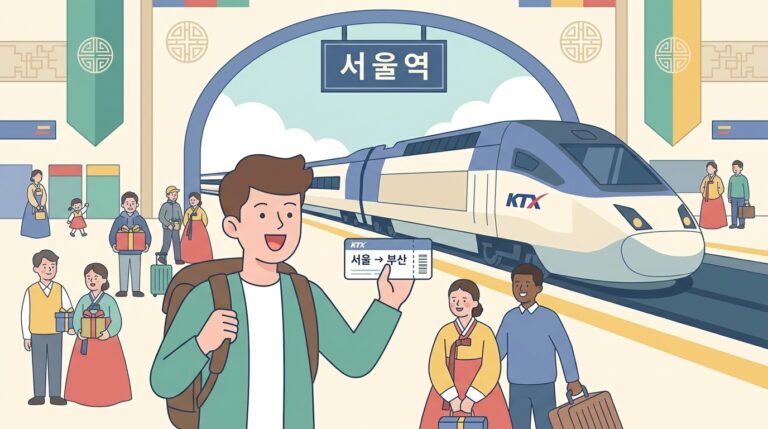
Setting: Seoul Station, Friday evening right before Seollal. It is packed. People are carrying wrapped boxes of fruits and Spam. You are standing near the ticket gates with your Korean co-worker.
Characters:
– YOU: A beginner in Korean, experiencing the Seollal rush for the first time.
– Min-su: (30s) Your friendly Korean co-worker who is trying to get back to Busan.
Dialogue:
Min-su: 와, 서울역에 사람 진짜 많네요! 🤯
(Wa, seoulyeoge saram jinjja manneyo!)
[Wow, there are really a lot of people at Seoul Station!]
YOU: 네, 처음 봐요. 다들 고향에 가요?
(Ne, cheoeum bwayo. Dadeul gohyang-e gayo?)
[Yes, it’s my first time seeing this. Is everyone going to their hometowns?]
Min-su: 맞아요. 설날이니까요. 기차표 있어요?
(Majayo. Seollarinikkayo. Gichapyo isseoyo?)
[That’s right. Because it’s Seollal. Do you have a train ticket?]
YOU: 네, 예매했어요. 민수 씨는요?
(Ne, yemaehaesseoyo. Minsu ssineunyo?)
[Yes, I booked it. How about you, Min-su?]
Min-su: 저도요! 티켓팅 진짜 힘들었어요.
(Jeodoyo! Tiketting jinjja himdeureosseoyo.)
[Me too! The ticketing (war) was really hard.]
(🎭 Stage Direction: Min-su wipes fake sweat from his forehead)
YOU: 다행이네요. 부산에 가요?
(Dahaeng-ineyo. Busan-e gayo?)
[That’s a relief. Are you going to Busan?]
Min-su: 네, 본가 가요. 가서 떡국 많이 먹을 거예요.
(Ne, bonga gayo. Gaseo tteokguk mani meogeul geo-yeyo.)
[Yes, I’m going to my parents’ house. I’m going to eat a lot of tteokguk (rice cake soup) there.]
YOU: 떡국이요? 맛있는 음식이에요?
(Tteokgugiyo? Masinneun eumsigieyo?)
[Tteokguk? Is it a delicious food?]
Min-su: 네! 근데 한국에서는 떡국을 먹으면 한 살 더 먹어요.
(Ne! Geunde hangugeseoneun tteokgugeul meogeumyeon han sal deo meogeoyo.)
[Yes! But in Korea, if you eat tteokguk, you gain one year of age.]
YOU: 헉! 그럼 저는 안 먹을래요! 😂
(Heok! Geureom jeoneun an meogeullaeyo!)
[Gasp! Then I won’t eat it!]
🔀 Your Turn! Min-su’s train is arriving. What should you say to say goodbye?
– A) 안녕히 가세요! (Annyeonghi gaseyo! – Goodbye!)
– B) 새해 복 많이 받으세요! (Saehae bok mani badeuseyo! – Happy New Year!)
– C) 수고하세요! (Sugohaseyo! – Keep up the good work!)✅ Best Choice: B! While A is also correct, B is the absolute perfect holiday greeting to say before parting ways during Seollal.
⚠️ Choice C Analysis: Never say ‘수고하세요’ to someone going to rest for the holidays. It implies they have more work to do!
Bonus K-Culture Scenario: At the Highway Rest Area
(You finally made it to a rest area, but the menu is overwhelming!)
YOU: 이거 얼마예요? (igeo eolmayeyo? – How much is this?)
Staff: 사천 원입니다. (Sacheon won-imnida. – It’s 4,000 won.)
YOU: 소떡소떡 하나 주세요. (Sotteok-sotteok hana juseyo. – One Sotteok-sotteok, please.)
Staff: 케첩 뿌려 드릴까요? (Kecheop ppuryeo deurilkkayo? – Shall I sprinkle ketchup on it?)
YOU: 네, 많이 주세요! (Ne, mani juseyo! – Yes, please give me a lot!)
Phase 6: 10-Second Shadowing Drill
Let’s practice the most important phrase. Read out loud and follow the slashes for pausing!
😊 새해 복 / 많이 / 받으세요!
(sae-hae bok / ma-ni / ba-deu-se-yo!)
Emotion: Bright, warm, and smiling! Remember the ‘eu’ sound!
😢 아, / 기차표 / 없어요?
(Ah, / gichapyo / eopseoyo?)
Emotion: Sad and panicked because the tickets are sold out!
Phase 7: K-Culture Mini Dictionary
1. 귀성길
* Romanization: gwiseong-gil
* English: Journey to one’s hometown
* Context: The agonizingly long drive or train ride back to the hometown during major holidays.
2. 본가
* Romanization: bonga
* English: Main house / Parents’ house
* Context: Used by young adults living independently to refer to the home where their parents live.
3. 티켓팅
* Romanization: tiketting
* English: Ticketing (war)
* Context: The intense, competitive process of booking tickets online. It requires multiple monitors, super-fast internet, and lightning reflexes.
4. 떡국
* Romanization: tteokguk
* English: Rice cake soup
* Context: The traditional Seollal dish. The long white rice cakes symbolize a long, pure life.
Phase 8: Traveler Survival Kit
If you are traveling in Korea during Seollal, you absolutely need these phrases!
🆘 Survival Phrases TOP 3
– 🇰🇷 “부산행 기차표 있어요?” (Busanhaeng gichapyo isseoyo?)
– 🗣️ English: Do you have train tickets to Busan?
– 📍 Where to use: Seoul Station, Bus Terminals
- 🇰🇷 “여기 화장실 어디예요?” (Yeogi hwajangsil eodiyeyo?)
- 🗣️ English: Where is the restroom here?
- 📍 Where to use: Highway rest areas (crucial during traffic jams!)
🇰🇷 “와이파이 비밀번호 뭐예요?” (Waipai bimilbeonho mwoyeyo?)
- 🗣️ English: What is the Wi-Fi password?
- 📍 Where to use: Cafes while waiting for your delayed train.
📌 Editor’s Travel Note
– Apps to use: KORAIL Talk (for trains), Kakao T (for taxis/buses). Naver Map is your best friend.
– Holiday Closures: Many restaurants and shops close on the actual day of Seollal. Always check Naver Maps for operating hours!
– Traffic Warning: A drive from Seoul to Busan usually takes 4 hours. During Seollal? It can take 8 to 10 hours. Take the KTX if possible!
Phase 9: Critical Thinking Corner — “A Step Deeper”
Food & Identity: The Magic of Tteokguk
In Korea, you don’t age on your birthday; traditionally, everyone ages together on January 1st. However, the cultural symbol of gaining that year of age is eating Tteokguk (떡국) on Seollal. If you ask a child, “How many bowls of Tteokguk have you eaten?” you are actually asking their age! Sharing this soup from a giant pot with the whole extended family reinforces the deep Korean identity of ‘우리’ (We/Us) over ‘나’ (I/Me). It’s not just a meal; it’s a shared milestone of growing older together.
💬 Your Turn: Does your culture have a specific food that is tied to growing older or celebrating a new year? Let me know in the comments!
Phase 10: FAQ & Avoiding Misunderstandings
Q: “Can I say ‘새해 복 많이 받으세요’ to my boss?”
– Yes! It is the most universally polite greeting. You can say it to your boss, your teacher, your friend, and the convenience store clerk.
Q: “Are shops really closed during Seollal?”
– Maybe. Big malls and convenience stores are usually open. However, small local restaurants often close for 2-3 days to visit their own hometowns.
❌ Common Mistake #1: Saying “Happy Birthday” instead of “Happy New Year” because you heard eating Tteokguk makes you a year older.
✅ Do this instead: Just stick to “새해 복 많이 받으세요!”❌ Common Mistake #2: Buying train tickets at the station on the day of Seollal.
✅ Do this instead: Train tickets open for booking about a month in advance, and they sell out in minutes. You MUST book online in advance!
Phase 11: Summary & Action Items
- One-Liner Summary: Survive the Seollal migration by mastering basic travel questions and throwing out the ultimate “새해 복 많이 받으세요!” greeting.
-
Action Mission:
- 🥉 Bronze (Solo): Stand in front of a mirror, bow slightly, and say “새해 복 많이 받으세요!” 3 times.
- 🥈 Silver (Online): Go to your favorite K-Pop idol’s Instagram or Weverse and comment: “새해 복 많이 받으세요! 💖”
- 🥇 Gold (Real-world): If you are in Korea, say this greeting to the cashier at the cafe or convenience store!
- K-Culture Mission: Search for “Korean Highway Rest Area Food” (휴게소 음식) on YouTube and pick one street food you want to try during your next Korean road trip!
Phase 12: Quiz — Interactive Challenge
1. Situational Judgment:
You are leaving the office on the Friday before Seollal. Your Korean boss is walking out with you. What is the BEST thing to say?
– A) 안녕! (Annyeong!)
– B) 고향에 가요! (Gohyang-e gayo!)
– C) 새해 복 많이 받으세요! (Saehae bok mani badeuseyo!)
2. True or False — K-Culture Edition:
In Korea, eating “Tteokguk” (Rice cake soup) on Seollal symbolically makes you one year younger. (T/F)
3. Fill in the Blank:
To ask “Do you have tickets?” at the bus terminal, you say: “[ ] 있어요? (isseoyo?)”
👀 Click here for Answers!
- C (A is too casual for a boss. B means “I am going to my hometown” which is okay to say, but C is the perfect holiday send-off!)
- False (Eating it makes you one year OLDER!)
- 표 (pyo)
Frequently Asked Questions (FAQ)
Q: What does "고향에 가요. (I'm going to my hometown.)" mean in Korean and how do you pronounce it?
A: In Korean, "고향에 가요. (I'm going to my hometown.)" is pronounced [go-hyang-e ga-yo. ('hyang' sounds like 'hyang' but say it smoothly] and means: Literal: I go to hometown. / Real nuance: I'm heading back to visit my parents for the holidays.
Q: What does "새해 복 많이 받으세요! (Happy New Year!)" mean in Korean and how do you pronounce it?
A: In Korean, "새해 복 많이 받으세요! (Happy New Year!)" is pronounced [sae-hae bok ma-ni ba-deu-se-yo!] and means: a key conversational Korean expression covered in this lesson.
Q: What does "표 있어요? (Do you have tickets? / Are there tickets?)" mean in Korean and how do you pronounce it?
A: In Korean, "표 있어요? (Do you have tickets? / Are there tickets?)" is pronounced [pyo i-sseo-yo?] and means: Literal: Ticket exists? / Real nuance: Do you have a ticket? OR Are there any tickets left?






