

Phase 1: Empathy & K-Culture Cold Open
Hello! I am your lead editor at Daily Hangul, your veteran tutor and local culture navigator.
Picture this: You are watching a classic K-Drama. The main character wakes up with a terrible hangover. Their sweet roommate or partner is in the kitchen, cracking an egg into a sizzling pan. They ask a simple question, and the protagonist answers with a tired, cute voice.
Or maybe you are at a bustling Bunsikjeom (Korean snack shop) in Seoul, ordering Kimchi Fried Rice. The Imo-nim (auntie) behind the counter shouts a two-syllable word at you holding a spatula. You freeze. She’s asking about the egg, but what did she say?
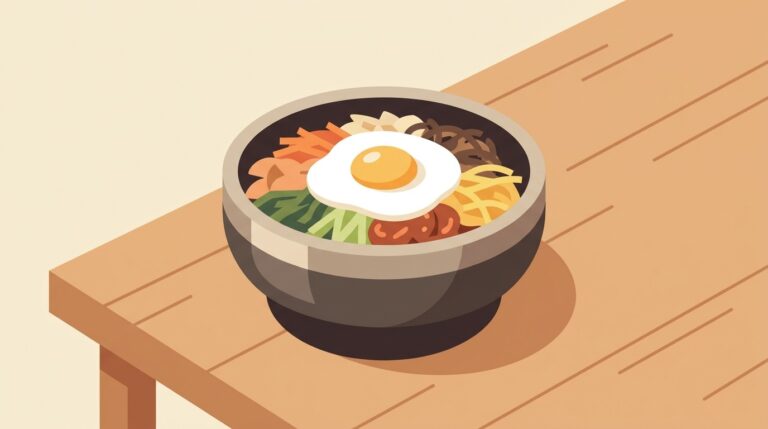
In Korean food culture, a fried egg (계란 프라이 – gyeran peuray) is not just breakfast. It is the glorious crown jewel of Bibimbap, Ramyeon, and Fried Rice. If you don’t know how to order your egg, you might end up with a fully cooked yolk when you were dreaming of that perfect, runny yolk to mix into your spicy rice.
Don’t worry! This guide is based on real moments my beginner students faced in Korea. Let’s make sure you get your perfect K-Egg every time!
Phase 2: Core Expressions Deep Dive
Here are the absolute must-know words when dealing with fried eggs in Korea.
1. 반숙
- Pronunciation: [ban-suk] (Sounds like “ban” + “sook” rhyming with ‘book’)
- Meaning: Sunny-side up / Soft-boiled / Half-cooked
- K-Culture Moment: You order spicy Bibimbap. You absolutely need bansuk so the creamy yolk balances the spicy Gochujang (red pepper paste). This is the default favorite for most young Koreans!
- Editor’s Insight: The word literally means “half” (반 – ban) “cooked” (숙 – suk). It feels trendy and specific. When you confidently order “반숙으로 주세요” (bansuk-euro juseyo – Make it sunny-side up, please), the restaurant owner will immediately think, “Ah, this foreigner knows how to eat!”
- Situation Spectrum:
- Friends (Casual): ✅
- Co-workers (Semi-formal): ✅
- Elders/Boss (Formal): ✅ (Just add “주세요” at the end!)
- 🤔 Think About It: Why is a runny yolk so popular in Korean cuisine? Think about how many Korean dishes are spicy and served boiling hot. How might a soft yolk help your stomach?
2. 완숙
- Pronunciation: [wan-suk] (Sounds like “wan” rhyming with ‘swan’ + “sook”)
- Meaning: Hard-boiled / Well-done / Fully cooked
- K-Culture Moment: If you are packing a lunchbox (Dosirak) for a picnic at the Han River, wansuk is the safe choice so it doesn’t spill!
- Editor’s Insight: “완” (wan) means “complete.” If you hate runny eggs, this is your survival word.
- Situation Spectrum:
- Friends (Casual): ✅
- Co-workers (Semi-formal): ✅
- Elders/Boss (Formal): ✅
- 🤔 Think About It: In your home country, do people have specific words for every style of egg (over-easy, poached, scrambled)? In Korea, bansuk and wansuk cover almost 90% of situations!
3. 뒤집다
- Pronunciation: [dwi-jip-da] (Sounds like “dwee” + “jeep” + “da”)
- Meaning: To flip over
- K-Culture Moment: You are cooking an egg for a friend, but wait… this word is also the most important word at a Korean BBQ! The moment the pork belly sizzles, your Korean boss might yell, “뒤집어!” (Dwi-ji-beo! – Flip it!).
- Editor’s Insight: It’s an action word. You’ll hear it constantly in kitchens, BBQ joints, and even in K-Pop songs when they talk about “flipping the world upside down.”
- Situation Spectrum:
- Friends (Casual): ✅ (뒤집어! – Dwi-ji-beo!)
- Co-workers (Semi-formal): ⚠️ (Use 뒤집으세요 – Dwi-ji-beu-se-yo)
- Elders/Boss (Formal): 🚫 (Let them flip their own meat/egg!)
- 🤔 Think About It: Cooking in Korea is highly communal. Everyone watches the pan together. Do you usually cook together at the table in your culture?
Phase 3: Textbook vs. Real Korean
[Situation 1: Asking how they want their egg]
* 📖 Textbook Korean: 계란을 어떻게 요리해 드릴까요? (gye-ran-eul eo-tteo-ke yo-ri-hae deu-ril-kka-yo? – How shall I cook the egg for you?)
* 🗣️ Real Korean: 계란, 반숙? 완숙? (gye-ran, ban-suk? wan-suk? – Egg, half-cooked or fully-cooked?)
* 💡 Why is it different?: Koreans love the “Pali-Pali” (hurry hurry) culture. Why use a 13-syllable sentence when 5 syllables get the job done perfectly?
[Situation 2: Telling someone you are making an egg]
* 📖 Textbook Korean: 저는 지금 계란을 튀기고 있습니다. (jeo-neun ji-geum gye-ran-eul twi-gi-go it-seum-ni-da – I am deep-frying the egg now. Note: 튀기다 means deep-fry!)
* 🗣️ Real Korean: 나 계란 프라이 할게. (na gye-ran peu-ra-i hal-ge – I’ll make a fried egg.)
* 💡 Why is it different?: Koreans adopted the English word “fry” specifically for eggs. “계란 프라이” (gyeran peuray) is used as a noun, meaning “a fried egg.”
Phase 4: Cultural Context — K-Culture Deep Dive
4-1. Non-Verbal Nunchi (눈치) in Cooking
When someone asks you how you want your egg, don’t take 5 minutes to decide. In a fast-paced Korean diner, Nunchi (reading the room) dictates that you answer quickly. Just smile, hold up one finger, and say “반숙 하나요!” (Bansuk hana-yo! – One half-cooked!).
4-2. The K-Food Connection
Why do Koreans love adding a fried egg on top of everything?
In the past, eggs were an expensive luxury in Korea. Putting a perfectly fried egg on top of a bowl of Jjajangmyeon (black bean noodles) or Kimchi Bokkeumbap was a sign of wealth and care. Even today, if a restaurant owner sneaks an extra fried egg onto your plate, it is the ultimate expression of Jeong (정 – warmth/affection). It means they like you!
Phase 5: Real-Life Roleplay Scenario
Setting: Saturday afternoon. You are at your Korean friend Minsu’s apartment. He is making his famous Kimchi Fried Rice for you. The spicy smell fills the kitchen.
Characters:
– YOU: A beginner Korean learner, super hungry.
– Minsu (30): Your friendly Korean buddy who takes cooking very seriously.
Dialogue:
Minsu: 와, 냄새 대박이지?
(wa, naem-sae dae-ba-gi-ji?)
[Wow, smells amazing, right?]
YOU: 네! 진짜 맛있겠어요.
(ne! jin-jja ma-sit-ge-sseo-yo.)
[Yes! It looks really delicious.]
Minsu: 잠깐만. 계란 프라이 올려야지.
(jam-kkan-man. gye-ran peu-ra-i ol-lyeo-ya-ji.)
[Wait. I have to put a fried egg on top.]
(🎭 Stage Direction: Minsu grabs an egg and a frying pan)
Minsu: 너 반숙? 완숙?
(neo ban-suk? wan-suk?)
[You want it half-cooked or fully-cooked?]
🔀 Your Turn! How should you reply?
– A) “저는 반숙으로 해 주세요!” (jeo-neun ban-suk-euro hae ju-se-yo! – Please make mine half-cooked!)
– B) “계란을 튀겨주세요.” (gye-ran-eul twi-gyeo-ju-se-yo. – Please deep-fry the egg.)
– C) “아무거나.” (a-mu-geo-na – Whatever.)✅ Best Choice: A — It uses the exact vocabulary naturally and politely.
⚠️ Choice B & C Analysis: B means you want him to deep-fry the egg in a pot of boiling oil! C (Whatever) can sound a bit rude or indifferent if you aren’t super close friends.
YOU: 저는 반숙으로 해 주세요!
(jeo-neun ban-suk-euro hae ju-se-yo!)
[Please make mine half-cooked!]
Minsu: 오케이! 반숙이 진짜 맛있지.
(o-ke-i! ban-su-gi jin-jja ma-sit-ji.)
[Okay! Half-cooked is the best, indeed.]
YOU: 노른자 터뜨려서 비벼 먹을게요.
(no-reun-ja teo-tteu-ryeo-seo bi-byeo meo-geul-ge-yo.)
[I’ll pop the yolk and mix it in.]
Minsu: 와… 한국 사람 다 됐네!
(wa… han-guk sa-ram da dwaen-ne!)
[Wow… You’ve basically become Korean!]
Phase 6: 10-Second Shadowing Drill
Practice this sentence to sound like a local ordering at a restaurant. Follow the slashes for pausing!
😊 이모! / 여기 / 계란 프라이 / 반숙으로 / 하나 추가요!
(i-mo! / yeo-gi / gye-ran peu-ra-i / ban-su-geu-ro / ha-na chu-ga-yo!)
[Auntie! / Here / Fried egg / Sunny-side up / One added please!]
Phase 7: K-Culture Mini Dictionary
1. 계란 프라이 (gyeran peuray)
* English: Fried egg
* Context: A perfect example of “Konglish” (Korean-English). We don’t say “fried egg,” we just say “egg fry.”
2. 노른자 (noreunja)
* English: Egg yolk
* Context: The golden center. Koreans also use this word in real estate to mean “the best, most central location” (노른자 땅 – yolk land).
3. 이모 (imo)
* English: Aunt (Mother’s sister) / Polite term for female restaurant workers
* Context: Used to affectionately call female servers in casual restaurants.
4. 비벼 먹다 (bibyeo meokda)
* English: To mix and eat
* Context: The core action of eating Bibimbap or a fried egg on rice.
Phase 8: Traveler’s Survival Kit
If you visit a Korean diner (Bunsikjeom) or a meat restaurant, you need these phrases:
🆘 Survival Phrase #1
– 🇰🇷 “계란 프라이 하나 추가해 주세요.” (gye-ran peu-ra-i ha-na chu-ga-hae ju-se-yo)
– 🗣️ English: “Please add one fried egg.”
– 📍 Where to use: Diners, Kimchi stew restaurants.
– 💡 Pro Tip: Sometimes an extra egg costs 1,000 KRW, but sometimes it’s free!📌 Editor’s Travel Note
– Self-Serve Eggs: Some casual cafeterias in Korea have a “Self-Bar” where you can fry your own eggs for free! If you see a portable stove and a carton of eggs, go ahead and practice your dwi-jip-da (flipping) skills!
– Tipping: Remember, there is NO tipping in Korea. Giving the Imo extra money for a good egg will only confuse her.
Phase 9: Critical Thinking — “One Step Deeper”
Food & Identity: The Magic of Sharing
Why do Koreans care so much about your egg preference? In Korean culture, eating is rarely a solitary act; it is communal. Asking “Do you like bansuk or wansuk?” before cooking is a micro-expression of care and empathy. It shows that they are paying attention to your personal tastes to ensure you enjoy the meal. Furthermore, giving someone the perfect bansuk egg is a modern gesture of Jeong (정) — the unique Korean concept of invisible affection and bonding.
💬 Your Turn: In your culture, what is a simple food gesture that shows someone cares about you? Tell us in the comments!
Phase 10: FAQ & Avoiding Mistakes
- Q: Can I use “Bansuk/Wansuk” for steak?
- No! These words are strictly for boiled or fried eggs (and sometimes potatoes/sweet potatoes). For meat, use English words: “레어 (Rare), 미디엄 (Medium), 웰던 (Well-done).”
- Q: Can I ask for an egg in a fancy restaurant by yelling “Imo!”?
- No. “Imo” is only for casual diners, tents (Pojangmacha), and BBQ places. In a nice cafe or hotel, say “저기요” (Jeogiyo – Excuse me) or “사장님” (Sajangnim – Boss/Manager).
❌ Common Mistake #1: Translating “fry” directly to “튀기다” (twi-gi-da).
✅ Do This Instead: Always use “계란 프라이 하다” (gyeran peuray hada). “튀기다” means deep-frying in massive oil, like fried chicken!
Phase 11: Summary & Action Items
- One-Liner Summary: To master the Korean fried egg, remember Bansuk (half-cooked), Wansuk (fully-cooked), and Gyeran Peuray (fried egg)!
-
Action Mission:
- 🥉 Bronze (Solo): Stand in your kitchen, crack an egg, and declare: “나 계란 프라이 할게!” (I will fry an egg!)
- 🥈 Silver (Online): Post a picture of your breakfast egg on social media with the hashtag #Bansuk or #Wansuk.
- 🥇 Gold (Real Life): Next time you are at a Korean restaurant, ask the server: “계란 프라이 추가되나요?” (Can I add a fried egg?)
- K-Culture Mission: Watch a Mukbang (eating show) on YouTube featuring Kimchi Fried Rice or Jjajangmyeon. Listen carefully to see if they mention Bansuk!
Phase 12: Interactive Challenge Quiz
1. You are making Bibimbap and want the yolk to be soft and runny. What should you ask for?
A) 완숙 (Wansuk)
B) 반숙 (Bansuk)
C) 튀김 (Twigim)
(Answer: B! A runny yolk makes Bibimbap delicious.)
2. True or False: You should say “계란을 튀겨주세요” if you want a fried egg.
(Answer: False! That means “deep-fry my egg.” Say “계란 프라이 해 주세요” instead.)
3. Fill in the Blank:
“Oh no, the bottom of the egg is burning! Quick, _____!” (Flip it!)
A) 완숙해!
B) 뒤집어! (Dwi-ji-beo!)
C) 아무거나!
(Answer: B!)
Frequently Asked Questions (FAQ)
Q: What does "반숙" mean in Korean and how do you pronounce it?
A: In Korean, "반숙" is pronounced [ban-suk] and means: Sunny-side up / Soft-boiled / Half-cooked
Q: What does "완숙" mean in Korean and how do you pronounce it?
A: In Korean, "완숙" is pronounced [wan-suk] and means: Hard-boiled / Well-done / Fully cooked
Q: What does "뒤집다" mean in Korean and how do you pronounce it?
A: In Korean, "뒤집다" is pronounced [dwi-jip-da] and means: To flip over






