

Hello! I’m the Lead Editor of Daily Hangul.
Have you ever watched a K-Drama—perhaps something like Parasite or Queen of Tears—and noticed how the ridiculously wealthy characters always live in hyper-minimalist, concrete-and-glass mansions? There’s hardly any furniture, just a vast expanse of empty space and maybe one dramatically placed piece of modern art. Meanwhile, the struggling protagonists live in cozy, cramped rooftop apartments (옥탑방) or tiny one-room (원룸) studios where every square inch is utilized with puzzle-like precision.
This isn’t just an aesthetic choice by directors. In a hyper-dense, bustling metropolis like Seoul, space is the ultimate luxury.
At the C2 level, you already know words like ‘방’ (room) or ‘넓다’ (wide). But to truly engage in conversations with locals—whether you’re sipping a flat white in a brutalist cafe in Seongsu-dong or discussing K-Architecture trends—you need the sophisticated vocabulary that Koreans use to describe spatial perception and efficiency.
Let’s dive into the architectural zeitgeist of modern Korea and learn how to talk about space like a true Seoulite!
Phase 2: Core Expressions Deep Dive
1. 개방감 (A Sense of Openness)
- Pronunciation: [gaebang-gam] — Think of the ‘gae’ as in ‘gap’, ‘bang’ like a door slamming, and ‘gam’ like ‘calm’.
- Meaning: Literal: ‘Feeling of opening.’ Real nuance: The sense of spaciousness, unobstructed views, or airiness in a room.
- K-Culture Moment: You walk into a massive, converted-warehouse cafe in Jeju Island. The ceiling is three stories high, and there’s a floor-to-ceiling glass wall looking out at the ocean. Your Korean friend looks around, inhales deeply, and says, “와, 여기 개방감 장난 아니다!” (Wow, the sense of openness here is no joke!)
- Editor’s Insight: The suffix ‘-감’ (gam) means ‘feeling’ or ‘sense’ (like 자신감 – confidence). Koreans use ‘개방감’ heavily in real estate and interior design to describe spaces that make you feel liberated from the cramped city outside.
- Situation Spectrum:
- Casual friends: ✅ (개방감 미쳤다!)
- Professional / Colleagues: ✅ (이 공간은 개방감이 훌륭하네요.)
- Formal / Elders: ✅ (개방감이 좋아서 답답하지 않습니다.)
- 🤔 Think About It: Why do you think ‘개방감’ is such a heavily marketed feature in Korean apartments? Does your native language have a single noun that perfectly captures ‘the feeling of wide-open spatial freedom’?
2. 동선 (Circulation / Flow of Movement)
- Pronunciation: [dongseon] — ‘Dong’ sounds like ‘dongle’, ‘seon’ sounds like ‘sun’.
- Meaning: Literal: ‘Moving line.’ Real nuance: The physical path people take through a space; spatial flow.
- K-Culture Moment: In a chaotic K-Food restaurant kitchen (think of a scene from Jinny’s Kitchen), the head chef might yell because the kitchen layout is causing servers and cooks to bump into each other: “아, 주방 동선 꼬이잖아!” (Ah, the kitchen movement flow is getting tangled!)
- Editor’s Insight: This is a crucial word for efficiency. Whether it’s an architect designing a house or a manager organizing a K-Pop idol’s fan-meeting queue, ‘동선이 좋다’ (the flow is good) or ‘동선이 낭비된다’ (the flow is wasted) is the ultimate metric of spatial efficiency.
- Situation Spectrum:
- Casual friends: ✅
- Professional / Colleagues: ✅
- Formal / Elders: ✅
- 🤔 Think About It: Koreans love efficiency (‘빨리빨리’ culture). How does the concept of ‘동선’ perfectly marry the idea of architectural design with the cultural desire for speed and zero-wasted effort?
3. 여백의 미 (The Beauty of Emptiness)
- Pronunciation: [yeobaegui mi] — ‘Yeo-baek’ (empty space) + ‘ui’ (of) + ‘mi’ (beauty).
- Meaning: The aesthetic value of leaving spaces empty; traditional Korean minimalism.
- K-Culture Moment: An RM (BTS) vlog where he visits a minimalist art gallery or a traditional Hanok. There is just one simple wooden table in a large, white-walled room. This isn’t ‘empty’—it’s intentional.
- Editor’s Insight: Before Western ‘minimalism’ became a trend, Korea had ‘여백의 미’. It comes from traditional East Asian ink wash paintings, where the unpainted white paper is just as important as the ink. It implies breathing room for the mind.
- Situation Spectrum:
- Casual friends: ⚠️ (Can sound a bit pretentious or poetic for a casual chat, unless used playfully.)
- Professional / Colleagues: ✅ (Great for design critiques.)
- Formal / Elders: ✅
- 🤔 Think About It: Western minimalism often focuses on ‘decluttering’ (getting rid of things). Korean ‘여백의 미’ focuses on ‘honoring the empty space’. What is the philosophical difference here?
Phase 3: Textbook vs. Real Korean
[Describing Efficient Use of a Small Space]
* 📖 Textbook Korean: 공간을 아주 효율적으로 사용했습니다. (The space was used very efficiently.)
* 🗣️ Real Korean: 죽은 공간(데드 스페이스)을 기가 막히게 살렸네요. (They amazingly revived the dead space.)
* 💡 Why the difference?: Koreans frequently adopt the English term ‘dead space’ (데드 스페이스) or translate it directly to ‘죽은 공간’. ‘살리다’ (to save/revive) gives it an active, dramatic flair common in modern interior design reviews.
[Praising High Ceilings in a Cafe]
* 📖 Textbook Korean: 천장이 높아서 방이 넓어 보입니다. (The ceiling is high, so the room looks wide.)
* 🗣️ Real Korean: 층고가 높아서 탁 트인 느낌이에요. (The floor height is high, so it has a wide-open feeling.)
* 💡 Why the difference?: Architecture buffs and real estate savvy locals use ‘층고’ (floor-to-ceiling height) rather than just ‘천장’ (ceiling). ‘탁 트이다’ visually expresses a space completely free of visual obstacles.
[Commenting on Minimalist Decor]
* 📖 Textbook Korean: 물건이 없고 단순해서 좋습니다. (It’s good because there are no items and it’s simple.)
* 🗣️ Real Korean: 미니멀리즘의 정석이네요. 군더더기가 하나도 없어요. (It’s the textbook definition of minimalism. There’s zero unnecessary clutter.)
* 💡 Why the difference?: ‘군더더기’ means useless additions or clutter. Saying something has ‘no gundeodeogi’ is the highest compliment for minimalist efficiency.
Phase 4: Cultural Context — K-Culture Deep Dive
4-1. Non-Verbal Cues: The ‘Gaze of Appreciation’
When complimenting the spatial design of a place in Korea, do not just stare directly at the person you are talking to. Koreans visually validate the space. Look up at the ceiling, trace the ‘동선’ (path) with your eyes, nod slowly, and then make eye contact to deliver your praise. It shows you are actively experiencing the architecture, not just throwing out empty compliments.
4-2. K-Culture Connection: Cafe Architecture as a Destination
In Korea, especially in areas like Seongsu-dong (often called the Brooklyn of Seoul) or the outskirts of Gyeonggi-do, a cafe is not just a place that sells coffee; it is a meticulously curated spatial experience.
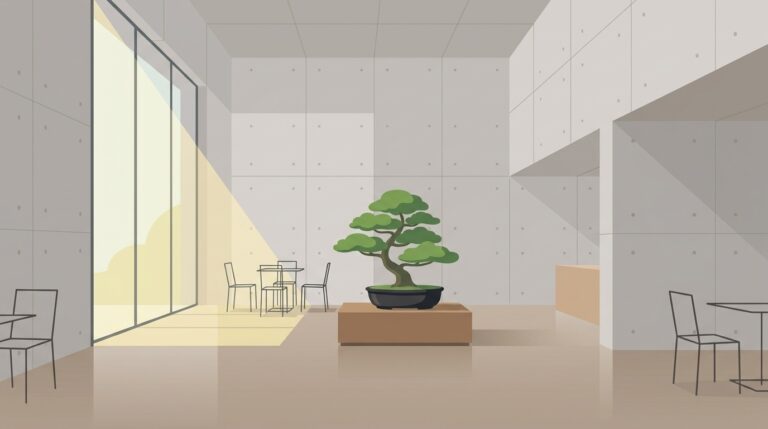
- The Trend: Industrial Brutalism meets Zen. You will often see exposed concrete walls, steel fixtures, and intentionally uncomfortable low tables, juxtaposed with a single, perfectly manicured pine tree or a rock garden.
- The Critical View: Why this extreme minimalism? In a society plagued by sensory overload, neon signs, high-pressure jobs, and cluttered tiny apartments, ‘empty space’ provides intense psychological relief. When you visit these cafes, pay attention to the 동선 (how they force you to walk a certain way to view art) and the 개방감 (massive glass windows to counter the feeling of being trapped in a concrete jungle).
Phase 5: Real-World Roleplay Scenario
Scenario A: The Seongsu-dong Cafe Critique
- Setting: Saturday afternoon, 2 PM. You and your Korean friend are visiting a highly anticipated newly opened cafe in Seongsu-dong. It used to be an old shoe factory. Now, it’s a massive, stark-naked concrete space with exactly three tables and an art installation in the center.
- Characters:
- YOU: An advanced Korean learner with an eye for architecture and design.
- Ji-hoon (30): Your trendy, design-conscious local friend who found this spot on Instagram.
Ji-hoon: 야, 여기 진짜 핫플이래. 주말이라 웨이팅 길 줄 알았는데 다행이다.
(Ya, yeogi jinjja hatpeurirae. Jumalira weiting gil jul aranneunde dahaeng-ida.)
[Hey, they say this place is a total hotspot. I thought the wait would be long since it’s the weekend, but thank goodness.]
YOU: 공간이 생각보다 훨씬 넓네. 기존 공장 뼈대를 그대로 살렸구나.
(Gong-gani saenggakboda hwolssin neomne. Gijon gongjang ppyeodaereul geudaero sallyeotguna.)
[The space is much wider than I thought. They preserved the original factory framework as it is.]
Ji-hoon: 응, 맞아. 근데 테이블이 몇 개 없네? 사장님이 돈 벌 생각이 없나 봐. 😅
(Eung, maja. Geunde teibeuri myeot gae eomne? Sajangnimi don beol saenggagi eomna bwa.)
[Yeah, right. But there are barely any tables? I guess the owner has no intention of making money.]
🔀 Your Turn! How should you respond like an architecture critic?
– A) 공간이 너무 텅 비어있네요. (The space is too empty.)
– B) 일부러 여백의 미를 강조한 것 같아. 층고가 높아서 개방감도 장난 아니고.
– C) 동선이 너무 안 좋아요. (The movement flow is too bad.)✅ Best Choice: B — “I think they intentionally emphasized the beauty of emptiness. Plus, the high ceilings give an incredible sense of openness.” This perfectly utilizes advanced spatial vocabulary. It shows you understand the intent of the minimalist design.
⚠️ Choice A & C Analysis: ‘A’ sounds a bit literal and misses the artistic intent. ‘C’ is incorrect contextually because with fewer tables, the flow (동선) is actually probably very free and unobstructed, not bad.
(Continuing with Choice B)
YOU: 일부러 여백의 미를 강조한 것 같아. 층고가 높아서 개방감도 장난 아니고.
(Ilbureo yeobaegui mireul gangjohan geot gata. Cheunggoga nopaseo gaebang-gamdo jangnan anigo.)
[I think they intentionally emphasized the beauty of emptiness. Plus, the high ceilings give an incredible sense of openness.]
Ji-hoon: 오, 너 한국어 표현력 뭐야? 건축가인 줄! 맞아, 서울 한복판에 이런 탁 트인 공간이 귀하잖아.
(O, neo hangugeo pyohyeollyeok mwoya? Geonchukgain jul! Maja, seoul hanbokpane ireon tak teuin gong-gani gwihajana.)
[Oh, what’s up with your Korean expressiveness? Thought you were an architect! You’re right, such wide-open spaces in the middle of Seoul are rare.]
YOU: 게다가 주문 카운터랑 좌석 사이 동선도 아주 깔끔해.
(Gedaga jumun kounteorang jwaseok sai dongseondo aju kkalkkeumhae.)
[Plus, the circulation flow between the order counter and the seating is very clean.]
Scenario B: Bonus Roleplay (K-Pop V-Live Dorm Tour)
(You are watching your favorite idol’s live stream. They just moved out of their crowded dorm into their own solo apartment. It has almost nothing in it.)
Idol: 여러분, 제 새 집 어때요? 가구가 아직 하나도 없죠?
(Yeoreobun, je sae jip eottaeyo? Gaguga ajik hanado eopjyo?)
[Everyone, how is my new place? There’s absolutely no furniture yet, right?]
YOU (Typing in chat): 텅 빈 게 아니라 미니멀리즘의 정석이네요! 여백의 미가 느껴져요. 🖤
(Teong bin ge anira minimeollijeumui jeongseogineyo! Yeobaegui miga neukkyeojyeoyo.)
[It’s not empty, it’s the textbook definition of minimalism! I can feel the beauty of emptiness.]
Idol (Reading your comment): 오~ ‘여백의 미’! 멋진 표현 감사합니다. 일부러 안 채운 거예요, 진짜로요! (Laughs)
(O~ ‘yeobaegui mi’! Meotjin pyohyeon gamsahamnida. Ilbureo an chaeun geoyeyo, jinjjaroyo!)
[Oh~ ‘The beauty of emptiness’! Thank you for the cool expression. I left it unfilled on purpose, really!]
Phase 6: 10-Second Shadowing Drill
Time to sound like a local. Follow the slashes (/) for natural pausing and rhythm.
😲 층고가 높아서 / 개방감이 / 장난 아니네요!
(cheunggoga nopaseo / gaebang-gami / jangnan anineyo!)
[The ceiling is high, so the sense of openness is no joke!]
🤔 쓸데없는 가벽을 없애니까 / 동선이 훨씬 효율적이네요.
(Sseuldeeomneun gabyeogeul eopsaenikka / dongseoni hwolssin hyoyuljeogineyo.)
[Since they removed the useless partition walls, the circulation flow is much more efficient.]
Phase 7: K-Culture Mini Dictionary (Architecture & Space Edition)
1. 가벽
* Romanization: gabyeok
* English: False wall / Partition / Temporary wall
* Context: Extremely common in Korean apartment remodeling (인테리어) to artificially divide a space without altering the building’s core structure.
2. 빌트인
* Romanization: bilteuin
* English: Built-in (furniture/appliances)
* Context: The absolute hero of space efficiency in Korean ‘원룸’ (one-rooms) and ‘오피스텔’ (officetels). Refrigerators, washing machines, and wardrobes seamlessly hidden behind identical cabinet doors.
3. 평상
* Romanization: pyeongsang
* English: Traditional flat wooden bench/platform
* Context: Often found outside rural houses or retro cafes. It’s an efficient multi-use space where Koreans sit, eat, nap, and socialize, blurring the line between furniture and architecture.
4. 공간 활용도
* Romanization: gong-gan hwalyongdo
* English: Degree of space utilization
* Context: The ultimate metric for small apartments. “공간 활용도가 높다” means every nook and cranny has been utilized brilliantly.
Phase 8: Traveler Survival Kit (Space & Mobility)
Even as an advanced learner, navigating physical spaces in Korea requires knowing how locals negotiate boundaries and comfort.
🆘 Survival Expressions for Finding Space
– 🇰🇷 “혹시 자리 언제쯤 날까요?” (Hoksi jari eonje-jjeum nalkkayo?)
– 🗣️ Meaning: Any idea when a seat might free up? (Crucial for crowded cafes).
– 🇰🇷 “안쪽으로 들어가실게요~” (Anjjogeuro deureogasilgeyo~)
– 🗣️ Meaning: Please move towards the inside. (You will hear this constantly on crowded buses or subways. It’s the polite way to force space efficiency!).
– 🇰🇷 “콘센트 자리 혹시 있나요?” (Konsenteu jari hoksi innayo?)
– 🗣️ Meaning: Are there any seats with power outlets?
📌 Editor’s Travel Note:
* The Bag Rule: In Western cafes, leaving a laptop to save a seat is risky. In Korea, it’s the norm. However, taking up a 4-person table by yourself during peak hours in a crowded cafe with ‘bad movement flow’ is considered very poor nunchi (눈치).
* Finding Bathrooms: In multi-story minimalist cafes, the bathroom (화장실) is often hidden to preserve the ‘여백의 미’. Just ask: “화장실 동선이 어떻게 되나요?” (Where’s the route to the restroom?) – a witty way to ask!
Phase 9: Critical Thinking Corner — “One Step Deeper”
🧠 Think Deeper: Space, Wealth, and the Illusion of Emptiness
In modern Korea, ‘여백의 미’ (the beauty of emptiness) has evolved from a traditional artistic philosophy into an indicator of socio-economic status. In a densely populated city where real estate prices are astronomical, having ‘empty space’ in your home means you can afford not to use it. While a struggling student must maximize every inch of a 5-pyeong studio with built-in furniture and loft beds, the elite showcase their wealth through hyper-minimalist living rooms free of clutter. The architectural efficiency in Korea is dual-natured: for the wealthy, it is about aesthetic curation; for the working class, it is a matter of strict survival.
💬 Your Turn: Does the concept of ‘minimalism’ in your home country symbolize wealth, a philosophical lifestyle choice, or simply an architectural trend? Share your thoughts in the comments!
Phase 10: FAQ & Avoiding Misunderstandings
Q: Can I tell an elder that their house has great ‘개방감’?
A: Yes! It is a highly sophisticated compliment. Say: “집 층고가 높아서 개방감이 아주 좋네요.” (The high ceilings give the house an excellent sense of openness.) They will be deeply impressed by your vocabulary.
Q: Is ‘데드 스페이스’ (Dead Space) slang? Can I use it in a business meeting?
A: Yes, you can use it in business. In an architectural firm, interior design meeting, or real estate pitch, “데드 스페이스를 최소화했습니다” (We minimized the dead space) is standard professional jargon.
❌ Common Mistake #1: Saying ‘방이 비어 있어요’ (The room is empty) when trying to compliment a minimalist design.
✅ Do this instead: ‘비어 있다’ implies something is missing or vacant (like a vacant hotel room). Instead, use ‘여백의 미’ or ‘미니멀한 매력’ (minimalist charm) to imply the emptiness is intentional and beautiful.
Phase 11: Summary & Action Items
💡 One-Liner Summary: To master Korean spatial vocabulary at a C2 level, look beyond ‘big’ and ‘small’, and embrace concepts like 개방감 (openness), 동선 (flow), and 여백의 미 (beauty of emptiness).
🚀 Action Mission 3-Steps:
* 🥉 Bronze (Solo): Look around your current room. Identify one area that is ‘데드 스페이스’ (dead space) and say it out loud in Korean.
* 🥈 Silver (Online): Find an Instagram post of a trendy Seoul cafe and leave a comment praising its “동선” or “개방감”.
* 🥇 Gold (Real-world): Next time you visit a nicely designed space with a Korean friend, initiate the conversation by critiquing the ‘층고’ (ceiling height) and ‘여백의 미’!
🎬 K-Culture Mission: Watch an episode of a Korean home-makeover show like Where is My Home (구해줘! 홈즈). I guarantee you will hear the words ‘개방감’, ‘동선’, and ‘공간 활용’ within the first 10 minutes!
Phase 12: Interactive Quiz
1. Situational Judgment: You are touring a tiny office space that managed to fit desks, a coffee corner, and a meeting pod without feeling cramped. What is the most natural C2-level compliment?
* A) 정말 큰 방이네요.
* B) 가구가 많아서 꽉 찼네요.
* C) 버려진 공간 없이 공간 활용도가 정말 뛰어나네요.
2. Fill in the Blank:
“이 미술관은 일부러 작품을 빽빽하게 걸지 않고, ____________를 살려서 전시를 기획했어.”
(This art gallery didn’t pack the artworks tightly on purpose; they planned the exhibition by highlighting the __________.)
3. True or False – K-Culture Edition:
In Korean interior design terminology, ‘빌트인’ (Built-in) is generally seen as an old-fashioned style, and people prefer bringing their own large, freestanding wardrobes. (T / F)
👀 Click here for answers!
1. Answer: C. “버려진 공간 없이 공간 활용도가 정말 뛰어나네요.” (The space utilization is truly outstanding with no wasted space.) A is factually wrong (it’s tiny), and B sounds like a complaint about clutter.
2. Answer: 여백의 미 (Beauty of emptiness).
3. Answer: False. Built-in furniture is the absolute gold standard for modern Korean apartments and studios because it maximizes spatial efficiency (‘공간 활용’).
Frequently Asked Questions (FAQ)
Q: What does "개방감 (A Sense of Openness)" mean in Korean and how do you pronounce it?
A: In Korean, "개방감 (A Sense of Openness)" is pronounced [gaebang-gam] and means: Literal: 'Feeling of opening.' Real nuance: The sense of spaciousness, unobstructed views, or airiness in a room.
Q: What does "동선 (Circulation / Flow of Movement)" mean in Korean and how do you pronounce it?
A: In Korean, "동선 (Circulation / Flow of Movement)" is pronounced [dongseon] and means: Literal: 'Moving line.' Real nuance: The physical path people take through a space; spatial flow.
Q: What does "여백의 미 (The Beauty of Emptiness)" mean in Korean and how do you pronounce it?
A: In Korean, "여백의 미 (The Beauty of Emptiness)" is pronounced [yeobaegui mi] and means: The aesthetic value of leaving spaces empty; traditional Korean minimalism.







