

Phase 1: Empathy & The K-Culture Connection
Hello! It’s your Daily Hangul Editor.
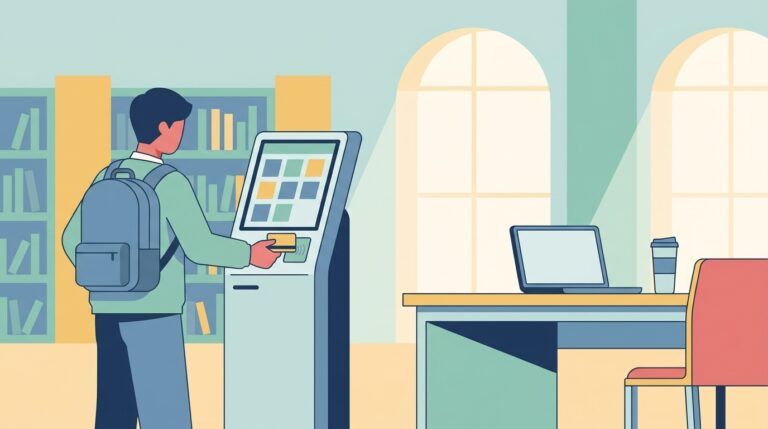
Imagine this classic K-Drama scene: The main characters are college students. It’s midnight during midterms. The camera pans across a massive, perfectly silent library. One character walks up to a glowing touch-screen kiosk, scans their ID, and selects a seat on a digital map. Later, they find a sticky note and a canned coffee left on their desk by their crush.
Seems romantic, right? But if you’re actually in Korea, walking into a public or university library can feel like entering a high-tech fortress. You might spot an empty seat and think, “Great!”—only to have someone tap your shoulder 5 minutes later, pointing to their receipt and whispering, “Excuse me, this is my seat.”
In Korea, you can’t just sit anywhere in a 열람실 (Yeollamsil – Reading Room). You must go through 좌석 발권 (Jwaseok balgwon – Seat Ticketing). If you don’t know the kiosk system, you might end up wandering the aisles or losing your spot entirely. But don’t worry! I’ve seen countless international students sweat over these machines, and today, I’m going to turn you into a library pro.
Phase 2: Deep Dive into Core Expressions
Let’s break down the most important words you’ll see on that kiosk screen.
1. 좌석 발권 (Seat Ticketing / Issuing a Seat)
- Pronunciation: [jwaseok balgwon]
- Sound-alike guide: “Jwa” (sounds like ‘mwah’ but with a j) + “seok” (like ‘suck’ but rounder) + “bal” (like ball) + “gwon” (like ‘gone’ but with a w).
- Meaning: Literally “Seat Ticketing,” but it means “reserving/claiming a seat.”
- K-Culture Moment: This is the first button you press on the kiosk. During exam season (시험기간), students line up at 6 AM just to hit this button and secure a good spot. It’s practically a competitive sport!
- Editor’s Insight: You’ll see the word ‘발권’ (ticketing) a lot in Korea—at movie theaters, bus terminals, and even waiting lines at popular restaurants.
- Situation Spectrum:
- Casual (with friends): ✅ “나 방금 발권했어.” (I just got my ticket/seat.)
- Formal (at the desk): ✅ “좌석 발권은 어떻게 하나요?” (How do I issue a seat?)
- 🤔 Think About It: Why does Korea use a strict ticketing system even for free public library seats? It reflects a culture that highly values efficiency, fairness, and maximizing limited space.
2. 연장 (Extension)
- Pronunciation: [yeonjang]
- Sound-alike guide: “Yeon” (sounds like ‘yawn’) + “jang” (like ‘jong’ in ping-pong).
- Meaning: Extension (of time).
- K-Culture Moment: Most library seats are given for a block of time (usually 3-4 hours). When you have 30 minutes left, you get a text message. If you ignore it and your time expires, your seat is automatically checked out, and someone else can claim it! You’ll often see students sprinting to the kiosk to press the ‘연장’ button.
- Editor’s Insight: This word is crucial. You also use it for visa extensions (비자 연장) or extending a library book return date.
- Situation Spectrum:
- Casual: ✅ “시간 다 돼서 연장해야 돼.” (My time is almost up, I need to extend.)
- Semi-formal: ✅ “자리 연장할게요.” (I will extend my seat.)
- 🤔 Think About It: Time limits ensure that no one hogs a desk all day if they aren’t actually studying. Have you experienced a system like this in your home country’s libraries?
3. 퇴실 (Check-out / Leaving the Room)
- Pronunciation: [toesil]
- Sound-alike guide: “Toe” (like your foot toe) + “sil” (like ‘seal’ but shorter).
- Meaning: Leaving the room / checking out.
- K-Culture Moment: When you’re finally done studying and packing up your heavy backpack, you MUST go back to the kiosk and press ‘퇴실’ or scan your barcode at the exit gate.
- Editor’s Insight: If you just leave without processing your ‘퇴실’, you might get a penalty (패널티) and be banned from reserving a seat for a few days. It’s a system built on consideration for the next person waiting.
- Situation Spectrum:
- Universal: ✅ “퇴실 처리 할게요.” (I will process my check-out.)
Phase 3: Textbook vs. Real Korean
How do people actually talk when finding a seat?
[Situation 1: Asking a friend if they got a seat]
* 📖 Textbook Korean: 도서관에 자리를 예약했습니까? (Did you reserve a seat at the library?)
* 🗣️ Real Korean: 너 자리 잡았어? (Did you grab a seat?) or 발권했어? (Did you ticket?)
* 💡 Why the difference?: Koreans love using the verb 잡다 (to catch/grab) for securing spaces, like “자리 잡다” (grab a seat) or “택시 잡다” (grab a taxi). It implies quick action!
[Situation 2: Warning a friend about the time limit]
* 📖 Textbook Korean: 이용 시간을 연장하시길 바랍니다. (I hope you extend your usage time.)
* 🗣️ Real Korean: 야, 너 빨리 연장해. (Hey, extend it quickly.)
* 💡 Why the difference?: Friends use short, direct imperatives. Missing the extension window is a mini-crisis, so urgency is key.
Phase 4: Cultural Context — K-Culture Deep Dive
4-1. Non-verbal Nunchi (눈치) in the Reading Room
In a Korean 열람실 (Reading Room), the silence is sacred.
* The Laptop Rule: If you are in a general reading room, typing loudly on your laptop is a massive faux pas. Koreans often use a 키스킨 (Key skin – a silicone keyboard cover) and a silent mouse (무소음 마우스) to avoid bothering others. If you don’t, you might receive a polite but passive-aggressive sticky note on your desk!
* The Laptop Trust: You will see students leave $2,000 MacBooks, iPads, and wallets on their desks while they go to lunch for an hour. This is the ultimate Korean flex. Do not touch their stuff!
4-2. The ‘Grasshopper’ Culture (메뚜기)
In university libraries, there’s a slang term called 메뚜기 (Mettugi – Grasshopper). If someone hasn’t officially issued a ticket but just sits in a temporarily empty seat, they have to jump up and move like a grasshopper the moment the real ticket-holder arrives.
* “저 메뚜기 좀 할게요” (I’ll just be a grasshopper for a bit) is something you might hear during exams when no seats are left.
Phase 5: Real-Life Roleplay Scenario
Setting: Saturday afternoon at a massive, modern public library in Gangnam. The air conditioning is crisp, and the silence is intimidating. You want to study Korean, but the kiosk screen is entirely in Korean, and there’s a line forming behind you.
Characters:
* YOU: An expat who just got a library membership card.
* Min-su (32): A friendly Korean who is standing in line behind you.
Dialogue:
YOU: (Staring at the screen) 아… 어떻게 하는 거지? 💦
(a… eotteoke haneun geoji?)
[Ah… how do I do this?]
(🎭 Stage Direction: You tap the screen randomly, looking slightly panicked)
Min-su: 저기요, 혹시 도와드릴까요?
(jeogiyo, hoksi dowadeurilkkayo?)
[Excuse me, do you need some help?]
YOU: 네, 좌석 발권… 어떻게 해요?
(ne, jwaseok balgwon… eotteoke haeyo?)
[Yes, seat ticketing… how do I do it?]
Min-su: 아, 먼저 회원 카드를 여기에 찍으셔야 돼요.
(a, meonjeo hoewon kadeureul yeogie jjigeusyeoya dwaeyo.)
[Ah, first you have to scan your membership card right here.]
YOU: 아! (Scans card) 스크린에 자리가 파란색, 회색이 있네요.
(a! … seukeurine jariga paransaek, hoesaegi inneyo.)
[Ah! … The seats on the screen are blue and gray.]
Min-su: 파란색이 빈 자리예요. 원하시는 자리 누르시면 돼요.
(paransaegi bin jariyeyo. wonhasineun jari nureusimyeon dwaeyo.)
[The blue ones are empty seats. Just press the seat you want.]
🔀 Your Turn! The screen asks if you want a receipt. What do you say?
* A) “영수증은 버려주세요!” (Throw away the receipt!)
* B) “이거 꼭 뽑아야 돼요?” (Do I really have to print this?)
* C) “감사합니다. 영수증은 안 뽑아도 괜찮아요.”✅ Best Choice: B or C.
Why? B is a natural question (often, you don’t need a paper receipt if you have the library app). C is a polite way to end the interaction and thank Min-su. A sounds a bit aggressive like a command.
YOU: (Presses no receipt) 이거 꼭 뽑아야 돼요?
(igeo kkok ppobaya dwaeyo?)
[Do I really have to print this?]
Min-su: 아니요, 카카오톡으로 알림이 와요. 4시간 쓸 수 있어요.
(aniyo, kakaotogeuro allimi wayo. nesigan sseul su isseoyo.)
[No, you’ll get a notification via KakaoTalk. You can use it for 4 hours.]
YOU: 아하! 4시간 끝나면요?
(aha! nesigan kkeunnamyeonnyo?)
[Aha! What if the 4 hours end?]
Min-su: 기계에서 연장하시거나, 집에 갈 때 퇴실 누르시면 됩니다. 열공하세요! 📚
(gigyeeseo yeonjanghasigeona, jibe gal ttae toesil nureusimyeon domnida. yeolgonghaseyo!)
[You can extend it at the machine, or press check-out when you go home. Study hard!]
Phase 6: 10-Second Shadowing Drill
Practice this sentence to sound incredibly natural when your time is running out!
🥺 아, / 저 시간 다 돼서 / 연장 좀 / 하고 올게요!
(a, / jeo sigan da dwaeseo / yeonjang jom / hago olgeyo!)
[Ah, my time is almost up, I’ll go extend it real quick!]
Rhythm tip: Pause slightly at the slashes (/). Say “yeonjang jom” quite quickly together.
Phase 7: K-Culture Mini Dictionary
1. 눈치 (Nunchi)
* Romanization: nunchi
* English: Situational awareness / reading the room
* Context: Crucial in the library. Typing loudly, sighing heavily, or eating smelly snacks shows a severe lack of nunchi.
2. 열람실 (Yeollamsil)
* Romanization: yeollamsil
* English: Reading room
* Context: Unlike a normal library floor where you can browse books, the yeollamsil is strictly for sitting and studying. It’s pin-drop quiet.
3. 열공 (Yeolgong)
* Romanization: yeolgong
* English: Studying hard
* Context: Short for ‘열심히 공부하다’. A common cheering phrase among students (e.g., “열공해!”).
4. 노트북석 (Noteubuk-seok)
* Romanization: noteubuk-seok
* English: Laptop seat
* Context: Many libraries have separate seating zones just for laptop users so that the typing noises don’t bother people who are just reading or writing.
Phase 8: Traveler’s Survival Kit
If you’re visiting Korea, public libraries like the Starfield Library in COEX or the Seoul Metropolitan Library are amazing places to rest or work. But if you need a proper desk, here are your survival phrases.
🆘 Survival Phrases for Spaces
* 🇰🇷 “여기 빈 자리예요?” (yeogi bin jariyeyo?)
* 🗣️ Meaning: Is this an empty seat?
* 📍 Where to use: Cafes, open-area libraries, food courts.
* 💡 Pro Tip: If there is a jacket on the chair or a single pen on the desk, it is not an empty seat. That’s the Korean reservation system!
- 🇰🇷 “자리 맡아줄까?” (jari matajulgga?)
- 🗣️ Meaning: Should I save a seat for you?
- 📍 Where to use: When traveling with a friend in crowded cafes.
📌 Editor’s Travel Note
* Tourist access: Most public library reading rooms require a resident ID card to register at the kiosk. If you’re a tourist, look for 자유 열람실 (Open reading rooms) or book cafes where ticketing isn’t required!
* Wi-Fi: “Public WiFi Free” is available almost everywhere in Korea, especially in libraries.
Phase 9: Critical Thinking — “One Step Deeper”
🧠 Think Deeper: Space, Community, and High Trust
Have you ever wondered how Korea balances hyper-competition with immense social trust? The library kiosk system is a perfect example. Because land is scarce and population density is high, Koreans compete fiercely for resources—even a library seat requires a digital ticketing system to ensure absolute fairness. Yet, once that space is yours, the community respects it entirely. You can leave your expensive electronics unattended for hours, knowing no one will touch them because the “seat is claimed.” It’s a fascinating duality: a strict digital contract (ticketing) supported by an unwritten moral code (don’t touch other’s belongings).
💬 Your Turn: Would you feel comfortable leaving your laptop on a library desk in your home country? Share your thoughts in the comments!
Phase 10: FAQ & Avoiding Misunderstandings
- Q: Can I just ask a stranger to watch my stuff?
- A: You can, but you really don’t need to! If you must, say “저 화장실 다녀올 건데, 짐 좀 봐주실 수 있나요?” (I’m going to the restroom, could you watch my stuff?). But honestly, just walking away is 99% safe in Korea.
- Q: Can I drink coffee in the reading room?
- A: Water and tightly sealed tumblers are usually OK. Takeout cups with straws or snacks are a big NO.
❌ Common Mistake #1: Forgetting to press ‘퇴실’ (Check-out) when leaving.
✅ Do this instead: Always scan your card at the exit or kiosk. If you forget repeatedly, your library account might be suspended!❌ Common Mistake #2: Assuming a seat is empty because there’s no person there.
✅ Do this instead: Always check the kiosk screen. If it’s blue, it’s free. If it’s gray, someone just went to the bathroom or convenience store.
Phase 11: Summary & Action Items
One-Liner Summary: To study in a Korean library, master the kiosk trio: 발권 (ticket), 연장 (extend), and 퇴실 (check out)!
Action Mission 3 Steps:
* 🥉 Bronze (Solo): Look at your own study desk and say “나 자리 잡았어” (I grabbed a seat) out loud 3 times.
* 🥈 Silver (Online): Find a picture of a Korean library on Instagram and comment “여기서 열공하고 싶어요!” (I want to study hard here!).
* 🥇 Gold (Real Life): Next time you go to a Korean cafe or library, use the phrase “여기 빈 자리예요?” to ask if a seat is free.
K-Culture Mission: Watch an episode of a college K-Drama (like Weightlifting Fairy Kim Bok-joo or Cheese in the Trap) and try to spot the library kiosk or the moment someone leaves a drink on a desk!
Phase 12: Quiz — Interactive Challenge
1. Situational Judgment:
You’ve been studying for 3.5 hours. You get a text message saying you have 30 minutes left, but you want to study for two more hours. What button should you look for on the kiosk?
* A) 퇴실 (Check-out)
* B) 연장 (Extend)
* C) 예약 (Reserve)
* (Answer: B. Press 연장 before the time runs out!)
2. True or False — K-Culture Edition:
* It is perfectly acceptable to type loudly on your mechanical keyboard in a general “열람실” (Reading room) as long as you have a ticket.
* (Answer: False. Typing loudly shows a lack of ‘눈치’ (nunchi). Look for a specific 노트북석 (laptop seat) instead!)
3. Fill in the Blank:
You want to ask someone if the empty chair next to them is taken.
“여기 [ ] 자리예요?” (Is this an empty seat?)
* (Answer: 빈 (bin) – Empty)
Happy studying, or as we say in Korea, 열공하세요!
Frequently Asked Questions (FAQ)
Q: What does "좌석 발권 (Seat Ticketing / Issuing a Seat)" mean in Korean and how do you pronounce it?
A: In Korean, "좌석 발권 (Seat Ticketing / Issuing a Seat)" is pronounced [jwaseok balgwon] and means: a key conversational Korean expression covered in this lesson.
Q: What does "연장 (Extension)" mean in Korean and how do you pronounce it?
A: In Korean, "연장 (Extension)" is pronounced [yeonjang] and means: a key conversational Korean expression covered in this lesson.
Q: What does "퇴실 (Check-out / Leaving the Room)" mean in Korean and how do you pronounce it?
A: In Korean, "퇴실 (Check-out / Leaving the Room)" is pronounced [toesil] and means: a key conversational Korean expression covered in this lesson.







