

The Magic of ‘Service’: Surviving the Korean Noraebang Bonus Time!
Phase 1: Empathy & Immersion (Welcome to the Noraebang!)
Annyeonghaseyo! I’m the lead editor at Daily Hangul, your veteran tutor and local culture navigator.
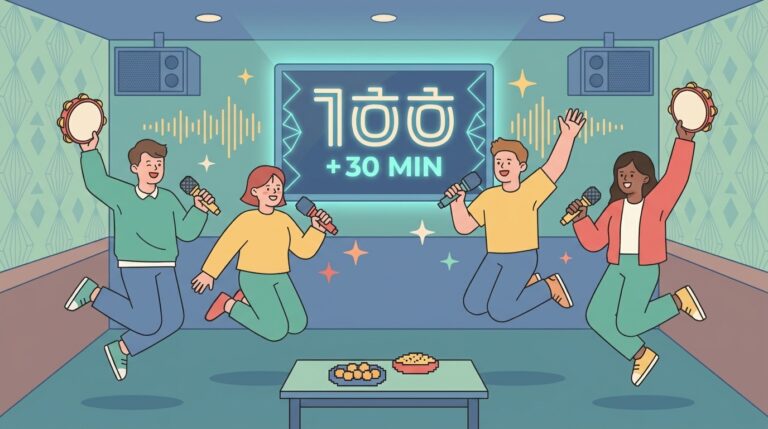
Imagine this: You’re watching your favorite K-Drama. The main characters have just finished a stressful day at work. Cut to the next scene—they are in a dark, neon-lit room, shaking tambourines like their lives depend on it, screaming into microphones. The screen flashes a massive 100점 (100 points), and suddenly, the machine announces they’ve been gifted an extra 30 minutes! The characters go absolutely wild.
Have you ever been to a Korean Noraebang (노래방, singing room) and wondered why the time never seems to end? You pay for one hour, but somehow you’re still singing two hours later. This is the magic of Korean ‘Service’ (서비스) culture.
If you don’t know how to react when the bonus time hits, you might nervously pack your bags while your Korean friends are just getting warmed up. But if you know exactly what to say? You instantly become an insider—the life of the party! Let’s dive into the phrases you need to survive (and thrive) during the endless Noraebang bonus time.
Phase 2: Core Expressions Deep Dive
1. 아싸, 서비스 대박!
- Pronunciation: [Assa, seobiseu daebak!]
- Assa sounds like an excited “Ah-sah!”.
- Seobiseu is the Korean pronunciation of “Service”.
- Daebak sounds like “Dae-bahk”.
- Meaning:
- Literal: Oh yeah, service is a big hit!
- Real Nuance: Heck yes, this free bonus time is awesome!
- K-Culture Moment: You look at the clock on the screen. It says “01:00” (1 minute left). Suddenly, the screen blinks, and it jumps to “31:00”. The owner just gave you 30 minutes of free time! Everyone in the room yells this phrase.
- Editor’s Insight: Assa is the ultimate Korean exclamation of joy, like “Yay!” or “Oh yeah!”. Service in Korea doesn’t mean the tip you give a waiter; it means “on the house” or “freebies” given by the business owner.
- Situation Spectrum:
- Friends (Casual): ✅
- Coworkers (Semi-formal): ✅ (Great for hyping up the team)
- Strict Boss (Formal): ⚠️ (Skip “Assa” and just smile happily)
- 🤔 Think About It: Why did Koreans adopt the English word “Service” to mean “free stuff”? How do businesses in your country show appreciation to customers?
2. 나 백 점 맞았어!
- Pronunciation: [Na baek jeom majasseo!]
- Baek sounds like “back” but with a softer ‘b’.
- Jeom sounds like “jum”.
- Meaning:
- Literal: I received 100 points!
- Real Nuance: I scored a perfect 100! (I nailed it!)
- K-Culture Moment: At a Noraebang, getting exactly 100 points often triggers the machine to fanfare, and it’s a common superstition that getting 100 points prompts the owner to give you more “Service” time.
- Editor’s Insight: You say this with deep pride. Even if your singing sounded like a dying cat, the Noraebang machine is generous. When that 100 pops up, you have the right to brag.
- Situation Spectrum:
- Friends (Casual): ✅
- Coworkers (Semi-formal): ⚠️ (Use “저 백 점 맞았어요!” [Jeo baek jeom majasseoyo!] to be polite)
- Boss (Formal): 🚫
- 🤔 Think About It: In Korean culture, achieving “100 points” on tests is a big deal from childhood. Do you think this obsession with perfect scores carried over into leisure activities like Noraebang?
3. 목이 터질 것 같아요.
- Pronunciation: [Mogi teojil geot gatayo.]
- Mogi sounds like “mo-gee”.
- Teojil sounds like “tuh-jil”.
- Meaning:
- Literal: I think my throat will explode.
- Real Nuance: My throat is completely gone. / I sang too much.
- K-Culture Moment: It’s 2 AM. You’ve received “Service” three times. You are exhausted, and you need an excuse to stop singing high-pitched K-Pop songs.
- Editor’s Insight: Koreans love dramatic expressions. Instead of simply saying “My throat hurts” (목이 아파요), saying it will explode (터질 것 같다) shows you put your heart and soul into the party.
- Situation Spectrum:
- Friends (Casual): ✅ (Change to: 목 터질 것 같아!)
- Coworkers (Semi-formal): ✅
- Boss (Formal): ✅ (A polite way to decline another song)
- 🤔 Think About It: Korean language often uses dramatic physical metaphors (e.g., “I could die of joy,” “My throat will explode”). Does your language use similar dramatic hyperbole?
Phase 3: Textbook vs. Real Korean
Let’s compare what you learned in the classroom with what you actually hear over the loud music at a Noraebang!
[Reacting to Bonus Time]
* 📖 Textbook: 우리는 무료 시간을 더 받았습니다. (We received more free time.)
* 🗣️ Real Korean: 오! 사장님 서비스 폼 미쳤다! (Oh! The owner’s service form is crazy! / The owner is the best!)
* 💡 Why the difference?: “폼 미쳤다” (Form is crazy) is a trendy slang used by younger generations to say something is top-tier or exceptionally good.
[Praising Someone’s Singing]
* 📖 Textbook: 노래를 정말 잘 부르시네요. (You sing very well.)
* 🗣️ Real Korean: 와, 완전 찢었다! (Wow, you totally tore it up!)
* 💡 Why the difference?: “찢었다” (Tore it) is a widely used slang meaning “You killed it” or “You dominated the stage.”
Bottom Note: At a B1 level, you want to sound natural but not trying too hard to use slang. Stick to “서비스 대박!” (Service daebak!)—it’s the perfect balance of natural and universally understood!
Phase 4: Cultural Context — K-Culture Deep Dive
4-1. Non-Verbal Cues: The Art of the Tambourine
In a Korean Noraebang, language is only half the communication. When someone is singing, it is considered rude to just stare at your phone. You must show Nunchi (눈치, social awareness). How? The Tambourine.
When the boss or a friend hits the high note, you shake the tambourine. When the screen flashes 100 points, you stand up, clap, and give high-fives. If you get “Service” time, you cheer loudly so the owner (who might be listening outside or via CCTV) knows you appreciate it!
4-2. The “Hospital Playlist” Vibe & Corporate Hoesik
If you watch the K-Drama Hospital Playlist (슬기로운 의사생활), you see the doctors letting off steam by singing their hearts out. In Korea, Noraebang is the ultimate stress reliever.
Furthermore, Noraebang is almost always “Round 2” (2차) of a Hoesik (회식, company dinner). After eating BBQ and drinking Soju for Round 1, the team moves to the Noraebang. The youngest employee usually books the room, types in the songs for the older staff, and reacts enthusiastically to their singing. Getting “Service” time during a Hoesik is a sign that the team is having a great time!
Phase 5: Real-Life Roleplay Scenario
Let’s put you in the action! You are the main character here.
- Setting: It’s 10:30 PM on a Friday. You are at a brightly lit, slightly retro Noraebang in Hongdae. The table is covered with empty water bottles and a plate of fruit. The timer on the screen says
00:01. - Characters:
- YOU: A B1-level Korean learner, an exchange student who loves K-Pop.
- Min-su: Your Korean university buddy (Age 23). He thinks he’s the next BTS main vocalist.
The Dialogue:
Min-su: 아, 벌써 1분밖에 안 남았어.
(Ah, beolsseo il-bun-bakke an namasseo.)
[Translation] Ah, there’s only 1 minute left.
(🎭 Stage Direction: Min-su looks sadly at the screen holding the mic)
YOU: 진짜 아쉽다. 마지막 곡 할까?
(Jinjja aswipta. Majimak gok halkka?)
[Translation] That’s such a bummer. Should we do one last song?
Min-su: 응, 내가 부를게!
(Eung, naega bureulge!)
[Translation] Yeah, I’ll sing it!
(🎭 Stage Direction: Min-su passionately sings a dramatic ballad. The song ends. The screen calculates the score… 100점!)
Min-su: 나이스! 나 백 점 맞았어!
(Naiseu! Na baek jeom majasseo!)
[Translation] Nice! I got 100 points!
YOU: 와, 진짜 잘 부른다. 완전 찢었어!
(Wa, jinjja jal bureunda. Wanjeon jjijeosseo!)
[Translation] Wow, you sing really well. You totally killed it!
Min-su: 어? 야, 화면 봐봐!
(Eo? Ya, hwamyeon bwabwa!)
[Translation] Huh? Hey, look at the screen!
(🎭 Stage Direction: The timer suddenly jumps from 00:00 to 30:00)
YOU: 헐! 시간이 다시 늘어났어?
(Heol! Sigani dasi neureonasseo?)
[Translation] Gasp! The time increased again?
Min-su: 사장님이 서비스 주셨나 봐. 대박!
(Sajangnimi seobiseu jusyeonna bwa. Daebak!)
[Translation] I guess the owner gave us service. Awesome!
🔀 Your Turn! How should YOU react?
– A) “아, 피곤해요. 집에 가요.” (Ah, I’m tired. Let’s go home.)
– B) “아싸, 서비스 대박! 한 곡 더 하자!” (Oh yeah, service is awesome! Let’s do one more song!)
– C) “제가 돈을 더 낼게요.” (I will pay more money.)✅ Best Choice: B — Embrace the bonus time! “Assa!” matches Min-su’s excitement.
⚠️ Choice A & C Analysis: A is a buzzkill (even if you are tired, pretend to be happy for at least one more song!). C is a cultural misunderstanding—Service is free! Don’t try to pay for it.
Min-su: 넌 무슨 노래 부를래? 예약해!
(Neon museun norae bureullae? Yeyakhae!)
[Translation] What song do you want to sing? Reserve it!
YOU: 좋아, 내 18번 부를게!
(Joa, nae sip-pal-beon bureulge!)
[Translation] Alright, I’ll sing my go-to song!
Phase 6: 10-Second Shadowing Drill
Read these sentences out loud. Pay attention to the pauses (/) and the emotion tags!
- 😊 Excitedly: 아싸! / 사장님 / 서비스 대박!
(Assa! / sajangnim / seobiseu daebak!) - 😤 Proudly: 나 방금 / 백 점 / 맞았어!
(Na banggeum / baek jeom / majasseo!) - 🥺 Dramatically: 목이 / 터질 것 / 같아요~
(Mogi / teojil geot / gatayo~)
Phase 7: K-Culture Mini Dictionary
Here are 4 keywords you absolutely need for Noraebang survival:
1. 서비스 (Service)
* Romanization: seobiseu
* English: Freebies / On the house
* Context: In Korea, tipping doesn’t exist. Instead, businesses give “Service” (extra time, free drinks, free side dishes) to build loyalty and show hospitality.
2. 18번 (18-beon)
* Romanization: sip-pal-beon
* English: One’s go-to song / Favorite karaoke song
* Context: Originating from an old Japanese Kabuki term for a successful 18th play, Koreans use this to mean “The song I am most confident singing at a Noraebang.”
3. 예약 (Yeyak)
* Romanization: yeyak
* English: Reservation / Queuing a song
* Context: You don’t wait for your turn to pick; you use the remote to “Yeyak” (queue) your song while someone else is singing!
4. 코노 (Kono)
* Romanization: kono
* English: Coin Noraebang
* Context: A modern, smaller version of Noraebang where you pay per song (or for exactly 30 mins/1 hour) using a machine. Note: You rarely get “Service” at a Kono because it’s unmanned!
Phase 8: Traveler’s Survival Kit
If you’re visiting Korea, going to a Noraebang is a must. Here are the survival phrases for the front desk:
🆘 Survival Phrases for Noraebang
– 🇰🇷 “한 시간 얼마예요?” (han sigan eolmayeyo?)
– 🗣️ Meaning: How much is it for one hour?
– 🇰🇷 “물 좀 주실 수 있나요?” (mul jom jusil su innayo?)
– 🗣️ Meaning: Can you give us some water?
– 🇰🇷 “여기 카드 되나요?” (yeogi kadeu doenayo?)
– 🗣️ Meaning: Do you take cards here?📌 Editor’s Travel Note
– Pricing: Regular Noraebangs charge by the room (approx. 15,000~25,000 KRW/hour). Coin Noraebangs (Kono) charge per song (usually 1,000 KRW for 2-3 songs).
– Service Rule: If there is a line of people waiting outside, the owner is less likely to give you “Service” time. Go on a weekday late night for infinite bonus time!
Phase 9: Critical Thinking — “One Step Deeper”
🧠 Think Deeper: The Culture of ‘Jeong’ (정) vs. Tipping
Why does the Noraebang owner give you an extra 30 minutes for free? It stems from the Korean concept of Jeong (정)—a feeling of deep connection, affection, and community bonding. In many Western cultures, excellent service is rewarded by the customer with a tip. In Korea, the dynamic is flipped. The business owner initiates the goodwill by giving “Service” (extra time, free soda, extra dumplings) to say, “Thank you for choosing my place, feel at home.” It’s not just an economic transaction; it’s an emotional exchange.
💬 Your Turn: Does your culture have a concept similar to “Jeong”? Or is your service culture strictly based on tipping? Share in the comments below!
Phase 10: FAQ & Avoiding Misunderstandings
Q: “Can I ask the owner for more ‘Service’ time?”
Yes and no. If you are a regular, you can playfully ask “사장님, 서비스 좀 더 주세요~” (Boss, please give us a little more service~). But if it’s your first time, it’s better to wait and see if they offer it. Demanding it is rude!
Q: “Can I use the word ‘Service’ (서비스) in restaurants too?”
Absolutely! If the waiter brings you a free steamed egg (계란찜) at a BBQ place, they will usually say, “서비스입니다~” (This is service~).
❌ Common Mistake #1: Trying to leave a cash tip to thank the owner for the “Service” time.
✅ Do this instead: Simply bow slightly and say “사장님, 서비스 감사합니다! 잘 놀았습니다!” (Boss, thank you for the service! We had a great time!). Tipping might actually confuse or even offend them.
Phase 11: Summary & Action Items
✨ One-Liner Summary:
When the Noraebang machine gives you free time, shout “아싸, 서비스 대박!” and get ready to sing until your throat explodes!
🚀 Your Action Missions:
– 🥉 Bronze (Solo): Stand in front of your mirror, pretend you hold a mic, and shout “나 백 점 맞았어!” (I got 100 points!).
– 🥈 Silver (Online): Go to a K-Pop music video on YouTube and comment: “이 노래 완전 내 18번!” (This song is totally my go-to!).
– 🥇 Gold (Real World): Visit a Korean restaurant or Noraebang. If you get a freebie, confidently say, “서비스 감사합니다!” (Thank you for the service!).
🎤 Special K-Culture Mission:
Search “슬기로운 의사생활 노래방” (Hospital Playlist Noraebang) on YouTube and watch how the actors use the tambourines and react to the music. Study their Nunchi!
Phase 12: Interactive Quiz
Let’s test your Noraebang survival skills!
1. You are at a Noraebang with your new Korean coworkers. The screen shows you got 100 points. What is the most polite yet happy way to announce it?
A) 나이스! 나 백 점!
B) 저 백 점 맞았어요!
C) 사장님, 서비스 줘요!
(Answer: B. “A” is too casual/informal for coworkers you just met. “C” is rude.)
2. Fill in the blank:
“When I go to a Noraebang, I always sing ‘Gangnam Style’. That song is my ________ (go-to song).”
(Answer: 18번 / sip-pal-beon)
3. True or False – K-Culture Edition:
“If a Korean restaurant gives you ‘Service’ (free drinks), you should leave a 10% tip on the table.”
(Answer: False! Korea is a no-tip culture. Just say a warm thank you!)
Frequently Asked Questions (FAQ)
Q: What does "아싸, 서비스 대박!" mean in Korean and how do you pronounce it?
A: In Korean, "아싸, 서비스 대박!" is pronounced [Assa, seobiseu daebak!] and means: a key conversational Korean expression covered in this lesson.
Q: What does "나 백 점 맞았어!" mean in Korean and how do you pronounce it?
A: In Korean, "나 백 점 맞았어!" is pronounced [Na baek jeom majasseo!] and means: a key conversational Korean expression covered in this lesson.
Q: What does "목이 터질 것 같아요." mean in Korean and how do you pronounce it?
A: In Korean, "목이 터질 것 같아요." is pronounced [Mogi teojil geot gatayo.] and means: a key conversational Korean expression covered in this lesson.







