

Phase 1: Empathy (Immersive Open)
Hello! I’m your Daily Hangul Editor.
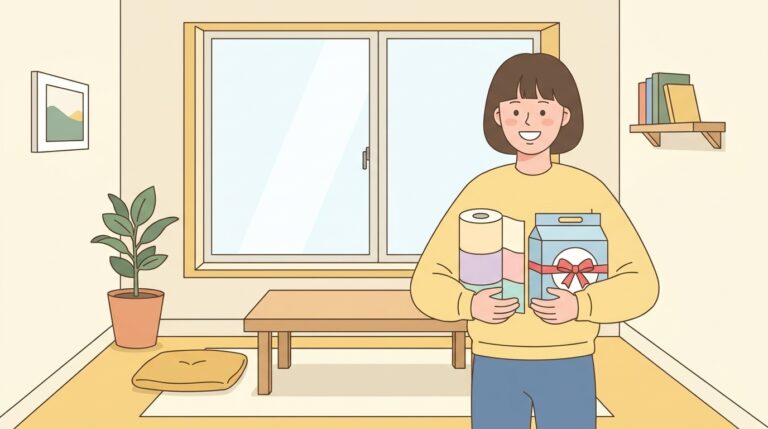
Picture this: You’re watching a classic K-Drama. The main characters are celebrating someone moving into a new home. They ring the doorbell, smile brightly, and hand over… a gigantic 30-roll pack of toilet paper.
Wait, what? Are they implying the house is dirty? Did they forget to go to a real gift shop?
If you’ve ever watched a Korean vlog or drama, you’ve probably seen this and been completely bewildered. Or maybe you’ve been invited to a Korean friend’s new Officetel (오피스텔) in Seoul, and they told you, “Hey, just come empty-handed!”
Spoiler alert: Do not go empty-handed.
Moving to a new place in Korea is a massive milestone, especially with Korea’s unique housing systems like Jeonse (전세). Knowing how to navigate a 집들이 (Jip-deul-i, Housewarming party) and bringing the right gift will instantly upgrade you from “foreign guest” to “insider friend who truly gets it.”
This guide is crafted from the real panic moments my students have faced. Let’s make sure you walk into that new apartment like a true local!
Phase 2: Core Expressions Deep Dive
Here are the absolute must-know expressions for a Korean housewarming, specially curated for B2 learners.
1. 초대해 주셔서 감사합니다 (Thank you for inviting me)
- Pronunciation: [chodaehae jusyeoseo gamsahamnida] / ‘cho-dae’ sounds like ‘choke’ without the k + ‘day’
- Meaning: Literal = Thank you for inviting. / Real nuance = I’m honored you opened your personal space to me.
- K-Culture Moment: You say this right at the entryway (현관) while taking off your shoes. It sets a polite, warm tone before you step onto the pristine living room floor.
- Editor’s Insight: At a B2 level, you should upgrade from the basic “고맙습니다” to the “-아/어 주셔서” (thank you for doing X) grammar pattern. It shows deep appreciation for their effort.
- Situation Spectrum:
- Close Friends (Casual): ⚠️ (Use “초대해 줘서 고마워” instead)
- Co-workers (Semi-formal): ✅
- Boss/Elders (Formal): ✅
- 🤔 Think About It: Why is inviting someone to a home such a big deal in Korea? Since Korean society is highly communal outdoors (cafes, restaurants), the home is considered a very private sanctuary. Who do you usually invite to your home in your culture?
2. 빈손으로 오셔도 돼요 (You can come empty-handed)
- Pronunciation: [binsoneuro osyeodo dwaeyo] / ‘bin’ means empty, ‘son’ means hand
- Meaning: Literal = It is okay if you come with empty hands. / Real nuance = I don’t want you to feel burdened, but please bring a small token of appreciation.
- K-Culture Moment: You ask your friend what they need for their new place, and they hit you with this line. It’s the ultimate test of your Nunchi (눈치).
- Editor’s Insight: This is a classic Korean “white lie” born out of courtesy. If you actually go empty-handed, they might feel slightly disappointed (서운하다). Always bring something, even if it’s just a roll of paper towels or a cake!
- Situation Spectrum:
- Close Friends (Casual): ✅ (“그냥 와~” – Just come!)
- Co-workers (Semi-formal): ✅
- Boss/Elders (Formal): ✅
- 🤔 Think About It: Why do Koreans often say the opposite of what they mean in polite situations? How does this concept of ‘burdening others’ (폐를 끼치다) reflect Korean social values?
3. 휴지 풀리듯 일도 잘 풀리길 바라요 (I hope things work out as smoothly as this toilet paper unrolls)
- Pronunciation: [hyuji pullideut ildo jal pulligil barayo] / ‘pul-li-da’ sounds like pulling a string
- Meaning: Literal = I hope your work unrolls like toilet paper. / Real nuance = Wishing you endless good luck and success in your new home.
- K-Culture Moment: The moment you hand over the giant pack of toilet paper. Saying this line will make your Korean friends gasp and say, “Wow, where did you learn that?!”
- Editor’s Insight: The verb 풀리다 means “to be unrolled/untangled” (like paper) but also “to be resolved successfully” (like a problem). It’s an amazing pun that proves your advanced Korean skills!
- Situation Spectrum:
- Close Friends (Casual): ✅ (Drop ‘바라요’ to ‘바래’)
- Co-workers (Semi-formal): ✅
- Boss/Elders (Formal): ✅
Phase 3: Textbook vs. Real Korean
Let’s ditch the robotic phrases and speak like a true Seoulite.
[Situation 1: Asking what gift they want]
* 📖 Textbook Korean: 집들이 선물로 무엇을 받고 싶습니까? (What do you want to receive as a housewarming gift?)
* 🗣️ Real Korean: 필요한 거 없어? 편하게 말해! (Anything you need? Feel free to tell me!)
* 💡 Why the difference?: Asking directly what someone “wants to receive” sounds like an interrogation. “Is there anything you need?” sounds caring and practical.
[Situation 2: Handing over the gift]
* 📖 Textbook Korean: 이것은 제 선물입니다. (This is my gift.)
* 🗣️ Real Korean: 오다 주웠어. (I picked it up on the way.) OR 약소하지만 준비했어요. (It’s modest, but I prepared this.)
* 💡 Why the difference?: “오다 주웠어” is a popular Tsundere (tough outside, warm inside) slang phrase among close friends to show you didn’t stress over it. For elders, “약소하지만” (modest/humble) shows traditional humility.
[Situation 3: Complimenting the house]
* 📖 Textbook Korean: 집이 정말 큽니다. (The house is really big.)
* 🗣️ Real Korean: 우와, 집 진짜 좋다! 인테리어 완전 센스 있는데요? (Wow, the house is so nice! The interior is so sensible/tasteful!)
* 💡 Why the difference?: Young Koreans love the word “센스 있다” (to have good sense/taste). It compliments their effort, not just the physical size of the house.
Bottom Note: For B2 level, start using “센스 있다” to compliment people’s taste in interior design, food, or fashion. It’s the ultimate modern compliment!
Phase 4: Cultural Context — K-Culture Deep Dive
4-1. Non-verbal Etiquette at the Doorstep
Language is only half the battle. When you arrive at a Korean home:
1. Take off your shoes! This is non-negotiable. Point your toes toward the door when you leave them.
2. Hand the gift with two hands. Even if it’s a bulky pack of toilet paper, use two hands or support your right arm with your left hand.
3. Do not wander into the bedroom. Unless they offer a “house tour” (집 구경), stay in the living room (거실) or kitchen.
4-2. The Secret Meaning of K-Housewarming Gifts
Have you ever noticed in K-Dramas that housewarming guests bring Toilet Paper (두루마리 휴지) and Laundry Detergent (세제)?
There’s a beautiful, superstitious meaning behind this:
– Toilet Paper: As easily as the paper unrolls, may your problems be untangled and your life be smooth and successful.
– Detergent: Just as the soap bubbles multiply rapidly, may your wealth and prosperity bubble up and grow!
Critical Viewpoint: While older generations still stick strictly to these, millennials and Gen Z often prefer modern gifts like diffusers, wine, fancy hand soap (Aesop is a huge favorite!), or small appliances. However, bringing toilet paper with that B2-level pun we learned? Still an absolute crowd-pleaser.
Phase 5: Real-Life Roleplay Scenario
Setting: Friday evening, 7:30 PM. You’ve been invited to your Korean coworker Min-su’s new Jeonse apartment in Mapo-gu. You’re standing at the front door, holding a beautiful diffuser and a small pack of toilet paper.
Characters:
– YOU: A foreign professional working in Seoul. You want to show off your cultural Nunchi.
– Min-su (32): Your friendly coworker who finally moved out of a tiny studio into a nicer 2-bedroom apartment.
Dialogue:
YOU: 민수 대리님, 축하해요! 초대해 주셔서 감사합니다.
(Minsu daerinim, chukahaeyo! Chodaehae jusyeoseo gamsahamnida.)
[Congratulations, Assistant Manager Minsu! Thank you for inviting me.]
Min-su: 어서 와요! 아이구, 뭐 이런 걸 다 사 왔어요? 그냥 빈손으로 오셔도 되는데!
(Eoseo wayo! Aigu, mwo ireon geol da sa wasseoyo? Geunyang binsoneuro osyeodo doeneunde!)
[Welcome! Oh my, why did you buy all this? You could have just come empty-handed!]
YOU: 에이, 어떻게 빈손으로 와요. 새집 보니까 진짜 좋네요!
(Ei, eotteoke binsoneuro wayo. Saejip bonikka jinjja jonneyo!)
[Oh come on, how could I come empty-handed? Seeing the new house, it’s really nice!]
Min-su: 고마워요. 전세 구하느라 고생 좀 했거든요. 들어와서 앉아요.
(Gomawoyo. Jeonse guhaneura gosaeng jom haetgeodeunyo. Deureowaseo anjayo.)
[Thank you. I struggled a bit to find a Jeonse. Come in and sit down.]
YOU: 인테리어가 완전 센스 있는데요? 이거 약소하지만 준비했어요.
(Interieoga wanjeon senseu inneundeyo? Igeo yaksoshajiman junbihaesseoyo.)
[The interior is so tasteful! It’s modest, but I prepared this.]
(🎭 Stage Direction: You hand over the gift with both hands)
Min-su: 우와, 디퓨저랑 휴지네요? 센스 대박!
(Uwa, dipyujeorang hyujineyo? Senseu daebak!)
[Wow, a diffuser and toilet paper? Such great sense!]
🔀 Your Turn! How should you respond to show off your B2 Korean?
– A) “네, 휴지입니다. 화장실에서 쓰세요.” (Yes, it is toilet paper. Use it in the bathroom.)
– B) “휴지 풀리듯 일이 술술 풀리길 바라요!” (I hope your affairs unroll smoothly like this toilet paper!)
– C) “오다 주웠어요. 버리든지 말든지요.” (I picked it up on the way. Throw it away or whatever.)✅ Best Choice: B — It uses advanced vocabulary (술술 풀리다) and shows you understand Korean cultural symbolism perfectly!
⚠️ Choice A Analysis: Too robotic and literal.
⚠️ Choice C Analysis: “오다 주웠어” is funny, but adding “버리든지 말든지” (throw it away or whatever) to a coworker is way too rude and breaks the polite boundary!
YOU: (Smiling) 휴지 풀리듯 새집에서 일도 술술 풀리길 바라요!
(Hyuji pullideut saejibeseo ildo sulsul pulligil barayo!)
Min-su: (Eyes wide) 헐… 한국인인 줄 알았어요! 감동인데요? 배고프죠? 치킨 시켜놨어요!
(Heol… Hanguginin jul arasseoyo! Gamdongindeyo? Baegopeujyo? Chikin sikyeonwasseoyo!)
[Whoa… I thought you were Korean! I’m touched. You’re hungry, right? I ordered fried chicken!]
Phase 6: 10-Second Shadowing Drill
Practice these natural rhythms. The slashes (/) mark where you should take a micro-pause.
- 😊 밝게 (Brightly): 초대해 주셔서 / 정~말 감사합니다! (chodaehae jusyeoseo / jeong~mal gamsahamnida!)
- 🥺 애교 섞어서 (With a bit of charm): 에이~ / 어떻게 빈손으로 와요~ (ei~ / eotteoke binsoneuro wayo~)
- 😤 단호하지만 따뜻하게 (Firm but warm): 휴지 풀리듯 / 모든 일이 / 술술 풀리길 바라요! (hyuji pullideut / modeun iri / sulsul pulligil barayo!)
Phase 7: K-Culture Mini Dictionary
1. 눈치 (Nunchi)
* Meaning: Social tact; the ability to read the room.
* Context: When a friend says “Don’t bring anything,” having Nunchi means knowing you should still bring a small gift.
2. 집들이 (Jip-deul-i)
* Meaning: Housewarming party.
* Context: Traditionally, it involved a huge feast cooked by the host. Today, it often means ordering delivery food (like chicken and pizza) and drinking together.
3. 전세 (Jeonse)
* Meaning: A unique Korean lease system where you give the landlord a massive lump-sum deposit (often 50-80% of the house value) instead of paying monthly rent.
* Context: Getting a Jeonse apartment is considered a huge symbol of financial stability and “adulting” in Korea.
4. 오피스텔 (Officetel)
* Meaning: Office + Hotel. A multi-purpose building with residential studios.
* Context: Very popular among young, single professionals in Korea due to high security and built-in appliances (풀옵션).
Phase 8: Traveler’s Survival Kit
If you are visiting a friend’s house or staying at an Airbnb in a residential area, you might get lost. Korean addresses (Villas and Apartments) can be a maze!
🆘 Survival Phrases for the Neighborhood
– 🇰🇷 “기사님, 이 아파트 정문으로 가주세요.” (gisanim, i apateu jeongmuneuro gajuseyo.)
– 🗣️ Meaning: Driver, please go to the main gate of this apartment.
– 📍 Where to use: In a taxi.
- 🇰🇷 “선물용 쇼핑백 하나 주세요.” (seonmullyong syopingbaek hana juseyo.)
- 🗣️ Meaning: Please give me a shopping bag for a gift.
- 📍 Where to use: At Paris Baguette or a convenience store when buying a cake or wine.
📌 Editor’s Travel Note:
When using KakaoMap to find an apartment building, look for the “Dong” (동 – Building number). Korean apartments look identical, so finding “Building 104” (104동) is crucial. Also, if you buy a gift at a convenience store, don’t just hand it over in a plastic bag—ask for a paper bag (종이 가방)!
Phase 9: Critical Thinking — “One Step Deeper”
🧠 Think Deeper: Housing & Identity in Modern Korea
Why is a Jip-deul-i such a celebrated event? In Korea’s highly competitive real estate market, moving from a tiny basement room (Banjia) or a cramped dorm to a proper Officetel or a Jeonse apartment is a massive leap in social status and adult independence. The tradition of inviting friends isn’t just about showing off the wallpaper; it’s about sharing a moment of hard-earned stability. When you bring detergent to wish them “bubbling wealth,” you are actively acknowledging their hard work and wishing them upward mobility in a tough society.💬 Your Turn: Is buying a house or getting a nice apartment considered the ultimate goal for young people in your culture? How do you celebrate moving in?
Phase 10: FAQ & Avoiding Misunderstandings
Q: My friend said “Just bring your body” (몸만 와). Does that really mean zero gifts?
A: NO! It means “Don’t buy an expensive coffee machine.” You should still bring dessert, fruit, beer, or a small diffuser.
Q: I bought them a nice t-shirt. Is that a good housewarming gift?
A: Maybe for their birthday, but not for Jip-deul-i. Housewarming gifts should be for the house (household items, scents, plants, or food/drinks to share).
❌ Common Mistake #1: Walking into the house with your shoes on.
✅ How to fix: Always hesitate at the door. If you don’t see shoes on the floor, take yours off immediately. (99.9% of Korean homes are shoe-free!).❌ Common Mistake #2: Buying a standard plastic garbage bag (종량제 봉투) to carry the gift.
✅ How to fix: While practical, it doesn’t look pretty. Pay 100~500 won extra for a paper shopping bag at the bakery or store.
Phase 11: Summary & Action Items
One-Liner Summary: Never go to a Korean housewarming empty-handed, take off your shoes, and wish them luck that unrolls as smoothly as toilet paper!
Action Mission:
– 🥉 Bronze (Solo): Stand in front of your mirror and practice saying, “초대해 주셔서 감사합니다!” with a bright smile.
– 🥈 Silver (Online): Leave a comment in a Korean learning community asking, “제 집들이에 올 때 휴지를 가져오실 건가요?” (Will you bring toilet paper when you come to my housewarming?)
– 🥇 Gold (Real Life): The next time you are invited to a Korean’s home, bring a diffuser or toilet paper and use the “술술 풀리길 바라요” pun!
🎬 K-Culture Mission:
Go to YouTube and search “자취방 집들이 브이로그” (Studio housewarming vlog). Try to spot what kind of gifts the friends bring and see if you can catch them saying “센스 있다!”
Phase 12: Interactive Quiz
1. Situational Judgment:
You arrive at your boss’s new apartment for a team dinner. What is the FIRST thing you should say at the door?
– A) 배고파요. 밥 주세요. (I’m hungry. Give me food.)
– B) 초대해 주셔서 감사합니다. (Thank you for inviting me.)
– C) 오다 주웠어요. (I picked this up on the way.)
(Answer: B. C is too casual for a boss!)
2. Fill in the Blank:
휴지 풀리듯 일이 _______ 풀리길 바라요! (I hope things unroll smoothly!)
(Answer: 술술 – sulsul)
3. True or False — K-Culture Edition:
When a Korean friend invites you and says “빈손으로 오셔도 돼요” (You can come empty-handed), you should actually go empty-handed to respect their wishes.
(Answer: False! Always bring a small gift to show your appreciation and Nunchi.)
Frequently Asked Questions (FAQ)
Q: What does "초대해 주셔서 감사합니다 (Thank you for inviting me)" mean in Korean and how do you pronounce it?
A: In Korean, "초대해 주셔서 감사합니다 (Thank you for inviting me)" is pronounced [chodaehae jusyeoseo gamsahamnida] and means: Literal = Thank you for inviting. / Real nuance = I'm honored you opened your personal space to me.
Q: What does "빈손으로 오셔도 돼요 (You can come empty-handed)" mean in Korean and how do you pronounce it?
A: In Korean, "빈손으로 오셔도 돼요 (You can come empty-handed)" is pronounced [binsoneuro osyeodo dwaeyo] and means: Literal = It is okay if you come with empty hands. / Real nuance = I don't want you to feel burdened, but please bring a small token of appreciation.
Q: What does "휴지 풀리듯 일도 잘 풀리길 바라요 (I hope things work out as smoothly as this toilet paper unrolls)" mean in Korean and how do you pronounce it?
A: In Korean, "휴지 풀리듯 일도 잘 풀리길 바라요 (I hope things work out as smoothly as this toilet paper unrolls)" is pronounced [hyuji pullideut ildo jal pulligil barayo] and means: Literal = I hope your work unrolls like toilet paper. / Real nuance = Wishing you endless good luck and success in your new home.







