

Phase 1: Empathy (Welcome to the Neon Jungle)
Hello! I’m the lead editor of Daily Hangul.
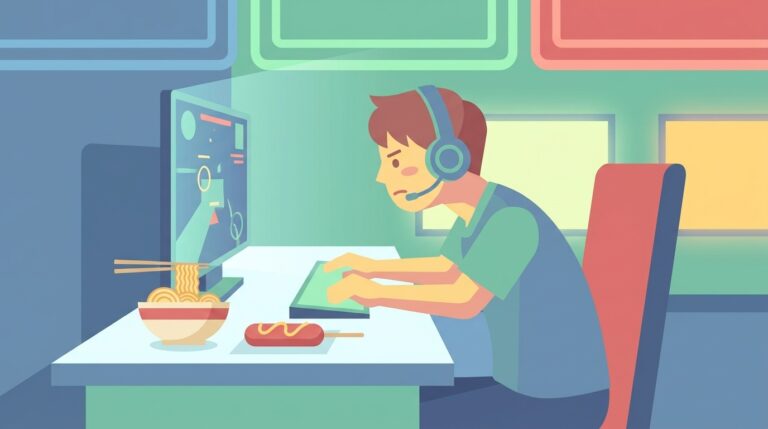
Picture this: It’s 11 PM on a Friday in Seoul. You step into a neon-drenched PC Bang (Internet Cafe). You’ve just ordered a steaming bowl of spicy Ramyeon and a crispy hot dog directly from your computer monitor. The vibe is chill… until the guy next to you suddenly slams his desk, grabs his headset, and screams at the top of his lungs.
Are you in danger? Is a fight breaking out? Nope! He just lost a crucial team fight in League of Legends.
If you’ve watched K-Dramas featuring gamers or have accidentally wandered into a Korean PC Bang, you’ve definitely witnessed this intense passion. Today, we are going to decode exactly what they are screaming, why they do it, and how you can survive (and thrive!) in this unique ecosystem.
This guide is based on real SOS messages from my tutoring students who were completely shocked by their first Korean e-sports experience. Let’s dive in!
Phase 2: Deep Dive into Key Expressions
1. 아, 뭐 하냐고!
- Pronunciation: a, mwo ha-nya-go! (Say ‘mwo’ fast like a kissing sound, and put strong emphasis on ‘nya’)
- Meaning: Literal: “I’m asking what you are doing!” / Real Nuance: “Dude, what the heck are you doing?!”
- K-Culture Moment: You will hear this echoing across the room when a teammate makes a terrible mistake. It is the ultimate expression of gaming frustration.
- Editor’s Insight: This isn’t just a simple question; it’s a rhetorical explosion. The ‘-냐고’ ending is used when you are frustratedly repeating a question or emphasizing disbelief. It feels like throwing your hands up in the air.
- Situation Spectrum:
- Casual (Friends): ✅
- Semi-formal (Co-workers): ⚠️ (Only if you are very close gaming buddies)
- Formal (Boss/Elders): 🚫 (Never!)
- 🤔 Think About It: Why does Korean have a specific grammatical ending (
-냐고) just for repeating a question in frustration? It shows how much Korean communication relies on constantly confirming the other person’s actions and intentions!
2. 아, 까비!
- Pronunciation: a, kka-bi! (For ‘ㄲ’, imagine stopping your breath for a millisecond before saying ‘gabi’)
- Meaning: Literal: None (It’s a slang abbreviation of 아깝다 – to be a pity). / Real Nuance: “Ah, so close!” or “What a shame!”
- K-Culture Moment: When a player almost defeats the boss but dies at the last second, or when their team barely loses. You’ll also hear this playing sports or even when a K-Pop idol narrowly misses a game during a variety show.
- Editor’s Insight: This is the most common, least aggressive exclamation. It shows empathy for a missed opportunity rather than anger.
- Situation Spectrum:
- Casual: ✅
- Semi-formal: ⚠️
- Formal: 🚫
- 🤔 Think About It: Koreans love shortening words for efficiency (like Kka-bi from Akkapda). Does your native language have slang created specifically to save a split second of speaking time?
3. 버스 좀 태워주세요.
- Pronunciation: beo-seu jom tae-wo-ju-se-yo.
- Meaning: Literal: “Please let me ride the bus.” / Real Nuance: “Please carry me (in this game).”
- K-Culture Moment: When a beginner plays with an expert. The expert ‘drives the bus’ while the beginners just sit back and enjoy the ride to victory.
- Editor’s Insight: This is a cute, slightly self-deprecating way to ask a good player for help. It’s highly used in PC Bangs when friends play together.
- Situation Spectrum:
- Casual: ✅
- Semi-formal: ✅ (Funny to use with a skilled co-worker)
- Formal: 🚫
Phase 3: Textbook vs Real Korean
[When a teammate makes a silly mistake]
* 📖 Textbook Korean: 왜 그렇게 하셨어요? (Why did you do that?)
* 🗣️ Real Korean: 아, 뭐 하냐고! (Ah, what the heck are you doing?!)
* 💡 Why the difference?: In the heat of an e-sports battle, the polite honorifics of Korean society are completely thrown out the window for maximum efficiency and emotional release.
[When you almost win but lose]
* 📖 Textbook Korean: 정말 아쉽습니다. (That is truly a pity.)
* 🗣️ Real Korean: 아 까비! (Ah, so close!)
* 💡 Why the difference?: Typing or speaking quickly is vital in gaming. “Kka-bi” takes half the time to say and packs way more emotional punch.
Phase 4: Cultural Context — K-Culture Deep Dive
4-1. Non-verbal Elements: The Art of “Shotgun”
In a PC Bang, language isn’t just spoken; it is performed physically. When someone screams “뭐 하냐고!”, it is often accompanied by the action of 샷건 치다 (Shotgunning). This means slamming the keyboard with both hands so hard it sounds like a shotgun blast. Also, the Korean concept of Nunchi (눈치, reading the room) temporarily shifts here. In daily life, raising your voice is bad Nunchi. But in a PC Bang, intense emotional reactions are the socially accepted norm.
4-2. The PC Bang Food Culture (K-Food Connection)
A Korean PC Bang isn’t just for gaming; it is a Michelin-level experience for comfort food. You don’t go to the counter; you order directly from your screen with a few clicks. Eating Sotteok Sotteok (sausage and rice cake skewers) in one hand while screaming into a headset is a classic trope. Why do Koreans eat full meals while gaming? Because the PC Bang serves as a communal living room—a cheap, comfortable, air-conditioned escape from small apartments and intense study or work pressure.
Phase 5: Real-Life Roleplay Scenario
Setting: Friday night, 10 PM. A dark, neon-lit PC Bang near Gangnam Station. The smell of spicy Ramyeon fills the air. You and your Korean co-worker, Min-su (32, usually very polite, but highly competitive in games), are playing a co-op survival game.
Characters:
– YOU: A foreign expat who is okay at games but still adjusting to Korean gaming speed.
– Min-su: Your friendly Korean co-worker who transforms into a general when wearing a headset.
Dialogue:
Min-su: 야, 나 먼저 들어간다! ⚔️
(Ya, na meonjeo deureoganda!)
[Hey, I’m going in first!]
(🎭 Stage Direction: Min-su aggressively clicks his mouse, leaning into the monitor)
YOU: 잠깐! 나 아직 준비 안 됐어.
(Jamkkan! Na ajik junbi an dwaesseo.)
[Wait! I’m not ready yet.]
Min-su: 아, 뭐 하냐고! 빨리 와!
(A, mwo hanyago! Ppalri wa!)
[Ah, what are you doing?! Come quickly!]
YOU: 가고 있어! 어, 적군 왔다!
(Gago isseo! Eo, jeokgun watda!)
[I’m coming! Oh, the enemy is here!]
Min-su: 으아악! 살려줘!
(Euaak! Sallyeojwo!)
[Aaaagh! Save me!]
(🎭 Stage Direction: Min-su’s character dies on screen. He sighs loudly)
Min-su: 아… 까비! 거의 다 잡았는데.
(A… kkabi! Geoui da jabanneunde.)
[Ah… so close! I almost had them.]
YOU: 미안, 내가 너무 늦었지?
(Mian, naega neomu neujeotji?)
[Sorry, I was too late, right?]
Min-su: 괜찮아. 다음 판은 내가 버스 태워줄게.
(Gwaenchana. Daeum paneun naega beoseu taewojulge.)
[It’s okay. I’ll carry you next round.]
YOU: 진짜? 다행이다.
(Jinjja? Dahaengida.)
[Really? What a relief.]
Min-su: 어. 자, 우리 라면이나 시키자. 내가 살게!
(Eo. Ja, uri ramyeonina sikija. Naega salge!)
[Yeah. Now, let’s order some Ramyeon. My treat!]
🔀 Your Turn! How should you respond to Min-su treating you?
– A) “오예! 공짜 라면 최고!” (Oh yeah! Free Ramyeon is the best!)
– B) “에이~ 피시방비는 제가 낼게요!” (Hey~ I’ll pay for the PC Bang time then!)
– C) “아닙니다. 제가 사겠습니다.” (No. I will buy it – overly formal)✅ Best Choice: B — Why? Korean culture loves the ‘give and take’ of treating each other. If he buys the food, offering to pay for the PC time shows great sense and builds a strong friendship!
Phase 6: 10-Second Shadowing Drill
Repeat these sentences focusing on the intonation and pauses!
😤 아, / 뭐 하냐고! / 빨리 / 와!
(a, / mwo hanyago! / ppalri / wa!)
Feeling: Frustrated, rushed
😢 아, / 까비! / 거의 다 / 잡았는데.
(a, / kkabi! / geoui da / jabanneunde.)
Feeling: Disappointed but supportive
🥺 저 / 버스 좀 / 태워주세요~
(jeo / beoseu jom / taewojuseyo~)
Feeling: Cute, asking for a favor
Phase 7: K-Culture Mini Dictionary
1. 피시방 (PC Bang)
* Romanization: pi-si-bang
* English: Internet Cafe
* Context: A highly advanced gaming center. “Bang” means room. It’s the cradle of Korean e-sports.
2. 샷건 치다 (Shotgunning)
* Romanization: syat-geon chi-da
* English: To slam the keyboard
* Context: An expression for hitting the keyboard hard in anger, sounding like a gunshot.
3. 현질 (Hyeon-jil)
* Romanization: hyeon-jil
* English: Pay-to-win / Microtransactions
* Context: Using real money (현금) to buy in-game items to get an advantage.
4. 버프 (Buff)
* Romanization: beo-peu
* English: Buff (Power-up)
* Context: Used not just in games, but in daily life! Ex: “Coffee gives me a morning buff.”
Phase 8: Traveler Survival Kit
Even if you don’t play games, a PC Bang is a great place for cheap food and fast internet. Here are survival expressions for your visit!
🆘 Survival Expression #1: Adding Time
– 🇰🇷 “여기 시간 충전 어떻게 해요?”
– 🗣️ (yeogi sigan chungjeon eotteoke haeyo?)
– 📍 Where to use: At the front desk or the automated kiosk.🆘 Survival Expression #2: Ordering Food
– 🇰🇷 “음식 주문은 어디서 해요?”
– 🗣️ (eumsik jumuneun eodiseo haeyo?)
– 📍 Where to use: Asking the staff. (Usually, there is a button on the computer screen labeled ‘먹거리 주문’).🆘 Survival Expression #3: Printing
– 🇰🇷 “프린트할 수 있나요?”
– 🗣️ (peurinteuhal su innayo?)
– 📍 Where to use: When you need to print travel tickets. Not all PC Bangs have printers, so always ask first!📌 Editor’s Travel Note
– Cash vs Card: Most PC Bang kiosks take credit cards, but having 1,000 KRW bills is handy for old machines.
– Food Delivery: The staff will cook your food and bring it directly to your seat. Don’t get up to get it!
Phase 9: Critical Thinking Corner — “Think Deeper”
Language & Power in the Digital Age
Korean society is famous for its strict hierarchy based on age and status, reflected in its complex honorifics (Jondaetmal). However, the moment Koreans put on a gaming headset, this hierarchy often vanishes. In the PC Bang, an anonymous high schooler might yell “뭐 하냐고!” in Banmal (informal language) at a 40-year-old manager playing on their team. The digital world strips away social status, creating a raw meritocracy where only your gaming skill matters. It acts as a powerful pressure valve for a highly structured society.
💬 Your Turn: Does your native language have a space or hobby where the normal rules of politeness are completely ignored? Share it in the comments!
Phase 10: FAQ & Avoiding Mistakes
Q: If the guy next to me is screaming too loud, can I tell him to be quiet?
Maybe, but proceed with caution. A little noise is expected. If it’s unbearable, it’s better to ask the staff (알바생) to handle it rather than confronting the gamer directly.
Q: Can I use “아 까비!” with my boss if we are playing golf together?
Yes, but add “요”! Say “아, 아깝네요!” (A, akkamneyo!) instead of the slang “까비”.
❌ Common Mistake #1: Saying “뭐 하냐고!” to someone blocking your way on the street.
✅ Do this instead: Say “잠시만요” (Excuse me). Remember, gaming slang sounds extremely aggressive if used outside of the gaming/friends context!
Phase 11: Summary & Action Items
📌 One-Liner Summary: In a Korean PC Bang, screaming “뭐 하냐고!” is just passionate teamwork, and “까비” is the perfect way to mourn a near-win.
🚀 Action Mission 3 Steps:
– 🥉 Bronze (Solo): Scream “아 까비!” next time you drop your phone (on a soft bed, hopefully!).
– 🥈 Silver (Online): Go to a Korean gaming YouTube channel and spot the word “까비” or “버스” in the comments.
– 🥇 Gold (Real Life): Visit a PC Bang in Korea, order a Ramyeon through the screen, and enjoy the passionate screams around you!
🎮 K-Culture Mission: Watch an episode of a K-Drama with an e-sports scene (like Crash Landing on You or Record of Youth) and try to catch them slamming the keyboard or yelling at the monitor!
Phase 12: Quiz — Interactive Challenge
1. Situational Judgment: Your friend almost catches a rare Pokemon in Pokemon Go, but it runs away. What is the most natural Korean reaction to say to them?
a) 왜 그렇게 하셨어요?
b) 아 까비!
c) 버스 좀 태워주세요.
2. True or False – K-Culture Edition:
“If you order food in a Korean PC Bang, you must go to the kitchen counter to pick it up when it’s ready.”
3. Fill in the Blank:
Your team is losing, and your friend keeps running into traps. You yell: “아, 뭐 ( ______ )고!”
(Answers: 1: b / 2: False – they bring it to your seat! / 3: 하냐)
Did you enjoy this deep dive into PC Bang culture? Drop a comment below with your favorite game to play, and I’ll tell you how to say it in Korean! 💻🎮
Frequently Asked Questions (FAQ)
Q: What does "아, 뭐 하냐고!" mean in Korean and how do you pronounce it?
A: In Korean, "아, 뭐 하냐고!" is pronounced [a, mwo ha-nya-go! (Say 'mwo' fast like a kissing sound, and put strong emphasis on 'nya'] and means: Literal: "I'm asking what you are doing!" / Real Nuance: "Dude, what the heck are you doing?!"
Q: What does "아, 까비!" mean in Korean and how do you pronounce it?
A: In Korean, "아, 까비!" is pronounced [a, kka-bi! (For 'ㄲ', imagine stopping your breath for a millisecond before saying 'gabi'] and means: Literal: None (It's a slang abbreviation of 아깝다 - to be a pity). / Real Nuance: "Ah, so close!" or "What a shame!"
Q: What does "버스 좀 태워주세요." mean in Korean and how do you pronounce it?
A: In Korean, "버스 좀 태워주세요." is pronounced [beo-seu jom tae-wo-ju-se-yo.] and means: Literal: "Please let me ride the bus." / Real Nuance: "Please carry me (in this game)."







