

Hello! I’m your Daily Hangul Editor.
Imagine this: You are at Lotte World in Seoul, wearing a cute fox ear headband that your Korean friend (or your crush!) bought for you. You hear the screams from the roller coasters, the upbeat K-Pop playing from the speakers, and then… it hits you. The irresistible, sweet smell of cinnamon and sugar. You need a churro.
In K-Dramas, this is the classic amusement park date scene. The male lead casually walks up to the snack cart, buys a warm churro, and shares it with the female lead. It looks so effortless, right? But standing in front of the bustling snack stall, listening to the fast-paced Korean of the cashier, you might freeze.
Don’t worry! I’ve seen countless students panic over simple snack orders. By the end of this quick guide, you won’t just know how to order a churro—you’ll order it with the natural swag of a local Seoulite. Let’s dive in!
Phase 2: Deep Dive into Core Expressions
Here are the absolute must-know phrases for securing that sweet, sugary goodness.
1. 츄러스 하나 주세요.
- Pronunciation: chureoseu hana juseyo. [chu-reo-seu ha-na joo-se-yo]
- Sound Analogy: For ‘으’ (eu), make the sound you make when you step in sticky gum—”eugh!”
- Meaning: (Literal) Give me one churro. / (Real nuance) I’ll have one churro, please.
- K-Culture Moment: You’re at the snack stand near the carousel. It’s loud. You make eye contact with the busy staff member and say this clearly. It’s the magic formula for any food order in Korea: [Item] + [Quantity] + 주세요 (Please give me).
- Editor’s Insight: You don’t need complicated grammar here. Forget “I would like to order…” Just name the thing, the number, and add “juseyo.”
- Situation Spectrum:
- Casual with friends: 🚫 (Use ‘하나 줘’ instead)
- Service staff (Formal/Polite): ✅
- Boss/Elders: ⚠️ (Depends on the context, but polite enough)
- 🤔 Think About It: Why do Koreans prefer such short, direct phrases when ordering, instead of long, flowery requests? How does this reflect the “빨리빨리 (Ppal-i ppal-i / Hurry hurry)” culture?
2. 카드로 할게요.
- Pronunciation: kadeuro halgeyo. [ka-deu-ro hal-gge-yo]
- Sound Analogy: ‘hal-gge-yo’ sounds a bit like saying “I’ll hug you” but with an ‘L’ and a hard ‘G’.
- Meaning: (Literal) I will do with card. / (Real nuance) I’ll pay by card.
- K-Culture Moment: Korea is a cashless society. If you hand over cash at a busy amusement park stall, the cashier might have to dig for change. Saying “카드로 할게요” while pulling out your physical card or Samsung/Apple Pay makes the transaction smooth like butter.
- Editor’s Insight: This phrase makes you sound 10x more fluent. It shows you know the system and you’re ready to pay the Korean way.
- Situation Spectrum:
- Service staff (Formal/Polite): ✅
- 🤔 Think About It: Do you use mostly cash or cards in your home country? How does the payment method change the way people interact at stores?
3. 영수증 버려주세요.
- Pronunciation: yeongsujeung beoryeojuseyo. [young-soo-jeung buh-ryuh-joo-se-yo]
- Sound Analogy: ‘beo’ sounds like the ‘bu’ in “butter”.
- Meaning: (Literal) Please throw away the receipt. / (Real nuance) No receipt, please. / You can throw away the receipt.
- K-Culture Moment: You’ve paid. The machine spits out a paper receipt. Unless you are traveling for business and need expenses tracked, you don’t want it. Say this, and the cashier will quickly toss it in the mini-bin next to them.
- Editor’s Insight: Cashiers often ask, “영수증 드릴까요? (Shall I give you the receipt?)”. Instead of just saying “No,” using this phrase sounds incredibly natural and considerate.
- Situation Spectrum:
- Service staff (Formal/Polite): ✅
Phase 3: Textbook vs. Real Korean
[Ordering at the Snack Stand]
* 📖 Textbook Korean: 츄러스 한 개 주시겠습니까? (chureoseu han gae jusigesseumnikka? / Would you please give me one churro?)
* 🗣️ Real Korean: 츄러스 하나 주세요. (chureoseu hana juseyo. / One churro, please.)
* 💡 Why the difference?: Amusement parks are busy. Koreans prioritize efficiency and clear communication over overly formal grammar in casual retail settings.
[When asked: “Do you need a receipt?”]
* 📖 Textbook Korean: 아니요, 영수증은 필요 없습니다. (aniyo, yeongsujeungeun piryo eopseumnida. / No, I do not need a receipt.)
* 🗣️ Real Korean: 괜찮아요. or 버려주세요. (gwaenchanayo. or beoryeojuseyo. / It’s okay. or Please throw it away.)
* 💡 Why the difference?: Saying “It’s not needed” can sound a bit cold. “괜찮아요 (It’s fine/I’m good)” softens the rejection, maintaining a polite harmony.
Bottom Note: At the A2 level, mastering these short, polite, and functional phrases is your golden ticket. You don’t need complex sentences to sound like a local!
Phase 4: Cultural Context — K-Culture Deep Dive
4-1. Non-verbal Cue: The ‘Two-Handed’ Card Pass
When handing your credit card to the churro vendor, try using both hands, or lightly support your right elbow with your left hand. It’s a subtle sign of respect built into Korean DNA. If you do this while smiling and saying “카드로 할게요,” the vendor will instantly think, “Wow, this foreigner knows our manners!”
4-2. The K-Drama Trope: The Amusement Park Date
In almost every romantic K-Drama, there’s a scene where the couple visits an amusement park (usually Everland or Lotte World). They must buy matching animal headbands (머리띠), and they almost always share street food like a churro or a hotdog.
Critical Viewpoint: Why share? In Western cultures, you might buy two churros so everyone gets their own. But in Korea, sharing a single snack is a way to build 썸 (flirtation) and 정 (affection). It breaks the physical barrier and creates a shared experience. So, if your Korean friend buys one churro for the two of you, they aren’t being cheap—they are sharing “Jeong!”
Phase 5: Real-Life Roleplay Scenario
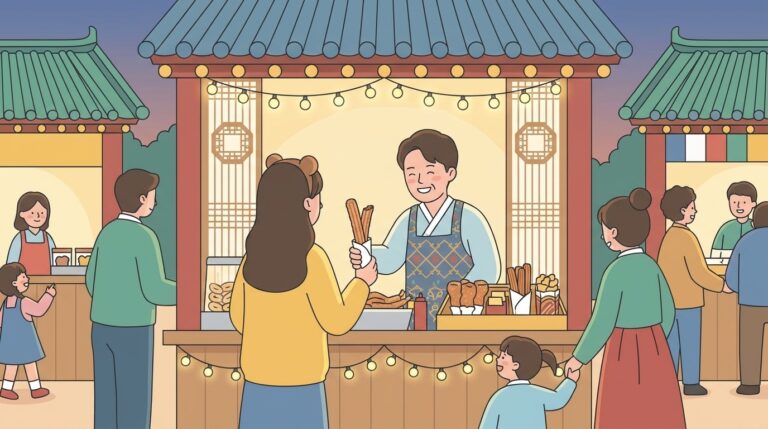
Setting: Saturday afternoon at Everland. The sun is shining, the lines are long, and you’ve finally reached the front of the snack cart line. The smell of cinnamon is heavenly.
Characters:
– YOU: A hungry language learner wanting a snack after riding the T-Express.
– Staff Member (알바생): A tired but polite 20-something part-timer wearing a theme park uniform.
Dialogue:
Staff Member: 안녕하세요! 주문하시겠어요? 🎪
(annyeonghaseyo! jumunhasigesseoyo?)
[Hello! Would you like to order?]
YOU: 네, 츄러스 하나 주세요.
(ne, chureoseu hana juseyo.)
[Yes, one churro, please.]
Staff Member: 네, 3,500원입니다. 결제 도와드릴게요.
(ne, samcheon-obaegwonimnida. gyeolje dowadeurilgeyo.)
[Okay, that’s 3,500 won. I’ll help you with the payment.]
🔀 Your Turn! How do you respond?
– A) “돈 여기 있어요.” (Here is the money.)
– B) “카드로 할게요.” (I’ll pay by card.)
– C) “저 돈 없어요.” (I don’t have money.)✅ Best Choice: B — Korea is largely cashless, and amusement parks prefer card payments for speed.
⚠️ Choice A Analysis: While okay if you actually have cash, handing over cash might slow down the line. Plus, “여기 있어요” can sound a tiny bit blunt if not said with a warm tone.
(You hand over your card. The staff processes it.)
Staff Member: 영수증 드릴까요?
(yeongsujeung deurilkkayo?)
[Shall I give you the receipt?]
YOU: 괜찮아요. 버려주세요. 😊
(gwaenchanayo. beoryeojuseyo.)
[It’s okay. Please throw it away.]
Staff Member: 네, 맛있게 드세요!
(ne, masitge deuseyo!)
[Okay, enjoy your food!]
Phase 6: 10-Second Shadowing Drill
Let’s practice the rhythm! Pay attention to the pauses (/).
😊 안녕하세요! / 츄러스 하나 / 주세요.
(annyeonghaseyo! / chureoseu hana / juseyo.)
Smile and keep the tone bright at the end!
💳 카드로 / 할게요.
(kadeuro / halgeyo.)
Slightly lower, confident tone as you pull out your wallet.
🙅♀️ 영수증은 / 버려주세요.
(yeongsujeungeun / beoryeojuseyo.)
Polite but firm, with a gentle head shake.
Phase 7: K-Culture Mini Dictionary
1. 놀이공원
* Romanization: norigongwon
* English: Amusement park
* Context: Think Lotte World, Everland, or Seoul Land. A major spot for dates, family outings, and school trips.
2. 머리띠
* Romanization: meoritti
* English: Headband (specifically the cute animal ones)
* Context: It is practically an unwritten rule in Korea to buy and wear animal ear headbands when visiting an amusement park, regardless of your age!
3. 알바생
* Romanization: albaseng
* English: Part-time worker
* Context: From the German word “Arbeit.” The people working at the churro carts, rides, and ticket booths are usually young “albasengs.”
4. 썸
* Romanization: sseom
* English: The “talking stage” / Flirtation phase
* Context: Derived from “Something.” Going to an amusement park and sharing a churro is a classic date activity during the “sseom” phase before officially becoming a couple.
Phase 8: Traveler Survival Kit
🆘 Survival Expression #1: “이거 얼마예요?”
– 🇰🇷 igeo eolmayeyo?
– 🗣️ Pronunciation: [ee-guh ohl-ma-ye-yo?]
– 📍 Where to use: Kiosks, street food stalls, souvenir shops.
– 💡 Pro Tip: If you can’t understand the numbers they say in Korean, just politely point to your phone or hold out the card reader. They will type the amount on the screen!📌 Editor’s Travel Note: Paying in Korea
– Cash vs. Card: Korea is a “Card Heaven.” Even a 1,000 KRW (under $1) purchase can be put on a card. Don’t feel guilty for not having cash.
– Tipping: There is absolutely NO tipping culture in Korea. If you try to tip the churro vendor, they will probably chase you down thinking you forgot your change!
Phase 9: Critical Thinking Corner — “One Step Deeper”
Food & Identity: The Culture of Sharing
🧠 Think Deeper:
Notice how in Korea, even snacks at an amusement park are meant to be shared. From eating out of the same large stew pot (찌개) at a restaurant to sharing one hot churro on a date, food is deeply tied to the concept of 정 (Jeong – collective affection and attachment). In many Western cultures, having your own individual portion is standard and hygienic. In Korea, sharing a single portion signifies closeness, trust, and erasing the boundaries between “you” and “me.”💬 Your Turn: Do people share single snacks like a churro or an ice cream in your culture, or does everyone buy their own? Tell me in the comments!
Phase 10: FAQ & Avoiding Mistakes
Q: The vendor is much younger than me. Can I just say “츄러스 줘” (Give me a churro)?
A: NO! Even if the part-timer (알바생) looks like a high schooler, they are providing a service. Always use polite form (주세요) to service workers. Using informal language (반말) to service staff is considered extremely rude in modern Korea.
Q: What if I want more than one?
A: Use native Korean numbers!
– One: 하나 (hana)
– Two: 두 개 (du gae)
– Three: 세 개 (se gae)
(e.g., 츄러스 두 개 주세요 – Two churros, please!)
❌ Common Mistake #1: Saying “감사합니다” (Thank you) and then leaving your trash on the counter.
✅ Do this instead: Amusement parks in Korea have very strict trash separation (Recycling/General waste). Look for the bins usually located right next to the stall and throw away your own napkin/churro wrapper!
Phase 11: Summary & Action Items
🎯 One-Liner Summary: To get your sweet treat like a local, just smile and say, “츄러스 하나 주세요, 카드로 할게요!”
🔥 Action Missions:
– 🥉 Bronze (Solo): Stand in front of your mirror and practice the 10-second shadowing drill three times.
– 🥈 Silver (Online): Go to a K-Culture community or our comment section and write: “If I go to Lotte World, I will order [Your favorite snack] 주세요!”
– 🥇 Gold (Real Life): Next time you visit a Korean café or market, try ordering your pastry or coffee using the “[Item] + 하나 + 주세요” structure!
🎡 K-Culture Mission:
Search “Korean amusement park food” on YouTube or Instagram. Watch a vlog and see if you can catch the moment they pay. Did they take the receipt, or did they tell the cashier to throw it away?
How excited are you for your future Korean amusement park date? Let me know below! 👇
Phase 12: Quiz — Interactive Challenge
1. Situational Judgment:
You bought a churro and the cashier hands you a long paper receipt that you don’t want. What is the most natural thing to say?
– A) 안녕히 계세요. (Goodbye)
– B) 영수증 버려주세요. (Please throw away the receipt.)
– C) 이거 얼마예요? (How much is this?)
2. True or False – K-Culture Edition:
It is common and polite to leave a 10% tip in cash at the churro cart if the service was fast. (True / False)
3. Fill in the Blank:
You want to pay with your credit card.
“_____로 할게요.” (_____ro halgeyo.)
👀 Click here for answers!
1. B (A is just goodbye, C is asking for the price again.)
2. False (There is NO tipping culture in Korea!)
3. 카드 (Card)
Frequently Asked Questions (FAQ)
Q: What does "츄러스 하나 주세요." mean in Korean and how do you pronounce it?
A: In Korean, "츄러스 하나 주세요." is pronounced [chureoseu hana juseyo. [chu-reo-seu ha-na joo-se-yo] and means: (Literal) Give me one churro. / (Real nuance) I'll have one churro, please.
Q: What does "카드로 할게요." mean in Korean and how do you pronounce it?
A: In Korean, "카드로 할게요." is pronounced [kadeuro halgeyo. [ka-deu-ro hal-gge-yo] and means: (Literal) I will do with card. / (Real nuance) I'll pay by card.
Q: What does "영수증 버려주세요." mean in Korean and how do you pronounce it?
A: In Korean, "영수증 버려주세요." is pronounced [yeongsujeung beoryeojuseyo. [young-soo-jeung buh-ryuh-joo-se-yo] and means: (Literal) Please throw away the receipt. / (Real nuance) No receipt, please. / You can throw away the receipt.







