

Phase 1: Empathy (The K-Culture Cold Open)
Hello there! I’m the lead editor at Daily Hangul, your veteran tutor and local culture navigator.
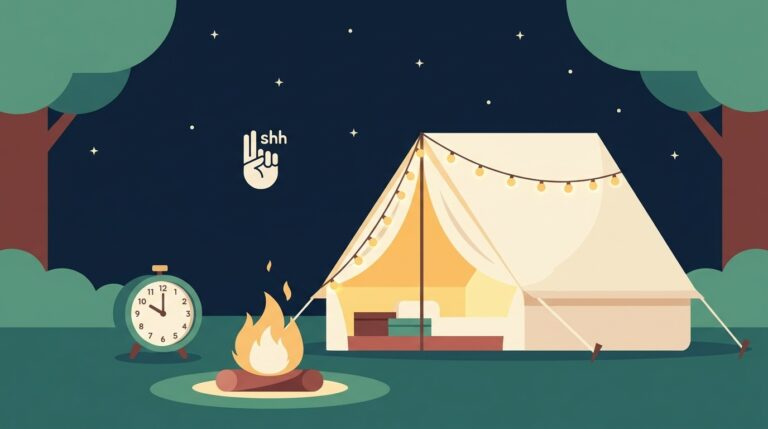
Imagine this: You’re at a breathtaking luxury glamping site in Gapyeong, surrounded by pine trees. String lights are glowing warmly above your aesthetic canvas tent. You’ve just finished grilling Samgyeopsal (pork belly), and a gentle K-Pop acoustic playlist is setting the perfect mood. You and your friends are laughing, sharing stories, and living out that perfect K-Drama camping scene.
Then, the clock strikes 10:00 PM.
Suddenly, the ambient noise drops to a whisper. A staff member walks by with a flashlight, or perhaps a neighbor gives your tent a hesitant, slightly uncomfortable look. Welcome to the uniquely Korean camping concept: 매너타임 (Manner Time).
For advanced (C1) Korean learners, surviving Manner Time isn’t just about knowing the word “quiet.” It’s about navigating the delicate social contract of shared spaces in Korea. If you don’t know how to handle this gracefully, you might come off as the clueless tourist. But if you master the nuanced, polite expressions we’re covering today, you’ll instantly earn the respect of locals and be treated like a true insider. Let’s dive in!
Phase 2: Core Expressions Deep Dive
At the C1 level, you already know “조용히 하세요” (Be quiet). But in real life, using that phrase will make you sound aggressive. Here is how Korean adults actually handle noise complaints politely.
1. 매너타임이라서 조금만 조용히 해 주시겠어요?
- Pronunciation: [maeneotaim-iraseo jogeum-man joyong-hi hae ju-si-get-eo-yo?]
Sound-alike guide: ‘eo’ sounds like the ‘uh’ in ‘uh-oh’.- Meaning: (Literal) Because it is manner time, could you please be quiet just a little bit? / (Real nuance) It’s quiet hours now, so I’d appreciate it if you could keep it down.
- K-Culture Moment: This is the gold standard of polite confrontation. You’ll hear this in reality shows like Camping Club or In the Soop when cast members remind each other of the late hour. By blaming “Manner Time” (an external rule) rather than attacking the person, it saves face for everyone.
- Editor’s Insight: The magic word here is 조금만 (just a little bit). Koreans use “조금” or “조금만” to soften a command. You aren’t asking them for absolute silence; you’re just gently nudging them to lower their volume.
- Situation Spectrum:
- Close Friends (Casual): 🚫 (Too formal, you’d just say “야, 매너타임이다 조용히 하자”)
- Strangers at a campsite (Semi-formal): ✅ (Perfect)
- Camp Manager to Guests (Formal): ✅
- 🤔 Think About It: Why do Koreans often attribute their requests to external rules (like Manner Time or company policy) rather than expressing their personal annoyance? How does this relate to maintaining harmony (기분 – Kibun)?
2. 저희가 너무 시끄러웠나요? 주의하겠습니다.
- Pronunciation: [jeo-hui-ga neo-mu si-kkeu-reo-weot-na-yo? ju-ui-ha-get-seum-ni-da.]
Sound-alike guide: ‘eu’ sounds like the disgusted sound you make when stepping in gum.- Meaning: (Literal) Were we too loud? We will be careful. / (Real nuance) Oh, were we being too loud? I apologize, we’ll keep it down from now on.
- K-Culture Moment: Imagine you’re the one who got too excited playing a drinking game. When someone approaches you, this is your ultimate de-escalation phrase.
- Editor’s Insight: Notice that there is no explicit “미안합니다” (I’m sorry) here. In adult, formal situations, “주의하겠습니다” (I will pay attention/be careful) is a highly sophisticated way to acknowledge a mistake and promise to fix it without groveling.
- Situation Spectrum:
- Close Friends (Casual): 🚫
- Neighbors/Strangers (Semi-formal): ✅
- Formal Apology to Manager (Formal): ✅
- 🤔 Think About It: In English, we might instinctively say “Sorry!” but in Korean business or public etiquette, promising future action (“I will be careful”) often carries more weight. Do you have a similar dynamic in your culture?
3. 옆 텐트가 너무 시끄러운데, 조치 좀 취해 주실 수 있나요?
- Pronunciation: [yeop tenteu-ga neo-mu si-kkeu-reo-un-de, jo-chi jom chwi-hae ju-sil su it-na-yo?]
Sound-alike guide: ‘chwi’ sounds like ‘chwee’ (like tweeting like a bird).- Meaning: (Literal) The next tent is too loud, can you take some measures? / (Real nuance) The neighboring tent is being really loud; could you please do something about it?
- K-Culture Moment: You don’t want to confront the loud, drunk college students next door. So, you text or call the 캠지기 (Camp-jigi, camp manager). This is a highly advanced, natural way to file a complaint.
- Editor’s Insight: 조치를 취하다 (to take measures/action) is a fantastic C1 vocabulary word. It sounds professional and urgent, prompting the manager to step in immediately.
- Situation Spectrum:
- Direct to the loud neighbors: 🚫 (Never say this to their face!)
- Speaking to the Camp Manager: ✅ (Highly recommended)
Phase 3: Textbook vs. Real Korean
Let’s see how language shifts from the ruleboard to the actual campfire.
[Asking someone to be quiet]
* 📖 Textbook Korean: 정숙해 주십시오. (Please maintain silence.)
* 🗣️ Real Korean: 저기 죄송한데, 지금 매너타임이라서요… (Excuse me, but it’s manner time right now… [trail off])
* 💡 Why the difference?: Real conversational Korean heavily relies on trailing off sentences (ending with ~라서요 or ~인데요) to let the listener fill in the blank. It’s the ultimate polite, non-confrontational nudge.
[Promising to be quiet]
* 📖 Textbook Korean: 네, 조용히 하겠습니다. (Yes, I will be quiet.)
* 🗣️ Real Korean: 아, 넵! 주의할게요. 죄송합니다~ (Ah, yup! We’ll be careful. Sorry~)
* 💡 Why the difference?: Adding “아, 넵!” (Ah, yep!) shows immediate, slightly embarrassed compliance, which instantly diffuses any tension.
[Complaining to the manager]
* 📖 Textbook Korean: 다른 사람들이 너무 시끄럽습니다. (Other people are too loud.)
* 🗣️ Real Korean: 매너타임 관리가 잘 안 되는 것 같아요. (It seems like manner time isn’t being managed well.)
* 💡 Why the difference?: At an advanced level, critiquing the situation rather than the people is a strategic way to make a complaint sound objective and urge the manager to do their job.
Phase 4: Cultural Context — K-Culture Deep Dive
4-1. Non-verbal Nuances & Nunchi (눈치)
When enforcing or reacting to Manner Time, your body language speaks volumes. If you must ask a neighbor to be quiet, do not stare them down aggressively. Approach with a slightly bowed posture, a hesitant smile, and perhaps scratch the back of your neck. This physical display of “I feel awkward bringing this up, but I have to” is a crucial part of Nunchi. It signals that you aren’t trying to pick a fight.
4-2. The Reality of Korean Camping (K-Travel)
If you’ve watched K-Dramas like Hospital Playlist where characters go camping, you might think you’re alone in the wilderness. In reality, Korea is a small, mountainous peninsula. Glamping sites are highly optimized for space, meaning tents are often placed just a few meters apart. Because canvas tents offer zero soundproofing, Manner Time (usually 10 PM or 11 PM to 7 AM) is an absolute survival necessity. During this time, washing dishes, loud talking, music, and sometimes even showering, are strictly prohibited. Understanding this prevents the “ugly tourist” stereotype.
Phase 5: Real-life Roleplay Scenario
Setting: A Friday night at a luxury glamping spot in Pocheon. It is 10:30 PM. The night air is crisp, and you’re sitting around a fire pit with two Korean coworkers. You’ve had a few beers and the conversation is getting animated.
Characters:
– YOU: An expat working in Seoul, having a great time but mindful of your surroundings.
– Minho (32): Your Korean coworker. He’s a bit tipsy and telling a very loud, funny story.
– Jimin (28): A guest from the neighboring tent. Looks tired.
Dialogue:
Minho: 아, 그래서 그때 부장님이 어떻게 했는지 알아요? 대박 웃겨 진짜! 🤣
(A, geuraeseo geuttae bujangnimi eotteoke haenneunji arayo? Daebak utgyeo jinjja!)
[Oh, so do you know what the manager did then? It was freaking hilarious!]
YOU: 민호 씨, 목소리가 좀 큰 것 같아요. 지금 몇 시죠?
(Minho ssi, moksoriga jom keun geot gatayo. Jigeum myeot sijo?)
[Minho, I think your voice is a bit loud. What time is it now?]
Minho: 에이, 캠핑 왔는데 좀 놀아도 되죠! 짠 합시다, 짠!
(Ei, kaemping wanneunde jom norado doejo! Jjan hapsida, jjan!)
[Hey, we’re camping, we can have some fun! Let’s toast, cheers!]
(🎭 Stage Direction: Jimin steps into the light of your site, looking apologetic but firm.)
Jimin: 저기요… 죄송한데요.
(Jeogiyo… joesonghandeyo.)
[Excuse me… I’m sorry, but…]
Minho: 네? 무슨 일이시죠?
(Ne? Museun irisijo?)
[Yes? What’s the matter?]
Jimin: 지금 매너타임이라서요… 조금만 조용히 해 주시겠어요? 애기가 자고 있어서요.
(Jigeum maeneotaim-iraseoyo… jogeum-man joyong-hi hae ju-sigesseoyo? Aegiga jago isseoseoyo.)
[It’s manner time right now, so… could you please keep it down a bit? Our baby is sleeping.]
🔀 Your Turn! How do you respond?
– A) “아, 네. 알겠습니다.” (Standard, but slightly cold)
– B) “저희가 너무 시끄러웠나요? 정말 죄송합니다. 주의하겠습니다!” (The empathetic de-escalator)
– C) “우리가 왜요? 아직 10시 반인데요.” (The absolute worst choice)✅ Best Choice: B — Reason: Acknowledging your fault (“Were we too loud?”) and promising action (“We will be careful”) is the C1-level standard for adult social interactions in Korea. It instantly makes Jimin feel heard and respected.
⚠️ Choice C Analysis: This will lead to an immediate fight and likely result in the camp manager kicking you out. Never argue against Manner Time!
YOU: (Choosing B) 아, 저희가 너무 시끄러웠나요? 정말 죄송합니다. 주의하겠습니다!
(A, jeohuiga neomu sikkeureowonnayo? Jeongmal joesonghamnida. Juuihagetseumnida!)
[Oh, were we too loud? I’m so sorry. We’ll be careful!]
Jimin: 아, 네… 감사합니다. 좋은 밤 되세요.
(A, ne… gamsahamnida. Joeun bam doeseyo.)
[Ah, yes… thank you. Have a good night.]
Minho: 아휴, 제가 너무 신났었네요. 우리 이제 불멍이나 합시다.
(Ahyu, jaega neomu sinnasseonneyo. Uri ije bulmeong-이나 hapsida.)
[Sigh, I got too excited. Let’s just do bulmeong (stare at the fire) now.]
YOU: 네, 조용히 불멍 타임 가질게요.
(Ne, joyonghi bulmeong taim gajilgeyo.)
[Yeah, let’s have a quiet fire-gazing time.]
Phase 6: 10-Second Shadowing Drill
Master the tone of the polite apology. Follow the slashes for pacing!
😥 아, / 저희가 / 너무 시끄러웠나요? / 🙏 정말 죄송합니다. / 주의하겠습니다!
(Ah, / jeo-hui-ga / neo-mu si-kkeu-reo-weot-na-yo? / jeong-mal joe-song-ham-ni-da. / ju-ui-ha-get-seum-ni-da!)
Editor’s Tip: Make sure your tone goes up slightly at the question mark (to show genuine concern), and falls flat and serious at “주의하겠습니다” to show sincerity.
Phase 7: K-Culture Mini Dictionary
Master these glamping vocabulary words to sound like a local!
1. 매너타임 (Manner Time)
* Romanization: maeneotaim
* English: Quiet hours at a campsite.
* Context: Usually from 10 PM to 7 AM. The single most important rule in Korean camping culture.
2. 불멍 (Bulmeong)
* Romanization: bulmeong
* English: Zoning out while staring at a campfire.
* Context: A portmanteau of 불 (fire) and 멍때리다 (to zone out). The ultimate goal of a Korean camping trip.
3. 캠지기 (Camp-jigi)
* Romanization: kaemjigi
* English: Camp manager / owner.
* Context: A friendly slang term combining 캠핑 (camping) and 지기 (keeper). They are the judges and enforcers of Manner Time.
4. 진상 (Jinsang)
* Romanization: jinsang
* English: An entitled, annoying customer or guest.
* Context: If you blast K-Pop from a Bluetooth speaker at 11 PM, you will be labeled a 진상 캠퍼 (Jinsang camper).
Phase 8: Traveler’s Survival Kit
Glamping in Korea? Keep these phrases in your back pocket.
🆘 Survival Phrases TOP 3
– 🇰🇷 “장작 한 망 주세요.” (jangjak han mang juseyo.)
– 🗣️ Meaning: “Please give me one bag of firewood.”
– 📍 Where to use: At the camp store (매점) before bulmeong.
– 🇰🇷 “여기 바닥 난방이 안 들어오는 것 같아요.” (yeogi badak nanbang-i an deureo-oneun geot gatayo.)
– 🗣️ Meaning: “It seems like the floor heating isn’t working here.”
– 📍 Where to use: When your glamping tent’s Ondol (floor heating) fails in autumn/winter.
– 🇰🇷 “매점은 몇 시에 닫나요?” (maejeomeun myeot sie dannayo?)
– 🗣️ Meaning: “What time does the convenience store close?”
– 📍 Where to use: When checking in. (Camp stores usually close right before Manner Time!).📌 Editor’s Travel Note
– App to use: Download ‘캠핏 (Camfit)’ or use Naver Map to find glamping sites.
– Trash Etiquette: You must separate your recycling (분리수거) perfectly before checking out. It is mandatory in Korea!
Phase 9: Critical Thinking Corner — “한 발 더 깊이”
🧠 Think Deeper: Language & Power in Shared Spaces
Why is Korean “Manner Time” enforced so strictly, and why is the language around it so indirect? In a high-density country like Korea, the social contract of “not inconveniencing others” (민폐 끼치지 않기) is paramount. Notice how the Korean language provides a buffer for this. Instead of a direct “You are too loud,” people say “It seems like it’s a bit loud” or “Because of Manner time…”. The language itself acts as a shock absorber for social friction, allowing rules to be enforced without destroying the harmony between strangers.💬 Your Turn: Does your home country have strict “quiet hours” at campsites? How do people confront noisy neighbors in your language? Share in the comments!
Phase 10: FAQ & Avoiding Misunderstandings
Q: “Can I just confront a loud neighbor directly instead of calling the manager?”
Maybe, but be careful. If it’s a slight noise, the gentle approach we learned today works. However, if they are heavily intoxicated, it is always better to text the Camp-jigi. In Korea, letting a third-party authority handle disputes is considered the most “clean” way to resolve conflicts without losing face.
Q: “What if I whisper during Manner Time?”
No. In strict glamping sites, even whispering or the sound of washing dishes is considered a violation. Manner time means complete sleep mode.
❌ Common Mistake #1: Saying “저희는 괜찮아요” (We are fine) when someone complains.
✅ Do this instead: They aren’t asking if you are okay; they are telling you that they are uncomfortable. Always apologize and promise to lower your volume!
Phase 11: Summary & Action Items
- One-Liner Summary: To survive Korean Manner Time, use indirect, polite requests and promise to “be careful” (주의하겠습니다) if you are the one making noise.
-
Action Mission 3 Steps:
- 🥉 Bronze: Practice the 10-second shadowing drill in front of a mirror until “주의하겠습니다” rolls off the tongue naturally.
- 🥈 Silver: Leave a comment below explaining what “불멍” means in your own words!
- 🥇 Gold: The next time you book an Airbnb or glamping spot in Korea, ask the host: “매너타임은 몇 시부터인가요?” (From what time is manner time?)
- K-Culture Mission: Go watch an episode of Tent Outside Europe or In the Soop on streaming platforms. Pay attention to how the volume of the cast drastically drops after dinner, and listen for the word “매너타임”!
Did you find this helpful? Have you ever had a funny camping fail in Korea? Let me know in the comments! 👇
Phase 12: Quiz — Interactive Challenge
Q1. (Situational Judgment) It’s 11 PM at your glamping site. The tent next door is blasting a K-Pop playlist. You text the manager. Which is the most natural C1-level text?
A) 저기요, 옆 텐트 조용히 하라고 하세요.
B) 옆 텐트가 너무 시끄러운데, 조치 좀 취해 주실 수 있나요?
C) 매너타임 싫어요.
Q2. (Fill in the Blank) You accidentally dropped a pan at 10:30 PM. The neighbor looks over. You say: “아, 너무 시끄러웠나요? __________.”
A) 주의하겠습니다 (I will be careful)
B) 신경 쓰지 마세요 (Don’t mind it)
C) 수고하세요 (Keep up the good work)
Q3. (True or False) In Korea, “Manner Time” usually means you can still play acoustic guitar as long as it’s not a loud speaker.
(Answers: Q1 – B, Q2 – A, Q3 – False! Instruments are strictly banned during Manner Time!)
Frequently Asked Questions (FAQ)
Q: What does "매너타임이라서 조금만 조용히 해 주시겠어요?" mean in Korean and how do you pronounce it?
A: In Korean, "매너타임이라서 조금만 조용히 해 주시겠어요?" is pronounced [maeneotaim-iraseo jogeum-man joyong-hi hae ju-si-get-eo-yo?] and means: (Literal) Because it is manner time, could you please be quiet just a little bit? / (Real nuance) It's quiet hours now, so I'd appreciate it if you could keep it down.
Q: What does "저희가 너무 시끄러웠나요? 주의하겠습니다." mean in Korean and how do you pronounce it?
A: In Korean, "저희가 너무 시끄러웠나요? 주의하겠습니다." is pronounced [jeo-hui-ga neo-mu si-kkeu-reo-weot-na-yo? ju-ui-ha-get-seum-ni-da.] and means: (Literal) Were we too loud? We will be careful. / (Real nuance) Oh, were we being too loud? I apologize, we'll keep it down from now on.
Q: What does "옆 텐트가 너무 시끄러운데, 조치 좀 취해 주실 수 있나요?" mean in Korean and how do you pronounce it?
A: In Korean, "옆 텐트가 너무 시끄러운데, 조치 좀 취해 주실 수 있나요?" is pronounced [yeop tenteu-ga neo-mu si-kkeu-reo-un-de, jo-chi jom chwi-hae ju-sil su it-na-yo?] and means: (Literal) The next tent is too loud, can you take some measures? / (Real nuance) The neighboring tent is being really loud; could you please do something about it?






