

Phase 1: Empathy & Immersion (The Cold Open)
Hello! I’m your Daily Hangul Editor.
Picture this: You are watching a K-Drama. The main character just had a terrible day at work, or maybe they just broke up. Where do they go? A Jjimjilbang (찜질방). The next scene shows them lying on a wet vinyl table, while a person in black underwear scrubs them down with a brightly colored, abrasive towel. Suddenly, the scrubber slaps the table, and the character obediently rolls over like a pancake.
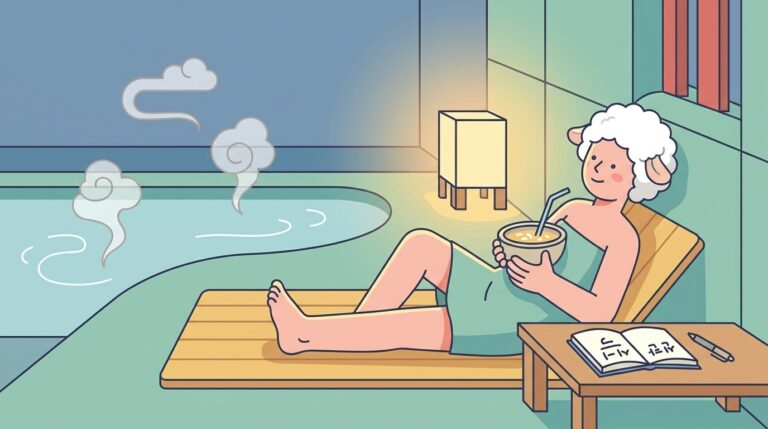
Later, they emerge glowing, drinking a sweet rice beverage with a towel folded like sheep horns on their head. You think, “I want to try that!”
But then reality hits. You walk into a Korean bathhouse, you’re entirely naked, and there’s a loud, bustling wet room. How do you actually book the scrub? What if it hurts too much? What do you say when the legendary Imo-nim (auntie) tells you to flip over?
If you don’t know the right phrases, you might end up either missing out on the best exfoliation of your life, or silently enduring a scrub that feels like sandpaper. Don’t worry! This guide is based on real panic moments from my tutoring students. By the end of this post, you’ll be navigating the Korean body scrub experience like a true insider.
Phase 2: Core Expressions Deep Dive
Let’s look at the absolute must-know phrases for your body scrub mission.
1. 세신 예약할게요 (I would like to book a body scrub)
- Pronunciation: [se-sin ye-ya-kal-ge-yo]
- Sound-alike guide: ‘se-sin’ sounds like “say sheen”, ‘ye-yak’ sounds like “yeah yak”.
- Meaning: Literal: “I will reserve a body scrub.” / Real nuance: “Put me on the waitlist for a scrub, please!”
- K-Culture Moment: In a busy bathhouse, the scrub masters (세신사 – Seshinsa) are always working. You don’t book at the front desk; you walk into the wet room, find the scrub area, and say this to the scrubber. They will usually ask for your locker key number to put on their whiteboard.
- Editor’s Insight: The word Seshin (세신) is the professional term for a body scrub. If you use this word instead of the basic ttae-mili (때밀이), you sound much more respectful and natural.
- Situation Spectrum:
- Friends (Casual): 🚫 (You wouldn’t say this to a friend)
- Bathhouse Staff (Polite): ✅
- Formal/Business: 🚫
- 🤔 Think About It: In many cultures, bathing is strictly private. Why do you think Koreans are so comfortable paying a stranger to scrub them in a communal room?
2. 살살 해주세요 (Please do it gently)
- Pronunciation: [sal-sal hae-ju-se-yo]
- Sound-alike guide: ‘sal’ rhymes with “Hal”. Say it softly, twice!
- Meaning: Literal: “Please do it softly.” / Real nuance: “Ouch! Please don’t peel my skin off!”
- K-Culture Moment: Korean scrub masters take deep pride in removing every ounce of dead skin from your body. They have strong hands! If you are not used to it, it can sting. Saying this phrase will make them adjust their pressure.
- Editor’s Insight: You can use “sal-sal” (gently/softly) in many situations! If a hairdresser is brushing your tangled hair, or a massage therapist is pressing too hard, just say “sal-sal haejuseyo.”
- Situation Spectrum:
- Friends (Casual): ✅ (살살 해! – sal-sal hae!)
- Staff/Service providers: ✅
- 🤔 Think About It: Korean uses lots of “mimetic words” (words that mimic sensations or actions), like sal-sal. Does your language have words that sound like the feeling they describe?
3. 아, 시원하다! (Ah, that’s refreshing!)
- Pronunciation: [A, si-won-ha-da!]
- Sound-alike guide: ‘si-won’ sounds like “she won”.
- Meaning: Literal: “It is cool (temperature).” / Real nuance: “Ah, that hits the spot! / That feels incredibly relieving.”
- K-Culture Moment: You will hear older Koreans say this when they step into a boiling hot bath. It confuses many foreigners! In Korea, siwonhada isn’t just about cold temperatures; it’s about the physical and mental release of tension. When the scrub is over and they pour warm water over you, this is exactly how you will feel.
- Editor’s Insight: Muttering this to yourself after the scrub will earn you an approving nod from the scrub master. You’ve truly understood the Korean soul!
- Situation Spectrum:
- Muttering to yourself (Casual): ✅
- Friends: ✅
- Formal: ⚠️ (Use 시원합니다 [si-won-ham-ni-da])
Phase 3: Textbook vs. Real Korean
Let’s see how textbook phrases differ from what you actually hear at the bathhouse.
[Getting the Scrub Master’s Attention]
* 📖 Textbook Korean: 저기요, 때를 밀고 싶습니다. (Excuse me, I want to scrub dirt off.)
* 🗣️ Real Korean: 이모님! 세신 예약이요~ (Auntie! Scrub reservation!)
* 💡 Why the difference?: Koreans often use family terms like Imo-nim (Auntie) to show friendly respect to older female service workers, creating an instant warm connection.
[Expressing Pain]
* 📖 Textbook Korean: 너무 아픕니다. (It is too painful.)
* 🗣️ Real Korean: 앗! 쪼금만 살살요 ㅠㅠ (Ack! Just a little softer please.)
* 💡 Why the difference?: Apeumnida sounds like a medical diagnosis. Adding “jjogeum-man” (just a little) makes your request softer and less like a complaint.
Bottom Note: For a
B1learner, using “이모님 (Imo-nim)” in a Jjimjilbang is perfectly fine and shows high cultural fluency. However, don’t use it in high-end spas; stick to “저기요 (Jeogiyo – Excuse me)” there.
Phase 4: Cultural Context — K-Culture Deep Dive
4-1. Non-Verbal Cues: The Art of the Flip
During the scrub, you don’t need to speak much. The Seshinsa will communicate via touch. When they lightly slap your shoulder or the table, it means “roll over.” Don’t make intense eye contact; just relax your muscles and let them maneuver your arms and legs. It’s an ultimate exercise in letting go of your Nunchi (social anxiety about what others think).
4-2. The Jjimjilbang Aftercare: K-Food and K-Drama Magic
Once you are scrubbed raw and clean, you put on your provided Jjimjilbang T-shirt and shorts and enter the co-ed dry sauna area. Here, you must partake in the holy trinity of K-Drama bathhouse culture:
1. 양머리 (Yangmeori – Sheep Head): Folding your towel into two buns like Princess Leia. It keeps the sweat out of your eyes and looks incredibly cute.
2. 식혜 (Sikhye): An ice-cold, sweet rice drink. After sweating and getting scrubbed, the sugar hit of Sikhye is legendary.
3. 맥반석 계란 (Maekbanseok Gyeran): Roasted eggs that are slightly brown inside.
Critical View: While dramas often show characters cracking these eggs on each other’s heads for laughs, doing it too hard actually hurts. Be gentle with your friends!
Phase 5: Real-Life Roleplay Scenario
Let’s put you in the action!
Setting: A Saturday afternoon inside the wet area of “Dragon Hill Spa.” Steam is everywhere. The sound of splashing water echoes. You are wearing nothing but your locker key wristband.
Characters:
– YOU: A brave foreigner determined to get a Korean scrub.
– Seshinsa (Scrub Master): A tough but motherly woman in black waterproof underwear.
Dialogue:
YOU: 저기… 이모님! 세신 예약할게요.
(Jeogi… Imo-nim! Seshin yeyakalgeyo.)
[Excuse me… Auntie! I’d like to book a scrub.]
Seshinsa: (Scrubbing another customer without looking back) 몇 번?
(Myeot beon?)
[What number?]
YOU: 네? 아, 팔찌 번호요? 104번이요.
(Ne? Ah, paljji beonhoyo? Baek-sa-beon-iyo.)
[Pardon? Ah, my wristband number? 104.]
Seshinsa: (Writes 104 on a wet whiteboard) 온탕에 들어가서 15분 불리고 와요.
(Ontang-e deureogaseo sibo-bun bulligo wayo.)
[Go into the hot bath, soak for 15 minutes, and come back.]
(15 minutes later, she calls “104!!” You lie on the table. She starts scrubbing your back vigorously.)
YOU: 윽!
(Euk!)
[Ugh!]
Seshinsa: 아파요? 때가 아주 많아~ 시원하죠?
(Apayo? Ttaega aju mana~ Siwonhajyo?)
[Does it hurt? You have a lot of dead skin~ Refreshing, right?]
🔀 Your Turn! How do you respond?
– A) 네, 너무 아픕니다. 그만하세요! (Yes, it hurts too much. Stop!)
– B) 아! 이모님, 쪼금만 살살 해주세요 ㅠㅠ (Ah! Auntie, please do it just a little more gently.)
– C) 시원해요! 빡빡 밀어주세요! (It’s refreshing! Scrub me hard!)✅ Best Choice: B — It politely communicates your limit without offending her pride.
⚠️ Choice A Analysis: This is too harsh and direct. It breaks the mood.
⚠️ Choice C Analysis: Only say this if you have the pain tolerance of a superhero. She will scrub harder.
(Seshinsa slaps your thigh lightly)
Seshinsa: 자, 돌아누워요.
(Ja, doranuwoyo.)
[Okay, turn over.]
YOU: (Flipping over like a pro) 네~
(Ne~)
[Okay~]
Phase 6: 10-Second Shadowing Drill
Practice this until it flows naturally. Pay attention to the pauses (/) and the emotion!
🥺 이모님~ / 쪼금만 / 살~살 / 해주세요 ㅠㅠ
(Imo-nim~ / jjogeum-man / sal~sal / hae-ju-se-yo)
Pro-tip: Stretch out the “sal~sal” to emphasize that you want it really soft.
Phase 7: K-Culture Mini Dictionary
Here are the essential cultural keywords for your bathhouse survival:
1. 눈치
* Romanization: nunchi
* English: Social sense / reading the room
* Context: In the bathhouse, you need nunchi to see which pools are empty, when to step out of someone’s way, and knowing not to splash others.
2. 찜질방
* Romanization: jjimjilbang
* English: Korean bathhouse and dry sauna
* Context: ‘Jjimjil’ means heating/fomentation, and ‘bang’ means room. It’s a 24-hour leisure complex where families, friends, and couples hang out.
3. 세신사 (or 때밀이)
* Romanization: seshinsa (or ttaemiri)
* English: Scrub master
* Context: Highly skilled professionals who perform the body scrub. Seshinsa is the polite occupational title.
4. 식혜 & 구운 계란
* Romanization: sikhye & guun gyeran
* English: Sweet rice punch & roasted eggs
* Context: The quintessential post-sauna snack combo. Eating this while wearing the sheep-head towel is the ultimate K-Culture flex.
Phase 8: Traveler Survival Kit
🆘 Survival Phrases for the Bathhouse
– 🇰🇷 “이거 팔찌로 결제되나요?” (igeo paljji-ro gyeolje-dwenayo?)
– 🗣️ English: “Can I pay with this wristband?”
– 📍 Where to use: Buying snacks, booking a scrub, or getting a massage inside the Jjimjilbang.
– 💡 Pro Tip: In modern Jjimjilbangs, your locker key is an electronic wristband. You tap it to buy food and pay for scrubs. You settle the final bill at the front desk when you leave! No need to carry wet cash.📌 Editor’s Travel Note
– Tattoos: Unlike Japan, most Korean bathhouses do not ban tattoos. However, if you have very large, prominent tattoos, you might get some curious stares from older folks. Just smile!
– Soap & Towels: Women usually get 2 small towels at the front desk and must bring/buy their own shampoo. Men have unlimited towels and basic soap in the locker room.
– Tipping: There is NO tipping culture in Korea. The price on the menu for the scrub is exactly what you pay.
Phase 9: Critical Thinking Corner — “Think Deeper”
Language & Power: The Great Equalizer
In Korean society, hierarchy (based on age, job title, and social status) is strictly woven into the language. You use different vocabulary for your boss versus your friend. However, the public bathhouse is known as the ultimate social equalizer. When everyone is completely naked, the markers of wealth—designer clothes, luxury watches—disappear.
Even a company CEO becomes just another person sweating in the sauna. Yet, interestingly, the language of respect remains. You still use polite forms (존댓말 – Jondaetmal) to strangers, and you address the scrub masters respectfully as Imo-nim. It shows that in Korea, basic human respect isn’t just about the clothes you wear; it’s a fundamental social fabric.
💬 Your Turn: Are there places in your culture where social hierarchies completely disappear? Share in the comments!
Phase 10: FAQ & Avoiding Misunderstandings
Q: “Can I wear a swimsuit in the wet/bath area?”
No! This is a very common foreigner mistake. You must be completely naked in the gender-segregated wet rooms. Wearing a swimsuit is considered unhygienic because it brings outside dirt into the clean bathwater.
Q: “Do I need to wash before getting into the hot pools?”
YES. Please take a quick shower with soap before entering any communal soaking tubs. It’s basic bathhouse etiquette.
Q: “Can I just say ‘때 밀어주세요’ (Ttae mireojuseyo)?”
Yes, it literally means “Please scrub my dirt,” and people do use it. But saying “세신 예약할게요” (Seshin yeyakalgeyo – I’d like to book a scrub) sounds much more natural and polite.
❌ Common Mistake #1: Going straight to the scrub table without soaking first.
✅ Do this instead: The scrub master will always tell you to soak in the warm pool (온탕 – Ontang) for at least 15-20 minutes. This softens your skin. If you don’t soak, the scrub will be incredibly painful!
Phase 11: Summary & Action Items
- One-Liner Summary: Remember to book your scrub politely (“세신 예약할게요”), ask for mercy gently (“살살 해주세요”), and enjoy the refreshing aftermath (“시원하다”).
-
Action Mission:
- 🥉 Bronze (Solo): Stand in your shower at home, turn on the warm water, and practice saying “아, 시원하다~” like a Korean grandfather.
- 🥈 Silver (Online): Comment below with the phrase you are most excited (or nervous) to use!
- 🥇 Gold (Real Life): Visit a Korean Jjimjilbang (or a Korean spa in your home country) and actually get a Seshin!
- K-Culture Mission: Watch an episode of a K-Drama featuring a Jjimjilbang scene (like Crash Landing on You or Reply 1988). Spot the sheep-head towels, Sikhye, and see if you can hear anyone say “시원하다”!
Phase 12: Interactive Quiz
Test your Jjimjilbang survival skills!
1. Situational Judgment: You are getting a scrub, and it feels like the auntie is using sandpaper. What is the most natural way to ask her to ease up?
– A) 너무 아파요. (Neomu apayo.)
– B) 살살 해주세요. (Salsal haejuseyo.)
– C) 안 시원해요. (An siwonhaeyo.)
2. True or False – K-Culture Edition:
“You should wear a bikini or swimming trunks in the gender-segregated wet room to be polite.”
– True / False
3. Fill in the Blank:
When you want to book a scrub, you should find the scrub master and say, “이모님, ______ 예약할게요!”
– A) 수영 (Suyeong – Swimming)
– B) 세신 (Seshin – Body scrub)
– C) 식혜 (Sikhye – Rice drink)
🚨 Click here for the Answers!
- B (Saying “Salsal haejuseyo” is the softest, most natural way. A is a bit blunt, and C means “It’s not refreshing/satisfying”, which might make her scrub harder!)
- False (You must be fully nude. Swimsuits are considered unhygienic in the baths.)
- B (Seshin! Though booking a Sikhye sounds delicious, you buy that outside the wet room.)
How did you do? Let me know in the comments if you’re ready for your first Korean body scrub!
Frequently Asked Questions (FAQ)
Q: What does "세신 예약할게요 (I would like to book a body scrub)" mean in Korean and how do you pronounce it?
A: In Korean, "세신 예약할게요 (I would like to book a body scrub)" is pronounced [se-sin ye-ya-kal-ge-yo] and means: a key conversational Korean expression covered in this lesson.
Q: What does "살살 해주세요 (Please do it gently)" mean in Korean and how do you pronounce it?
A: In Korean, "살살 해주세요 (Please do it gently)" is pronounced [sal-sal hae-ju-se-yo] and means: a key conversational Korean expression covered in this lesson.
Q: What does "아, 시원하다! (Ah, that's refreshing!)" mean in Korean and how do you pronounce it?
A: In Korean, "아, 시원하다! (Ah, that's refreshing!)" is pronounced [A, si-won-ha-da!] and means: a key conversational Korean expression covered in this lesson.







