

Phase 1: Empathy & The “Aha!” Moment
Hello there! It’s your Lead Editor from Daily Hangul.
Picture this: You are watching a popular Korean variety show like Knowing Bros (아는 형님). The cast is constantly teasing the legendary MC Kang Ho-dong, calling him “Cheonhajangsa” (천하장사). Or maybe you’re at a convenience store, and you see a bright yellow snack called “Cheonhajangsa Sausage.” What does a traditional wrestler have to do with a cheese sausage or a modern TV host?
If you’re studying Korean at an upper-intermediate or advanced level (C1), you already know the grammar. You can order food, write emails, and chat with friends. But the real “Insider” (인싸) level is unlocked when you understand cultural metaphors.
Ssireum (씨름), traditional Korean wrestling, is not just a sport. Its terminology has deeply infiltrated everyday Korean conversation, corporate politics, and media. Not knowing these terms means you might completely miss the subtext when your Korean colleagues are gossiping about office politics or when news anchors describe a dramatic election.
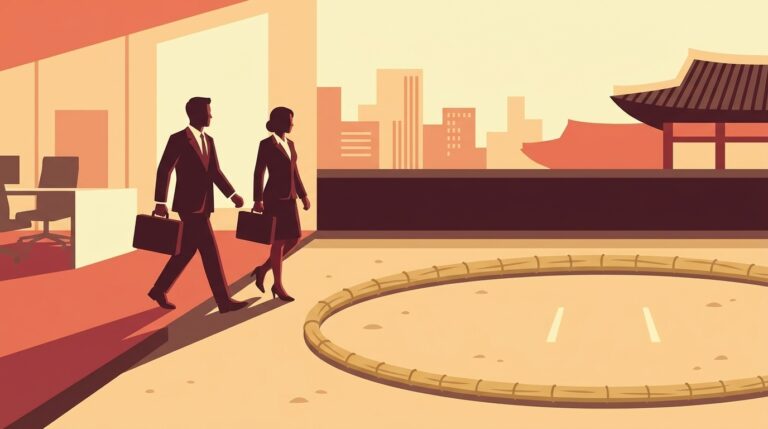
Let’s dive into the sand ring (모래판) and uncover the metaphorical power of Ssireum!
Phase 2: Core Expressions Deep Dive
Here are the top three Ssireum-derived expressions that Koreans use constantly in modern contexts.
1. 천하장사
- Pronunciation: [cheon-ha-jang-sa] Sounds like “chon-ha-jang-sah”
- Meaning:
- Literal: The Strongest Man Under Heaven (The highest champion title in Ssireum).
- Real Nuance: Someone with immense physical strength, or metaphorically, someone who eats a massive amount of food.
- K-Culture Moment: When a friend effortlessly opens a tightly sealed jam jar, or when someone carries three heavy boxes at once, Koreans will dramatically exclaim, “Oh! Are you a Cheonhajangsa?”
- Editor’s Insight: At the C1 level, you should notice how this word is often used playfully or ironically. It carries a warm, nostalgic vibe rather than an intimidating “macho” feel, partly due to the beloved snack “Cheonhajangsa Sausage” which every Korean grew up eating.
- Situation Spectrum:
- Casual with friends: ✅
- With coworkers (joking): ⚠️ (Okay if close)
- Formal/To seniors: 🚫
- 🤔 Think About It: Why is the ultimate champion named “Under Heaven” (천하)? How does this reflect the traditional East Asian worldview of nature and human limits?
2. 샅바 싸움
- Pronunciation: [sat-ba ssa-um] The “t” in sat stops sharply, like catching your breath.
- Meaning:
- Literal: The fight for the thigh band (satba) grip before the match starts.
- Real Nuance: An intense psychological battle, a power struggle, or a “war of nerves” before an actual negotiation or major event begins.
- K-Culture Moment: In corporate K-Dramas like Misaeng or Search: WWW, before the companies sign a contract, the executives have a passive-aggressive meeting where they test each other’s boundaries. The commentators (or your coworkers) will call this a “샅바 싸움.”
- Editor’s Insight: This is an incredibly sophisticated term. Using this instead of the basic “기싸움” (war of nerves) instantly elevates your Korean to a professional, native-like level.
- Situation Spectrum:
- Casual: ✅
- Semi-formal (Describing a situation): ✅
- Formal (Directly saying it to your boss): 🚫
- 🤔 Think About It: In Ssireum, the “satba ssaum” requires physical contact. In modern business, it requires “Nunchi” (reading the room). How are physical tension and psychological tension connected in Korean culture?
3. 막판 뒤집기
- Pronunciation: [mak-pan dwi-jip-gi] “Mak-pan” sounds like “mock-pan”, “dwi-jeep-ghee”.
- Meaning:
- Literal: A reversal technique at the very last stage of the game.
- Real Nuance: A dramatic, last-minute comeback or turning the tables when all hope seemed lost.
- K-Culture Moment: Think of an idol group from a small agency who was failing but suddenly goes viral and sweeps the music charts. That is the ultimate “막판 뒤집기”!
- Editor’s Insight: The word “막판” implies the final, desperate stage. It adds a layer of thrill. You’ll hear this a lot during election seasons or sports broadcasts.
- Situation Spectrum:
- Casual: ✅
- Semi-formal: ✅
- Formal: ⚠️ (Use carefully in professional reports)
Phase 3: Textbook vs. Real Korean
Let’s see how leveling up to these Ssireum metaphors changes your fluency.
[Describing Office Politics]
* 📖 Textbook Korean: 두 팀장이 신경전을 벌이고 있습니다. (The two team leaders are having a war of nerves.)
* 🗣️ Real Korean: 아휴, 두 팀장님 또 샅바 싸움 시작하셨네. (Ugh, the two team leaders started their satba-ssaum again.)
* 💡 Why the difference?: “신경전” sounds like a news report. “샅바 싸움” paints a vivid, dynamic picture of two people grappling for dominance, adding a slightly cynical but humorous tone among coworkers.
[Describing a Dramatic Success]
* 📖 Textbook Korean: 마지막에 상황이 역전되었습니다. (The situation was reversed at the end.)
* 🗣️ Real Korean: 와, 이걸 막판 뒤집기로 이기네! 대박! (Wow, winning this with a last-minute flip! Awesome!)
* 💡 Why the difference?: Koreans love a dramatic underdog story. “막판 뒤집기” captures the emotional rollercoaster of almost losing and then gloriously winning.
Bottom Note: At the C1 level, your goal is not just to communicate facts, but to communicate flavor. Metaphors like these show you truly understand the cultural heartbeat.
Phase 4: Cultural Context — K-Culture Deep Dive
4-1. The Non-Verbal “Nunchi” in Satba-Ssaum
When Koreans engage in a metaphorical satba-ssaum (like a business negotiation or even deciding who pays the bill), eye contact is crucial. Unlike Western cultures where direct eye contact shows confidence, in a Korean power struggle, holding eye contact too intensely can be seen as aggressive provocation. It’s a delicate dance of “Nunchi” (눈치)—reading the micro-expressions of the opponent while maintaining your own leverage.
4-2. The K-Drama Trope: Corporate Gladiators
Have you noticed how Korean business dramas frame boardrooms like battlefields? The Ssireum metaphor perfectly aligns with this K-Drama trope. In Ssireum, you don’t strike your opponent; you use their own weight and momentum against them. Similarly, in Korean corporate dramas, the protagonist rarely “attacks” directly. Instead, they use the opponent’s greed or hidden flaws to “flip” (뒤집기) the situation. It’s not about violent destruction; it’s about strategic imbalance.
Phase 5: Real-Life Roleplay Scenario
Setting: Friday night, 8 PM. A trendy Izakaya near Gangnam Station. You are having drinks with your Korean coworker, Min-su. The company recently announced a major restructuring, and the tension between the Marketing and Sales directors has been the talk of the office.
Characters:
* YOU: An expat manager working in Seoul for 3 years. You understand the corporate dynamics well.
* Min-su (32): Your close colleague. Loves office gossip and is very animated.
Dialogue:
민수: 야, 너 오늘 회의 때 마케팅 상무님 표정 봤어? 완전 살벌하더라.
(Ya, neo oneul hoeui ttae maketing sangmunim pyojeong bwasseo? wanjeon salbeolhadeora.)
[Hey, did you see the Marketing Director’s face during the meeting today? It was brutal.]
YOU: 봤지. 영업팀 상무님이랑 계속 기싸움 하시던데?
(Bwatji. Yeongeoptim sangmunimirang gyesok gissaum hasideonde?)
[Yeah, I saw. They kept having a war of nerves with the Sales Director, right?]
민수: 기싸움 정도가 아니야. 완전 본격적인 샅바 싸움 들어갔다니까.
(Gissaum jeongdoga aniya. Wanjeon bongyeokjeogin satba ssaum deureogatdanikka.)
[It’s more than just a war of nerves. They’ve entered a full-blown satba-ssaum.]
(🎭 Stage Direction: Min-su leans in and lowers his voice)
민수: 솔직히 이번 프로젝트 주도권 뺏기면 마케팅팀 끝이잖아.
(Soljikhi ibeon peurojekteu judogwon ppaetgimyeon maketingtim kkeuchijana.)
[Honestly, if they lose the initiative on this project, the Marketing team is done.]
YOU: 근데 마케팅팀이 준비한 플랜 B가 꽤 괜찮던데?
(Geunde maketingtimi junbihan peullaen B-ga kkwae gwaenchandeonde?)
[But the Plan B the Marketing team prepared seemed pretty good?]
민수: 맞아! 나도 그거 보고 놀랐어. 그거 통과되면 완전…
(Maja! Nado geugeo bogo nollasseo. Geugeo tonggwadoemyeon wanjeon…)
[Right! I was surprised too. If that gets approved, it’s a total…]
🔀 Your Turn! How should you complete this sentence?
* A) “…역전이네.” (…reversal.)
* B) “…막판 뒤집기네!” (…last-minute flip!)
* C) “…천하장사네!” (…Cheonhajangsa!)✅ Best Choice: B — It perfectly captures the dramatic, “turning the tables” vibe of the situation. It shows Min-su you not only understand the business impact but also the emotional weight of the drama.
⚠️ Choice A Analysis: Correct, but a bit dry for a casual gossip session over drinks.
❌ Choice C Analysis: Incorrect context. Cheonhajangsa is used for strength or appetite, not for turning a situation around.
Phase 6: 10-Second Shadowing Drill
Practice the rhythm and emotion of an office insider!
😲 와, / 이번 프로젝트는 / 완전히 / 막판 뒤집기였어요!
(Wa, / ibeon peurojekteuneun / wanjeonhi / makpan dwijipgiyeosseoyo!)
[Wow, this project was a total last-minute comeback!]
Pro-tip: Put a heavy emphasis on “막판” (makpan) and raise your pitch slightly on “뒤집기” (dwijipgi) to sound genuinely impressed.
Phase 7: K-Culture Mini Dictionary
Here are some essential terms to complete your cultural vocabulary:
1. 눈치 (Nunchi)
* English: The subtle art of gauging others’ moods and reading the atmosphere.
* Context: Absolutely essential for winning a metaphorical satba-ssaum in Korean society.
2. 모래판 (Moraepan)
* English: The sand pit where Ssireum is played.
* Context: Metaphorically used to describe a fierce competitive arena (e.g., “정치 모래판” – the political arena).
3. 천하장사 소시지 (Cheonhajangsa Sausage)
* English: A famous brand of fish-and-cheese snack sausage.
* Context: The most common place you’ll see the word “Cheonhajangsa” in daily life. A nostalgic snack for all Koreans.
4. 기싸움 (Gi-ssaum)
* English: A battle of unseen energy (Gi/Chi) or wills.
* Context: The everyday, slightly less intense version of satba-ssaum.
Phase 8: Traveler’s Survival Kit
You might not do Ssireum while traveling, but you will definitely encounter situations requiring some “satba ssaum”—like negotiating at a traditional market like Namdaemun or Dongdaemun!
🆘 Survival Expression: The Market Satba-Ssaum
* 🇰🇷 “사장님, 조금만 깎아주세요~” (Sajangnim, jogeumman kkakajuseyo~)
* 🗣️ Pronunciation: [Sah-jang-nim, jo-geum-man kkah-kkah-joo-seh-yo]
* 📍 Where to use: Traditional markets, underground shopping malls (Not department stores or franchises!).
* 💡 Pro Tip: This is a playful negotiation. Say it with a smile. If they say no, acting slightly disappointed but respectful is the key to winning this gentle “satba ssaum.”📌 Editor’s Travel Note
* Where to find Cheonhajangsa: Literally any GS25, CU, or 7-Eleven in Korea. It’s usually near the hotbars or dairy section.
* Tipping: Remember, winning a negotiation doesn’t mean leaving a tip later. There is NO tipping culture in Korea!
Phase 9: Critical Thinking — “One Step Deeper”
Language & Power (언어와 권력)
🧠 Think Deeper:
Have you noticed how many Korean corporate idioms come from traditional sports (like Ssireum) or the military? Terms like satba ssaum or chongdae-reul meda (carrying the gun stock – taking the blame) reveal a society that historically viewed business and social advancement as a highly competitive, physical struggle. Yet, Ssireum is fundamentally a sport of respect—you bow before you grab the satba, and you cannot win by punching. It reflects a uniquely Korean corporate power dynamic: intensely competitive, yet bound by strict rules of etiquette, hierarchy, and non-verbal respect.💬 Your Turn: Does your native language use sports metaphors in the workplace? (e.g., “Hitting a home run” in English). How does that shape your work culture? Let us know in the comments!
Phase 10: FAQ & Mistake Prevention
Q: Can I use “샅바 싸움” (Satba ssaum) in an official email to my boss?
* No. While it’s a great C1 level expression, it’s slightly colloquial and can sound too casual or cynical for official written communication. Use it in spoken conversations with colleagues.
Q: If I want to compliment a male friend on working out, do I call him “Cheonhajangsa”?
* Maybe, but be careful. Today, young Koreans use “몸짱” (mom-jjang) or “헬창” (hel-chang – slang for gym rat) for fitness. “Cheonhajangsa” implies raw, bulky strength (like a strongman), so it might sound like you’re calling them big and heavy rather than aesthetically fit!
❌ Common Mistake: Using “뒤집기” (Dwijipgi) for literally turning an object over (like flipping a pancake) and thinking it implies a dramatic comeback.
✅ Do this instead: To describe a comeback, you must say “막판 뒤집기” or use it in a metaphorical context (e.g., 상황을 뒤집다 – flipping the situation).
Phase 11: Summary & Action Items
One-Liner Summary: From describing a dramatic comeback (막판 뒤집기) to surviving office politics (샅바 싸움), Ssireum metaphors give you the ultimate “insider” vocabulary for C1 Korean.
Action Mission 3 Steps:
* 🥉 Bronze (Solo): Say the shadowing drill sentence 3 times out loud with dramatic flair.
* 🥈 Silver (Online): Leave a comment in a Korean learning forum describing a “막판 뒤집기” moment in your life.
* 🥇 Gold (Real Life): Next time your Korean friends are arguing playfully over something trivial, tell them: “둘이 샅바 싸움 장난 아니네!”
🌟 K-Culture Special Mission:
Go to a Korean convenience store (or an Asian supermarket near you) and find the “천하장사” sausage. Buy it, eat it, and imagine you have the strength of a traditional champion!
Phase 12: Quiz — Interactive Challenge
1. Situational Judgment: Your favorite K-Pop group was ranking #50 on the charts, but suddenly a fan cam went viral, and they hit #1 on the last day of the promotion. What is the BEST way to describe this?
* A) 그들은 기싸움을 했어요.
* B) 완벽한 막판 뒤집기였어요!
* C) 천하장사가 되었어요.
2. True or False – K-Culture Edition:
* It is considered highly professional to tell your CEO that they are engaged in a “satba-ssaum” with a rival company during a formal board meeting. (T/F)
(Answers: 1: B, 2: False – it’s too colloquial for a formal board meeting with the CEO!)
Did you enjoy today’s deep dive into Korean metaphors? What was your biggest “Aha!” moment? Drop a comment below!
Frequently Asked Questions (FAQ)
Q: What does "천하장사" mean in Korean and how do you pronounce it?
A: In Korean, "천하장사" is pronounced [cheon-ha-jang-sa] and means: Literal: The Strongest Man Under Heaven (The highest champion title in Ssireum).
Q: What does "샅바 싸움" mean in Korean and how do you pronounce it?
A: In Korean, "샅바 싸움" is pronounced [sat-ba ssa-um] and means: Literal: The fight for the thigh band (satba) grip before the match starts.
Q: What does "막판 뒤집기" mean in Korean and how do you pronounce it?
A: In Korean, "막판 뒤집기" is pronounced [mak-pan dwi-jip-gi] and means: Literal: A reversal technique at the very last stage of the game.







