

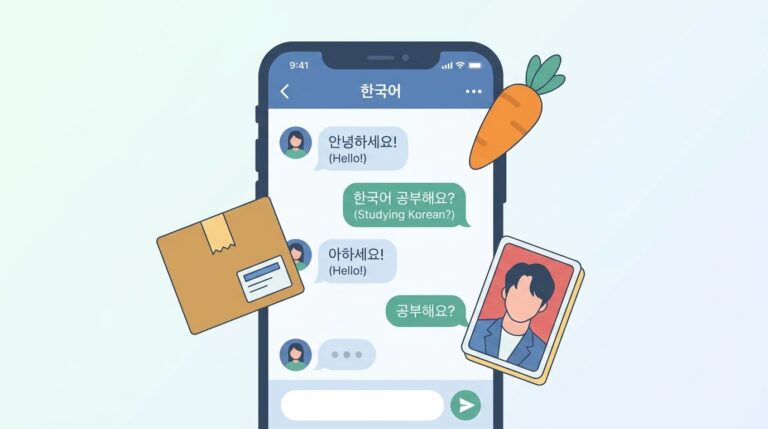
Phase 1: Empathy — Welcome to the Korean Second-hand Jungle!
Hello! I’m your Daily Hangul Editor. 🙋♀️
Picture this: You are scrolling through X (Twitter) or a Korean second-hand app like Bunjang (번장). You finally found it—that super rare K-Pop photocard of your bias, or maybe a vintage digital camera you’ve been searching for since you arrived in Seoul. The price is surprisingly good! You nervously message the seller, “I’d like to buy this.”
Then, the seller replies: “택포 1.5입니다.” (taekpo il-jeom-o-imnida.)
You stare at the screen. Taekpo? 1.5? Is that a secret code? The translation app says “Taekpo is 1.5,” which helps absolutely zero percent. While you are frantically Googling, another fan swoops in and buys it. 😭
Don’t worry! Second-hand trading in Korea is a massive subculture. Whether it’s the neighborhood-based Danggeun Market (당근마켓) or nationwide K-Pop merch trades, understanding the unwritten rules of Shipping Fees (택배비) will instantly upgrade you from a confused foreigner to a savvy local “Insider” (인싸).
This guide is packed with real questions from my students who successfully bought concert tickets, photocards, and winter coats online. Let’s decode the secret language of Korean second-hand trading!
Phase 2: Core Expressions Deep Dive
Here are the top 3 expressions you absolutely must know when dealing with shipping in Korea.
1. 택포 (Shipping Included)
- Pronunciation: taekpo [Sounds like ‘tech’ + Edgar Allan ‘Poe’]
- Meaning: Literal: Shipping included / Real nuance: The price you see is the final price.
- K-Culture Moment: This is the holy grail word in K-Pop merch trading. “택포” is actually an abbreviation of 택배비 포함 (taekbaebi poham – shipping fee included). If a seller writes “택포 2만원” (20,000 KRW), you only wire exactly 20,000 KRW. No hidden fees!
- Editor’s Insight: Saying “택포인가요?” (Is shipping included?) makes you sound incredibly fluent. It shows you know the culture, not just textbook Korean.
- Situation Spectrum:
- Second-hand app chat (Casual/Stranger): ✅
- Official online mall customer service (Semi-formal): ⚠️ (Use the full term: 택배비 포함인가요?)
- Formal business email (Formal): 🚫
- 🤔 Think About It: Why do Koreans love abbreviations like ‘택포’? In a fast-paced “Palli-Palli” (빨리빨리) culture, typing speed often dictates who gets the limited K-Pop photocard first!
2. 택배비 별도 (Shipping Excluded / Extra)
- Pronunciation: taekbaebi byeoldo [taek-bae-bee byul-doh]
- Meaning: Literal: Delivery fee separate / Real nuance: You need to pay extra for shipping.
- K-Culture Moment: You’re buying a cute vintage jacket on a second-hand app. The price is 10,000 KRW. But the description says “택배비 별도”. When you message them, they’ll likely say, “That will be 13,000 KRW total, including shipping.”
- Editor’s Insight: “별도” is a slightly formal word meaning “separate.” You’ll also see “착불” (chakbul – cash on delivery for shipping). If an item is “착불”, you pay for the item now, but you hand the shipping fee directly to the delivery driver when the package arrives at your door.
- Situation Spectrum:
- Second-hand app description (Casual/Stranger): ✅
- Official website (Semi-formal): ✅
- Formal contracts (Formal): ✅
- 🤔 Think About It: Have you ever experienced ‘Cash on Delivery’ in your home country? In Korea, ‘착불’ is very common for personal trades to avoid calculating exact shipping costs in advance.
3. 반택 (Half-price Convenience Store Shipping)
- Pronunciation: bantaek [bahn-tech]
- Meaning: Literal: Half delivery / Real nuance: Cheap shipping method picking up at a convenience store.
- K-Culture Moment: “반택 가능해요?” (Is bantaek possible?) is the most commonly asked question among Gen Z and K-Pop fans. Because standard shipping is around 3,000~4,000 KRW, Koreans use “반값 택배” (bangap taekbae), which costs only about 1,800 KRW. The catch? The seller drops it off at a convenience store (like GS25 or CU), and you have to go to a convenience store near you to pick it up!
- Editor’s Insight: This requires you to know the exact branch name of your local convenience store (e.g., GS25 Hongdae Station Branch). It’s a lifesaver for cheap items like photocards!
- Situation Spectrum:
- Peer-to-peer trading (Casual/Stranger): ✅
- Official corporate shopping (Semi-formal): 🚫
- Professional business (Formal): 🚫
- 🤔 Think About It: Korea has a convenience store on almost every block. How does the urban layout of a country change the way its delivery systems work?
Phase 3: Textbook vs. Real Korean
Let’s see how the textbook differs from the wild streets of the Korean internet.
[Asking if shipping is included]
* 📖 Textbook Korean: 배송비는 포함되어 있습니까? (baesongbineun pohamdoeeo isseumnikka? – Is the shipping fee included?)
* 🗣️ Real Korean: 혹시 택포인가요? (hoksi taekpo-ingayo? – By any chance, is it taekpo?)
* 💡 Why the difference?: Second-hand trading is mostly chat-based. “혹시” (by any chance) adds the necessary politeness, while “택포” keeps it highly efficient.
[Asking for a discount]
* 📖 Textbook Korean: 가격을 할인해 주실 수 있습니까? (gageogeul harinhae jusil su isseumnikka? – Could you please discount the price?)
* 🗣️ Real Korean: 에누리 되나요? / 네고 가능할까요? (enuri doenayo? / nego ganeunghalkkayo?)
* 💡 Why the difference?: “에누리” is a traditional Korean word for discount, while “네고” comes from the English word “negotiation.” Both are universally understood slang in Korean markets and apps.
Bottom Note for B1 Learners: When chatting with strangers on apps, always use the polite form (-요). Even if it’s slang like ‘택포’, attaching ‘인가요?’ makes it polite. Never use casual form (반말) with a seller!
Phase 4: Cultural Context — K-Culture Deep Dive
4-1. The Art of ‘Nunchi’ in Trading
In Korean second-hand trading, speed is trust. If you send a message, Koreans expect a reply within minutes. If you read a message and don’t reply (읽씹 – ilkssip), it’s considered very rude. If you change your mind about buying, just say, “생각해보고 다시 연락드릴게요” (I’ll think about it and contact you again) rather than ghosting.
4-2. K-Pop Connection: The Photocard Economy (포카 양도)
If you are a K-Pop fan, X (Twitter) and Bunjang are your battlegrounds. Fans don’t say “I’m selling” (팔아요); they say “양도합니다” (yangdo-hamnida – I am transferring ownership).
When buying merch, sellers often ask for a “certification” (인증 – injeung) to prove you aren’t a scammer. They might ask you to take a picture of the photocard with today’s date and your username written on a post-it note. Also, if they say “하자 없어요” (haja eopseoyo), it means “There are no defects/scratches.”
Phase 5: Real-life Roleplay Scenario
Let’s put you in the director’s chair.
Setting: Saturday afternoon. You are lying in bed, scrolling through a second-hand app. You just found a sold-out official lightstick (응원봉) for an upcoming K-Pop concert. The price is listed as “30,000 KRW.”
Characters:
– YOU: An excited B1 Korean learner. You really need this lightstick.
– SELLER (판매자): A fast-typing Korean fan who wants a quick, hassle-free deal.
(The chat begins on the app…)
YOU: 안녕하세요! 응원봉 아직 있나요?
(annyeonghaseyo! eungwonbong ajik innayo?)
[Hello! Do you still have the lightstick?]
SELLER: 네, 아직 있습니다! 😊
(ne, ajik isseumnida!)
[Yes, I still have it!]
YOU: 혹시 하자는 없나요?
(hoksi hajaneun eomnayo?)
[By any chance, are there any scratches/defects?]
SELLER: 네, 콘서트 때 한 번 쓰고 박스에 보관해서 완전 새거예요.
(ne, konseoteu ttae han beon sseugo baksee bogwanhaeseo wanjeon saegeoyeyo.)
[Yes, I used it once at the concert and kept it in the box, so it’s completely new.]
YOU: 아, 다행이네요. 구매하고 싶습니다!
(a, dahaeng-ineyo. gumaehago sipseumnida!)
[Ah, that’s a relief. I’d like to buy it!]
🔀 Your Turn! The listing just said “30,000 KRW”. How should you ask about the shipping?
- A) “3만원 입금할게요.” (I’ll wire 30,000 won.)
- B) “혹시 택포 3만원인가요?” (By any chance, is it 30,000 won including shipping?)
- C) “배송비는 얼마입니까?” (How much is the shipping fee?)
✅ Best Choice: B — This clarifies the exact amount before you send the money, using natural slang.
⚠️ Choice A Analysis: If you just send 30,000, the seller might message you back saying, “You need to send 4,000 more for shipping!”
⚠️ Choice C Analysis: It’s grammatically perfect, but sounds a bit too robotic like a textbook.
(Let’s say you chose B)
YOU: 혹시 택포 3만원인가요?
(hoksi taekpo sam-man-won-ingayo?)
[By any chance, is it 30,000 won including shipping?]
SELLER: 아뇨, 택배비 별도입니다. 일반 택배 하시면 34,000원이에요.
(anyo, taekbaebi byeoldo-imnida. ilban taekbae hasimyeon sam-man-sa-cheon-won-ieyo.)
[No, shipping is extra. If you use regular shipping, it’s 34,000 won.]
YOU: 그럼 반택도 가능할까요?
(geureom bantaekdo ganeunghalkkayo?)
[Then is half-price (convenience store) shipping possible?]
SELLER: 네! 반택 하시면 31,800원 입금해 주시면 됩니다. 점포명 알려주세요!
(ne! bantaek hasimyeon sam-man-cheon-pal-baek-won ipgeumhae jusimyeon doemnida. jeompomyeong allyeojuseyo!)
[Yes! If you do bantaek, you can wire 31,800 won. Please tell me the branch name!]
YOU: 네, GS25 홍대역점입니다. 계좌번호 주세요!
(ne, GS-i-si-bo hongdaeyeokjeom-imnida. gyejwabeonho juseyo!)
[Yes, it’s the GS25 Hongdae Station branch. Please give me your account number!]
Phase 6: 10-Second Shadowing Drill
Let’s practice the flow and intonation so you sound perfectly natural! Pay attention to the pauses (/).
- 😊 Friendly & Polite:
혹시 / 택포 / 가격인가요? (hoksi / taekpo / gageogingayo?) -
🥺 Asking for a favor:
저기요... / 혹시 반택도 / 가능할까요? (jeogiyo... / hoksi bantaekdo / ganeunghalkkayo?) -
😤 Confirming firmly (to avoid scams):
택배비 별도면 / 총 얼마를 / 입금해야 되나요? (taekbaebi byeoldomyeon / chong eolmareul / ipgeumhaeya doenayo?)
Phase 7: K-Culture Mini Dictionary
Master these keywords, and you’ll navigate Korean second-hand apps like a pro!
1. 당근 (Danggeun)
* Romanization: danggeun
* English: Carrot (Refers to Karrot Market)
* Context: Korea’s #1 neighborhood trading app. People literally say “Are you a carrot?” (혹시 당근이세요?) when meeting a stranger on the street for a trade to confirm their identity.
2. 쿨거래 (Cool georae)
* Romanization: kul-geo-rae
* English: “Cool trade” (Hassle-free transaction)
* Context: A fast trade with no complaints, no excessive questions, and immediate payment. Sellers love buyers who do “cool trades” and might even throw in freebies (덤 – deom)!
3. 찔러보기 (Jjilleobogi)
* Romanization: jjil-leo-bo-gi
* English: Poking around / Window shopping
* Context: Messaging the seller with lots of questions but having no real intention to buy. Sellers hate this! You’ll often see “찔러보기 사절” (No poking around allowed) in profiles.
4. 네고 (Nego)
* Romanization: nego
* English: Negotiation / Discount
* Context: Asking to lower the price. If a post says “네고 불가” (nego bulga), it means the price is strictly fixed. Don’t ask for a discount here!
Phase 8: Traveler’s Survival Kit
Even if you aren’t living in Korea, the Convenience Store Shipping (편의점 택배 – pyeon-ui-jeom taekbae) system is a lifesaver for travelers. Bought too many clothes in Myeongdong? Send them straight to the airport or your next hotel!
🆘 Survival Phrases for Convenience Store Shipping
– 🇰🇷 “택배 보내려고 하는데요.” (taekbae bonaeryeogo haneundeyo.)
– 🗣️ English: I’d like to send a package.
– 📍 Where to use: Inside a CU, GS25, or 7-Eleven that has a delivery kiosk.
– 💡 Pro Tip: Look for the self-service scale machine in the corner. You usually have to register the package on the screen yourself, print the sticker, attach it to the box, and THEN pay at the cash register.
📌 Editor’s Travel Note:
– Boxes: Convenience stores don’t usually sell boxes! You must pack your item before you go. Post offices (우체국) sell boxes of all sizes.
– Payment: You can pay for shipping with a foreign credit card or cash at the counter.
– Speed: Regular convenience store shipping takes 2-3 days. If you use “Bantaek” (store-to-store), it can take 4-5 days, so don’t use it for urgent items!
Phase 9: Critical Thinking — “One Step Deeper”
🧠 Think Deeper: Trust and the “Manner Temperature”
Have you heard the joke that you can leave your laptop on a table in a Korean cafe and no one will steal it? Korea is built on a high-trust society, and this extends to language and digital platforms. For example, the Danggeun Market app doesn’t use star ratings; it uses “Manner Temperature” (매너온도). Everyone starts at 36.5°C (human body temperature). If you are polite, use good Korean honorifics, and do “cool trades,” your temperature goes up. If your temperature is below 36.5°C, Koreans will hesitate to trade with you, assuming you are rude or untrustworthy. Language and politeness directly translate to social credit in Korea!
💬 Your Turn: Does your country have a popular second-hand market? How do people build trust with strangers online in your culture? Share it in the comments!
Phase 10: FAQ & Mistake Prevention
Q: Can I use informal language (반말) if the seller seems younger than me?
A: ABSOLUTELY NOT. Even if you are trading a K-Pop photocard with a high school student, if you are strangers, you must use standard polite language (-요/-습니다). Using informal language to a stranger is extremely disrespectful.
Q: What if the seller says “착불” (Payment on Delivery), but I won’t be home?
A: Ask for “선불” (seonbul – Payment in advance). You can say, “제가 집에 없을 것 같아서요, 택배비 선불로 입금해 드릴까요?” (I don’t think I’ll be home, can I wire the shipping fee in advance?).
❌ Common Mistake #1: Asking “배송비 얼마예요?” after the post already says “택포” (Taekpo).
✅ How to fix: Always read the description carefully! If it says 택포, the shipping is already included. Asking again makes you look like a “찔러보기” (time-waster).❌ Common Mistake #2: Promising to wire the money and then going silent.
✅ How to fix: Koreans expect instant transactions. If you say you will buy it, wire the money within 10-15 minutes, or at least tell them exactly when you will send it (e.g., “I will wire it by 6 PM”).
Phase 11: Summary & Action Items
One-Liner Summary: When buying second-hand items in Korea, “택포” means shipping is free, and “별도” means you pay extra!
🎯 Action Mission 3 Steps:
– 🥉 Bronze (Solo): Look at a random object on your desk. Point to it and say, “이거 택포 만원인가요?” (Is this 10,000 won, shipping included?) out loud 3 times.
– 🥈 Silver (Online): Go to Twitter, search your favorite K-Pop idol’s name + “양도 택포”, and see how fans write their posts!
– 🥇 Gold (Real-world): If you are in Korea, try buying something small and cheap (under $5) on Danggeun Market. Experience the thrill of the “Cool Trade”!
🇰🇷 K-Culture Mission:
Download the Danggeun (Karrot) app or visit the Bunjang website. Try to find the words “택포” and “반택” in 3 different item descriptions!
Phase 12: Interactive Quiz
Test your new “Insider” knowledge!
1. Situational Judgment:
You are buying a vintage jacket for 50,000 KRW. The seller’s description says: “가격: 50,000원 (택배비 별도)”. You want to use standard shipping, which costs 4,000 KRW. How much should you wire to the seller?
– A) 46,000 KRW
– B) 50,000 KRW
– C) 54,000 KRW
2. Fill in the Blank:
To ask politely if the shipping is included, you say: “혹시 _____ 인가요?”
3. True or False (K-Culture Edition):
“When meeting someone from Danggeun Market in person, it’s polite to ask for a huge discount right as you hand over the money.” (T/F)
👀 Click here for Answers!
- C) 54,000 KRW. “별도” means excluded. You must add the 4,000 KRW shipping fee to the 50,000 KRW item price.
- 택포 (taekpo)
- False. This is considered incredibly rude in Korea. All negotiations (네고) should happen in the chat app BEFORE you meet. If you try to lower the price at the scene, the seller might just walk away!
Frequently Asked Questions (FAQ)
Q: What does "택포 (Shipping Included)" mean in Korean and how do you pronounce it?
A: In Korean, "택포 (Shipping Included)" is pronounced [taekpo [Sounds like 'tech' + Edgar Allan 'Poe'] and means: Literal: Shipping included / Real nuance: The price you see is the final price.
Q: What does "택배비 별도 (Shipping Excluded / Extra)" mean in Korean and how do you pronounce it?
A: In Korean, "택배비 별도 (Shipping Excluded / Extra)" is pronounced [taekbaebi byeoldo [taek-bae-bee byul-doh] and means: Literal: Delivery fee separate / Real nuance: You need to pay extra for shipping.
Q: What does "반택 (Half-price Convenience Store Shipping)" mean in Korean and how do you pronounce it?
A: In Korean, "반택 (Half-price Convenience Store Shipping)" is pronounced [bantaek [bahn-tech] and means: Literal: Half delivery / Real nuance: Cheap shipping method picking up at a convenience store.







