

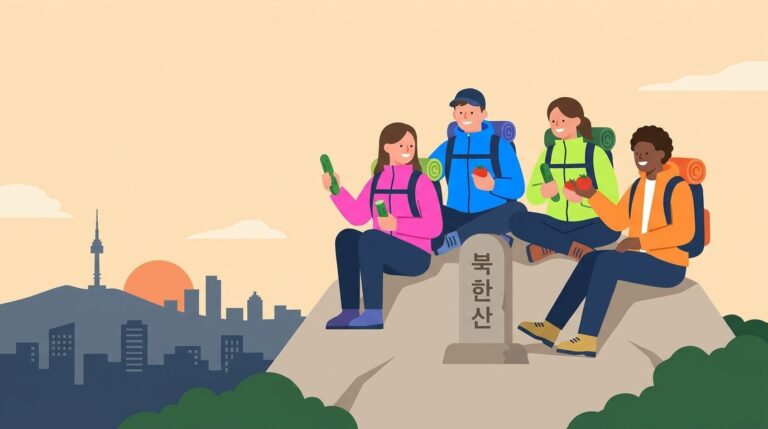
Phase 1: Empathy (Immersive Open)
Hello! I am your Daily Hangul editor. Picture this: It is a crisp Saturday morning in Seoul. You hop on the subway, and suddenly, you are surrounded by a sea of vibrant, neon-colored outdoor jackets. Ahjussis and Ajummas are adjusting their hiking poles, laughing loudly, and someone is already passing around a bag of cherry tomatoes. You have just encountered one of Korea’s most passionate subcultures: the Sanakhoe (산악회), or mountain hiking club.
If you live in Korea, you will quickly realize that hiking is not just an exercise; it is a profound social ritual. It is where business is discussed, friendships are forged, and massive amounts of Makgeolli (Korean rice wine) are consumed. But if you join a group without knowing the unwritten rules and the specific trail lingo, you might find yourself exhausted, confused, and overwhelmed by the aggressive offering of cucumbers.
This guide is based on real experiences from my students who joined local hiking groups hoping for a quiet nature walk, only to find themselves in a lively, moving feast. Let us prepare you for the trail so you can hike—and socialize—like a true local!
Phase 2: Core Expressions Deep Dive
Here are the top expressions you will hear (and need to use) when hiking with Koreans.
1. 다 왔어요. 5분만 더 가면 돼요.
- Pronunciation: Da wasseoyo. obunman deo gamyeon dwaeyo. + [Dah wah-sso-yo. Oh-boon-mahn duh gah-myun dway-yo.]
- Meaning: (Literal) We are all here. We just need to go 5 more minutes. vs (Real nuance) Keep walking, I have no idea how long it will take, but I am saying this to give you false hope so you don’t quit.
- K-Culture Moment: You are panting, sweating, and feeling like your legs will give out. A friendly older hiker passes by going down the mountain and cheerfully drops this line. Thirty minutes later, you are still climbing.
- Editor’s Insight: This is the most famous ‘hiker’s lie’ in Korea. It is said with pure intentions to encourage you, but never take the ‘5 minutes’ literally. It is the Korean way of cheering you on through a white lie.
- Situation Spectrum:
- Casual/Strangers on the trail: ✅
- Hiking Club Members: ✅
- Formal Business Hike: ✅ (Even the CEO will say this!)
- 🤔 Think About It: Why do Koreans prefer giving a ‘white lie’ like 5 minutes rather than saying ‘You still have an hour left’? How does this reflect the cultural emphasis on collective motivation?
2. 오이 하나 드실래요?
- Pronunciation: Oi hana deusillaeyo? + [Oh-ee hah-nah deu-shil-lay-yo?]
- Meaning: (Literal) Would you like to eat a cucumber? vs (Real nuance) I am sharing my precious water-substitute with you because we are a team now.
- K-Culture Moment: At the halfway rest area, backpacks are unzipped. Suddenly, Tupperware containers appear. Someone hands you a whole, unpeeled cucumber.
- Editor’s Insight: In Korean hiking culture, bringing food to share is mandatory. Cucumbers are favored because they are hydrating and refreshing. Accepting it with a smile is the quickest way to bond.
- Situation Spectrum:
- Casual: ✅
- Semi-formal: ✅
- Formal: ✅
- 🤔 Think About It: Sharing food is a huge part of Korean affection (Jeong, 정). Do hikers in your home country share food with strangers, or is it strictly ‘bring your own’?
3. 오늘 뒤풀이는 어디 파전집인가요?
- Pronunciation: Oneul dwipurineun eodi pajeonjibingayo? + [Oh-neul dwee-poo-ree-neun uh-dee pah-jeon-jib-een-gah-yo?]
- Meaning: (Literal) Where is the Pajeon (scallion pancake) restaurant for today’s after-party? vs (Real nuance) Let’s get to the real reason we climbed this mountain: the food and drinks.
- K-Culture Moment: You have successfully descended. Before anyone even takes off their hiking boots, the group leader is already pointing toward a restaurant at the base of the mountain, smelling of sizzling oil and Makgeolli.
- Editor’s Insight: The ‘Dwipuri’ (after-party) is the climax of the hike. Skipping it is often seen as missing the main event.
- Situation Spectrum:
- Casual: ✅
- Semi-formal: ⚠️ (Let the senior members suggest the place first)
- Formal: 🚫 (Wait for the boss to announce the venue)
- 🤔 Think About It: Why is physical exertion in Korea almost always followed by collective eating and drinking?
Phase 3: Textbook vs. Real Korean
- Greeting on the trail
- 📖 Textbook: 안녕하십니까. (Annyeonghasimnikka. – Hello.)
- 🗣️ Real Korean: 수고하십니다~ (Sugohasimnida~ – Keep up the good work~) or a bright 안녕하세요~!
- 💡 Why the difference?: Acknowledging someone’s effort (‘Sugo’) creates instant camaraderie among people doing the same difficult task.
- Cheering someone up
- 📖 Textbook: 힘내세요. (Himnaeseyo. – Cheer up.)
- 🗣️ Real Korean: 파이팅! 다 왔어요! (Paiting! Da wasseoyo! – Fighting! We are almost there!)
- 💡 Why the difference?: ‘Fighting’ is the ultimate energetic Konglish phrase used to inject energy into any physically demanding situation.
- Suggesting a break
- 📖 Textbook: 조금 쉬었다가 갑시다. (Jogeum swieotdaga gapsida. – Let’s rest a little and go.)
- 🗣️ Real Korean: 여기서 목 좀 축이고 가시죠. (Yeogiseo mok jom chugigo gasijyo. – Let’s wet our whistles/drink something here before we go.)
- 💡 Why the difference?: Focuses on the action of hydrating (often implying water, but sometimes Makgeolli) rather than just sitting around.
Phase 4: Cultural Context — K-Culture Deep Dive
4-1. Non-verbal Elements on the Mountain
When someone offers you food on the trail, always receive it with two hands, or at least support your right arm with your left hand. It shows respect. Also, when resting, notice the ‘Nunchi’ (눈치) dynamic: younger or junior members will usually be the ones unpacking the snacks, pouring the drinks, and packing up the trash. If you want to impress, be the first to hand out wet wipes!
4-2. The K-Food Connection: Mountain Base Feasts
If you have watched K-Dramas featuring middle-aged characters, you have seen this trope: after a hike, they sit at outdoor plastic tables under bright umbrellas. The absolute staple of Korean hiking food is Pajeon (seafood and scallion pancake) paired with Makgeolli (milky rice wine). Why this combo? Historically, Makgeolli was a farmer’s drink—cheap, filling, and low enough in alcohol that you could still work (or walk) after a few bowls. The sizzling sound of Pajeon cooking is said to resemble falling rain, making it a comforting, rustic meal that perfectly contrasts the exhaustion of the climb.
Phase 5: Real-world Roleplay Scenario
Setting: Saturday morning, 9:00 AM. The entrance of Bukhansan National Park. You are joining ‘Bukhansan Go Go’, an expat-friendly hiking club, for the first time. The autumn leaves are beautiful, but the trail looks incredibly steep.
Characters:
* YOU: An expat eager to make local friends but slightly intimidated by the mountain.
* Minsu (34): The energetic club leader. He is wearing head-to-toe neon GORE-TEX and carrying a massive backpack that looks like it holds a small refrigerator.
Dialogue:
Minsu: 환영합니다! 오늘 컨디션 어떠세요? 😊
(Hwanyeonghamnida! oneul keondisyeon eotteoseyo?)
[Welcome! How is your condition today?]
(🎭 Stage Direction: Minsu stretches his legs enthusiastically)
YOU: 안녕하세요! 조금 긴장되지만 괜찮아요.
(Annyeonghaseyo! jogeum ginjangdoejiman gwaenchanayo.)
[Hello! I am a little nervous but okay.]
Minsu: 에이, 걱정 마세요. 우리 산악회는 초보자 환영이에요. 자, 출발할까요?
(Ei, geokjeong maseyo. uri sanakhoeneun choboja hwanyeongieyo. ja, chulbalhalkkayo?)
[Hey, do not worry. Our club welcomes beginners. Shall we start?]
YOU: 네! 잘 부탁드립니다.
(Ne! jal butakdeurimnida.)
[Yes! Please take good care of me.]
(2 hours later, you are sweating profusely near the peak)
Minsu: 다 왔어요! 5분만 더 가면 정상이에요!
(Da wasseoyo! obunman deo gamyeon jeongsangieyo!)
[We are here! Just 5 more minutes and it is the peak!]
YOU: 아까도 5분이라고 하셨잖아요…
(Akkado obunirago hasyeotjanayo…)
[You said 5 minutes earlier too…]
Minsu: (Laughs) 들켰네요! 자, 잠시 쉬었다 가죠. 오이 좀 드실래요?
(Deulkyeonneyo! ja, jamsi swieotda gajyo. oi jom deusillaeyo?)
[(Laughs) I am caught! Let’s rest a bit. Would you like some cucumber?]
(🎭 Stage Direction: Minsu hands you a bright green cucumber)
🔀 Your Turn! How do you respond to the cucumber?
* A) 아니요, 괜찮습니다. 물이 있어요. (Polite, but a bit cold)
* B) 우와, 감사합니다! 잘 먹겠습니다! (Enthusiastic and team-spirited)
* C) 저는 오이 알레르기가 있어요. (Only say this if it’s true!)
✅ Best Choice: B — In Korea, accepting food on a hike is accepting friendship. Even if you are not terribly hungry, taking a bite shows you are part of the crew.
Minsu: 내려가서 뒤풀이 갈 거죠? 오늘 파전 기가 막힌 곳 알아놨어요.
(Naeryeogaseo dwipuri gal geojyo? oneul pajeon giga makhin got arannasseoyo.)
[You are going to the after-party after we go down, right? I found a place with amazing Pajeon today.]
YOU: 당연하죠! 파전에 막걸리 기대할게요.
(Dangyeonhajyo! pajeone makgeolli gidaehalgeyo.)
[Of course! I am looking forward to Pajeon and Makgeolli.]
Phase 6: 10-Second Shadowing Drill
Read this aloud to practice the ultimate exhausted-but-hopeful hiker’s sigh!
😤 아휴, / 다리가 / 너무 아파요. / 진짜 / 5분만 / 가면 돼요?
(Ahyu, / dariga / neomu apayo. / jinjja / obunman / gamyeon dwaeyo?)
[Phew, my legs hurt so much. Is it really just 5 more minutes?]
- Tone: Start with a heavy sigh, pause, then ask with a mix of desperation and pleading.
Phase 7: K-Culture Mini Dictionary
1. 산악회
* Romanization: sanakhoe
* English: Hiking club / Mountaineering association
* Context: Often organized by age, alumni groups, or neighborhoods. They are notorious for their intense loyalty, matching outfits, and heavy drinking after hikes.
2. 뒤풀이
* Romanization: dwipuri
* English: After-party / Wrap-up party
* Context: The post-event gathering. In hiking, it is arguably more important than the hike itself. It builds the team’s bond.
3. 등산복
* Romanization: deungsanbok
* English: Hiking clothes / Outdoor wear
* Context: Koreans take hiking gear very seriously. Even for a 2-hour walk on a small hill, many dress like they are scaling Mount Everest.
4. 눈치
* Romanization: nunchi
* English: Social situational awareness
* Context: Reading the room. On a hike, good nunchi means knowing when to offer water, when to suggest a break, or when to pour a senior member’s drink at the after-party.
Phase 8: Traveler’s Survival Kit
If you plan to hike famous trails like Bukhansan or Seoraksan, keep these phrases handy!
🆘 Survival Phrases
* 🇰🇷 “정상 가는 길이 이쪽 맞나요?” (jeongsang ganeun giri ijjok mannayo? – Is this the right way to the peak?)
* 🇰🇷 “화장실은 어디에 있어요?” (hwajangsireun eodie isseoyo? – Where is the restroom?)
* 🇰🇷 “파전 하나랑 막걸리 두 병 주세요.” (pajeon hanarang makgeolli du byeong juseyo. – One scallion pancake and two bottles of makgeolli, please.)📌 Editor’s Travel Note
* App to use: Naver Map and KakaoMap have hiking trails mapped out beautifully! Don’t rely on Google Maps for mountain trails in Korea.
* Trash: There are NO trash cans on Korean mountains. You must carry all your garbage back down. Bring a small plastic bag!
* Etiquette: Playing loud trot music on a portable radio used to be common among older hikers, but it is increasingly frowned upon. Enjoy the sounds of nature.
Phase 9: Critical Thinking Corner — “A Step Deeper”
Food & Identity on the Mountain
Why do Koreans pack heavy bags full of kimbap, fruit, and even hot coffee just to carry them up a steep mountain? In Korean culture, eating together (Commensality) is the ultimate expression of ‘Jeong’ (affection and connection). The physical hardship of the hike breaks down social barriers, and sharing food acts as the glue that bonds the group. To eat alone on a mountain is seen as slightly lonely; to share a bruised apple at the peak is to become family.
💬 Your Turn: In your culture, what is the ‘food’ or ‘ritual’ that brings people together after a difficult physical activity? Share in the comments!
Phase 10: FAQ & Avoiding Misunderstandings
- Q: Can I wear leggings and sneakers on a Korean hike?
- A: For small hills (like Namsan), yes. But for rocky mountains like Bukhansan, older hikers will actively scold you out of concern. Always wear proper hiking boots!
- Q: If a senior member pours me a cup of Makgeolli, what should I do?
- A: Hold your cup with two hands. If you don’t drink alcohol, politely accept the pour, say thank you, and simply don’t drink it, or cheers with water.
❌ Common Mistake #1: Refusing food too directly.
✅ Do this instead: If you really cannot eat something offered to you, express extreme gratitude first, then gently decline with an excuse. “너무 감사한데, 제가 배가 너무 불러서요!” (I am so thankful, but I am too full!)
Phase 11: Summary & Action Items
- One-Liner Summary: Surviving a Korean hike means understanding the ‘5-minute lie’, accepting cucumbers with a smile, and bringing your best energy to the Pajeon after-party.
-
Action Mission 3 Steps:
- 🥉 Bronze (Solo): Practice saying the ‘5-minute lie’ expression aloud 3 times, sounding as encouraging as possible.
- 🥈 Silver (Online): Find a Korean hiking vlog on YouTube and leave a comment: “풍경이 너무 멋져요! 파이팅!”
- 🥇 Gold (Real World): Visit a Korean restaurant, order Pajeon and Makgeolli, and practice pouring the drink with two hands for your friends.
- K-Culture Mission: Search for ‘#등산스타그램’ (Hiking-stagram) on Instagram and notice the colorful fashion and the inevitable food photos at the end of the carousel!
Phase 12: Quiz — Interactive Challenge
1. Situational Judgment: You are resting halfway up the mountain, and an older hiker hands you a cherry tomato. What is the most culturally appropriate response?
* A) “얼마예요?” (How much is it?)
* B) “감사합니다!” (Receive it with two hands and eat it)
* C) “저는 토마토 안 좋아해요.” (I don’t like tomatoes.)
* Answer: B. It’s an expression of Jeong! (A is insulting, C is a bit rude).
2. Fill in the Blank:
“다 왔어요. ( ______ )만 더 가면 돼요!”
* Answer: 5분 (5 minutes – the universal hiker’s lie)
3. True or False: In a Korean hiking club (Sanakhoe), the ‘Dwipuri’ (after-party) is often considered just as important as the hike itself.
* Answer: True! It is essential for team bonding.
4. Roleplay Consequence: In Phase 5, if you chose Option A (refusing the cucumber coldly), what would likely happen next?
* Answer: Minsu would respect your boundary, but the warm, communal atmosphere (Jeong) might cool down slightly. Accepting small gestures builds rapid rapport in Korea.
Frequently Asked Questions (FAQ)
Q: What does "다 왔어요. 5분만 더 가면 돼요." mean in Korean and how do you pronounce it?
A: In Korean, "다 왔어요. 5분만 더 가면 돼요." is pronounced [Da wasseoyo. obunman deo gamyeon dwaeyo. + [Dah wah-sso-yo. Oh-boon-mahn duh gah-myun dway-yo.] and means: (Literal) We are all here. We just need to go 5 more minutes. vs (Real nuance) Keep walking, I have no idea how long it will take, but I am saying this to give you false hope so you don't quit.
Q: What does "오이 하나 드실래요?" mean in Korean and how do you pronounce it?
A: In Korean, "오이 하나 드실래요?" is pronounced [Oi hana deusillaeyo? + [Oh-ee hah-nah deu-shil-lay-yo?] and means: (Literal) Would you like to eat a cucumber? vs (Real nuance) I am sharing my precious water-substitute with you because we are a team now.
Q: What does "오늘 뒤풀이는 어디 파전집인가요?" mean in Korean and how do you pronounce it?
A: In Korean, "오늘 뒤풀이는 어디 파전집인가요?" is pronounced [Oneul dwipurineun eodi pajeonjibingayo? + [Oh-neul dwee-poo-ree-neun uh-dee pah-jeon-jib-een-gah-yo?] and means: (Literal) Where is the Pajeon (scallion pancake) restaurant for today's after-party? vs (Real nuance) Let's get to the real reason we climbed this mountain: the food and drinks.







