

Phase 1: Empathy & K-Culture Cold Open
Hello! I am the senior editor of Daily Hangul.
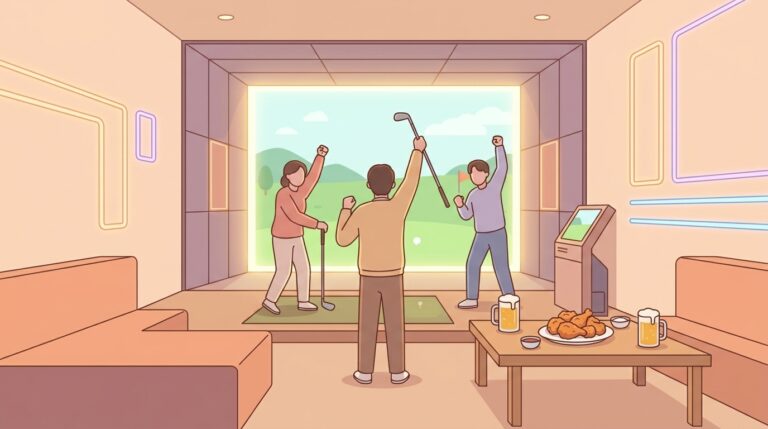
Picture this: You are watching an intense K-Drama. The ruthless CEO and his rival are in a dimly lit, luxurious room. They aren’t in a boardroom; they are holding golf clubs, smashing a ball into a giant digital screen. Deals are made, secrets are spilled, and dramatic slow-motion swings ensue.
Welcome to the world of Screen Golf (스크린 골프)! But here is the secret—it is not just for billionaires plotting corporate takeovers. In reality, screen golf is an everyday social hub for friends, couples, and coworkers. It is where you go on a Friday night after eating Korean BBQ, where you drink beer, order delivery food, and laugh at your friends’ terrible swings.
If you live in Korea or are visiting for business, you will eventually be invited to a screen golf room. Walking in without knowing the etiquette or vocabulary can be intimidating. But don’t worry! As your local culture navigator, I have gathered the exact expressions you need to survive—and thrive—in a Korean screen golf facility. Let’s tee off!
Phase 2: Core Expressions Deep Dive
1. 방 있나요?
- Pronunciation: Bang in-na-yo? (Bang sounds like a short, dull explosion, but softer. In-na-yo flows smoothly together.)
- Meaning: Do you have a room? (Literal: Is there a room?)
- K-Culture Moment: Korean screen golf is just like Noraebang (karaoke). You don’t play in an open hall; you rent a private room. You will use this exact phrase the moment you walk up to the counter.
- Editor’s Insight: This is your absolute universal phrase for any room-based business in Korea. PC bangs, Noraebangs, board game cafes, and screen golf. It is polite, concise, and perfectly natural.
- Situation Spectrum:
- Friends (Casual): 방 있어? (Bang isseo?)
- Staff/Clerks (Semi-formal/Formal): 방 있나요?
- 🤔 Think About It: Why does Korean culture love private rooms (Bang) so much? From Noraebang to Jjimjilbang, how does having a separated space change the dynamic of socializing compared to your home country?
2. 게스트로 로그인할게요.
- Pronunciation: Ge-seu-teu-ro ro-geu-in hal-ge-yo. (Ge-seu-teu-ro sounds like guest-uh-row. Roll the ‘r’ slightly on ‘ro’.)
- Meaning: I will log in as a guest.
- K-Culture Moment: The software (like Golfzon or Kakao VX) asks you to log in to track your handicap and swing videos. If it’s your first time, your Korean friends will ask if you have the app. This is your save-the-day response.
- Editor’s Insight: Koreans love membership systems, but they also value speed. Saying you will play as a guest keeps the game moving without making everyone wait for you to download an app and verify your phone number.
- Situation Spectrum:
- Friends/Coworkers: 게스트로 할게요.
3. 멀리건 쓸게요!
- Pronunciation: Meol-li-geon sseul-ge-yo! (Meol sounds like mull, geon sounds like gun. Sseul sounds like a soft hiss before saying ul.)
- Meaning: I will use a mulligan! (A do-over shot).
- K-Culture Moment: You hit the ball, and it flies straight into the virtual water hazard. Your Korean coworkers gasp. Before the penalty is applied, you shout this phrase! In Korean screen golf culture, being generous with mulligans is a sign of good manners.
- Editor’s Insight: This is Konglish (Korean-English). Even though mulligan is an English word, pronouncing it with the Korean syllable blocks is crucial. If you say it with a perfect American accent, the machine—and your friends—might not understand you!
- Situation Spectrum:
- Casual/Coworkers: ✅
- Strict tournaments: 🚫
- 🤔 Think About It: The concept of Jung (정) means warmth and shared affection. How is giving someone a free mulligan an expression of Jung in a competitive setting?
Phase 3: Textbook vs Real Korean
[Making a Reservation]
* 📖 Textbook Korean: 예약하고 싶습니다. (I would like to make a reservation.)
* 🗣️ Real Korean: 오늘 저녁 7시, 두 명 방 있나요? (Tonight at 7, do you have a room for two?)
* 💡 Why the difference?: Koreans value Ppal-li Ppal-li (hurry hurry) culture. Jumping straight to the time and headcount saves the staff from asking follow-up questions.
[Borrowing Equipment]
* 📖 Textbook Korean: 골프용품을 빌릴 수 있습니까? (Can I borrow golf equipment?)
* 🗣️ Real Korean: 장갑이랑 신발 대여되나요? (Can I rent gloves and shoes?)
* 💡 Why the difference?: You rarely need to borrow clubs (they are usually already in the room). You specifically need to ask for personal items like shoes and gloves. Dae-yeo is the natural term for renting equipment.
Phase 4: Cultural Context — K-Culture Deep Dive
4-1. Non-verbal Nunchi (눈치) in the Room
Screen golf rooms are spacious, but swinging a metal club is dangerous. Korean Nunchi (situational awareness) dictates that you must stay firmly behind the hitting mat when someone is swinging. Also, never step on the green putting area with your street shoes—you must wear the provided golf shoes!
4-2. The Hoesik & K-Food Connection
Screen golf is often the second or third round of a Hoesik (company dinner). Here is the best part: you can order food into the room!
It is completely normal to see a group of businessmen eating Jajangmyeon (black bean noodles) or Chi-maek (Fried Chicken and Beer) off a small table while taking turns swinging. The combination of intense sports, heavy drinking, and eating in a private room is the ultimate Korean bonding experience.
Phase 5: Real-life Roleplay Scenario
Setting: Friday night, 9:00 PM. You just finished a heavy Korean BBQ dinner with your team. Your coworker, Minsu, drags you into a brightly lit Golfzon building.
Characters:
* YOU: An expat working in Seoul, a bit nervous because you have only played mini-golf.
* Minsu (32): Your friendly, slightly tipsy Korean coworker who loves golf.
Dialogue:
Minsu: 배부르죠? 이제 소화시키러 가야죠! 스크린 한 게임 칠까요?
(Bae-bu-reu-jyo? Ije so-hwa-si-ki-reo ga-ya-jyo! Seu-keu-rin han ge-im chil-kka-yo?)
[Translation: You’re full, right? Now we need to go digest! Shall we play a game of screen golf?]
YOU: 스크린 골프 처음인데, 저 장비가 하나도 없어요.
(Seu-keu-rin gol-peu cheo-eum-in-de, jeo jang-bi-ga ha-na-do eop-seo-yo.)
[Translation: It’s my first time playing screen golf, and I don’t have any equipment.]
Minsu: 걱정 마세요! 여기서 다 빌려줘요. 카운터 가서 물어볼게요.
(Geok-jeong ma-se-yo! Yeo-gi-seo da bil-lyeo-jwo-yo. Ka-un-teo ga-seo mu-reo-bol-ge-yo.)
[Translation: Don’t worry! They rent everything here. I’ll go ask the counter.]
(🎭 Stage Direction: Minsu walks to the staff)
Minsu: 사장님, 여기 270 사이즈 신발 두 켤레 대여되나요?
(Sa-jang-nim, yeo-gi i-baek-chil-sip sa-i-jeu sin-bal du kyeol-le dae-yeo-doe-na-yo?)
[Translation: Boss, can we rent two pairs of size 270 shoes?]
YOU: 오, 장갑도 빌릴 수 있나요?
(O, jang-gap-do bil-lil su in-na-yo?)
[Translation: Oh, can I borrow gloves too?]
Minsu: 네, 장갑은 방에 다 준비되어 있어요. 자, 로그인할게요.
(Ne, jang-gap-eun bang-e da jun-bi-doe-eo is-seo-yo. Ja, ro-geu-in hal-ge-yo.)
[Translation: Yes, gloves are all prepared in the room. Now, I’ll log in.]
YOU: 저는 아이디가 없어서 게스트로 할게요.
(Jeo-neun a-i-di-ga eop-seo-seo ge-seu-teu-ro hal-ge-yo.)
[Translation: I don’t have an ID, so I’ll play as a guest.]
Minsu: 난이도는 초보 모드로 설정할게요. 자, 제 차례네요!
(Nan-i-do-neun cho-bo mo-deu-ro seol-jeong-hal-ge-yo. Ja, je cha-rye-ne-yo!)
[Translation: I’ll set the difficulty to beginner. Alright, my turn!]
(🎭 Stage Direction: Minsu takes a massive, dramatic swing. The ball goes flying… straight into the virtual trees. The machine makes a sad sound.)
Minsu: 아… 망했다. 해저드에 빠졌네.
(Ah… mang-haet-da. Hae-jeo-deu-e ppa-jyeon-ne.)
[Translation: Ah… I’m ruined. It fell into the hazard.]
🔀 Your Turn! How should you respond?
* A) 나이스 샷! (Nice shot!)
* B) 아깝다! 멀리건 쓰세요. (Ah-ggap-da! Meol-li-geon sseu-se-yo.)
* C) 진짜 못 치시네요! (Jin-jja mot chi-si-ne-yo!)
✅ Best Choice: B — Ah-ggap-da means So close! or What a shame! Offering them to use a mulligan shows great Nunchi and manners.
⚠️ Choice A Analysis: Saying nice shot when the ball went into the water is pure sarcasm. Good for close friends, dangerous for coworkers!
🚫 Choice C Analysis: You really can’t play! This will kill the mood instantly.
Phase 6: 10-Second Shadowing Drill
Let’s practice the magic phrase to save your coworker’s dignity. Repeat out loud!
😢 아깝다! / 😊 멀리건 / 🥺 쓰세요!
(A-kkap-da! / Meol-li-geon / Sseu-se-yo!)
Pro-tip: Put a little empathy into ‘A-kkap-da’, then brighten up when offering the ‘Mulligan’!
Phase 7: K-Culture Mini Dictionary
1. 스크린 (Seu-keu-rin)
* English: Screen Golf
* Context: Koreans rarely say the full word Screen Golf. If someone asks, 오늘 스크린 어때? (How about screen today?), they mean golf, not a movie theater.
2. 멀리건 (Meol-li-geon)
* English: Mulligan
* Context: A free redo shot. Screen golf software usually grants 3 mulligans per player per 18 holes. Use them wisely!
3. 내기 (Nae-gi)
* English: A bet / Wager
* Context: Friendly betting is huge in Korean golf. Usually, the loser pays the room fee (게임비 내기) or buys the fried chicken.
4. 회식 (Hoe-sik)
* English: Company dinner
* Context: The quintessential Korean corporate bonding event. It often starts with BBQ, moves to a pub or Noraebang, and frequently ends at Screen Golf.
Phase 8: Traveler Survival Kit
If you are visiting Korea and want to try screen golf, here are your essential survival phrases:
🆘 Survival Phrase #1: Renting Items
* 🇰🇷 장갑이랑 신발 대여되나요? (Jang-gap-i-rang sin-bal dae-yeo-doe-na-yo?)
* 🗣️ English: Can I rent gloves and shoes?
* 📍 Where to use: At the front counter.🆘 Survival Phrase #2: Left-handed Players
* 🇰🇷 좌타 방 있나요? (Jwa-ta bang in-na-yo?)
* 🗣️ English: Do you have a left-handed room?
* 📍 Where to use: Booking a room. (Pro Tip: Left-handed rooms are rare, so always call ahead to ask for Jwa-ta!)🆘 Survival Phrase #3: Ordering Food
* 🇰🇷 방으로 배달시켜도 되나요? (Bang-eu-ro bae-dal-si-kyeo-do doe-na-yo?)
* 🗣️ English: Can I order delivery to the room?
* 📍 Where to use: Asking the staff. (Most places allow it, or they have their own in-house kitchen selling snacks and beer!)📌 Editor’s Travel Note
* App to use: Download KakaoMap and search for 골프존 (Golfzon) or 카카오VX (Kakao VX), the two biggest franchises.
* Dress Code: You don’t need collared shirts! People play in jeans, t-shirts, or their work suits.
Phase 9: Critical Thinking Corner — “One Step Deeper”
🧠 Think Deeper: Media vs Reality (The Democratization of Golf)
In K-Dramas, golf is almost exclusively portrayed as a tool for power. You see chaebol (conglomerate) families walking across lush green fields, making secret political deals away from the public eye. Historically, field golf in Korea was extremely expensive and exclusive.
However, the rise of screen golf completely flipped this narrative. By shrinking the golf course into a digital room and placing it in every city neighborhood, technology democratized the sport. Now, college students, young couples, and entry-level salarymen can enjoy what used to be a billionaire’s hobby for the price of a movie ticket and a meal. It changed from a symbol of status to a symbol of accessible, communal fun.
💬 Your Turn: Does technology in your country also make exclusive luxury sports more accessible to the public? Share your thoughts in the comments!
Phase 10: FAQ & Preventing Misunderstandings
Q: Do I need to bring my own golf clubs?
No! Every room is equipped with a standard set of men’s and women’s clubs. You can bring your own, but 90% of casual players just use the house clubs.
Q: Can I use the phrase ‘방 있나요?’ to a senior boss?
You wouldn’t ask your boss if they have a room. You use this only toward the staff of the facility. To a boss, you would say, 제가 방을 예약하겠습니다 (I will reserve a room).
❌ Common Mistake #1: Wearing your rented golf shoes outside the room.
✅ Do this instead: Change into the golf shoes inside the room, and change back to your street shoes before going to the restroom or leaving. The green hitting mats must stay clean!❌ Common Mistake #2: Walking in front of the screen while someone is addressing the ball.
✅ Do this instead: Always stay seated on the sofas behind the hitting area until it is your turn. It is a strict safety rule.
Phase 11: Summary & Action Items
One-Liner Summary: Screen golf in Korea is less about perfect athletic technique and more about food, fun, and bonding inside a private room!
Your Action Missions:
* 🥉 Bronze (Solo): Stand up and practice saying 방 있나요? three times smoothly.
* 🥈 Silver (Online): Find a Korean screen golf vlog on YouTube and leave a comment saying 나이스 샷! (Nice shot!).
* 🥇 Gold (Real Life): Next time you are in Korea, grab a friend, walk into a Golfzon, and say 장갑이랑 신발 대여되나요?
K-Culture Special Mission:
Open Google Maps or KakaoMap and search for 스크린골프 in Gangnam. Look at the photos of the rooms to see what the layout actually looks like!
Phase 12: Interactive Quiz
Q1. You walk into a screen golf facility with your friend. What is the most natural way to ask for a room?
1) 예약하고 싶습니다.
2) 골프 치고 싶어요.
3) 방 있나요?
4) 스크린방 어딨어요?
Q2. True or False: It is considered rude to order food and eat while playing screen golf in Korea.
Q3. Fill in the blank: Your coworker hit the ball into the water. To be polite and keep the mood up, you offer them a do-over by saying, “______ 쓸게요!”
(Answers: Q1- 3, Q2- False, it is highly encouraged! Q3- 멀리건)
Frequently Asked Questions (FAQ)
Q: What does "방 있나요?" mean in Korean and how do you pronounce it?
A: In Korean, "방 있나요?" is pronounced [Bang in-na-yo? (Bang sounds like a short, dull explosion, but softer. In-na-yo flows smoothly together.] and means: Do you have a room? (Literal: Is there a room?)
Q: What does "게스트로 로그인할게요." mean in Korean and how do you pronounce it?
A: In Korean, "게스트로 로그인할게요." is pronounced [Ge-seu-teu-ro ro-geu-in hal-ge-yo. (Ge-seu-teu-ro sounds like guest-uh-row. Roll the 'r' slightly on 'ro'.] and means: I will log in as a guest.
Q: What does "멀리건 쓸게요!" mean in Korean and how do you pronounce it?
A: In Korean, "멀리건 쓸게요!" is pronounced [Meol-li-geon sseul-ge-yo! (Meol sounds like mull, geon sounds like gun. Sseul sounds like a soft hiss before saying ul.] and means: I will use a mulligan! (A do-over shot).







