

Phase 1: Empathy & Immersion
Hello! I am the Senior Editor at Daily Hangul.
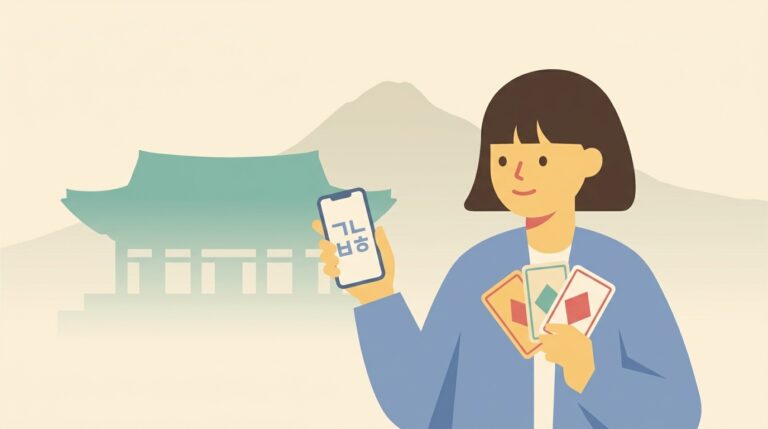
Picture this typical K-Drama scene: A devoted mother is at a peaceful mountain temple, bowing exactly 108 times, praying fervently for her daughter to pass a major corporate job interview. Meanwhile, the daughter is sitting in a neon-lit, slightly cramped cafe in Hongdae, anxiously paying 30,000 won to a Tarot card reader to ask the exact same question: Will I get the job?
If you have watched enough Korean dramas, you have probably noticed this fascinating contrast. Korea is historically deeply rooted in Buddhism and Confucianism, and currently has a massive Christian population. Yet, if you ask a young person in their 20s or 30s what their religion is, the overwhelming answer is: I do not have one.
Welcome to C2-level Korean! Today, we are not just learning how to say church or temple. We are diving into a profound sociological shift in modern Korea: Secularization (탈종교화). Understanding this cultural nuance will elevate you from a simple language learner to someone who truly understands the heartbeat of modern Korean society. Let us dive in!
Phase 2: Deep Dive into Core Expressions
Here are the high-level expressions you need to discuss modern Korean spirituality.
1. 탈종교화 (Secularization / De-religionization)
- Pronunciation: tal-jong-gyo-hwa [Sounds like: tahl-jong-gyo-hwa (Keep the ‘hwa’ breathy and light)]
- Meaning: The sociological phenomenon where the population moves away from organized religion.
- K-Culture Moment: You will hear this word in serious documentaries or news broadcasts analyzing why younger generations are abandoning traditional religious institutions.
- Editor’s Insight: This is a fantastic C2 academic word. Using this in a conversation with a native speaker will immediately show your deep understanding of Korean social issues.
- Situation Spectrum:
- Friends (Casual): ⚠️ (A bit too academic for a pub chat)
- Coworkers (Semi-formal): ✅ (Great for intellectual lunch debates)
- Boss/Elders (Formal): ✅
- Think About It: Why is taljonggyohwa accelerating in Korea? Could it be the hyper-competitive society leaving no time for weekend religious duties?
2. 무교 (Non-religious / Atheism / Agnosticism)
- Pronunciation: mu-gyo [Sounds like: moo-gyo (Moo like a cow, gyo with a hard ‘g’)]
- Meaning: Literally No (무) Religion (교). It does not necessarily mean strict atheism; it often just means unaffiliated.
- K-Culture Moment: On dating apps or blind dates (소개팅), religion is a major compatibility factor in Korea. Many people specifically look for mugyo partners to avoid family conflicts over religious duties like ancestral rites (제사).
- Editor’s Insight: This is the most common answer you will hear from Millennials and Gen Z. It carries a neutral, comfortable vibe.
- Situation Spectrum:
- Friends (Casual): ✅
- Coworkers (Semi-formal): ✅
- Boss/Elders (Formal): ✅
- Think About It: If someone is mugyo, does that mean they have no spiritual beliefs? Or have they simply replaced them with things like astrology and MBTI?
3. 사주를 보다 (To get one’s fortune told)
- Pronunciation: sa-ju-reul bo-da [Sounds like: sah-joo-reul bo-dah]
- Meaning: Saju refers to the Four Pillars of Destiny (based on birth year, month, day, and time). It means getting your Eastern astrological fortune read.
- K-Culture Moment: At the start of a new year, before a college entrance exam, or right before getting married, even the most logical, non-religious Koreans will often visit a Saju cafe just for fun (or so they claim!).
- Editor’s Insight: Saju occupies a unique gray area in Korea. It is not considered an organized religion, but it is deeply woven into the spiritual comfort of the culture.
- Situation Spectrum:
- Friends (Casual): ✅
- Coworkers (Semi-formal): ✅
- Boss/Elders (Formal): ⚠️ (Some devout elders might disapprove)
- Think About It: Why do people who claim to trust only science still pay to hear their Saju?
Phase 3: Textbook vs. Real Korean
Let us look at how the shift in religious attitudes changes everyday conversations.
Situation 1: Asking about someone’s religion
* Textbook Korean: 종교가 무엇입니까? (What is your religion?)
* Real Korean: 혹시 종교 있으세요? 전 무교예요. (By any chance, do you have a religion? I’m non-religious.)
* Why the difference?: Adding 혹시 (by any chance) softens the question. In modern Korea, religion is considered a private and potentially sensitive topic. Volunteering your own status first makes it less intrusive.
Situation 2: Rejecting a street evangelist
* Textbook Korean: 저는 종교에 관심이 없습니다. (I have no interest in religion.)
* Real Korean: 아, 괜찮습니다. (Oh, I’m okay. while avoiding eye contact and walking fast)
* Why the difference?: Engaging in a debate with aggressive street recruiters is exhausting. The most native Korean response is a polite but firm dismissal combined with swift body language.
Phase 4: Cultural Context — K-Culture Deep Dive
4-1. The Non-verbal Nuance
When discussing religion in Korea, Nunchi (눈치) is crucial. Because Korea has a volatile history of religious friction within families (especially between devout Christian daughters-in-law and Confucian mothers-in-law over ancestral rites), religion is generally not a topic for small talk. If someone says they are 무교, the conversation usually moves on. Prying further is considered a lack of Nunchi.
4-2. K-Travel & Society: The Templestay Phenomenon
Here is a fascinating paradox: As the Buddhist population in Korea declines, the popularity of Templestays among young people is skyrocketing. Why?
For Gen Z and Millennials suffering from extreme burnout (번아웃), a weekend at a mountain temple is not a religious pilgrimage. It is a digital detox. It is wellness tourism. They go to do 불멍 (staring blankly at a fire) or 산멍 (staring at the mountains), eat vegan temple food, and escape their smartphones. They are seeking spirituality and healing (힐링), not strict religious dogma.
Phase 5: Real-Life Roleplay Scenario
Setting: Friday evening at a trendy cafe in Yeonnam-dong. You and your Korean coworker, Min-su (32, humorous but currently stressed about work), are talking about your plans for the new year.
Min-su: 요즘 회사 일 때문에 스트레스가 너무 심해요. 진짜 퇴사하고 싶다.
(yojeum hwesa il ttaemune seuteureseuga neomu simhaeyo. jinjja toesahago sipda.)
[Translation] Work has been so stressful lately. I really want to quit.
Stage Direction: Min-su sighs and stirs his iced Americano aggressively.
YOU: 저런, 많이 힘드신가 봐요. 주말에 푹 쉬셔야겠어요.
(jeoreon, mani himdeusinga bwayo. jumare puk swisyeoyagesseoyo.)
[Translation] Oh no, you must be having a hard time. You should rest well this weekend.
Min-su: 그래서 이번 주말에 홍대 가서 사주나 한 번 보려고요. 내년에 이직운이 있는지 궁금해서요.
(geuraeseo ibeon jumare hongdae gaseo sajuna han beon boryeogoyo. naenyeone ijiguni inneunji gunggeumhaeseoyo.)
[Translation] So this weekend I’m thinking of going to Hongdae to get my Saju read. I’m curious if I have luck for changing jobs next year.
Decision Point! Your Turn! How do you respond?
* A) 사주요? 미신을 믿으세요? (Saju? Do you believe in superstitions?)
* B) 오, 저도 같이 가도 돼요? 한국 사주 궁금했어요! (Oh, can I go with you? I’ve been curious about Korean Saju!)
* C) 교회에 가서 기도하는 게 어때요? (How about going to church to pray?)
Best Choice Analysis:
B is the best choice. It shows open-mindedness and cultural curiosity.
Why A is wrong: Calling it 미신 (superstition) immediately can sound judgmental. For Koreans, Saju is often treated as psychological counseling rather than serious witchcraft.
Why C is wrong: Unless you know Min-su is Christian, suggesting a specific religion to solve his stress can be seen as stepping over boundaries in modern Korean society.
Phase 6: 10-Second Shadowing Drill
Let us practice a perfect C2-level sentence to explain this cultural phenomenon. Pay attention to the pauses (/) and the emotion!
🤔 진지하게 / jin-ji-ha-ge
요즘 한국의 젊은 세대는 / yo-jeum han-gu-ge jeol-meun se-dae-neun
특정 종교를 갖기보다는 / teuk-jeong jong-gyo-reul gat-gi-bo-da-neun
개인적인 마음 챙김을 / gae-in-jeo-gin ma-eum chaeng-gi-meul
더 중요하게 생각해요. / deo jung-yo-ha-ge saeng-ga-kae-yo.
[Translation] Modern young generations in Korea value personal mindfulness more than having a specific religion.
Phase 7: K-Culture Mini Dictionary
1. 제사
* Romanization: je-sa
* English: Ancestral rites
* Context: A traditional Confucian ritual honoring deceased ancestors. The heavy burden of preparing food for Jesa is a major cause of family conflict and a key reason younger generations distance themselves from traditional practices.
2. 기복신앙
* Romanization: gi-bok-sin-ang
* English: Prosperity faith / Praying for good fortune
* Context: A C2 academic term. It refers to the core characteristic of older Korean religious practices—praying strictly for worldly success (wealth, health, passing exams) rather than spiritual enlightenment.
3. 불멍
* Romanization: bul-meong
* English: Spacing out looking at a fire
* Context: A modern spiritual practice of emptying the mind. Often done at campsites or Templestays.
4. MBTI
* Romanization: em-bi-ti-ai
* English: Myers-Briggs Type Indicator
* Context: Practically the new religion of Korean Gen Z. People use it to understand themselves, judge compatibility, and find spiritual comfort in knowing they belong to a certain personality tribe.
Phase 8: Traveler’s Survival Kit
Even if you are just traveling to Korea, the topic of religion might literally approach you on the street.
Survival Phrase: Avoiding Cults on the Street
In areas like Gangnam or Hongdae, you might be approached by friendly strangers asking, 인상이 참 좋으시네요 (You have a very nice impression) or 길 좀 물어볼게요 (Can I ask for directions?). Often, these are aggressive pseudo-religion (사이비 종교) recruiters.
- 🇰🇷 아, 괜찮습니다. (a, gwaenchanseumnida.)
- 🗣️ English pronunciation: ah, gwaen-chan-seum-ni-da.
- 📍 Where to use: On the street.
- Pro Tip: Do not stop walking. Do not engage in conversation. Just say 괜찮습니다 with a slight nod and keep moving. Engaging them, even to practice Korean, is a trap!
Editor’s Travel Note
* If you want to experience Korean spirituality safely, book an official Templestay through the official Korean Templestay website. It is 100% tourist-friendly and does not require you to convert to Buddhism!
Phase 9: Critical Thinking Corner — A Step Deeper
Media vs Reality: The Shift from Collective to Individual
Historically, Korean religion was strictly collective. Jesa (Confucian rites) required the entire extended family to gather. Church meant attending Sunday service with thousands of others, followed by group lunches. However, modern Korean society is defined by extreme individualism (개인주의) and a severe lack of time due to grueling work hours.
The de-religionization (탈종교화) we see today isn’t necessarily a loss of faith; it is a shift in how faith is consumed. Young Koreans are replacing the heavy, collective burdens of traditional religion with personalized, on-demand spirituality. They want comfort without commitment. That is why they turn to Saju cafes, MBTI memes, and weekend Templestays. They are seeking healing, not commandments.
Your Turn: How is the younger generation in your culture treating traditional religion? Are they abandoning it, or simply reinventing it? Share your thoughts in the comments!
Phase 10: FAQ & Avoiding Common Mistakes
Q: Is it okay to ask my boss what their religion is?
* No. Unless they bring it up first, asking about religion in a professional setting can be seen as intrusive and unprofessional.
Q: If someone says they are ‘무교’, does that mean they hate religious people?
* No. It usually just means they are indifferent. They don’t mind if others believe, they just don’t participate themselves.
Common Mistake #1: Treating 사주 (Saju) as a highly offensive topic.
* How to fix it: Understand that for most Koreans, Saju is treated like a fun horoscope or light counseling. You don’t have to believe in it, but aggressively criticizing it as fake science will ruin the fun mood.
Phase 11: Summary & Action Items
One-Liner Summary: Modern Koreans are moving away from organized religion (탈종교화) and leaning toward personalized spiritual comforts like Saju, MBTI, and wellness healing.
Your Action Missions:
* Bronze (Solo): Practice saying 전 무교입니다 (I am non-religious) or 저는 [당신의 종교]입니다 (I am [Your religion]) naturally in front of a mirror.
* Silver (Online): Search the hashtag #템플스테이 on Instagram and read the captions. Notice how many people use the word 힐링 (healing)!
* Gold (Real World): Next time you chat with a Korean friend, ask them casually: 혹시 엠비티아이가 어떻게 되세요? (What is your MBTI by any chance?) Watch their eyes light up with quasi-religious fervor!
Phase 12: Quiz — Interactive Challenge
1. Situational Judgment: A coworker looks very stressed about their upcoming promotion and says they want to visit a Saju cafe. What is the most culturally appropriate C2-level response?
* A) 그거 다 사기예요. 가지 마세요.
* B) 마음이 답답하실 땐 그런 것도 위안이 되죠. 잘 다녀오세요.
* C) 종교를 가지는 게 어때요?
Answer: B. It validates their feelings (위안이 되다 – to be a comfort) without judging their belief system.
2. True or False – K-Culture Edition:
In modern Korea, it is considered polite and excellent ice-breaking to ask a stranger on the street what their religion is.
Answer: False! Religion is private. Also, asking strangers about religion on the street is the classic tactic of Korean cults (사이비).
Great job today! You have just unlocked a profound level of Korean cultural literacy. See you in the next lesson!
Frequently Asked Questions (FAQ)
Q: What does "탈종교화 (Secularization / De-religionization)" mean in Korean and how do you pronounce it?
A: In Korean, "탈종교화 (Secularization / De-religionization)" is pronounced [tal-jong-gyo-hwa [Sounds like: tahl-jong-gyo-hwa (Keep the 'hwa' breathy and light] and means: The sociological phenomenon where the population moves away from organized religion.
Q: What does "무교 (Non-religious / Atheism / Agnosticism)" mean in Korean and how do you pronounce it?
A: In Korean, "무교 (Non-religious / Atheism / Agnosticism)" is pronounced [mu-gyo [Sounds like: moo-gyo (Moo like a cow, gyo with a hard 'g'] and means: Literally No (무) Religion (교). It does not necessarily mean strict atheism; it often just means unaffiliated.
Q: What does "사주를 보다 (To get one's fortune told)" mean in Korean and how do you pronounce it?
A: In Korean, "사주를 보다 (To get one's fortune told)" is pronounced [sa-ju-reul bo-da [Sounds like: sah-joo-reul bo-dah] and means: Saju refers to the Four Pillars of Destiny (based on birth year, month, day, and time). It means getting your Eastern astrological fortune read.







