

Phase 1: Empathy & K-Culture Cold Open
Hello everyone! I’m your Daily Hangul editor.
Imagine this: You’re watching a K-Drama. The main character is running desperately to catch the last bus. They are panting, the music is swelling, and they finally reach the bus stop. But instead of jumping right onto the bus, they abruptly stop, catch their breath, and stand perfectly still behind a painted line on the sidewalk. Have you ever noticed that?
Or picture yourself at Gangnam Station at 6 PM. The subway doors open, and instead of everyone rushing in, the crowd miraculously parts like the Red Sea to let hundreds of people pour out first.
If you’ve ever felt completely lost at a Korean bus stop or subway station, wondering, “Is this a line? Am I cutting? Why is everyone staring at me?”—you are not alone. Navigating the unspoken rules of Korean public transit (대중교통) can be more intimidating than ordering spicy food! But don’t worry. This guide is based on the real-life struggles of my students. Today, we are going to learn how to line up, board politely, and survive the Seoul rush hour like a true local.
Phase 2: Core Expressions Deep Dive
1. 줄 서 계신 건가요?
- Pronunciation: jul seo gyesin geongayo? (jul sounds like jewel but as one quick syllable, gyesin sounds like gyeh-shin)
- Meaning: Are you standing in line? (Literal: Are you in the state of standing in a line?)
- K-Culture Moment: You are at a popular bus stop in Hongdae. There’s a loose group of people looking at their phones. You don’t want to be the rude foreigner who cuts the line, but you also don’t want to stand behind someone who is just waiting for a friend. You gently tap their shoulder and ask this.
- Editor’s Insight: This phrase is incredibly polite and soft. It uses the honorific 계시다 (to exist/stay) instead of the basic 있다, showing respect to a stranger. It avoids making them feel accused of blocking the way.
- Situation Spectrum:
- Casual (Friends): 🚫 (Too formal!)
- Semi-formal (Strangers on the street): ✅
- Formal (Elders/Supervisors): ✅
- 🤔 Think About It: Why does the Korean language use such high honorifics for complete strangers on the street? How does your native language handle polite questions to strangers?
2. 내리고 탈게요!
- Pronunciation: naerigo talgeyo! (nae sounds like the ne in net, tal sounds like tahl)
- Meaning: I will board after people get off! (Literal: Get off and then I will ride!)
- K-Culture Moment: The subway doors open. The people inside are trying to get out, but an impatient person behind you starts pushing you forward. You say this clearly, acting as the polite shield for the exiting passengers.
- Editor’s Insight: Koreans love 빨리빨리 (Ppali-ppali / Hurry hurry) culture, but transit etiquette strictly dictates letting people off first. Instead of saying “Stop pushing me,” Koreans announce their action to indirectly tell others to wait. It’s brilliant and non-confrontational!
- Situation Spectrum:
- Casual: ✅
- Semi-formal: ✅
- Formal: ⚠️ (Usually yelled into the crowd, so formality levels blur, but adding 요 at the end keeps it polite).
- 🤔 Think About It: Announcing your intended action instead of giving a direct command to someone else is a huge part of Korean communication. Do you prefer direct commands or indirect hints?
3. 먼저 타세요.
- Pronunciation: meonjeo taseyo. (meon sounds like mun in mundane, ta sounds like ta in taco)
- Meaning: Please go ahead. / You board first.
- K-Culture Moment: You are waiting for the elevator at the subway station with an elderly person. When the doors open, you gesture with an open hand and say this.
- Editor’s Insight: This is the ultimate “good manners” phrase. Whether it’s boarding a bus, entering an elevator, or stepping into a restaurant, offering the right of way to someone older or carrying heavy bags will instantly earn you deep respect.
- Situation Spectrum:
- Casual: ⚠️ (To a friend, just say 먼저 타)
- Semi-formal: ✅
- Formal: ✅
Phase 3: Textbook vs. Real Korean
Asking if there is a line
* 📖 Textbook Korean: 여기에 줄을 서야 합니까? (Must I stand in line here?)
* 🗣️ Real Korean: 여기 줄이에요? (Is this the line?)
* 💡 Why is it different?: In a fast-paced environment, short and sweet is best. The noun-ending question with 이에요? is the most common way to confirm things quickly.
Telling someone not to push
* 📖 Textbook Korean: 밀지 마십시오. (Do not push.)
* 🗣️ Real Korean: 아, 잠시만요! (Ah, just a moment!)
* 💡 Why is it different?: Direct commands sound too aggressive in Korean. 잠시만요 acts as a universal verbal bumper to pause someone’s action without starting a fight.
Bottom Note: For a B1 (Intermediate) level, mastering the balance between politeness and brevity is key. You don’t need long, complex sentences; you just need the right nuance!
Phase 4: Cultural Context — K-Culture Deep Dive
4-1. Non-Verbal Cues on the Subway
Language is only half the battle. In Korea, 눈치 (Nunchi)—the subtle art of reading the room—is your best friend on public transit.
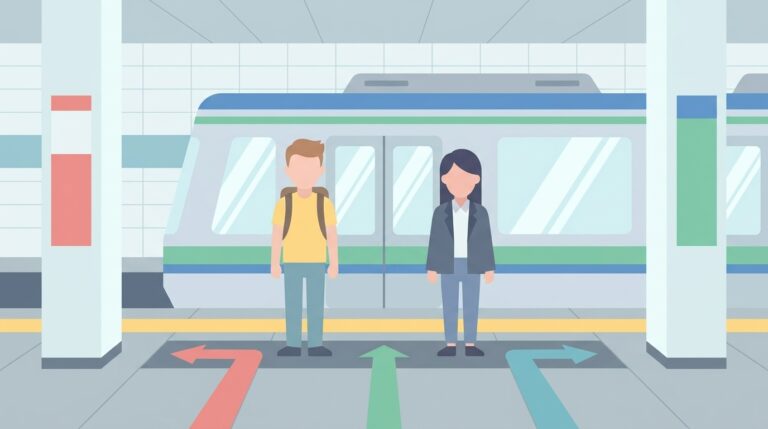
Look at the ground in any Seoul subway station. You will see painted triangles pointing outward (for exiting) and inward (for boarding). If you stand in the center, you will be swept away by a tidal wave of commuters! The golden rule: Stand on the sides, wait for the center lane to clear, and avoid intense eye contact with the people squeezing past you.
4-2. The “Hell Train” and Drama vs. Reality
Have you ever seen a K-Drama where the leads share a romantic, quiet moment on an empty bus at sunset? That does happen… but usually only at 11 PM!
During morning and evening rush hours, the Seoul subway is affectionately called 지옥철 (Jiokcheol), literally meaning “Hell Train.” Reality requires a delicate balance of survival skills. You must hold your backpack in your hands (not on your back) to save space, and you must shuffle quickly to the door before your stop. When you use phrases like “내리고 탈게요”, you are proving that you understand the unspoken rhythm of the Hell Train.
Phase 5: Real-Life Roleplay Scenario
Setting: Friday evening, 6:30 PM. Line 2 at Gangnam Station. The air is thick with anticipation for the weekend. The platform is packed. You are traveling with your Korean friend, Min-su.
Characters:
* YOU: An intermediate Korean learner, trying to navigate the chaos.
* Min-su (30): Your energetic local friend who navigates crowds like a ninja.
Min-su: 와, 오늘 사람 진짜 많네요! 퇴근 시간이라서 그래요.
(wa, oneul saram jinjja manneyo! toegeun siganiraseo geuraeyo.)
[Wow, there are so many people today! It’s because it’s rush hour.]
YOU: 그러게요. 우리 어디에 서야 해요?
(geureogeyo. uri eodie seoya haeyo?)
[I know, right. Where should we stand?]
Min-su: 저기 바닥에 화살표 보이죠? 저기 줄 서면 돼요.
(jeogi badage hwasalpyo boijyo? jeogi jul seomyeon dwaeyo.)
[Do you see the arrows on the floor over there? We can line up there.]
YOU: 아, 저 사람이 마지막이에요? 가서 물어볼게요.
(a, jeo sarami majimagieyo? gaseo mureobolgeyo.)
[Ah, is that person the last one? I’ll go ask.]
(You walk up to a stranger looking at their phone)
YOU: 저기요, 혹시 줄 서 계신 건가요?
(jeogiyo, hoksi jul seo gyesin geongayo?)
[Excuse me, are you by any chance in line?]
Stranger: 아, 네. 맞아요.
(a, ne. majayo.)
[Ah, yes. I am.]
YOU: 감사합니다. 민수 씨, 여기 줄 맞대요!
(gamsahamnida. minsu ssi, yeogi jul matdaeyo!)
[Thank you. Min-su, they said this is the line!]
Min-su: 오~ 한국어 진짜 자연스러웠어요! 앗, 지하철 들어온다!
(o~ hangugeo jinjja jayeonseureowosseoyo! at, jihacheol deureoonda!)
[Oh~ your Korean was really natural! Ah, the subway is coming!]
(The doors open, and someone behind Min-su starts pushing)
🔀 Your Turn! How should you react to protect the exiting passengers?
* A) 밀지 마세요!!! (Don’t push!!!)
* B) 아, 잠시만요! 내리고 탈게요!
* C) 가만히 있으세요. (Stay still.)✅ Best Choice: B — Saying 잠시만요! 내리고 탈게요! is the most culturally appropriate way to pause the crowd without causing an argument.
⚠️ Choice A & C Analysis: Both are direct commands and can sound aggressive or rude to strangers, especially older folks.
YOU: (Turning slightly) 아, 잠시만요! 내리고 탈게요!
(a, jamsimanyo! naerigo talgeyo!)
[Ah, just a moment! We’ll get on after they get off!]
Min-su: (Smiling) 완벽해요. 이제 탑시다!
(wanbyeokaeyo. ije tapsida!)
[Perfect. Let’s get on now!]
Phase 6: 10-Second Shadowing Drill
Practice your intonation and pacing! Read the slash (/) as a slight pause.
😊 Polite & Gentle:
저기요, / 혹시 / 줄 서 계신 건가요?
(jeogiyo, / hoksi / jul seo gyesin geongayo?)
😤 Firm but Respectful:
아, 잠시만요! / 내리고 / 탈게요!
(a, jamsimanyo! / naerigo / talgeyo!)
😊 Warm & Considerate:
천천히 오세요. / 먼저 / 타세요.
(cheoncheonhi oseyo. / meonjeo / taseyo.)
Phase 7: K-Culture Mini Dictionary
1. 지옥철
* Romanization: jiokcheol
* Meaning: Hell train (Jiok = Hell, Cheol = from Jihacheol/Subway)
* Context: The notoriously packed subway lines (like Line 2 and Line 9) during Seoul’s rush hours.
2. 눈치
* Romanization: nunchi
* Meaning: Reading the room / Social sense
* Context: Knowing when to move out of the way, when to offer your seat, and understanding the unwritten rules of the transit line.
3. 빨리빨리
* Romanization: ppali-ppali
* Meaning: Hurry, hurry
* Context: The driving force behind Korean society. It’s why people scan their transit cards while running to the turnstile!
4. 환승
* Romanization: hwanseung
* Meaning: Transfer
* Context: You will hear this word constantly on the subway announcements. Transferring between buses and subways is free if done within 30 minutes!
Phase 8: Traveler’s Survival Kit
Are you planning a trip to Korea soon? You MUST know these transit survival tips!
Survival Phrase 1
🇰🇷 “이 버스 OO 가나요?” (i beoseu OO ganayo?)
🗣️ English Guide: Does this bus go to [Destination]?
📍 Where to use: Before boarding a bus if you are unsure.
Survival Phrase 2
🇰🇷 “이번 역은 어디예요?” (ibeon yeogeun eodiyeyo?)
🗣️ English Guide: What station is this?
📍 Where to use: When you can’t see the screen and missed the English announcement.
Survival Phrase 3
🇰🇷 “내릴게요!” (naerilgeyo!)
🗣️ English Guide: I’m getting off!
📍 Where to use: Yell this politely if you are stuck at the back of a crowded bus and the doors are about to close.
📌 Editor’s Travel Note
* The Apps: Google Maps is notoriously unreliable for walking in Korea. You MUST download KakaoMap or Naver Map for accurate transit times and bus queue locations.
* Tag On, Tag Off: You must tap your T-money card when getting ON the bus and when getting OFF. If you forget to tap off, you will be charged a penalty fee on your next ride, and you’ll miss out on the free transfer!
Phase 9: Critical Thinking Corner — “한 발 더 깊이”
Media vs Reality: The Illusion of Empty Spaces
🧠 Think Deeper:
If you watch K-Dramas, public transportation often serves as a quiet, aesthetic backdrop for romantic confessions or melancholic reflections. Characters gaze out of pristine bus windows with plenty of personal space. However, the reality of Korean public transit is a fascinating display of intense collective efficiency. The rigid lines, the specific floor markings, and the silent “nunchi” dances are a necessity born from housing millions of people in a dense metropolis. The orderliness you see isn’t just about being polite; it’s a vital social contract to prevent chaos in the 빨리빨리 (hurry) culture.💬 Your Turn: Have you ever noticed a huge difference between how your country is portrayed in movies versus real daily life? Share it in the comments!
Phase 10: FAQ & Avoiding Misunderstandings
Q: “Can I use ‘줄이에요?’ with an older person?”
Yes, as long as you include the 요 at the end. However, if they are significantly older (like a grandparent), it is safer and more respectful to use our core phrase: 줄 서 계신 건가요?
Q: “What if someone cuts the line in front of me?”
Usually, if it’s an elderly person (often called Ajumma or Ajeossi), Koreans might just let it slide out of respect for elders, or they simply assume the person is confused. If it’s someone your age, a polite “저기요, 여기 줄이에요” (Excuse me, there is a line here) works perfectly.
❌ Common Mistake #1: Pushing your way onto the subway before people have exited.
✅ Do this instead: Stand to the left or right of the doors. Wait until the stream of exiting people stops completely before stepping in.❌ Common Mistake #2: Sitting in the pink “Pregnancy Priority” seats.
✅ Do this instead: Even if the train is completely packed and the pink seat is empty, Koreans leave it empty. It is a major social faux pas to sit there if you are not visibly pregnant or wearing the official pink badge.
Phase 11: Summary & Action Items
One-Liner Summary: Surviving Korean transit means mastering the art of waiting for others to exit and politely confirming your spot in line with “줄 서 계신 건가요?”.
Action Mission 3 Steps:
* 🥉 Bronze (Solo): Stand in front of your mirror and practice saying “아, 잠시만요! 내리고 탈게요!” with a firm but friendly face 3 times.
* 🥈 Silver (Online): Go to your favorite language learning app or community and write a short sentence about your daily commute using the word 지옥철.
* 🥇 Gold (Real Life): Next time you are in Korea (or at a busy Korean grocery store!), use “먼저 타세요” or “먼저 가세요” (Please go first) to a stranger.
K-Culture Mission:
Open Google Maps or KakaoMap Street View, drop yourself inside a Seoul subway station (like Seoul Station or Gangnam), and try to find the painted triangles on the floor where people queue up!
💬 Did you learn something new today? What is the public transit etiquette like in your country? Let me know below!
Phase 12: Interactive Quiz
Test your transit survival skills!
1. Situational Judgment: You are waiting for the elevator at the subway station. An elderly man approaches. The doors open. What should you say to let him go first?
* A) 제가 갈게요! (I will go!)
* B) 먼저 타세요. (Please get on first.)
* C) 빨리빨리! (Hurry hurry!)
2. Fill in the Blank:
“Excuse me, are you in line?”
“저기요, 혹시
___ 계신 건가요?”
3. True or False – K-Culture Edition:
In Korea, it is perfectly fine to sit in the pink “Pregnancy Priority” seats on the subway as long as you stand up when a pregnant woman boards. (T/F)
Click to see answers!
1. B – It shows respect and offers the right of way.
2. 줄 서 (jul seo)
3. False – The pink seats are almost always left empty as a sign of respect and “nunchi”, even during rush hour!
Frequently Asked Questions (FAQ)
Q: What does "줄 서 계신 건가요?" mean in Korean and how do you pronounce it?
A: In Korean, "줄 서 계신 건가요?" is pronounced [jul seo gyesin geongayo? (jul sounds like jewel but as one quick syllable, gyesin sounds like gyeh-shin] and means: Are you standing in line? (Literal: Are you in the state of standing in a line?)
Q: What does "내리고 탈게요!" mean in Korean and how do you pronounce it?
A: In Korean, "내리고 탈게요!" is pronounced [naerigo talgeyo! (nae sounds like the ne in net, tal sounds like tahl] and means: I will board after people get off! (Literal: Get off and then I will ride!)
Q: What does "먼저 타세요." mean in Korean and how do you pronounce it?
A: In Korean, "먼저 타세요." is pronounced [meonjeo taseyo. (meon sounds like mun in mundane, ta sounds like ta in taco] and means: Please go ahead. / You board first.







