

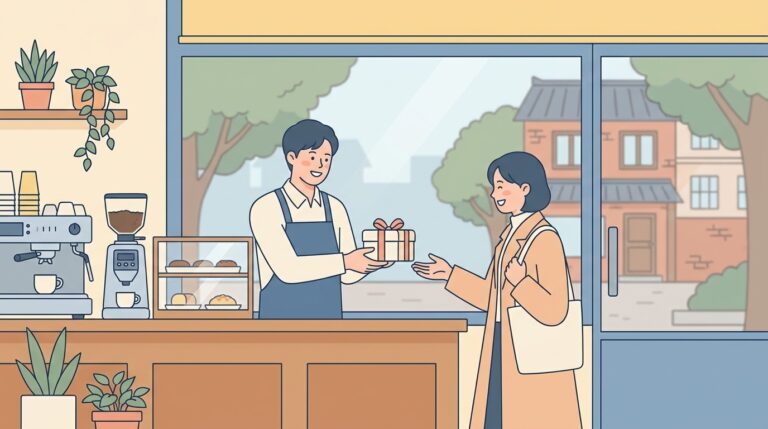
Mastering Korean Cafes: How to Order Desserts To-Go Like a Local
Phase 1: Empathy & The Perfect K-Cafe Moment
안녕하세요! (Hello!) I am the Senior Editor at Daily Hangul, your personal Korean tutor and local guide in Seoul.
Imagine this: You are in Seongsu-dong, the Brooklyn of Seoul. You just finished a fantastic iced Americano at a trendy, aesthetic cafe. Before you leave, your eyes lock onto a beautiful, perfectly layered Strawberry Shortcake in the display case. It looks exactly like the ones you see in K-Dramas! You want to take it back to your hotel to enjoy while watching your favorite show tonight.
But wait… you step up to the counter and freeze. You know how to say Take-out for coffee, but what about a fragile piece of cake? Do you say take-out for food too? If you just point and smile, will they give it to you on a plate?
Don’t worry! This is a classic A1 absolute beginner struggle. Today, I will teach you the magic word that turns you from a confused tourist into a cafe insider. All of this is based on real questions my students ask me after their cafe adventures in Korea!
Phase 2: Core Expressions — Deep Dive
Let’s learn the most essential expressions you need for packaging desserts.
1. 이거 포장해 주세요
- Pronunciation: ee-geo po-jang-hae joo-se-yo
- Meaning: (Literal) Please wrap this up. / (Real Nuance) I’d like this to go, please.
- K-Culture Moment: In K-Dramas, when the male lead buys a small, pretty cake box to bring to his family or his crush, he tells the bakery staff, pojanghae juseyo. It’s about careful packaging, not just grabbing food and running!
- Editor’s Insight: Pojang (포장) literally means packing or wrapping. While Koreans use the English word take-out for drinks, we almost always use pojang for food and desserts because they require a physical box or bag.
- Situation Spectrum:
- Casual (To a friend helping you order): ✅ 이거 포장하자
- Semi-formal (To cafe staff): ✅ 이거 포장해 주세요
- Formal (To a very strict elder): ⚠️ 이것 좀 포장해 주시겠어요?
- 🤔 Think About It: Why do Koreans separate take-out for drinks and pojang for food? It shows how much we value the presentation and safety of the food we carry! Does your language have different words for taking out drinks vs. food?
2. 따로 포장해 주세요
- Pronunciation: tta-ro po-jang-hae joo-se-yo
- Meaning: (Literal/Real) Please pack them separately.
- K-Culture Moment: You bought one matcha cookie for yourself and one chocolate scone as a gift for your friend. You don’t want them smushed together in one bag!
- Editor’s Insight: Ttaro (따로) means separately. It’s a lifesaver when you are buying gifts for multiple people.
- Situation Spectrum:
- Casual: ✅
- Semi-formal (Cafe staff): ✅
- Formal: 🚫 (Not needed)
- 🤔 Think About It: In Korean culture, giving small food gifts (like a pretty cafe dessert) to coworkers or friends is very common. Separating the packages makes the gift look much more respectful.
3. 포크도 주세요
- Pronunciation: po-keu-do joo-se-yo
- Meaning: (Literal/Real) Please give me a fork too.
- K-Culture Moment: You are back at your hotel, you open the beautiful cake box… and realize you have to eat it with your hands. Tragedy! Always ask for a fork (pokeu).
- Editor’s Insight: Do (도) means also or too. The ‘eu’ sound in pokeu sounds like the disgusted sound you make when stepping in gum. Make it short!
- Situation Spectrum:
- Casual: ✅
- Semi-formal (Cafe staff): ✅
- Formal: 🚫
Phase 3: Textbook vs. Real Korean
When you want to take your cake to-go:
* 📖 Textbook Korean: 디저트를 테이크아웃 하고 싶습니다. (I would like to take out the dessert.)
* 🗣️ Real Korean: 이거 포장해 주세요. (Pack this, please.)
* 💡 Why is it different?: Textbook Korean uses the formal -seumnida ending, which sounds like you are giving a news broadcast. The -yo ending is perfectly polite and much more natural for everyday cafe interactions!
When you don’t need a bag:
* 📖 Textbook Korean: 봉투는 필요하지 않습니다. (A bag is not necessary.)
* 🗣️ Real Korean: 봉투는 괜찮아요. (A bag is okay / I’m fine without a bag.)
* 💡 Why is it different?: Koreans prefer soft, indirect rejections. Saying It’s okay (괜찮아요) is the polite way to say No, thank you.
Phase 4: Cultural Context — K-Culture Deep Dive
4-1. Non-Verbal Tips: The Magic of Pointing
When you say igeo (this), you will naturally want to point at the cake in the display. Do not tap the glass hard! Instead, gently point with your open hand or gently with one index finger without touching the glass. Also, remember the Korean concept of Nunchi (reading the room). If you order your cake to-go (pojang), it means you shouldn’t sit at a table to eat it. Cafe seats are for dine-in customers!
4-2. K-Food Connection: The Dessert Stomach
Have you ever wondered why Korean cafes are so popular? In Korea, there is a famous saying: 디저트 배는 따로 있다 (The dessert stomach is separate). No matter how much spicy K-BBQ or heavy stew we eat for dinner, we always have room for coffee and a sweet treat afterward. Cafe hopping is an essential part of dating, hanging out with friends, and even business meetings. Packaging a dessert to take home is the perfect way to extend that happy cafe feeling!
Phase 5: Real-Life Roleplay Scenario
Setting: Saturday afternoon at a bustling, Instagram-famous bakery cafe in Bukchon Hanok Village. The smell of butter and espresso fills the air. You are standing in front of the cashier.
Characters:
– YOU: A traveler who just discovered the most amazing Earl Grey Pound Cake.
– Sujin (Cafe Staff): A friendly 20-something barista wearing a neat apron.
Dialogue:
Sujin: 안녕하세요! 주문 도와드릴까요?
(an-nyeong-ha-se-yo! ju-mun do-wa-deu-ril-kka-yo?)
[Hello! Can I help you with your order?]
YOU: 네, 아이스 아메리카노 한 잔 주세요. 그리고…
(ne, a-i-seu a-me-ri-ka-no han jan joo-se-yo. geu-ri-go…)
[Yes, one iced Americano please. And…]
(🎭 Stage Direction: You point at the Earl Grey Pound Cake in the case)
Sujin: 얼그레이 파운드케이크요? 드시고 가시나요?
(eol-geu-re-i pa-un-deu-ke-i-keu-yo? deu-si-go ga-si-na-yo?)
[The Earl Grey Pound Cake? Will you be eating here?]
🔀 Your Turn! How do you answer?
– A) “테이크아웃 하겠습니다!” (Very formal and slightly awkward for food)
– B) “이거 포장해 주세요!” (Natural and polite)
– C) “집에 갈게요!” (Literally means: I will go home! – Very confusing!)✅ Best Choice: B — Pojanghae juseyo is the golden phrase. The barista will perfectly wrap your cake in a nice box.
Sujin: 네, 포장해 드릴게요. 봉투 필요하세요?
(ne, po-jang-hae deu-ril-ge-yo. bong-tu pi-ryo-ha-se-yo?)
[Yes, I’ll pack it for you. Do you need a bag?]
YOU: 네, 주세요. 감사합니다!
(ne, joo-se-yo. gam-sa-ham-ni-da!)
[Yes, please. Thank you!]
Phase 6: 10-Second Shadowing Drill
Practice this out loud. Pay attention to the pauses (/) and the emotion tags!
😊 밝게 (Brightly): 이거 / 포장해 / 주세요!
(ee-geo / po-jang-hae / joo-se-yo!)
🥺 애교 섞어서 (Politely requesting): 따로 / 포장해 / 주세요~
(tta-ro / po-jang-hae / joo-se-yo~)
Phase 7: K-Culture Mini Dictionary
1. 포장 (pojang)
* Pronunciation: po-jang
* English: Wrapping / Packaging / To-go
* Context: Used for food, gifts, and desserts. Never use it for just a cup of coffee!
2. 디저트 배 (dijeoteu bae)
* Pronunciation: di-jeo-teu bae
* English: Dessert stomach
* Context: The magical second stomach Koreans believe they have, which activates only for sweets after a full meal.
3. 영수증 (yeongsujeung)
* Pronunciation: yeong-su-jeung
* English: Receipt
* Context: Staff will always ask if you need this. You can simply say Gwaen-chan-a-yo (It’s okay) if you don’t want it.
4. 진동벨 (jindongbel)
* Pronunciation: jin-dong-bel
* English: Pager / Buzzer
* Context: The little UFO-shaped device they give you. It vibrates wildly when your cake is finally packed and ready!
Phase 8: Traveler’s Survival Kit
Even if you just point at things, these 3 survival phrases will save your cafe trip!
🆘 Survival Phrases for the Cafe
– 🇰🇷 “이거 얼마예요?” (ee-geo eol-ma-ye-yo?)
– 🗣️ English: How much is this?
– 📍 Where to use: Any cafe, market, or small shop without clear price tags.
– 💡 Pro Tip: If you can’t understand the numbers they say, gently hand them your phone with the calculator app open!
- 🇰🇷 “화장실 어디예요?” (hwa-jang-sil eo-di-ye-yo?)
- 🗣️ English: Where is the restroom?
- 📍 Where to use: When you decide to dine-in before leaving.
🇰🇷 “와이파이 비밀번호 뭐예요?” (wa-i-pa-i bi-mil-beon-ho mwo-ye-yo?)
- 🗣️ English: What is the Wi-Fi password?
- 📍 Where to use: Every cafe in Korea has blazing fast, free Wi-Fi.
📌 Editor’s Travel Note
– Card vs. Cash: Korean cafes are 99% cashless! Always use a credit card or travel card (like Namane or T-Money).
– Tip Culture: There is absolutely ZERO tip culture in Korea. If you leave coins on the cafe counter, the barista might chase you down the street thinking you forgot your change!
Phase 9: Think Deeper — Korean in the Global Era
🧠 Think Deeper: The Konglish Dilemma
In Korean cafes, you will hear a fascinating mix of English and Korean. We say Aiseu Amerikano (Iced Americano), Keikeu (Cake), and Teikeu-aut (Take-out). But why does the very traditional Korean word Pojang (포장) survive so strongly for food? As Korea globalizes, English words represent modernity and trendiness (hence coffee terms in English). However, Pojang carries a deeper cultural weight of carefully wrapping a precious item, a tradition going back hundreds of years. So, we kept the traditional word for the food, but adopted the Western word for the quick drink!💬 Your Turn: In your country, do you use foreign words for trendy new foods or drinks? Let me know in the comments!
Phase 10: FAQ & Avoiding Common Mistakes
Q: Can I say “Take-out” for my cake?
Yes! They will understand you perfectly. However, using Pojang makes you sound like someone who truly understands Korean culture, not just a tourist.
Q: If I ask for Pojang, can I sit at the table to take a quick photo?
Just for 1 minute? Yes. But generally, in Korea, to-go packaging often means a cheaper tax bracket for the cafe or different cup regulations. If you have a to-go bag or disposable cup, you should leave the cafe quickly.
❌ Common Mistake #1: Saying “To-go please!” in English.
✅ Do this instead: Even if you speak English, add the Korean word! Point and say: “Pojang please!” The staff will be so impressed with your effort.
Phase 11: Summary & Action Items
One-Liner Summary: When you want to take that delicious Korean cafe dessert back to your hotel, simply point and say, “이거 포장해 주세요 (Igeo pojanghae juseyo).”
Your Action Missions:
– 🥉 Bronze (Solo): Stand in front of your mirror and practice saying “이거 포장해 주세요” three times with a confident smile.
– 🥈 Silver (Online): Find a YouTube vlog of someone cafe-hopping in Seoul. Listen closely—can you hear the barista say Pojang?
– 🥇 Gold (Real-world): Visit a Korean bakery or cafe in your city (or when you travel to Seoul) and order your dessert to-go using this exact phrase!
Special K-Culture Mission:
Next time you watch a K-Drama and a character brings a cake box to a hospital or a friend’s house, look at the box! That box is the beautiful result of saying Pojanghae juseyo.
Did you ever struggle to order food to-go in a foreign country? Share your funny stories in the comments below! 👇
Phase 12: Interactive Quiz
Let’s test what you learned today!
1. Situational Judgment: You are buying three different slices of cake for three different friends. What should you say?
– A) 이거 포장해 주세요.
– B) 따로 포장해 주세요.
– C) 화장실 어디예요?
(Answer: B. You need them packed separately!)
2. True or False – K-Culture Edition:
“It is considered polite to leave a small 10% tip in a cafe jar after asking them to carefully package a cake.”
(Answer: False! There is no tipping in Korea. A warm “Gam-sa-ham-ni-da” is the best tip!)
3. Fill in the Blank:
Barista: “드시고 가시나요?” (Will you eat here?)
You: “아니요, ______________.”
(Answer: 포장해 주세요 / po-jang-hae joo-se-yo)
Frequently Asked Questions (FAQ)
Q: What does "이거 포장해 주세요" mean in Korean and how do you pronounce it?
A: In Korean, "이거 포장해 주세요" is pronounced [ee-geo po-jang-hae joo-se-yo] and means: (Literal) Please wrap this up. / (Real Nuance) I'd like this to go, please.
Q: What does "따로 포장해 주세요" mean in Korean and how do you pronounce it?
A: In Korean, "따로 포장해 주세요" is pronounced [tta-ro po-jang-hae joo-se-yo] and means: (Literal/Real) Please pack them separately.
Q: What does "포크도 주세요" mean in Korean and how do you pronounce it?
A: In Korean, "포크도 주세요" is pronounced [po-keu-do joo-se-yo] and means: (Literal/Real) Please give me a fork too.







