Don’t Panic at the Korean Cinema! How to Choose the Perfect Movie Seats Like a Local
Hello! I am the Lead Editor at Daily Hangul.
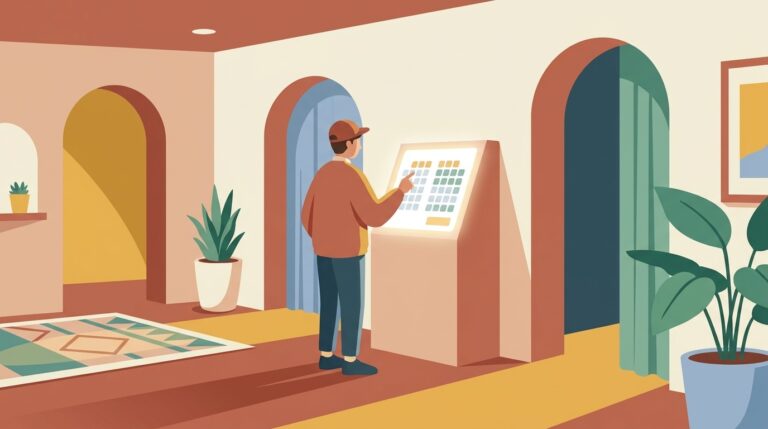
Imagine this: Your favorite Korean actor’s new movie just came out. You walk into a massive, shiny cinema in Seoul (like CGV, Megabox, or Lotte Cinema). You smell the amazing caramel popcorn, and you are so excited! But then… you face the giant ticket kiosk. It’s asking you to select seats, the clock is ticking down from 3 minutes, and there’s a line of impatient teenagers behind you. Cue the panic sweat!
In textbooks, you might learn sentences like “I would like to purchase one ticket for the 7 PM showing.” But in real life, especially in fast-paced Korea, choosing a seat is all about quick, practical phrases—whether you are talking to a staff member or asking a friend to tap the screen for you.
Don’t worry. This guide is based on real struggles my beginner students faced in Korea. By the end of this post, you’ll be able to secure the best seats like a true insider!
Phase 2: Core Expressions for Seat Selection
Let’s master the three most important phrases you need when choosing seats.
1. [가운데 자리로 해 주세요] (Middle seats, please)
- Pronunciation: ga-un-de ja-ri-ro hae ju-se-yo [gah-oon-deh jah-ree-ro heh joo-seh-yo]
- Meaning: Literal: Please do it as middle seats. / Real Nuance: I’d like seats in the middle.
- K-Culture Moment: You are on a date. In Korea, sitting in the middle (가운데) is considered the “prime spot” for the best screen view. If you confidently say this to the ticket staff, your date will definitely be impressed!
- Editor’s Insight: The word 자리 (ja-ri) means “seat” or “space.” The ending ~로 해 주세요 (~ro hae ju-se-yo) is a magic phrase! It means “Please make it [Choice].” You can use it anywhere—cafes, restaurants, or cinemas.
- Situation Spectrum:
- Friends (Casual): ✅ (Drop ‘요’ -> 가운데 자리로 해 줘)
- Co-workers (Semi-formal): ✅
- Elders/Strangers (Formal): ✅
- 🤔 Think About It: Koreans love efficiency and getting the “best” experience. Why do you think prime middle seats in Korean cinemas sometimes cost a little bit more during peak times? Does your country have dynamic pricing for seats?
2. [통로 쪽 자리 있나요?] (Are there any aisle seats?)
- Pronunciation: tong-ro jjok ja-ri in-na-yo? [tong-roh jjohk jah-ree een-nah-yo?]
- Meaning: Literal: Is there an aisle side seat? / Real Nuance: Do you have aisle seats available?
- K-Culture Moment: You bought a massive bucket of half-caramel, half-onion popcorn, and a giant soda. You know you’ll need a bathroom break halfway through the 2-hour K-Drama movie. “통로 쪽” (aisle side) is a lifesaver!
- Editor’s Insight: “쪽” (jjok) means “side” or “direction.” It’s very useful! You can say “창문 쪽” (window side) at a cafe, or “통로 쪽” (aisle side) on an airplane or train.
- Situation Spectrum:
- Friends (Casual): ✅ (통로 쪽 있어?)
- Co-workers (Semi-formal): ✅
- Elders/Strangers (Formal): ✅
- 🤔 Think About It: The word 있나요? (in-na-yo?) sounds slightly softer and more polite than 있어요? (isseo-yo?). It shows you are gently asking for a favor. How does tone of voice change requests in your language?
3. [두 자리 붙어 있어요?] (Are the two seats together?)
- Pronunciation: du ja-ri bu-teo i-sseo-yo? [doo jah-ree boo-tuh ee-ssuh-yo?]
- Meaning: Literal: Are the two seats attached? / Real Nuance: Are these two seats next to each other?
- K-Culture Moment: You and your friend are booking tickets late for a famous K-Pop idol’s concert movie. The cinema is almost full. You see two empty seats on the screen, but you need to double-check if they are side-by-side!
- Editor’s Insight: “붙다” (but-da) literally means “to stick.” So you are asking if the seats are “stuck” together. It’s a very visual and native-sounding way to say “next to each other.”
- Situation Spectrum:
- Friends (Casual): ✅ (두 자리 붙어 있어?)
- Co-workers (Semi-formal): ✅
- Elders/Strangers (Formal): ✅
Phase 3: Textbook vs. Real Korean
Let’s look at how native Koreans actually speak when looking at a seating chart.
[Choosing a specific seat]
* 📖 Textbook Korean: 저는 J열 5번 좌석을 원합니다. (I want seat J5.)
* 🗣️ Real Korean: 여기 J열 5번으로 할게요. (I’ll go with J5 here.)
* 💡 Why the difference?: Koreans rarely use “원합니다” (I want) in daily life. It sounds like a robot! “~로 할게요” (I’ll do/choose this) is the ultimate natural choice for picking something.
[Asking a friend where they want to sit]
* 📖 Textbook Korean: 당신은 어느 좌석에 앉고 싶습니까? (Which seat do you want to sit in?)
* 🗣️ Real Korean: 어디 앉을래? / 앞? 뒤? (Where do you wanna sit? Front? Back?)
* 💡 Why the difference?: Efficiency! In casual conversations, dropping the subject and using short directional words (앞 = front, 뒤 = back) is much more natural.
(Bottom Note: As an A2 learner, using “~로 할게요” will instantly make you sound like you’ve lived in Seoul for months!)
Phase 4: Cultural Context — K-Culture Deep Dive
4-1. Non-Verbal Cues (Nunchi at the Cinema)
In Korea, personal space inside a dark movie theater is highly respected. If you need to pass someone to get to your middle seat, do not make intense eye contact. Slightly bow your head, use your hand to make a small slicing motion forward to show you are passing, and softly whisper “죄송합니다” (Sorry) or “지나갈게요” (I’m passing). This is prime Nunchi (social awareness)!
4-2. The “Sweetbox” & K-Movie Culture
Have you ever watched a K-Drama where the main couple goes to the movies, and they sit on a special sofa seat at the very back?
In Korean cinemas, the back row is often reserved for “Sweetbox” (스위트박스) seats. These are premium couples’ seats with no armrest in the middle and high walls on the sides for privacy.
If you are just going with a regular friend, be careful not to accidentally book a Sweetbox! It might lead to a very awkward, or hilarious, misunderstanding.
Phase 5: Real-Life Roleplay Scenario
Setting: Friday night, 7:30 PM. A crowded CGV cinema in Hongdae. The air smells like sweet popcorn. You and your Korean friend, Min-su, are standing in front of the self-service ticket kiosk.
Characters:
– YOU: A beginner Korean learner, excited to watch the new action movie.
– Min-su (28): Your friendly Korean language exchange partner who speaks fast.
Dialogue:
Min-su: 영화 진짜 기대된다! 내가 화면 누를게.
(yeong-hwa jin-jja gi-dae-doen-da! nae-ga hwa-myeon nu-reul-ge.)
[I’m so excited for the movie! I’ll press the screen.]
(🎭 Stage Direction: Min-su taps the movie poster on the kiosk)
YOU: 응! 사람 진짜 많다.
(eung! sa-ram jin-jja man-ta.)
[Yeah! There are so many people.]
Min-su: 자리 어디 앉을래? 앞쪽? 뒤쪽?
(ja-ri eo-di an-jeul-lae? ap-jjok? dwi-jjok?)
[Where do you wanna sit? Front side? Back side?]
YOU: 음… 나는 앞자리는 피하고 싶어.
(eum… na-neun ap-ja-ri-neun pi-ha-go si-peo.)
[Hmm… I want to avoid the front seats.]
Min-su: 오케이. 그럼 중간 어때? H열!
(o-ke-i. geu-reom jung-gan eo-ttae? e-i-chi yeol!)
[Okay. Then how about the middle? Row H!]
🔀 Your Turn! How should you reply?
– A) “저는 H열 좌석을 원합니다.” (I want the Row H seat.)
– B) “좋아! 통로 쪽 자리 있나요?” (Sounds good! Are there any aisle seats?)
– C) “스위트박스 주세요!” (Give me a Sweetbox!)✅ Best Choice: B — Perfect blend of casual agreement with your friend and practical seat checking!
⚠️ Choice C Analysis: Unless you want to confess your romantic feelings to Min-su right now, avoid the Sweetbox!
Min-su: 통로 쪽? 잠시만… 어! 두 자리 붙어 있어!
(tong-ro jjok? jam-si-man… eo! du ja-ri bu-teo i-sseo!)
[Aisle side? Hold on… Oh! Two seats are together!]
YOU: 완벽해! 거기로 할게.
(wan-byeok-hae! geo-gi-ro hal-ge.)
[Perfect! I’ll go with that one.]
Min-su: 결제 완료! 팝콘 먹으러 가자!
(gyeol-je wal-ryo! pap-kon meo-geu-reo ga-ja!)
[Payment complete! Let’s go eat popcorn!]
Phase 6: 10-Second Shadowing Drill
Practice speaking out loud! Follow the slashes (/) for natural pausing. Pay attention to the emotion tags!
- 🥺 Asking carefully: 통로 쪽 / 자리 / 있나요? (tong-ro jjok / ja-ri / in-na-yo?)
- 😊 Bright & Decisive: 가운데 / 자리로 / 해 주세요! (ga-un-de / ja-ri-ro / hae ju-se-yo!)
- 😤 Confident: 앞자리는 / 피하고 싶어요. (ap-ja-ri-neun / pi-ha-go si-peo-yo.)
Phase 7: K-Culture Mini Dictionary
Here are 4 must-know words for the Korean movie theater experience:
1. 예매
* Romanization: ye-mae
* English: Advance booking / Reservation
* Context: Koreans rarely buy tickets at the counter right before the movie. Everything is done via “예매” on smartphone apps!
2. 조조할인
* Romanization: jo-jo-ha-rin
* English: Early bird discount
* Context: If you watch the very first movie of the day (usually before 10 AM), the ticket is significantly cheaper. Great for budget travelers!
3. 매진
* Romanization: mae-jin
* English: Sold out
* Context: The word you pray not to see on the screen. If it’s a Marvel movie or a famous K-Movie opening weekend, “매진” is everywhere.
4. 혼영
* Romanization: hon-yeong
* English: Watching a movie alone
* Context: Short for 혼자 (alone) 영화 (movie). A huge trend in Korea right now as people value their “me time.”
Phase 8: Traveler Survival Kit
Even if you just use a kiosk, you might need help from the staff.
🆘 Survival Phrases for the Cinema
1. “제 자리가 어디예요?” (je ja-ri-ga eo-di-ye-yo?)
– English: Where is my seat?
– Use when: It’s dark and you can’t find your row.2. “팝콘 반반 되나요?” (pap-kon ban-ban doe-na-yo?)
– English: Can I do half-and-half for the popcorn?
– Use when: You want sweet and savory! “반반” (half-and-half) is a magical Korean word.3. “화장실이 어디예요?” (hwa-jang-si-ri eo-di-ye-yo?)
– English: Where is the restroom?
– Use when: Emergency before the movie starts!📌 Editor’s Travel Note:
Most Korean cinema kiosks (키오스크) have an “English” button at the top right corner! Also, cash is rarely accepted at kiosks now. Make sure you have a physical credit card or Apple Pay/Samsung Pay ready.
Phase 9: Critical Thinking — “One Step Deeper”
🧠 Think Deeper: Media vs Reality (The “Hon-young” Culture)
If you watch Korean dramas, the movie theater is almost always portrayed as a romantic date spot or a place for large group outings. It gives the impression that Koreans never do things alone. However, the reality today is quite different. The culture of “혼영” (Hon-young: watching movies alone) is massive in Seoul. Cinemas even design single-seat zones for solo watchers. It shows how modern Korean society is shifting from a highly collective culture to one that respects individual space and “healing” time.💬 Your Turn: Do people in your country often go to the movies alone? Or is it strictly considered a social activity? Let me know in the comments!
Phase 10: FAQ & Mistake Prevention
Q: “Can I just sit anywhere if the cinema looks empty?”
No! In Korea, assigned seating is strictly followed. Even if the theater is empty, someone might walk in late and claim their exact seat. Always sit in your ticketed seat (지정 좌석).
Q: “How do I read the seat numbers in Korean?”
Rows are usually English letters (A열, B열), and columns are numbers (1번, 2번). Read the letter in English, and the number in Sino-Korean (il, i, sam…). For example, G15 is “지열 십오번” (G-yeol sip-o-beon).
❌ Common Mistake #1: Confusing the pronunciation of the letter “E” and “I”.
✅ Do this instead: When speaking to staff, Koreans often clarify by saying “ABCDE 할 때 E열이요” (Row E, as in ABCDE) to avoid confusion!
Phase 11: Summary & Action Items
One-Liner Summary: Remember “가운데 자리” (Middle seat) and “통로 쪽” (Aisle side) to pick the best spot, and use “~로 할게요” to sound completely natural!
Action Mission 3 Steps:
– 🥉 Bronze (Solo): Say “가운데 자리로 해 주세요” out loud 3 times pretending to point at a screen.
– 🥈 Silver (Online): Write a comment below sharing whether you are a “통로 쪽” (Aisle) or “가운데 자리” (Middle) person!
– 🥇 Gold (Real Life): Next time you are in Korea, order your movie ticket and popcorn entirely in Korean!
🍿 Special K-Culture Mission:
Download a Korean map app (like KakaoMap) and search for “CGV” or “Megabox” near Gangnam station. Look at the photo reviews to see what the Korean ticket kiosks actually look like so you are prepared!
Did you find this helpful? Which Korean movie are you planning to watch next? Leave a comment below!
Phase 12: Quiz — Interactive Challenge
Test your new skills before you head to the movies!
1. Situational Judgment:
You are buying tickets at the counter. You want to choose the two seats next to the aisle. What is the most natural thing to say?
– A) 저는 통로 좌석을 원합니다.
– B) 통로 쪽 두 자리로 할게요.
– C) 스위트박스 주세요.
2. True or False — K-Culture Edition:
In Korean cinemas, if the theater is 90% empty, it is perfectly okay to move to the middle seat even if you bought a back-row ticket. (T / F)
3. Fill in the Blank:
You want to make sure you and your friend aren’t separated.
“두 자리 ( _____ ) 있어요?” (Are the two seats together?)
(Answers below!)
Click to reveal answers!
1. B (It uses the natural “~로 할게요” and correctly asks for aisle seats.)
2. False (Koreans strictly follow assigned seating! Someone might come late.)
3. 붙어 (bu-teo – meaning attached/together)
Frequently Asked Questions (FAQ)
Q: What does "[가운데 자리로 해 주세요] (Middle seats, please)" mean in Korean and how do you pronounce it?
A: In Korean, "[가운데 자리로 해 주세요] (Middle seats, please)" is pronounced [ga-un-de ja-ri-ro hae ju-se-yo [gah-oon-deh jah-ree-ro heh joo-seh-yo] and means: Literal: Please do it as middle seats. / Real Nuance: I'd like seats in the middle.
Q: What does "[통로 쪽 자리 있나요?] (Are there any aisle seats?)" mean in Korean and how do you pronounce it?
A: In Korean, "[통로 쪽 자리 있나요?] (Are there any aisle seats?)" is pronounced [tong-ro jjok ja-ri in-na-yo? [tong-roh jjohk jah-ree een-nah-yo?] and means: Literal: Is there an aisle side seat? / Real Nuance: Do you have aisle seats available?
Q: What does "[두 자리 붙어 있어요?] (Are the two seats together?)" mean in Korean and how do you pronounce it?
A: In Korean, "[두 자리 붙어 있어요?] (Are the two seats together?)" is pronounced [du ja-ri bu-teo i-sseo-yo? [doo jah-ree boo-tuh ee-ssuh-yo?] and means: Literal: Are the two seats attached? / Real Nuance: Are these two seats next to each other?