Don’t Panic at a Korean K-Beauty Shop! How to Ask and Talk About Colors Like a Local
Phase 1: Empathy
Hello! I’m your Daily Hangul editor.
Picture this: You are walking through the bustling streets of Hongdae. You see a trendy K-Beauty shop offering “Personal Color” analysis, a massive trend in Korea right now. Or maybe you are at a K-Pop merchandise booth, trying to buy your favorite idol’s specific color lightstick. The friendly staff member smiles and asks you a question. You hear the word “color,” but your mind goes blank!
Don’t panic! Colors are everywhere in Korean culture, from the distinct fandom colors at concerts to the “warm tone vs. cool tone” makeup debates. Knowing how to talk about your favorite colors is not just a vocabulary lesson; it’s your VIP ticket to shopping, making friends, and understanding K-Culture on a whole new level.
As a tutor who has watched countless A1 beginners struggle to buy the right colored shirt in Myeongdong, I’ve designed this guide to help you sound like a local. Let’s dive in!
Phase 2: Deep Dive into Core Expressions
1. 무슨 색 좋아해요?
* Pronunciation: museun saek joahaeyo? (Sound-alike: moo-seun sak jo-ah-hae-yo?)
* Meaning: What color do you like?
* K-Culture Moment: You will hear this everywhere! Whether a K-Pop idol is reading comments on a live stream, or a Korean friend is trying to pick a cafe vibe you might enjoy, this is the go-to icebreaker.
* Editor’s Insight: The word “무슨 (museun)” means “what kind of,” and “색 (saek)” means “color.” It’s casual yet polite enough for everyday situations.
* Situation Spectrum:
* 친구 사이 (Casual): ✅ (Say: 무슨 색 좋아해? – museun saek joahae?)
* 직장 동료 (Semi-formal): ✅
* 직장 상사·어른 (Formal): ⚠️ (Better to use: 어떤 색을 좋아하세요? – eotteon saeg-eul joahaseyo?)
* 🤔 Think About It: Why do Koreans often drop the subject “you” in this sentence? In Korean culture, if it’s obvious who you are talking to, saying “you (당신 – dangsin)” can actually sound confrontational!
2. 저는 [색]을 좋아해요.
* Pronunciation: jeoneun [saek]-eul joahaeyo. (Sound-alike: juh-neun [sak]-eul jo-ah-hae-yo.)
* Meaning: I like [color].
* K-Culture Moment: When getting a Personal Color consultation, you might say this to tell the expert what you prefer before they tell you what actually suits you!
* Editor’s Insight: Let’s practice with some basics: 빨간색 (ppalgansaek – Red), 파란색 (paransaek – Blue), 검은색 (geomeunsaek – Black), 하얀색 (hayansaek – White).
* Situation Spectrum:
* 친구 사이 (Casual): ✅ (Drop ‘저는’ and say: 나 [색] 좋아해)
* 직장 동료 (Semi-formal): ✅
* 직장 상사·어른 (Formal): ✅
* 🤔 Think About It: Notice that every color ends with “색 (saek)”. It literally means “Red color,” “Blue color.” Why do you think Korean specifies the word “color” after the hue?
3. 이거 다른 색 있어요?
* Pronunciation: igeo dareun saek isseoyo? (Sound-alike: ee-guh da-reun sak ee-suh-yo?)
* Meaning: Do you have this in another color?
* K-Culture Moment: Your ultimate survival phrase at a Korean underground shopping mall (like Goto Mall in Gangnam). If you find a cute top but want it in black, this is your magic spell.
* Editor’s Insight: “이거 (igeo)” means “this,” “다른 (dareun)” means “other,” and “있어요? (isseoyo?)” means “do you have?”. Memorize this formula!
* Situation Spectrum:
* 상점 점원에게 (To shop staff): ✅
* 친구 사이 (Casual): ✅
* 직장 상사·어른 (Formal): 🚫 (Not applicable)
* 🤔 Think About It: Koreans love efficiency. Notice how short and direct this question is compared to the English translation. How does this reflect the fast-paced “Pali-Pali” (hurry up) culture of Korea?
Phase 3: Textbook vs. Real Korean
Asking someone’s favorite color
* 📖 Textbook Korean: 당신이 가장 좋아하는 색깔은 무엇입니까? (dangsin-i gajang joahaneun saekkkal-eun mueos-imnikka?)
* 🗣️ Real Korean: 무슨 색 제일 좋아해요? (museun saek jeil joahaeyo?)
* 💡 Why it’s different: Textbooks love complete sentences and formal endings (-mnikka). Real Koreans drop pronouns, use the shorter word for “most” (제일 – jeil), and use the softer -yo (-요) ending.
Answering with your favorite color
* 📖 Textbook Korean: 저의 좋아하는 색은 파란색입니다. (jeoui joahaneun saeg-eun paransaeg-imnida.)
* 🗣️ Real Korean: 전 파란색이요! (jeon paransaeg-iyo!)
* 💡 Why it’s different: In a fast-paced conversation, simply attaching “-이요 (-iyo)” to the noun is the most natural, efficient, and polite way to answer a direct question.
Bottom Note: For A1 beginners, it is always safer to stick to expressions ending in “-요 (-yo)”. It is the golden standard for being polite without sounding like a robot!
Phase 4: Cultural Context — K-Culture Deep Dive
4-1. Non-verbal Cues in Korea
When asking questions in Korea, especially to staff or new acquaintances, a slight bow of the head goes a long way. You don’t need to do a full 90-degree bow! Just a polite nod while saying “무슨 색 좋아해요?” shows you have great Nunchi (social awareness).
4-2. K-Beauty Connection: The “Personal Color” Craze
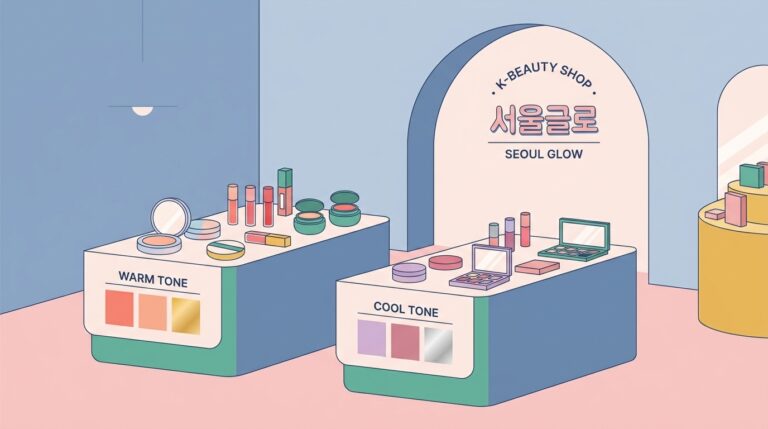
If you visit Korea right now, you will hear people identifying themselves not just by their MBTI, but by their “Personal Color” (퍼스널 컬러 – peoseuneol keolleo). You are either a 웜톤 (Warm Tone) or a 쿨톤 (Cool Tone), further divided into seasons (Spring Warm, Summer Cool, etc.).
When shopping for makeup at Olive Young, you might hear friends discussing: “You shouldn’t buy that orange tint, you’re a Summer Cool tone!” This hyper-categorization reflects the Korean cultural love for finding one’s exact “fit” within a group system.
Phase 5: Real-Life Roleplay Scenario
Setting: Friday afternoon. You are shopping at a bustling clothing store in Hongdae with your new Korean friend, Minji (25, outgoing and loves fashion).
Characters:
* YOU: A beginner Korean learner, looking for a new jacket.
* Minji: Your personal fashion guide today.
Dialogue:
Minji: 우와, 이 재킷 진짜 예쁘다! 한 번 입어봐요.
(uwa, i jaekit jinjja yeppeuda! han beon ibeobwayo.)
Wow, this jacket is really pretty! Try it on.
(Stage Direction: Minji holds up a bright neon green jacket.)
YOU: 아… 예쁘네요. 그런데 너무 튀어요.
(a… yeppeuneyo. geureonde neomu twieoyo.)
Ah… it’s pretty. But it’s too flashy.
Minji: 그래요? 그럼 무슨 색 좋아해요?
(geuraeyo? geureom museun saek joahaeyo?)
Really? Then what color do you like?
YOU: 저는 검은색을 좋아해요.
(jeoneun geomeunsaeg-eul joahaeyo.)
I like black.
Minji: 아하, 무난한 스타일! 저기 검은색 있네요!
(aha, munanhan seutail! jeogi geomeunsaek inneyo!)
Aha, a safe style! There’s a black one over there!
(Stage Direction: You check the rack, but they only have a size Small.)
Minji: 사이즈가 작네요. 직원한테 물어볼까요?
(saijeuga jangneyo. jigwonhante mureobolkkayo?)
The size is small. Shall we ask the staff?
🔀 Your Turn! How should you ask the staff for a black jacket in your size?
* A) “당신은 검은색을 가지고 있습니까?” (dangsin-eun geomeunsaeg-eul gajigo itseumnikka?)
* B) “저기요, 이거 검은색 있어요?” (jeogiyo, igeo geomeunsaek isseoyo?)
* C) “검은색 줘!” (geomeunsaek jwo!)
✅ Best Choice: B — “저기요 (Excuse me), 이거 검은색 있어요? (Do you have this in black?)”. It’s the perfect mix of polite and natural!
⚠️ Choice A 분석: It sounds like an AI robot from a 1990s textbook. “당신” (you) is a huge red flag and can sound offensive.
⚠️ Choice C 분석: It is informal/casual (반말). Using this with staff is considered very rude.
Bonus K-Pop Scenario (Mini Roleplay):
Imagine you are at a K-Pop fan meeting. You want to ask your favorite idol what color they like so you can write a letter on matching paper!
* YOU: 오빠! 무슨 색 제일 좋아해요? (oppa! museun saek jeil joahaeyo? – Oppa! What color do you like the most?)
* IDOL: 저요? 음… 저는 하얀색이요! (jeoyo? eum… jeoneun hayansaeg-iyo! – Me? Hmm… I like white!)
Phase 6: 10-Second Shadowing Drill
Read this out loud. Pay attention to the pauses (/) and the emotion tags!
😊 밝게 (Brightly): 저는 / 파란색을 / 정~~~말 좋아해요!
(jeo-neun / paransaeg-eul / jeong~~~mal joahaeyo!)
[I / reeeally like / blue!]
🥺 아쉽게 (Sadly): 혹시 / 다른 색 / 있어요?
(hoksi / dareun saek / isseoyo?)
[By any chance / do you have / another color?]
Phase 7: K-Culture Mini Dictionary
1. 눈치
* Romanization: nunchi
* English: Social awareness / tact
* Context: The quintessential Korean social skill of reading the room. Knowing when someone hates a color without them explicitly saying it requires good Nunchi.
2. 퍼스널 컬러
* Romanization: peoseuneol keolleo
* English: Personal Color
* Context: A popular beauty trend in Korea where an expert analyzes your skin tone to find the perfect color palette for your clothes and makeup.
3. 최애
* Romanization: choeae
* English: Ultimate bias / Number one favorite
* Context: Originally K-Pop slang for your favorite group member, now used for your favorite anything! “최애 색깔 (choeae saekkkal)” means your absolute favorite color.
4. 깔맞춤
* Romanization: kkalmatchum
* English: Color-coordinating / matching outfits
* Context: When your shirt, shoes, and hat are all the exact same color. Koreans love a good kkalmatchum moment for group trips!
Phase 8: Traveler Survival Kit
If you are traveling in Korea, shopping is inevitable. Here are the survival phrases you need when dealing with colors and items.
🆘 Survival Phrase 1
* 🇰🇷 “이거 까만색 있어요?” (igeo kkamansaek isseoyo?)
* 🗣️ English Sound: ee-guh kka-man-sak ee-suh-yo?
* 📍 Where to use: Clothing stores, cosmetic shops, shoe stores.
* 💡 Pro Tip: Point at the item while saying “이거” (this) to make it perfectly clear.
🆘 Survival Phrase 2
* 🇰🇷 “이 색깔로 주세요.” (i saekkkallo juseyo.)
* 🗣️ English Sound: ee sak-kkal-lo joo-se-yo.
* 📍 Where to use: When handing the item to the cashier. It means “Please give me this color.”
🆘 Survival Phrase 3
* 🇰🇷 “입어봐도 돼요?” (ibeobwado dwaeyo?)
* 🗣️ English Sound: ee-buh-bwa-do dwae-yo?
* 📍 Where to use: Asking “Can I try this on?” before taking that colored shirt to the fitting room.
📌 Editor’s Travel Note
* Fitting Room Etiquette: If you are trying on white or light-colored tops, staff will give you a “face cover” (페이스 커버) – a sheer white hood. You must put it on your head before the shirt to prevent makeup stains. Don’t skip this step!
* Translators: Papago is much better than Google Translate for Korean shopping terms!
Phase 9: Critical Thinking — “One Step Deeper”
🧠 Think Deeper: Global Era & Korean (Language Evolution)
Have you noticed that Koreans sometimes use English words for colors, like “핑크 (Pink)” or “블루 (Blue),” instead of the traditional Korean words “분홍색 (bunhongsaek)” or “파란색 (paransaek)”? As K-Beauty and fashion become more globalized, English loanwords have flooded the industry. A makeup brand will sell a “Pink Coral Tint” rather than a “Bunhong Tint” because the English word feels more modern and trendy to young consumers. However, for basic colors like Black, White, and Red, traditional Korean words are still dominant. This mix of pure Korean and English loanwords shows how the language is adapting to global fashion trends while keeping its roots.
💬 Your Turn: How does the beauty or fashion industry in your country use language to sound “trendy”? Do they borrow words from other languages? Share in the comments!
Phase 10: FAQ & Avoiding Mistakes
Q: Can I use “무슨 색 좋아해요?” to my boss?
A: Maybe, but be careful. If you are close to your boss, it’s fine. But for a strict boss or someone much older, it is safer to use the formal version: “어떤 색을 좋아하세요? (eotteon saeg-eul joahaseyo?)”
Q: Can I just say the color name without “색 (saek)”?
A: No. In English, you say “I like red.” In Korean, you must say “I like red-color (빨간색 – ppalgansaek)”. Dropping “색” sounds incomplete to native ears.
Q: If I don’t know the Korean word for a color, can I use English?
A: Yes! Most young Koreans understand English colors. Saying “오렌지색 (Orange-saek)” or “핑크색 (Pink-saek)” is totally normal and widely used!
❌ 흔한 실수 (Common Mistakes Alert!)
* ❌ Mistake 1: Saying “당신 (Dangsin)” when asking someone’s favorite color. (e.g., 당신은 무슨 색 좋아해요?)
* ✅ How to fix: Just drop it! Ask “무슨 색 좋아해요?” directly.
* ❌ Mistake 2: Mispronouncing “색 (saek)”. If you mispronounce the vowel ‘ae’, it might sound like an English swear word! Make sure it sounds like “sack” or the “se” in “secular”.
Phase 11: Summary & Action Items
One-Liner Summary:
To ask and answer about colors, master the magic word “색 (saek)” and the verb “좋아해요 (joahaeyo)”.
Action Mission 3 Steps:
* 🥉 Bronze (Solo): Look around your room right now. Point to 3 items and say “이거 다른 색 있어요?” to the mirror!
* 🥈 Silver (Online): Go to a K-Pop or K-Drama YouTube video and comment your favorite color using “저는 [색]을 좋아해요!”
* 🥇 Gold (Real World): Visit a Korean cosmetic store, a K-Pop shop, or a Korean restaurant and ask the staff “이거 다른 색 있어요?”
K-Culture Mission:
Next time you watch a K-Drama or a music show, look out for the idol’s hair color or the lead character’s coat. Try to name that color in Korean!
What is your Choeae (ultimate favorite) color? Let me know in the comments below!
Phase 12: Quiz — Interactive Challenge
1. Situational Judgment:
You are at an Olive Young store and want to buy a lip tint, but you want a different color. What is the MOST natural thing to say to the staff?
A) 너 무슨 색 좋아해?
B) 저기요, 이거 다른 색 있어요?
C) 당신의 색깔은 무엇입니까?
(Hint: Remember to be polite to staff!)
2. True or False – K-Culture Edition:
In Korea, “Personal Color” analysis is a popular trend where people use astrology and birth charts to find their lucky color. (T/F)
3. Fill in the Blank:
If you want to say “I like black,” you say: “저는 _______을 좋아해요.” (Hint: Black is geomeunsaek)
Answers:
1. B (A is rude because it is casual/banmal, C is unnatural and weird because of ‘당신’).
2. False (It is based on skin tone, hair, and eye color analysis to find flattering makeup/clothes, not astrology!).
3. 검은색 (geomeunsaek).