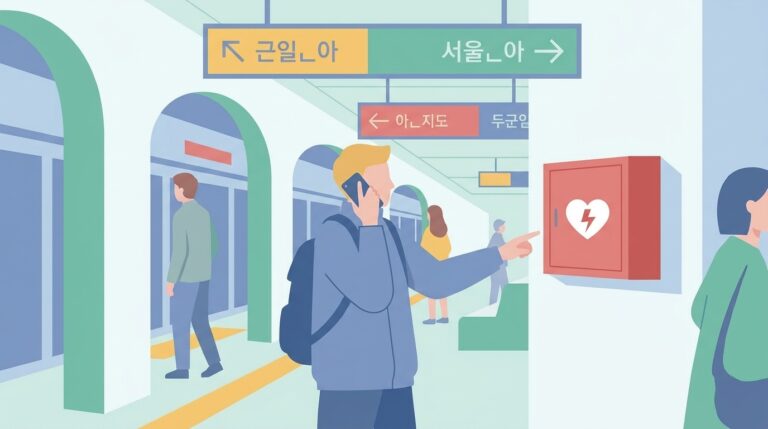
Phase 1: The Golden Time — More Than Just a K-Drama Trope
Hello! I am the senior editor of Daily Hangul, your veteran tutor and local culture navigator in Korea.
We’ve all seen that intense K-Drama scene. The camera pans, the dramatic OST swells, and someone collapses in a crowded subway station or a busy Seoul street. A doctor—usually ridiculously good-looking, like in Dr. Romantic or Hospital Playlist—slides in on their knees, checks for a pulse, and shouts medical jargon.
But let’s step out of the drama for a second. What if you are the one standing there in the middle of Gangnam Station? You are not a surgeon, and there are no subtitles in real life. Knowing basic Korean is great, but as an advanced (C1) learner, knowing how to navigate an emergency, find an Automated External Defibrillator (AED), and direct a crowd could literally save a life.
In this unit, we are going completely off the textbook. Textbooks teach you to politely ask, “Please help me.” But in a real Korean crisis, politeness shifts, and the way you command a room changes entirely. I have designed this based on real safety protocols taught in Korea combined with the nuances of advanced Korean phrasing.
Let’s learn how to be the person who steps up, breaks the bystander effect, and uses C1-level Korean to handle a medical emergency.
Phase 2: Core Phrases Deep Dive
1. 자동 심장 충격기 어디 있어요?
- Pronunciation: ja-dong sim-jang chung-gyeok-gi eo-di i-sseo-yo? [jah-dong sheem-jahng choong-gyuhk-ghee uh-dee ee-suh-yo?]
- Meaning: Where is the Automated External Defibrillator (AED)?
- K-Culture Moment: If you look closely at any Korean subway station or large apartment building, you will see a bright red or green box with a heart symbol. In official broadcasts and on the news, it is called 자동 심장 충격기 (Automated Heart Shock Device). However, medical professionals and many locals still use the Sino-Korean term 제세동기 (je-se-dong-gi).
- Editor’s Insight: This phrase is urgent but still maintains the polite “요” at the end. As a C1 learner, you should recognize that “자동 심장 충격기” is a purely descriptive Korean phrase created to replace the harder Hanja word “제세동기.” In a panic, shouting “에이이디 (AED) 어디 있어요?!” also works perfectly well, as Koreans are very familiar with the English acronym.
- Situation Spectrum:
- Friends/Casual: ✅
- Bystanders/Semi-formal: ✅
- Paramedics/Formal: ✅
- 🤔 Think About It: Even in a life-or-death situation, Koreans instinctively attach the polite suffix “~요” to strangers. How does your native language change in high-stress emergencies? Do you drop formalities entirely?
2. 거기 파란 셔츠 입으신 분, 119에 신고해 주세요!
- Pronunciation: geo-gi pa-ran syeo-cheu ib-eu-sin bun, il-il-gu-e sin-go-hae ju-se-yo! [guh-ghee pah-rahn shuh-chuh eeb-uh-sheen boon, eel-eel-goo-eh sheen-goh-hae joo-seh-yo!]
- Meaning: You there wearing the blue shirt, please report this to 119!
- K-Culture Moment: Korea has a highly responsive emergency system, but crowds can freeze due to the bystander effect (방관자 효과). Every CPR and First Aid training in Korea drills this rule into you: Do not just yell “Someone call 119!” You must point at a specific person, mention their clothing or glasses, and give a direct order.
- Editor’s Insight: Notice the advanced grammar here. You are commanding someone in an emergency, yet you still use the honorific “입으신” (wearing – honorific form) and “분” (person – honorific noun). It’s an authoritative command wrapped in social respect.
- Situation Spectrum:
- Friends/Casual: ⚠️ (You would just use their name)
- Strangers/Semi-formal: ✅ (Crucial for emergencies)
- Formal: ✅
- 🤔 Think About It: Pointing at someone is usually considered rude in Korean culture. Yet, in an emergency, it becomes a moral obligation. It shows how safety protocols override traditional etiquette.
3. 심폐소생술 할 줄 아시는 분 계신가요?
- Pronunciation: sim-pye-so-saeng-sul hal jul a-si-neun bun gye-sin-ga-yo? [sheem-pyeh-so-saeng-sool hahl jool ah-shee-neun boon gyeh-sheen-gah-yo?]
- Meaning: Is there anyone here who knows how to perform CPR?
- K-Culture Moment: Many Korean men learn basic CPR during their mandatory military service, and many office workers receive annual safety training. If you ask this loudly, there is a very high chance someone will step out of the crowd to take over chest compressions.
- Editor’s Insight: This sentence is a beautiful example of C1-level Korean. Look at the stacked honorifics: “할 줄 아시다” (know how to – honorific verb) + “분” (honorable person) + “계시다” (to exist/be present – honorific verb). You are showing immense respect to the crowd while desperately asking for help.
- Situation Spectrum:
- Friends/Casual: 🚫 (Too formal)
- Strangers/Crowd: ✅
- Formal: ✅
- 🤔 Think About It: Why not just shout “의사 있어요?” (Is there a doctor?) While that works in movies, CPR (심폐소생술) is a skill many regular citizens have in Korea. Asking for the skill is much more practical than asking for a title.
Phase 3: Textbook vs Real Korean
Let’s compare what you studied in class with what actually happens on the streets of Seoul.
Calling for Help
* 📖 Textbook Korean: 구급차를 불러주세요. (Please call an ambulance.)
* 🗣️ Real Korean: 119 (일일구) 신고해 주세요! (Please report to 119!)
* 💡 Why the difference?: Koreans rarely say the word “ambulance” (구급차) in a panic. They simply refer to the emergency number “119” as a noun and a verb.
Asking for the Defibrillator
* 📖 Textbook Korean: 심장 마비 환자가 발생했습니다. 제세동기를 가져와 주세요. (A heart attack patient has occurred. Please bring the defibrillator.)
* 🗣️ Real Korean: 여기 AED(에이이디) 어딨어요?! 자동 심장 충격기 좀 가져다주세요!
* 💡 Why the difference?: While 제세동기 is correct, the English acronym AED is widely understood and written on all public boxes. People use simpler, immediate language.
Screaming for Attention
* 📖 Textbook Korean: 살려주세요! 도와주세요! (Save me! Help me!)
* 🗣️ Real Korean: 사람 쓰러졌어요! 도와주세요! (A person collapsed! Help!)
* 💡 Why the difference?: “살려주세요” sounds like you are being attacked by a criminal. “사람 쓰러졌어요” (Someone collapsed) immediately informs bystanders that it is a medical emergency.
Bottom Note: At the C1 level, clarity and context are everything. Using the exact right phrase saves precious time.
Phase 4: Cultural Context — K-Culture Deep Dive
4-1. Non-Verbal Cues in a Crisis
Normally in Korea, eye contact is kept soft, and pointing with a single finger is a big no-no. We use an open hand to gesture toward things.
However, an emergency is the only time you must break these rules.
To overcome “Nunchi” (눈치) — where everyone is looking at each other waiting for someone else to act — you must establish aggressive, direct eye contact and point directly at a stranger. “거기 안경 쓰신 분!” (You there with the glasses!) This breaks their hesitation and assigns them a clear duty.
4-2. The “Golden Time” (골든타임) & Korean Infrastructure
If you watch a medical K-Drama, you will hear doctors screaming about the 골든타임 (Golden Time). This refers to the crucial minutes immediately following a heart attack or severe trauma.
Because Korea is so densely populated, the infrastructure is designed to protect this Golden Time. If you are traveling in Korea:
– Subway Stations: Every station has an AED, usually located near the central ticket gates or the station office (고객지원실).
– Apartment Complexes (아파트): By law, apartments with over 500 units must have an AED, usually in the management office (관리사무소) or on the ground floor.
– Convenience Stores: Some major convenience stores in rural areas are now being equipped with basic first aid and AEDs, acting as community lifelines.
Phase 5: Real-Life Roleplay Scenario
Setting: It is 8:30 AM on a Tuesday at Sindorim Station, one of the busiest subway transfer hubs in Seoul. People are rushing shoulder-to-shoulder. Suddenly, a middle-aged man walking in front of you collapses to the ground. He is unresponsive.
Characters:
– YOU: An expat living in Seoul. You’ve taken a CPR class back home but are panicking slightly.
– NPC 1: A young college student wearing a blue cap, staring in shock.
– NPC 2: A station attendant (역무원) who comes running.
Dialogue:
YOU: 헉, 아저씨! 괜찮으세요? 아저씨!
(Heok, ajeossi! Gwaenchaneuseyo? ajeossi!)
[Gasp, sir! Are you okay? Sir!]
(Stage Direction: You tap his shoulders, but there is no response.)
YOU: 사람 쓰러졌어요! 누가 좀 도와주세요!
(Saram sseureojyeosseoyo! Nuga jom dowajuseyo!)
[Someone collapsed! Somebody please help!]
(Stage Direction: The crowd stops, but people are just murmuring and looking at each other.)
YOU: 거기 파란 모자 쓰신 분!
(Geogi paran moja sseusin bun!)
[You there wearing the blue hat!]
NPC 1 (Blue Hat): 네? 저, 저요?
(Ne? Jeo, jeoyo?)
[Yes? M-me?]
YOU: 네, 빨리 119에 신고해 주세요! 그리고 여기 역무원 좀 불러주세요!
(Ne, ppalli il-il-gu-e sin-go-hae juseyo! Geurigo yeogi yeongmuwon jom bulleojuseyo!)
[Yes, please call 119 quickly! And please call a station attendant!]
NPC 1: 아, 네! 지금 전화할게요!
(Ah, ne! Jigeum jeonhwahalgeyo!)
[Ah, yes! I’ll call them right now!]
YOU: 심폐소생술 할 줄 아시는 분 계신가요?
(Simpyesosaengsul hal jul asineun bun gyesingayo?)
[Is there anyone here who knows how to do CPR?]
(Stage Direction: No one steps up. You realize you have to do it.)
역무원 (Station Attendant): 비키세요! 무슨 일입니까!
(Bikiseyo! Museun irimnikka!)
[Step aside! What’s going on!]
🔀 Your Turn! How should you respond to the attendant?
– A) “저기요, 에이이디 좀 가져다주세요!”
– B) “빨리 병원에 가야 해요!”
– C) “심장 마비 같아요. 빨리 자동 심장 충격기 가져와 주세요!”
✅ Best Choice: C — Reason: It gives a quick diagnosis (looks like a heart attack) and gives a specific, actionable command using the correct terminology. Option A is okay, but lacks context. Option B is too vague.
Phase 6: 10-Second Shadowing Drill
Practice this sentence until it becomes muscle memory. In an emergency, you won’t have time to think about grammar.
😤 Urgent & Loud / 단호하게
거기 / 파란 셔츠 / 입으신 분! / 119에 / 신고해 주세요!
(geo-gi / pa-ran syeo-cheu / ib-eu-sin bun! / il-il-gu-e / sin-go-hae ju-se-yo!)
🗣️ Clear & Projecting / 크고 또렷하게
자동 심장 충격기 / 할 줄 아시는 분 / 계신가요?!
(ja-dong sim-jang chung-gyeok-gi / hal jul a-si-neun bun / gye-sin-ga-yo?!)
Phase 7: K-Culture Mini Dictionary
1. 119
* Romanization: il-il-gu
* English: Korean emergency services number (Fire & Ambulance)
* Context: Do not call 911 in Korea. Calling 119 connects you to the central dispatch, and they have simultaneous interpreters for foreigners if you ask for “English please.”
2. 골든타임
* Romanization: goldeun-taim
* English: Golden Time (The critical first few minutes in a medical emergency)
* Context: A widely used Konglish term in Korean media, news, and daily life to describe the urgency of early intervention, like CPR.
3. 역무원
* Romanization: yeongmuwon
* English: Station Attendant / Subway staff
* Context: The people wearing uniforms in subway stations. They are all trained in First Aid and know exactly where the AED is.
4. 방관자 효과
* Romanization: banggwanja hyogwa
* English: Bystander Effect
* Context: A psychological phenomenon where people in a crowd wait for someone else to act. Overcoming this is the focus of all Korean CPR training.
Phase 8: Traveler’s Survival Kit
If you are traveling in Korea, this information is just as important as knowing how to order a latte.
🆘 Survival Phrases: Emergency Top 3
– 🇰🇷 “사람 쓰러졌어요!” (sa-ram sseu-reo-jyeo-sseo-yo! – Someone collapsed!)
– 🇰🇷 “자동 심장 충격기 어딨어요?” (ja-dong sim-jang chung-gyeok-gi eo-di-sseo-yo? – Where is the AED?)
– 🇰🇷 “영어 할 줄 아는 분?” (yeong-eo hal jul a-neun bun? – Anyone who speaks English?)
📌 Editor’s Travel Note
– Emergency Apps: Download the ‘Emergency Ready App’ (안전디딤돌) provided by the Korean government. It has an English interface and shows the locations of nearby AEDs, hospitals, and shelters.
– 119 Interpreters: If you call 119 and only speak English, do not hang up. Say “English please,” and they will conference in a translator immediately.
– 112 vs 119: 112 is for the Police (crimes). 119 is for Fire and Medical emergencies.
Phase 9: Think Deeper — K-Culture Critical Thinking
🧠 Language & Power: Politeness in Panic
One of the most fascinating aspects of the Korean language is how deeply ingrained the honorific system is, even when the brain is in full panic mode. If you listen to real 119 call recordings, you will hear people screaming in terror, yet still ending their sentences with “~요” or “~습니다.”
In many Western cultures, extreme stress strips language down to its bare, imperative bones: “Help!” “Call an ambulance!” “Move!” But in Korea, completely dropping honorifics (반말) to strangers, even in an emergency, feels psychologically jarring. The phrase “할 줄 아시는 분 계신가요?” is a perfect example of how the Korean identity—respecting the collective and acknowledging social boundaries—remains intact even during the chaos of saving a life.
💬 Your Turn: How does the language of emergency change in your culture? Do people become more direct and rude to get things done, or is a level of politeness maintained? Share in the comments!
Phase 10: FAQ & Avoiding Common Mistakes
Q: In an emergency, is it okay if I accidentally use casual language (반말) because I am panicking?
Yes, absolutely. If you yell “119 불러!” (Call 119!) instead of “불러주세요,” no one is going to scold you for bad manners while someone is dying. However, as an advanced learner, defaulting to “요” is the safest and most natural habit to build.
Q: What if I don’t know the exact word for their clothing when pointing them out?
Keep it simple. Use colors or obvious items. “거기 검은 옷 입으신 분” (You in the black clothes) or “거기 모자 쓰신 분” (You wearing the hat).
Q: Do Korean AED machines speak English?
Most modern AEDs in public spaces like subway stations or airports are bilingual or have a button to switch to English. However, older models in small apartment complexes might only have Korean voice prompts. The visual diagrams, however, are universal.
❌ Common Mistake #1: Yelling “도와주세요!” (Help!) without pointing to anyone.
✅ Do This Instead: Make eye contact, point (using your whole hand or index finger if necessary), and assign a task: “거기 안경 쓰신 분, 119 신고해 주세요!”❌ Common Mistake #2: Saying “엠뷸런스 불러주세요” (Call an ambulance).
✅ Do This Instead: Say “119 신고해 주세요” (Call 119). It is faster, clearer, and the standard cultural phrase.
Phase 11: Summary & Action Items
One-Liner Summary: In a Korean emergency, use specific commands to break the bystander effect, know that “119” means ambulance, and use “자동 심장 충격기” to find an AED.
Action Mission 3 Steps:
– 🥉 Bronze (Solo): Read the 10-second shadowing drill out loud in your room, projecting your voice as if you are in a loud subway station.
– 🥈 Silver (Online): Look up “자동 심장 충격기 사용법” (How to use an AED) on YouTube in Korean and see if you can understand the voice prompts.
– 🥇 Gold (Real World): The next time you are in a Korean subway station or your apartment lobby, actively locate the red/green AED box. Memorize its location.
K-Culture Mission:
Watch a clip of a Korean medical drama (like Dr. Romantic or Ghost Doctor) and listen closely during the ER scenes. Can you hear them calling for the 제세동기 or mentioning the 골든타임?
What is the emergency number in your country? Do you know where the nearest AED is right now? Let’s chat in the comments! 👇
Phase 12: Interactive Challenge Quiz
1. Situational Judgment: You are at a cafe, and a customer collapses. The barista freezes. What is the most culturally effective and correct way to get the barista to call for medical help?
– A) “저기요! 도와주세요!”
– B) “사장님! 빨리 119에 신고해 주세요!”
– C) “엠뷸런스 전화하세요!”
2. Fill in the Blank:
To overcome the bystander effect, you must assign a task to a specific person.
“거기 파란 모자 ( ) 분, 도와주세요!” (Hint: Honorific form of ‘wearing’)
3. True or False — K-Culture Edition:
In Korea, it is better to call 911 if you only speak English, because 119 operators only speak Korean. (T/F)
Click to see answers!
- Answer: B. Calling out their specific title “사장님” (Boss/Owner) breaks their panic, and “119에 신고해 주세요” is the standard exact phrase.
- Answer: 쓰신. (쓰다 -> 쓰신)
- Answer: False. Always call 119 in Korea. They have interpreter services available immediately if you ask for English.
Frequently Asked Questions (FAQ)
Q: What does "자동 심장 충격기 어디 있어요?" mean in Korean and how do you pronounce it?
A: In Korean, "자동 심장 충격기 어디 있어요?" is pronounced [ja-dong sim-jang chung-gyeok-gi eo-di i-sseo-yo? [jah-dong sheem-jahng choong-gyuhk-ghee uh-dee ee-suh-yo?] and means: Where is the Automated External Defibrillator (AED)?
Q: What does "거기 파란 셔츠 입으신 분, 119에 신고해 주세요!" mean in Korean and how do you pronounce it?
A: In Korean, "거기 파란 셔츠 입으신 분, 119에 신고해 주세요!" is pronounced [geo-gi pa-ran syeo-cheu ib-eu-sin bun, il-il-gu-e sin-go-hae ju-se-yo! [guh-ghee pah-rahn shuh-chuh eeb-uh-sheen boon, eel-eel-goo-eh sheen-goh-hae joo-seh-yo!] and means: You there wearing the blue shirt, please report this to 119!
Q: What does "심폐소생술 할 줄 아시는 분 계신가요?" mean in Korean and how do you pronounce it?
A: In Korean, "심폐소생술 할 줄 아시는 분 계신가요?" is pronounced [sim-pye-so-saeng-sul hal jul a-si-neun bun gye-sin-ga-yo? [sheem-pyeh-so-saeng-sool hahl jool ah-shee-neun boon gyeh-sheen-gah-yo?] and means: Is there anyone here who knows how to perform CPR?