

Phase 1: Empathy & The “Cold” Reality
Hello! I’m your Daily Hangul Editor. Grab a warm cup of coffee and let’s chat.
Picture this: It’s moving day. You’ve just signed your housing contract, the boxes are finally inside, and you’re eating a bowl of Jajangmyeon (black bean noodles) on the floor—just like in every K-Drama. You are exhausted. All you want is a hot shower and a warm bed. You turn on the faucet… and ICE COLD WATER hits you. You touch the floor… it feels like an ice rink.
What happened?
You forgot the most crucial step of moving into a Korean apartment: Setting up the City Gas (도시가스).
In Korea, your floor heating (Ondol) and hot water are almost always powered by the city gas boiler. If you don’t call them, you will freeze! This guide is based on the frantic messages I’ve received from my actual students over the years. Don’t worry, by the end of this post, you’ll know exactly how to handle this like a local.
Phase 2: Core Expressions Deep Dive
Here are the top 3 phrases you need to survive your first night in a new Korean apartment.
1. 도시가스 신청하려고요 (I’d like to apply for city gas)
- Pronunciation: dosigaseu sincheongharyeogoyo
(Tip: ‘시’ sounds like ‘shee’, and ‘요’ is a soft ‘yo’.)- Meaning: Literal: I am intending to apply for city gas. / Real nuance: I’m calling to set up my gas connection.
- K-Culture Moment: This is the first thing you say to the customer service agent when you call the local gas company (like Seoul City Gas).
- Editor’s Insight: Instead of demanding “Give me gas,” Koreans use “~하려고요” (I am planning to/intending to) to sound softer and more polite. It makes the request feel like a gentle conversation.
- Situation Spectrum:
- Close Friends (Casual): 🚫 (You wouldn’t say this to a friend)
- Customer Service (Semi-formal/Polite): ✅
- Boss/Elders (Formal): ⚠️
- 🤔 Think About It: Why do Koreans prefer indirect requests over direct commands? How does this reflect the cultural value of maintaining harmony (기분 – kibun)?
2. 오늘 방문 가능할까요? (Is a visit possible today?)
- Pronunciation: oneul bangmun ganeunghalkkayo?
(Tip: ‘으’ in ‘는’ sounds like the disgusted groan you make when stepping in gum—tighten your lips and say ‘uh’.)- Meaning: Literal: Is a visit possible today? / Real nuance: Can a technician come today? (Please, I’m freezing!)
- K-Culture Moment: “Pali-pali” (Hurry, hurry) is Korean culture! If you move in the morning, you can often get same-day service if you ask nicely.
- Editor’s Insight: By asking “Is it possible?” (가능할까요?) instead of “Come today” (오늘 오세요), you show respect for the technician’s busy schedule.
- Situation Spectrum:
- Close Friends (Casual): 🚫
- Customer Service/Technician (Semi-formal): ✅
- Formal Requests: ✅
- 🤔 Think About It: In your culture, is same-day utility setup common? How does Korea’s fast-paced service culture compare?
3. 가스레인지 연결도 해 주세요 (Please connect the gas stove too)
- Pronunciation: gaseureinji yeongyeoldo hae juseyo
(Tip: ‘레인지’ is just the English word ‘range’ pronounced with a Korean accent: ray-in-jee.)- Meaning: Please connect the gas stove as well.
- K-Culture Moment: When the technician (기사님 – gisanim) arrives, they will turn on the main valve. But if you brought your own gas stove, they need to connect the hose. You must ask for this specifically!
- Editor’s Insight: The tiny word ‘도’ (do) means ‘also/too’. It implies “I know you’re here for the boiler, but could you also do the stove?”
- Situation Spectrum:
- Close Friends (Casual): 🚫
- Technician (Semi-formal): ✅
- 🤔 Think About It: Many modern Korean apartments use induction stoves now. Have you noticed this shift in recent K-Dramas compared to older ones?
Phase 3: Textbook vs. Real Korean
[Situation 1: Telling them you want gas]
* 📖 Textbook Korean: 저는 도시가스를 원합니다. (I want city gas.)
* 🗣️ Real Korean: 가스 연결 좀 하려고 하는데요. (I’m trying to get the gas connected…)
* 💡 Why the difference?: “원하다” (to want) sounds incredibly robotic and demanding in everyday speech. Adding “좀” (a little) softens the sentence beautifully.
[Situation 2: Asking for the price/fee]
* 📖 Textbook Korean: 비용이 얼마입니까? (How much is the cost?)
* 🗣️ Real Korean: 출장비 얼마예요? (How much is the dispatch fee?)
* 💡 Why the difference?: In Korea, technicians charge a small “dispatch fee” (출장비) for coming to your house. It’s a specific vocabulary word everyone uses!
Bottom Note: For A2 learners, sticking to the
~해요or~요polite form is always your safest and most natural bet!
Phase 4: Cultural Context — K-Culture Deep Dive
4-1. Non-Verbal Communication: The “Bacchus” Culture
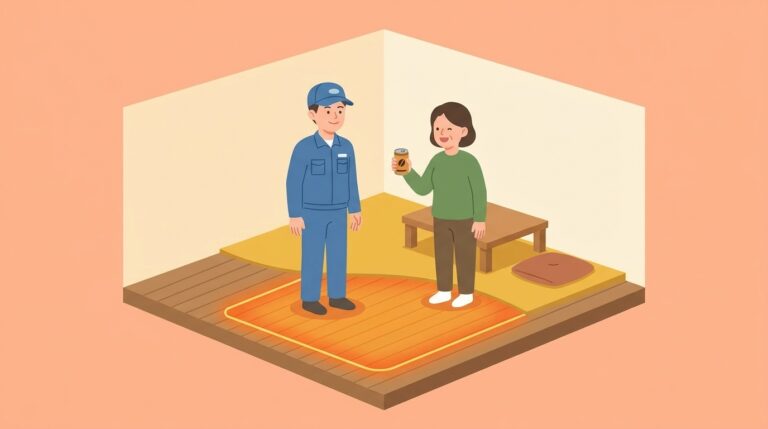
When the gas technician (기사님 – gisanim) visits your home, they are often rushing from one apartment to another. It is an unwritten, warm Korean tradition (정 – Jeong) to offer them a small drink. Handing them a cold vitamin drink (like Bacchus-D) or a warm canned coffee with two hands while bowing slightly will instantly earn you a huge smile and top-tier service.
4-2. The K-Drama Moving Tropes
Have you ever watched a K-Drama where the main character moves into a rooftop apartment (옥탑방)? The first thing they do is wipe the floor, then sit on newspapers to eat sweet-and-sour pork (탕수육) and black bean noodles (짜장면). But notice what happens next! They immediately turn a little dial on the wall to make the floor warm. That dial is the Boiler Controller (보일러 조절기), and without city gas, that dial is useless!
Phase 5: Real-Life Roleplay Scenario
Setting: It’s a chilly Tuesday afternoon. You just moved into a nice studio in Mapo-gu. You are calling the local gas company’s customer service center.
Characters:
* YOU: An expat who really wants a hot shower tonight.
* Counselor (상담원): Friendly but fast-speaking call center agent.
Dialogue:
Counselor: 네, 서울 도시가스입니다. 무엇을 도와드릴까요?
(ne, seoul dosigaseu-imnida. mueoseul dowadeurilkkayo?)
[Yes, this is Seoul City Gas. How may I help you?]
YOU: 안녕하세요. 저 오늘 이사 왔는데요. 📦
(annyeonghaseyo. jeo oneul isa wanneundeyo.)
[Hello. I moved in today.]
YOU: 도시가스 신청하려고요.
(dosigaseu sincheongharyeogoyo.)
[I’d like to apply for city gas.]
Counselor: 네, 고객님. 주소가 어떻게 되시나요?
(ne, gogaengnim. jusoga eotteoke doesinayo?)
[Yes, customer. What is your address?]
YOU: 마포구… (Your Address) 입니다.
(mapo-gu… imnida.)
[It is Mapo-gu…]
Counselor: 네, 확인되셨습니다. 방문 원하시는 날짜가 있으신가요?
(ne, hwagindoesyeotseumnida. bangmun wonhasineun naljjaga isseusingayo?)
[Yes, confirmed. Is there a date you want us to visit?]
🔀 Your Turn! How should you reply?
– A) “오늘 오세요!” (Come today!)
– B) “혹시… 오늘 방문 가능할까요?” (By any chance… is a visit possible today?)
– C) “빨리빨리!” (Hurry hurry!)✅ Best Choice: B — It’s polite, natural, and uses “혹시” (by any chance) to soften the request.
⚠️ Choice A & C Analysis: Choice A is too bossy. Choice C is a funny stereotype, but actually saying it to a customer service agent is considered very rude!
(Assuming you chose B)
Counselor: 오늘 오후 4시에서 5시 사이 방문 가능합니다. 괜찮으신가요?
(oneul ohu nesi-eseo daseotsi sai bangmun ganeunghamnida. gwaenchaneusingayo?)
[A visit is possible today between 4 and 5 PM. Is that okay?]
YOU: 네! 감사합니다. 가스레인지 연결도 해 주세요.
(ne! gamsahamnida. gaseureinji yeongyeoldo hae juseyo.)
[Yes! Thank you. Please connect the gas stove too.]
Counselor: 네, 기사님 방문 전 연락드릴 겁니다. 감사합니다!
(ne, gisanim bangmun jeon yeollakdeuril geomnida. gamsahamnida!)
[Yes, the technician will contact you before visiting. Thank you!]
Phase 6: 10-Second Shadowing Drill
Listen to the rhythm of the sentence. Follow the slashes for pausing.
🥺 혹시 / 오늘 / 방~문 / 가능할까요? (hoksi / oneul / bang~mun / ganeunghalkkayo?)
Voice tip: Raise your pitch slightly at the end to sound polite and hopeful. Say it with a slight pleading face (🥺) because you really need that hot water!
Phase 7: K-Culture Mini Dictionary
1. 눈치 (Nunchi)
* Romanization: nunchi
* English: Social situational awareness.
* Context: In this situation, if the technician looks extremely rushed, having nunchi means moving out of their way quickly and keeping questions brief.
2. 기사님 (Gisanim)
* Romanization: gisanim
* English: Technician / Driver (Respectful title)
* Context: Never say “Hey” or “Mister (아저씨)”. Always call the repair person, delivery person, or taxi driver “기사님”. It shows great respect!
3. 온돌 (Ondol) / 보일러 (Boiler)
* Romanization: ondol / boilleo
* English: Korean traditional floor heating system / Gas boiler.
* Context: Unlike Western houses with air radiators, Korean houses heat the floor itself. It’s the best feeling in winter!
4. 집들이 (Jipdeuri)
* Romanization: jipdeuri
* English: Housewarming party.
* Context: After your gas is connected and your house is warm, you invite friends over. They will traditionally bring toilet paper or laundry detergent as gifts!
Phase 8: Expat Survival Kit
Navigating Korean utilities can be tricky. Here is your essential toolkit:
🆘 Survival Phrases for Moving Day
– 🇰🇷 “기사님, 언제쯤 오시나요?” (gisanim, eonjejjeum osinayo?)
– 🗣️ Pronunciation: [gee-sa-neem, un-je-jjum oh-she-na-yo?]
– 📍 When to use: When the technician is late, and you are waiting at home.
– 💡 Pro Tip: They will usually call you 10 minutes before they arrive. If you miss the call, they might cancel! Keep your phone loud.📌 Editor’s Living Note
– ARS Menus: When calling, everything is an automated menu (ARS). If you don’t speak Korean well, press ‘0’ (영번) immediately. In Korea, ‘0’ almost always connects you directly to a human agent!
– Paying the Bill: You don’t need to mail a check. The gas company will send a paper bill with a “Virtual Account Number (가상계좌)”. Just wire transfer the money from your banking app to that specific account.
Phase 9: Critical Thinking — “One Step Deeper”
Housing & Lifestyle: Why do Koreans sleep on the floor?
🧠 Think Deeper:
If you watch historical K-Dramas, you’ll see people sleeping on thin mats directly on the floor. This is because of the Ondol system. Heat rises from beneath the floor, making the floor the warmest part of the house. Even today, with modern beds, many Koreans will instinctively drag their blankets down to the living room floor in the middle of winter to enjoy that toasty warmth. It’s more than just heating; the warm floor is a place of family gathering, eating, and ultimate comfort in Korean culture.💬 Your Turn: Does your country have a unique way to keep warm in the winter? Have you ever tried sleeping on a heated Korean floor? Let me know in the comments!
Phase 10: FAQ & Mistake Prevention
Q: Do I need to tip the gas technician?
A: NO! There is absolutely no tipping culture in Korea. If you try to give them extra money, they will be very confused and refuse it. Just offer a small canned coffee instead.
Q: Can I apply for gas on a Sunday?
A: Generally, no. Technicians usually work Monday to Saturday morning. If you move on a Sunday, you might have to survive one day without hot water. Plan your move accordingly!
❌ Common Mistake #1: Assuming electricity and gas are connected together.
✅ Do this instead: Electricity is usually active when you move in, but City Gas must be explicitly requested and unlocked by a technician. Don’t forget!
Phase 11: Summary & Action Items
One-Liner Summary: To avoid freezing in your new apartment, always call the gas company and politely ask, “도시가스 신청하려고요. 오늘 방문 가능할까요?”
Action Mission 3 Steps:
– 🥉 Bronze (Solo): Look at your heater/boiler controller on the wall right now and try to find the word “전원” (Power) or “외출” (Going out).
– 🥈 Silver (Online): Write the phrase “오늘 방문 가능할까요?” in your phone’s notepad so you can copy-paste it into a text message if needed.
– 🥇 Gold (Real Life): Next time you need a repair or delivery, hand the person a canned coffee and say “기사님, 감사합니다!”
K-Culture Mission: Watch any K-Drama episode where a character moves into a new house. Spot the “Jajangmyeon on the floor” scene and see if you can spot the white boiler controller on the wall!
Phase 12: Quiz — Interactive Challenge
1. Situational Judgment:
You just moved in. You are calling to get your gas connected. Which phrase is the MOST natural and polite?
* A) 가스 주세요! (gaseu juseyo!)
* B) 도시가스 신청하려고요. (dosigaseu sincheongharyeogoyo.)
* C) 오늘 오세요. (oneul oseyo.)
(Answer: B. It gently states your intention. A sounds like you are ordering food. C is too demanding.)
2. True or False – K-Culture Edition:
“If the gas technician does a great job, you should give him a 10,000 won tip.”
(Answer: False! Korea does not have a tipping culture. Offer a drink instead.)
3. Fill in the Blank:
기사님, 혹시 가스레인지 _____ 도 해 주세요.
(Technician, please _____ the gas stove too.)
(Answer: 연결 – yeongyeol – connection)
Great job today! Stay warm, and I’ll see you in the next lesson! 😊
Frequently Asked Questions (FAQ)
Q: What does "도시가스 신청하려고요 (I'd like to apply for city gas)" mean in Korean and how do you pronounce it?
A: In Korean, "도시가스 신청하려고요 (I'd like to apply for city gas)" is pronounced [dosigaseu sincheongharyeogoyo] and means: Literal: I am intending to apply for city gas. / Real nuance: I'm calling to set up my gas connection.
Q: What does "오늘 방문 가능할까요? (Is a visit possible today?)" mean in Korean and how do you pronounce it?
A: In Korean, "오늘 방문 가능할까요? (Is a visit possible today?)" is pronounced [oneul bangmun ganeunghalkkayo?] and means: Literal: Is a visit possible today? / Real nuance: Can a technician come today? (Please, I'm freezing!)
Q: What does "가스레인지 연결도 해 주세요 (Please connect the gas stove too)" mean in Korean and how do you pronounce it?
A: In Korean, "가스레인지 연결도 해 주세요 (Please connect the gas stove too)" is pronounced [gaseureinji yeongyeoldo hae juseyo] and means: Please connect the gas stove as well.







