

Phase 1: Empathy & The K-Culture Scene
Hello! I’m the lead editor of Daily Hangul, your local friend in Seoul.
Imagine this: You are walking through the vibrant streets of Myeongdong or watching a K-Drama where the main characters are eating delicious Tteokbokki and Bungeoppang at a traditional market. In K-Dramas, everyone taps their shiny black credit cards or uses Apple Pay. You think, “Ah, Korea is 100% a cashless society!”
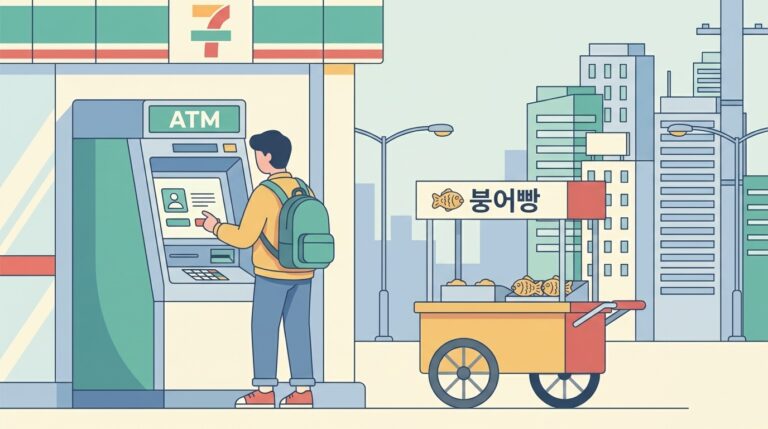
But suddenly, the sweet grandma at the street food stall smiles and points to a sign: “CASH ONLY” (or Bank Transfer). You freeze. The smell of sweet pancakes is right there, but your wallet is empty! You need to find a bank or an ATM, but how do you ask?
Don’t worry. Today, we are going to learn exactly what to say to withdraw cash safely and sound like a local while doing it. This lesson is based on real struggles from my A2 students who missed out on great street food because they couldn’t find an ATM. Let’s dive in!
Phase 2: Core Expressions Deep Dive
Let’s look at the 3 most essential phrases you need for banking and withdrawing cash.
1. 현금 인출기 어디에 있어요?
- Pronunciation: hyeongeum inchulgi eodie isseoyo? [hyeon-geum in-chool-gee uh-dee-eh ee-suh-yo]
- Meaning: Where is the ATM?
- K-Culture Moment: You are lost in the middle of a bustling underground shopping mall (like Goto Mall). Your data is acting up, and KakaoMap isn’t loading. You have to ask a passing security guard or shop owner this exact question.
- Editor’s Insight: 현금 (hyeongeum) means ‘cash’, and 인출기 (inchulgi) means ‘withdrawal machine’. It’s quite a formal word, but perfectly polite for asking strangers.
- Situation Spectrum:
- Casual with friends: ✅
- Semi-formal with shop owners/staff: ✅
- Formal with elders: ✅
- 🤔 Think About It: In Korea, we often use the full term “현금 인출기” with older people, but younger people just say “ATM-기” (ATM-gi). How does your language adapt foreign tech words? Do you use the English abbreviation or create a native word?
2. 돈 좀 뽑으려고요.
- Pronunciation: don jom ppobeuryeogoyo. [dohn johm ppob-eu-ryuh-go-yo]
- Meaning: I’m planning to withdraw some money.
- K-Culture Moment: You’re at a Samgyeopsal (pork belly) restaurant with coworkers. It’s time to pay, but the card reader is broken. You tell your coworker this phrase as you run out to the convenience store next door.
- Editor’s Insight: The textbook verb for withdrawing is 출금하다 (chulgeumhada). But in real daily life, Koreans say 돈을 뽑다 (doneul ppopda), which literally means “to pull out money.” It sounds incredibly natural and native!
- Situation Spectrum:
- Casual with friends: ✅
- Semi-formal with coworkers: ✅
- Formal with bank tellers/boss: ⚠️ (Use ‘출금하려고요’ instead)
- 🤔 Think About It: Why do you think Koreans prefer saying “pull out money” rather than “withdraw money” in casual speech? Could it be because of the physical action of pulling the cash from the machine?
3. 수수료가 얼마예요?
- Pronunciation: susuryoga eolmayeyo? [soo-soo-ryo-ga uhl-ma-yeh-yo]
- Meaning: How much is the fee?
- K-Culture Moment: You find an ATM inside a 24-hour convenience store (CU or GS25). But wait, using another bank’s ATM late at night can incur high fees! You might ask your Korean friend this before hitting “Confirm.”
- Editor’s Insight: 수수료 (susuryo) means ‘fee’ or ‘commission’. This is a golden word! You can use it at banks, currency exchanges, and even when buying concert tickets online for your favorite K-Pop idol.
- Situation Spectrum:
- Casual with friends: ✅
- Semi-formal with tellers: ✅
- Formal with elders: ✅
- 🤔 Think About It: Korean bank ATMs sometimes charge higher fees after normal business hours (usually after 4 PM). Does your home country change fees based on the time of day?
Phase 3: Textbook vs. Real Korean
[Telling someone you need to get cash]
* 📖 Textbook Korean: 현금을 출금하고 싶습니다. (hyeongeumeul chulgeumhago sipseumnida) – I would like to withdraw cash.
* 🗣️ Real Korean: 나 돈 좀 뽑을게. (na don jom ppobeulge) – I’ll pull out some money.
* 💡 Why is it different?: Koreans love efficiency in language. “돈을 뽑다” is shorter, action-oriented, and widely used in all casual situations.
[Looking for the machine]
* 📖 Textbook Korean: 현금 자동 입출금기가 어디에 있습니까? (hyeongeum jadong ipchulgeumgiga eodie itseumnikka?)
* 🗣️ Real Korean: ATM기 어딨어요? (ATM-gi eodisseoyo?)
* 💡 Why is it different?: The textbook word is a direct translation of ‘Automated Teller Machine’. Real Koreans just attach ‘기’ (machine) to the English acronym ‘ATM’.
Bottom Note: As an A2 learner, stick to “돈 좀 뽑으려고요” and “ATM 어딨어요?” to sound friendly, polite, and very natural!
Phase 4: Cultural Context — K-Culture Deep Dive
4-1. Non-Verbal Tips & Nunchi at the Bank
If you ever need to go inside a physical bank in Korea, remember Nunchi (눈치)—the subtle art of reading the room. Korean bank tellers are incredibly fast and efficient. When handing over your passport, alien registration card, or bank card to the teller, always use two hands. It shows respect. Also, if there is a long line behind you at an ATM, don’t spend 10 minutes checking your hair in the screen’s reflection; finish your withdrawal quickly!
4-2. The Street Food Reality (K-Food Connection)
Korea is famous for its “Cashless Society” ambition. You can buy a 1,000 KRW pack of gum with a credit card at a convenience store, and the cashier won’t even blink. BUT, if you go to famous traditional markets like Gwangjang Market (famous on Netflix) to eat Bindae-tteok (mung bean pancakes), or stop by a winter Bungeoppang (fish-shaped pastry) cart, they prefer cash or a Korean bank transfer (계좌이체 – gyejwaiche). Always having a 10,000 KRW bill in your pocket is a true sign of a Seoul local during winter!
Phase 5: Real-Life Roleplay Scenario
Setting: Friday night, 8 PM. A busy Samgyeopsal restaurant in Hongdae. The table is filled with empty soju glasses and lettuce leaves. You and your Korean coworker, Minsu, have just finished eating.
Characters:
– YOU: A foreigner working in Korea for 6 months. You only have an international credit card right now.
– Minsu (32): Your friendly Korean coworker who loves treating people, but tonight you agreed to split the bill.
Dialogue:
Minsu: 배부르다! 오늘 고기 진짜 맛있었죠?
(baebureuda! oneul gogi jinjja masisseotjyo?)
[I’m full! The meat was really good today, right?]
YOU: 네, 최고였어요! 우리 더치페이 해요.
(ne, choegoyosseoyo! uri deochipei haeyo.)
[Yes, it was the best! Let’s split the bill (Dutch pay).]
Minsu: 아, 여기는 현금이나 계좌이체만 할인해 준대요. 현금 있어요?
(a, yeogineun hyeongeumina gyejwaicheman harinhae jundaeyo. hyeongeum isseoyo?)
[Ah, they said they only give a discount for cash or bank transfer here. Do you have cash?]
YOU: 헉, 저 현금 없는데…
(heok, jeo hyeongeum eomneunde…)
[Gasp, I don’t have cash…]
Minsu: 괜찮아요, 제가 먼저 낼게요.
(gwaenchanayo, jaega meonjeo naelgeyo.)
[It’s okay, I’ll pay first.]
YOU: 아니에요! 저기 ATM기 있죠? 저 돈 좀 뽑아올게요.
(anieyo! jeogi ATM-gi itjyo? jeo don jom ppobaolgeyo.)
[No! There’s an ATM over there, right? I’ll go pull out some money.]
Minsu: 편의점 ATM은 수수료가 비싸요.
(pyeonuijeom ATM-eun susuryoga bissayo.)
[Convenience store ATMs have expensive fees.]
YOU: 수수료가 얼마예요?
(susuryoga eolmayeyo?)
[How much is the fee?]
Minsu: 보통 1,300원 정도 해요. 그냥 제가 낼 테니까 나중에 커피 사주세요!
(botong cheon-sam-baek-won jeongdo haeyo. geunyang jaega nael tenikka najunge keopi sajuseyo!)
[Usually about 1,300 won. I’ll just pay, so buy me coffee later!]
🔀 Your Turn! How should you reply to Minsu?
– A) “알겠습니다. 커피 살게요!” (Alright. I’ll buy coffee!)
– B) “싫어요. 제가 수수료 낼게요.” (I hate that. I’ll pay the fee.)
– C) “대박! 고마워요.” (Awesome! Thanks.)✅ Best Choice: A — Reason: It’s polite and accepts his generous offer while promising a favor in return (buying coffee). In Korea, trading a meal for coffee is a very common way to show friendship!
⚠️ Choice B Analysis: “싫어요” (I hate that/I don’t want to) is too direct and aggressive. It might ruin the good mood!
Phase 6: 10-Second Shadowing Drill
Practice reading this aloud. Pay attention to the pauses (/) and the emotion!
🥺 저기요, / 현금 인출기 / 어디에 있어요?
(jeogiyo, / hyeongeum inchulgi / eodie isseoyo?)
(Excuse me, where is the ATM? – Say it like you really need to find it!)
😊 제가 / 현금을 / 좀 뽑으려고요!
(jaega / hyeongeumeul / jom ppobeuryeogoyo!)
(I am planning to pull out some cash! – Say it brightly and confidently)
Phase 7: K-Culture Mini Dictionary
1. 눈치
* Romanization: nunchi
* English: Social situational awareness / Reading the room.
* Context: The Korean superpower. Knowing when to hurry up at the ATM because people are waiting behind you is good nunchi.
2. 더치페이
* Romanization: deochipei
* English: Going Dutch / Splitting the bill.
* Context: Derived from English, but universally used in Korea, especially among younger generations instead of one person paying for everything.
3. 계좌이체
* Romanization: gyejwaiche
* English: Bank transfer.
* Context: The ultimate alternative to cash in Korea. Friends use it to split bills instantly via mobile banking apps.
4. 붕어빵
* Romanization: bungeoppang
* English: Fish-shaped pastry (usually filled with red bean or custard).
* Context: The number one reason you need cash in your pocket during Korean winters!
Phase 8: Traveler’s Survival Kit
🆘 Survival Expressions for the ATM/Bank
– 🇰🇷 “영어 지원 돼요?” (yeongeo jiwon dwaeyo?)
– 🗣️ English Pronunciation: [yung-uh jee-won dweh-yo?]
– 📍 Where to use: Looking at a Korean ATM machine.
– 💡 Meaning: Does it support English?
- 🇰🇷 “비밀번호를 까먹었어요.” (bimilbeonhoreul kkameogeosseoyo.)
- 🗣️ English Pronunciation: [bee-mil-bun-ho-reul kka-muh-guh-suh-yo]
- 📍 Where to use: Talking to a bank teller when you are locked out of your account.
- 💡 Meaning: I forgot my password (PIN).
📌 Editor’s Travel Note
– Finding ATMs: Open KakaoMap or Naver Map and type “ATM” or “은행” (Bank).
– Foreign Cards: Not all Korean ATMs accept foreign cards. Look for ATMs with a “Global ATM” sign. They are usually found inside major bank branches or convenience stores.
– Business Hours: Korean banks close very early! Usually at 4:00 PM. Plan accordingly!
Phase 9: Critical Thinking — “One Step Deeper”
🧠 Think Deeper: Media vs Reality (The Cashless Illusion)
In K-Dramas, you constantly see characters paying for everything with their smartphones or smartwatches. While it’s true that Korea is one of the most cashless societies in the world, the reality of everyday life is a bit more nuanced. Traditional markets, small mom-and-pop shops, and street vendors still rely heavily on cash to avoid credit card terminal fees. When foreigners visit Korea relying only on Apple Pay or foreign credit cards, they often experience a culture shock when their payment is declined at smaller venues. Knowing how to ask for an ATM is not just a language skill; it’s a bridge between the hyper-modern Seoul seen on TV and the authentic, traditional Korea that still thrives in the streets.💬 Your Turn: Does your home country still use a lot of cash, or is it mostly digital? Have you ever had a “card declined” emergency while traveling? Share in the comments!
Phase 10: FAQ & Avoiding Misunderstandings
**Q: Can I ask an older person,
Frequently Asked Questions (FAQ)
Q: What does "현금 인출기 어디에 있어요?" mean in Korean and how do you pronounce it?
A: In Korean, "현금 인출기 어디에 있어요?" is pronounced [hyeongeum inchulgi eodie isseoyo? [hyeon-geum in-chool-gee uh-dee-eh ee-suh-yo] and means: Where is the ATM?
Q: What does "돈 좀 뽑으려고요." mean in Korean and how do you pronounce it?
A: In Korean, "돈 좀 뽑으려고요." is pronounced [don jom ppobeuryeogoyo. [dohn johm ppob-eu-ryuh-go-yo] and means: I'm planning to withdraw some money.
Q: What does "수수료가 얼마예요?" mean in Korean and how do you pronounce it?
A: In Korean, "수수료가 얼마예요?" is pronounced [susuryoga eolmayeyo? [soo-soo-ryo-ga uhl-ma-yeh-yo] and means: How much is the fee?






