

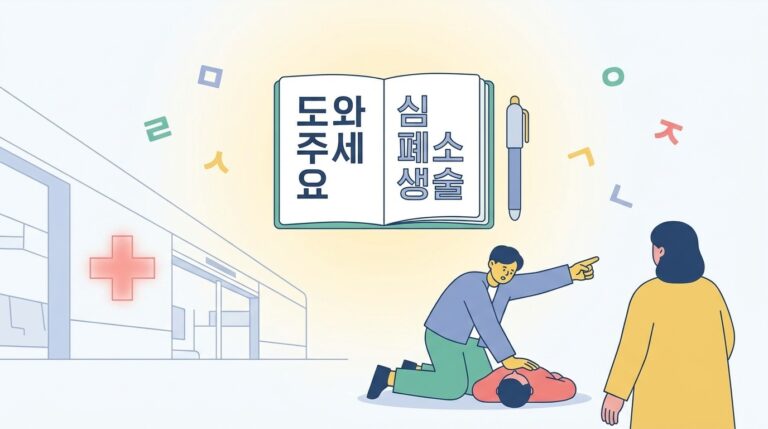
Be the Hero in a Seoul Crisis: Essential Korean CPR & First Aid Phrases Every Expat Should Know
Hello! I’m your Daily Hangul Editor.
Imagine this: You’re watching an intense medical K-Drama like Dr. Romantic or Hospital Playlist. The protagonist is off-duty, enjoying a quiet meal, when suddenly someone collapses in the restaurant. In a split second, the doctor transforms into a commanding hero, shouting orders, pointing at bystanders, and saving the day.
But what if this isn’t a drama? What if you’re standing in the middle of a crowded Gangnam subway station, and someone faints right in front of you? You know CPR, but the crowd is frozen. You need to call for help, find an AED, and direct people—fast. In an emergency, your C1-level debate skills won’t save you; you need sharp, precise, and culturally contextual survival phrases.
Today, we aren’t just learning vocabulary. We are learning how to command a room, break the Korean ‘bystander effect’ using specific linguistic tools, and navigate the cultural nuances of an emergency in South Korea. Let’s dive in.
Phase 2: Core Expressions Deep Dive
1. 119에 신고해 주세요!
- Pronunciation: [il-il-gue singohaeyo! -> il-il-gue singohae juseyo!]
- Sound-alike guide: ‘il-il-gu’ sounds like ‘eel-eel-goo’.
- Meaning: Please report to 119! (Call 119!)
- K-Culture Moment: In Korea, the emergency number for medical and fire emergencies is 119 (unlike 911 in North America or 999 in the UK). When a crisis hits a busy intersection, someone needs to explicitly take charge of making this call.
- Editor’s Insight: Notice we use ‘신고하다’ (to report) rather than ‘전화하다’ (to call). In Korean, you ‘report’ an emergency to the authorities. Saying ‘119에 전화해 주세요’ sounds a bit too casual, like you’re asking someone to chat with the dispatchers.
- Situation Spectrum:
- Casual (to anyone in an emergency): ✅
- Semi-formal: ✅
- Formal: ✅ (In a life-or-death crisis, politeness levels flatten slightly, but appending ‘주세요’ maintains the necessary social respect while conveying urgency.)
- 🤔 Think About It: Why does Korea use ‘신고하다’ (report) for emergencies, police (112), and even lost items? How does your culture differentiate between ‘calling’ a friend and ‘calling’ the authorities?
2. 거기 빨간 옷 입으신 분!
- Pronunciation: [geogi ppalgan ot ibeusin bun!]
- Sound-alike guide: ‘bun’ sounds like a short ‘boon’.
- Meaning: You there, the person wearing the red clothes!
- K-Culture Moment: This is the ultimate bystander-effect breaker. In standard Korean society, pointing at someone in public is considered rude. However, in an emergency CPR situation, you are actively taught in Korean safety classes to ‘지목하다’ (point out/designate) a specific person by their physical characteristics to prevent diffusion of responsibility.
- Editor’s Insight: You wouldn’t normally shout at a stranger describing their clothes, but doing so here is textbook hero behavior. Adding ‘입으신 분’ (the honored person wearing…) keeps a baseline of societal respect even while you’re shouting commands.
- Situation Spectrum:
- Casual: 🚫 (Don’t use it in normal daily life)
- Emergency Specific: ✅
- 🤔 Think About It: Even in a frantic emergency, Koreans automatically attach the honorific ‘시’ (ibeu-SIN) and the polite word for person ‘분’ (bun). What does this tell us about the deep-rooted nature of Korean honorifics?
3. 심장충격기(AED) 좀 가져다주세요!
- Pronunciation: [simjang-chunggyeok-gi jom gajyeoda juseyo!]
- Sound-alike guide: ‘sim-jang’ sounds like ‘seem-jahng’ (heart), ‘chung-gyeok’ sounds like ‘choong-gyuhk’ (shock).
- Meaning: Please bring an AED!
- K-Culture Moment: You will find AEDs in almost every Korean subway station, large apartment complex (아파트), and public building. They are legally mandated.
- Editor’s Insight: While many Koreans know the English acronym ‘AED’, the official term is ‘자동심장충격기’. Adding ‘좀’ (a little/please) softens the directness of the command, which is a reflex for Koreans even when someone’s heart has stopped.
- Situation Spectrum:
- Casual/Emergency: ✅
- Semi-formal: ✅
- Formal: ✅
- 🤔 Think About It: Notice the verb ‘가져다주다’ (to bring and give). Korean verbs are highly directional. Why is specifying the direction of the action so important in the Korean language?
Phase 3: Textbook vs. Real Korean
[Checking Consciousness]
* 📖 Textbook Korean: 괜찮으십니까? (Are you okay? – very formal)
* 🗣️ Real Korean: 저기요! 제 말 들리세요? (Excuse me! Can you hear me?)
* 💡 Why the difference?: ‘괜찮으십니까?’ sounds like a military report. In reality, gently tapping the collarbone and asking ‘제 말 들리세요?’ (Can you hear my words?) is the standard medical protocol taught in Korean CPR classes.
[Asking for General Help]
* 📖 Textbook Korean: 누군가 저를 도와주세요! (Someone please help me!)
* 🗣️ Real Korean: 사람 살려! / 도와주세요! (Save a person! / Help!)
* 💡 Why the difference?: ‘누군가’ (someone) is a direct translation from English that diffuses responsibility. Shouting ‘사람 살려’ (literally: save a person) cuts through the noise and instantly alerts everyone that it’s a life-or-death situation.
Bottom Note for C1 Learners: In emergencies, drop complex grammar. Use short, imperative sentences. Directness saves lives; over-politeness costs time.
Phase 4: Cultural Context — K-Culture Deep Dive
4-1. Non-verbal Communication in a Crisis
Korean society heavily relies on 눈치 (Nunchi)—the ability to read the room, act unobtrusively, and maintain social harmony. However, in a medical emergency, you must actively break Nunchi.
Usually, pointing with your finger is a massive faux pas. But during CPR, you must look directly into a stranger’s eyes, point your entire hand (or finger) at them, and give them a direct order. This temporary suspension of social rules is understood and expected during a crisis.
4-2. The K-Drama Medical Trope
If you’ve watched Descendants of the Sun or Romantic Doctor, Teacher Kim, you’ve seen the chaotic emergency room scenes. One cultural aspect portrayed beautifully is the collective effort. Even strangers will form a human shield to give the patient privacy, or run to find a police officer.
However, the media often exaggerates the legal risks of stepping in. In reality, Korea has the 착한 사마리아인 법 (Good Samaritan Law), which protects citizens from civil and criminal liability if they inadvertently cause harm while providing first aid in good faith. Don’t let fear stop you from doing chest compressions!
Phase 5: Real-Life Roleplay Scenario
Setting: Friday evening, 6:30 PM. Line 2, Sindorim Station. It’s incredibly crowded. A middle-aged man suddenly collapses near the transfer stairs. People gasp and step back, creating a small circle. You, holding a CPR certification, drop your bag.
Characters:
– YOU: An expat working in Seoul, confident but adrenaline-fueled.
– Ahjussi (Bystander 1): A man in his 50s wearing a blue suit, looking panicked.
– Student (Bystander 2): A university student wearing a yellow backpack.
– Paramedic: Arrives later.
Dialogue:
YOU: (Tapping the man’s shoulders gently)
저기요! 선생님, 제 말 들리세요? 눈 좀 떠보세요!
(Jeogiyo! Seonsaengnim, je mal deulliseyo? Nun jom tteoboseyo!)
[Excuse me! Sir, can you hear me? Please open your eyes!]
Ahjussi: 어휴, 어떡해. 이 사람 쓰러졌어!
(Eohyu, eotteokhae. I saram sseureojyeosseo!)
[Oh no, what do we do. This person collapsed!]
YOU: (Checking for breathing) 숨을 안 쉬어요. 심폐소생술 시작할게요.
(Sumeul an swieoyo. Simpyesosaengsul sijakhalgeyo.)
[He’s not breathing. I will start CPR.]
🔀 Your Turn! How will you delegate tasks?
– A) “누가 119 좀 불러주세요!” (Someone please call 119!)
– B) “도와주실 분 없나요?” (Is there anyone to help?)
– C) “거기 파란 정장 입으신 아저씨! 119에 신고해 주세요!”✅ Best Choice: C — By explicitly pointing out the man in the blue suit (파란 정장 입으신 아저씨), you shatter the bystander effect.
⚠️ Choice A & B Analysis: Using ‘someone’ (누가) means everyone will assume someone else is making the call.
(Continuing with Choice C)
YOU: 거기 파란 정장 입으신 아저씨! 119에 신고해 주세요!
(Geogi paran jeongjang ibeusin ajeossi! 119-e singohae juseyo!)
[You there, the Ahjussi in the blue suit! Please report this to 119!]
Ahjussi: 아, 네! 지금 바로 걸게요!
(Ah, ne! Jigeum baro geolgeyo!)
[Ah, yes! I’ll dial right now!]
YOU: (Performing chest compressions) 거기 노란 가방 멘 학생! 역사 사무실 뛰어가서 제세동기 좀 가져다주세요!
(Geogi noran gabang men haksaeng! Yeoksa samusil ttwieogaseo jesedonggi jom gajyeoda juseyo!)
[You there, the student with the yellow backpack! Please run to the station office and bring the AED!]
(Note: 제세동기 (jesedonggi) is the older/medical term for AED, often used interchangeably with 심장충격기)
Student: 제세동기요? 네, 알겠습니다!
(Jesedonggiyo? Ne, algetseumnida!)
[The AED? Yes, understood!]
YOU: (To the crowd) 공간 좀 넓혀주세요! 다치니까 물러서 주세요!
(Gonggan jom neolpyeojuseyo! Dachinikka mulleoseo juseyo!)
[Please make some room! You might get hurt, so please step back!]
(5 minutes later, paramedics arrive)
Paramedic: 119입니다! 환자 상태 어떤가요?
(119-imnida! Hwanja sangtae eotteongayo?)
[We are 119! What is the patient’s condition?]
YOU: 의식 없고 호흡이 없어서 5분 전부터 심폐소생술 중입니다.
(Uisik eopgo hoheubi eopseoseo 5-bun jeonbuteo simpyesosaengsul jungimnida.)
[No consciousness and no breathing, so I’ve been doing CPR for 5 minutes.]
Paramedic: 수고하셨습니다, 저희가 교대하겠습니다!
(Sugohasyeotseumnida, jeohuiga gyodaehagetseumnida!)
[Thank you for your effort, we will take over!]
Phase 6: 10-Second Shadowing Drill
Practice your commanding, urgent voice. It shouldn’t sound like a polite request at a cafe; it needs volume and authority.
😤 거기 / 파란 옷 입으신 분! / 119에 / 신고해 주세요!
(geogi / paran ot ibeusin bun! / il-il-gu-e / singohae juseyo!)
😤 노란 가방 학생! / 심장충격기 좀 / 가져다주세요!
(noran gabang haksaeng! / simjang-chunggyeok-gi jom / gajyeoda juseyo!)
🥺 제 말 / 들리세요? / 눈 좀 / 떠보세요!
(je mal / deulliseyo? / nun jom / tteoboseyo!)
Phase 7: K-Culture Mini Dictionary
1. 눈치 (Nunchi)
* Romanization: nunchi
* English: Situational awareness / Reading the room
* Context: Normally essential, but in CPR, you must abandon Nunchi to take control and shout orders.
2. 골든타임 (Golden Time)
* Romanization: goldeun-taim
* English: The Golden Hour / Critical Time
* Context: A widely used Konglish term in Korean media referring to the crucial first few minutes to save a patient (usually 4 minutes for cardiac arrest).
3. 심폐소생술 (CPR)
* Romanization: simpye-sosaeng-sul
* English: Cardiopulmonary Resuscitation
* Context: Literally translates to “Heart-Lung Resuscitation Technique.”
4. 착한 사마리아인 법 (Good Samaritan Law)
* Romanization: chakhan samariain beop
* English: Good Samaritan Law
* Context: The legal framework protecting individuals who provide emergency first aid from liability.
Phase 8: Traveler’s Survival Kit
Even if you aren’t performing CPR, navigating minor medical emergencies in Korea is a vital survival skill.
🆘 Survival Phrases TOP 3
– 🇰🇷 “가장 가까운 응급실이 어디예요?” (gajang gakkaun eunggeupsiri eodiyeyo?)
– 🗣️ English: Where is the nearest emergency room?
– 🇰🇷 “구급차 좀 불러주세요.” (gugeupcha jom bulleojuseyo.)
– 🗣️ English: Please call an ambulance.
– 🇰🇷 “여기 다쳤어요. 피가 나요.” (yeogi dachyeosseoyo. piga nayo.)
– 🗣️ English: I got hurt here. It’s bleeding.📌 Editor’s Travel Note
– 119 vs 112: Dial 119 for medical/fire, and 112 for the police.
– Language Barrier: If you call 119 and speak English, they will connect you to an interpreter service. Don’t hang up!
– Pharmacies (약국): For minor cuts, burns, or indigestion, you don’t need a hospital. Korean pharmacists are highly trained. Just point to the symptom on Papago and show them.
Phase 9: Critical Thinking Corner — “One Step Deeper”
🧠 Think Deeper: Language & Power in a Crisis
Korean is fundamentally built on a hierarchy of age, status, and social intimacy. Usually, a younger foreigner would never point at an older Korean man (Ahjussi) and give him a direct command. It would be considered a major breach of etiquette. However, an emergency situation acts as a fascinating sociological equalizer. The person with medical knowledge (or simply the courage to act) instantly assumes the highest rank in the social hierarchy. The language shifts from polite requests to authoritative commands (‘가져다주세요’, ‘신고해 주세요’), and society unconditionally accepts this. It proves that while Korean etiquette is strict, the ultimate societal value is preserving human life.
💬 Your Turn: In your culture, do people change the way they speak to strangers during an emergency? Do social barriers completely disappear? Share your thoughts in the comments!
Phase 10: FAQ & Avoiding Misunderstandings
Q: “Can I use 반말 (informal language) in an emergency because it’s faster?”
No. Even when shouting urgently, you should append ‘-요’ or ‘-주세요’ at the end of your sentences. Shouting “119 불러!” (Call 119!) might make people hesitate or feel offended by the sudden disrespect, even subconsciously. “119 불러주세요!” is just one syllable longer but significantly more effective.
Q: “I’m scared of getting sued if I break their ribs during CPR in Korea.”
This is a common fear globally, but South Korea strictly enforces the Good Samaritan Law (착한 사마리아인 법). If you act in good faith to save a life, you are protected. Do not hesitate.
❌ Common Mistake #1: Calling “911”.
✅ Do this instead: In the panic of the moment, expats often dial 911. While some cell networks reroute this, always drill “119 (일일구)” into your brain.
Phase 11: Summary & Action Items
One-Liner Summary: In a Korean emergency, break the Nunchi, point out specific people, and command politely with ‘119에 신고해 주세요!’
Action Mission 3 Steps:
– 🥉 Bronze (Solo): Look in the mirror, point firmly, and practice saying “거기 빨간 옷 입으신 분! 119에 신고해 주세요!” 3 times out loud.
– 🥈 Silver (Online): Find the nearest AED in your building or workplace and post a picture of it in your Korean learning community with the word “심장충격기”.
– 🥇 Gold (Real-world): Next time you take the Seoul subway, actively look for the AED (심장충격기). Identify where it is on your usual platform.
K-Culture Mission: Watch a medical K-Drama clip on YouTube (search: 슬기로운 의사생활 응급실). Listen carefully to how the doctors speak. Can you catch them dropping honorifics in the heat of the moment?
Phase 12: Quiz — Interactive Challenge
1. Situational Judgment:
A woman faints in a crowded cafe. You need someone to call 119. What is the most effective thing to shout?
– A) “아무나 119에 전화해요!” (Anyone, call 119!)
– B) “저기 안경 쓰신 분! 119에 신고해 주세요!” (You there with the glasses! Please report to 119!)
– C) “도와주세요!” (Help!)
2. True or False — K-Culture Edition:
– T/F: If you don’t speak Korean, the 119 dispatcher will hang up on you.
– T/F: It is illegal to use an AED if you don’t have a medical license in Korea.
(Answers: 1. B – Specificity breaks the bystander effect. 2. False – They will connect you to an interpreter. False – Anyone can and should use public AEDs.)
Did you find this helpful? Hopefully, you never have to use these phrases. But if you do, you’re now ready to be a hero in Korea. Stay safe! 🚑💙
Frequently Asked Questions (FAQ)
Q: What does "119에 신고해 주세요!" mean in Korean and how do you pronounce it?
A: In Korean, "119에 신고해 주세요!" is pronounced [il-il-gue singohaeyo! -> il-il-gue singohae juseyo!] and means: a key conversational Korean expression covered in this lesson.
Q: What does "거기 빨간 옷 입으신 분!" mean in Korean and how do you pronounce it?
A: In Korean, "거기 빨간 옷 입으신 분!" is pronounced [geogi ppalgan ot ibeusin bun!] and means: a key conversational Korean expression covered in this lesson.
Q: What does "심장충격기(AED) 좀 가져다주세요!" mean in Korean and how do you pronounce it?
A: In Korean, "심장충격기(AED) 좀 가져다주세요!" is pronounced [simjang-chunggyeok-gi jom gajyeoda juseyo!] and means: a key conversational Korean expression covered in this lesson.







