

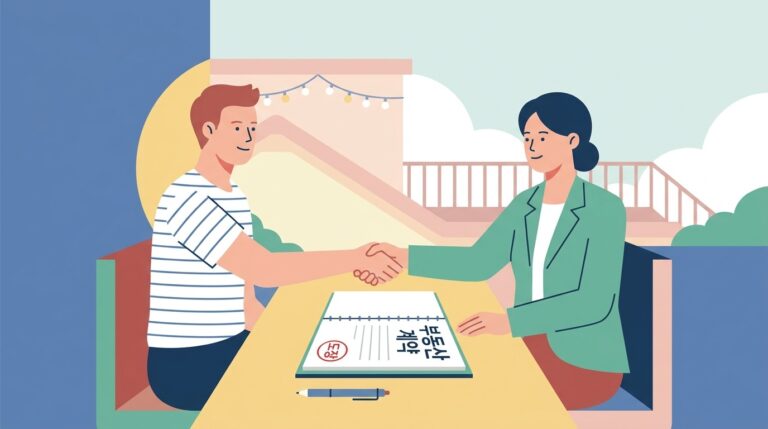
Phase 1: Empathy & The K-Culture Cold Open
Hello! I am your Daily Hangul Editor.
Have you ever watched a K-Drama where the main character moves into a cozy, fairy-light-decorated rooftop room (Oktapbang)? They usually crack open a can of beer, look out over the glittering Seoul skyline, and smile. But let me tell you a secret: before that romantic moment, there was a grueling, sweat-inducing process of navigating a Korean real estate agency (부동산).
Signing a lease agreement (임대차 계약서) in Korea can feel like stepping onto a battlefield without a shield. The numbers are huge, the vocabulary is legally dense, and the cultural rules of negotiation are completely different. If you don’t know the right expressions, you might end up like those drama characters who get scammed and lose all their savings!
But don’t worry. This guide is built on the real sweat and tears of expats who have survived the Korean housing market. By the end of this post, you won’t just understand a contract; you’ll know how to negotiate like a true Seoulite.
Phase 2: Deep Dive into Core Expressions
Let’s break down the essential words you must know before signing anything.
1. 보증금 (Deposit)
- Pronunciation: [bo-jeung-geum] -> Sounds like ‘bo’ (as in bow) + ‘jeung’ (rhymes with lung) + ‘geum’ (gum).
- Meaning: Security deposit (Literal: Guarantee money)
- K-Culture Moment: In Korea, deposits aren’t just “one month’s rent.” For a standard studio (One-room), the deposit usually starts at 5 million to 10 million KRW (approx. $3,500 – $7,500 USD)! You will often see drama characters begging their parents for Bo-jeung-geum or taking out massive bank loans.
- Editor’s Insight: This word carries a lot of weight. It represents your financial stability. The higher your Bo-jeung-geum, the lower your monthly rent (Wolse) becomes. This is a unique Korean negotiation tactic!
- Situation Spectrum:
- Casual: ✅ (Among friends: “보증금 얼마야?” – How much is your deposit?)
- Semi-formal: ✅
- Formal: ✅
- 🤔 Think About It: Why does Korea require such massive deposits compared to other countries? It’s tied to the banking system and the landlord’s ability to invest that lump sum to earn interest. Does your country have a similar system?
2. 특약 사항 (Special Clauses)
- Pronunciation: [teug-yak sa-hang] -> Sounds like ‘teuk’ (took) + ‘yak’ (yak) + ‘sa-hang’.
- Meaning: Special conditions or clauses in a contract
- K-Culture Moment: You finally find the perfect room. But wait! Your experienced Korean friend grabs the contract, points to the bottom, and says, “We need to add a Teuk-yak sa-hang.” This is the blank space where you write specific promises, like “Landlord will replace the broken wallpaper before move-in” or “If the pet causes damage, tenant pays for repairs.”
- Editor’s Insight: This is your safety net. If it’s not in the Teuk-yak sa-hang, it didn’t happen. It’s the ultimate ‘receipt’ in Korean real estate.
- Situation Spectrum:
- Casual: ⚠️ (Usually used in legal/business contexts)
- Semi-formal: ✅
- Formal: ✅
- 🤔 Think About It: Verbal promises mean very little in real estate, universally. But in Korea’s fast-paced “Palli-palli” culture, why is taking the time to write these down so crucial?
3. 확정일자 (Fixed Date / Timestamp)
- Pronunciation: [hwak-jeong-il-ja] -> Sounds like ‘hwak’ (hawk) + ‘jung’ (young) + ‘il’ (eel) + ‘ja’ (jah).
- Meaning: Fixed date received at the community center to protect your deposit.
- K-Culture Moment: The moment you sign the lease and move in, your real estate agent will urgently tell you, “Go to the community center and get your Hwak-jeong-il-ja right now!” It’s a stamp that registers your contract with the government. If the building goes bankrupt, this timestamp proves you were there first, ensuring you get your deposit back.
- Editor’s Insight: It sounds like legal jargon, but to anyone living in Korea, it’s a matter of survival. It feels like a magical protective spell over your money.
- Situation Spectrum:
- Casual: ✅ (Friends will actively remind you to do this!)
- Semi-formal: ✅
- Formal: ✅
- 🤔 Think About It: The existence of this system shows that tenant protection is a major social issue in Korea.
Phase 3: Textbook vs. Real Korean
[Situation 1: Stating your purpose at the agency]
* 📖 Textbook Korean: 임대할 주택을 찾고 있습니다. (I am looking for a house to rent.)
* 🗣️ Real Korean: 방 보러 왔는데요. (I came to look at a room.)
* 💡 Why the difference?: Koreans prefer practical, action-oriented phrases. “Looking at a room” (방을 보다) is the universally accepted slang for house-hunting.
[Situation 2: Asking about the landlord]
* 📖 Textbook Korean: 임대인은 어떤 분이십니까? (What kind of person is the lessor?)
* 🗣️ Real Korean: 집주인분 성향이 어때요? (What is the homeowner’s personality like?)
* 💡 Why the difference?: “임대인” (lessor) is strictly for paper. In reality, landlords are called “집주인” (house master), and knowing their “성향” (tendency/personality) is vital for your peace of mind.
[Situation 3: Negotiating the rent]
* 📖 Textbook Korean: 월세를 인하해 주실 수 있습니까? (Can you reduce the monthly rent?)
* 🗣️ Real Korean: 보증금 올리고 월세 깎아주실 수 있나요? (Can you raise the deposit and lower the rent?)
* 💡 Why the difference?: You rarely just ask for a discount. You offer a trade-off. Increasing the deposit to lower the rent is the standard Korean real estate haggle.
Bottom Note: At a B2 level, confidently using terms like “집주인” and “월세 깎다” will make the real estate agent treat you like a seasoned local rather than a clueless tourist!
Phase 4: Cultural Context — K-Culture Deep Dive
4-1. Non-Verbal Cues: The Art of “Nunchi” in the Agency
When negotiating a lease, Nunchi (눈치) is everything. Don’t look too desperate, even if you love the apartment. If the agent sees your eyes sparkle, you lose your negotiating power. Drink the mixed coffee (믹스커피) they offer you, nod thoughtfully, and always look slightly hesitant. This makes the agent work harder to get you a better deal from the landlord.
4-2. The K-Drama Trope: The “Oktapbang” and the Scam
In almost every coming-of-age K-Drama (think Fight for My Way or Work Later, Drink Now), the characters live in an Oktapbang (rooftop room) or a Banjiha (semi-basement). These spaces represent youth and financial struggle. However, dramas often feature a plotline where the protagonist gets scammed by a fake landlord because they didn’t check the 등기부등본 (Certified Copy of the Real Estate Register).
Critical View: Dramas romanticize these spaces, but in reality, rooftop rooms are freezing in winter and boiling in summer. And while the drama characters casually sign papers over a bowl of noodles, real-life lease signing involves hours of checking legal documents, verifying IDs, and transferring massive sums of money via mobile banking while holding your breath.
Phase 5: Real-Life Roleplay Scenario
Setting: A small, slightly cluttered real estate office near a university station. The walls are covered in maps. The agent hands you a cup of sweet instant coffee. You are here to sign the lease for a studio apartment.
Characters:
– YOU: An expat who has been working in Seoul for a year. You want to make sure everything is perfect.
– Mr. Kim (김 소장, 50s): The veteran real estate agent. Friendly, speaks fast, wants to close the deal quickly.
Dialogue:
Mr. Kim: 자, 여기가 계약서고요. 보증금 천만 원에 월세 60만 원, 맞죠? 📄
(Ja, yeogiga gyeyakseogoyo. Bo-jeung-geum cheonman won-e wolse yuksimman won, matjyo?)
[Here is the contract. Deposit 10 million won, monthly rent 600,000 won, right?]
YOU: 네, 맞아요. 그런데 관리비는 포함인가요?
(Ne, majayo. Geureonde gwanribineun pohamingayo?)
[Yes, that’s right. But are the maintenance fees included?]
Mr. Kim: 아유, 관리비 5만 원은 별도예요. 인터넷이랑 수도세는 포함! 전기랑 가스만 따로 내시면 돼요.
(Ayu, gwanribi oman won-eun byeoldoyeyo. Inteonesirang sudoseneun poham! Jeongirang gaseuman ttaro naesimyeon dwaeyo.)
[Oh, the 50,000 won maintenance fee is separate. Internet and water are included! You just pay for electricity and gas separately.]
YOU: 아, 알겠습니다. 혹시 특약 사항에 도배랑 장판 교체하는 거 적어주셨나요?
(Ah, algetseumnida. Hoksi teug-yak sa-hange dobaerang jangpan gyochehaneun geo jeogeojusyeotnayo?)
[Ah, understood. By the way, did you write down the wallpaper and floor replacement in the special clauses?]
Mr. Kim: (Typing quickly) 아, 맞다! 지금 적을게요. 집주인분이 입주 전까지 해주시기로 했어요.
(Ah, matda! Jigeum jeogeulgeyo. Jipjuinbuni ipju jeonkkaji haejusigiro haesseoyo.)
[Ah, right! I’ll write it now. The landlord agreed to do it before you move in.]
YOU: 확인해 주셔서 감사합니다. 등기부등본도 한 번 더 볼 수 있을까요?
(Hwaginhae jusyeoseo gamsahamnida. Deunggibudeungbondo han beon deo bol su isseulkkayo?)
[Thank you for checking. Could I also see the real estate registry one more time?]
Mr. Kim: 그럼요! 여기 융자 하나도 없는 깨끗한 집이에요.
(Geureomyo! Yeogi yungja hanado eomneun kkaekkeutan jibieyo.)
[Of course! It’s a clean house with absolutely no loans.]
Mr. Kim: 자, 그럼 도장이나 사인하시죠. 아, 그리고 가계약금 먼저 입금하실래요? 다른 사람이 채갈 수도 있어서.
(Ja, geureom dojangina sainhasijyo. Ah, geurigo ga-gyeyakgeum meonjeo ipgeumhasillaeyo? Dareun sarami chaegal sudo isseoseo.)
[Now, please stamp or sign. Oh, and do you want to wire the provisional deposit first? Someone else might snatch the room.]
🔀 Your Turn! How do you respond to the request for a provisional deposit (가계약금)?
– A) “네, 지금 바로 100만 원 보낼게요!” (Yes, I will send 1 million won right now!)
– B) “계약서 다 작성하고 본계약금으로 한 번에 보낼게요.” (I will send the full deposit at once after finishing the contract.)
– C) “가계약금 안 내면 안 되나요?” (Can I just not pay the provisional deposit?)✅ Best Choice: B — Reason: Since you are already sitting down signing the actual contract, there is no need for a “provisional” deposit (가계약금). You should just send the formal contract deposit (usually 10% of the total deposit) upon signing.
⚠️ Choice A Analysis: Never rush to send money until every document is double-checked! Real estate agents use FOMO (Fear Of Missing Out) to rush you.
Phase 6: 10-Second Shadowing Drill
Let’s practice a crucial question to ask the landlord or agent before signing.
😤 특약 사항에 / 이 내용 꼭 / 추가해 주세요!
(teug-yak sa-hang-e / i nae-yong kkok / chu-ga-hae ju-se-yo!)
[Please make sure to add this detail to the special clauses!]
- Pausing: Pause briefly after ‘사항에’ and ‘꼭’ to sound firm but polite.
- Tone: Speak with polite authority. You are protecting your rights!
Phase 7: K-Culture Mini Dictionary
1. 전세 (Jeonse)
* Romanization: jeon-se
* English: Lump-sum deposit housing lease
* Context: A uniquely Korean system where you give the landlord a massive deposit (often 50-80% of the home’s value) instead of paying monthly rent. You get the full amount back when you move out.
2. 공인중개사 (Gongin-junggaesa)
* Romanization: gong-in-jung-gae-sa
* English: Licensed Real Estate Agent
* Context: In daily life, usually referred to simply as “부동산” (Real Estate) or “부동산 아저씨/소장님” (Mr. Real estate / Director).
3. 임장 (Imjang)
* Romanization: im-jang
* English: House-hunting / Site visit
* Context: A trendy term among young Koreans. It originally meant official site inspections, but now it means “going around neighborhoods to check out real estate vibes.”
4. 도장 (Dojang)
* Romanization: do-jang
* English: Personal name stamp / Seal
* Context: While signatures are accepted nowadays, a traditional carved wooden or stone stamp (Dojang) carries a much stronger legal and cultural weight when signing real estate contracts.
Phase 8: Traveler Survival Kit
Even if you aren’t signing a 2-year lease, you might use an Airbnb, a guesthouse, or a short-term rental (단기 임대) during your stay in Korea. Here are your survival phrases!
🆘 Survival Phrases for Accommodations
– 🇰🇷 “보일러 어떻게 켜요?” (bo-il-leo eo-tteo-ke kyeo-yo?)
– 🗣️ English: How do I turn on the boiler (floor heating)?
– 📍 Where to use: Any Korean accommodation in winter. Ondol (floor heating) is essential!
– 💡 Pro Tip: Korean boiler remotes are notoriously complicated. Take a photo of it and ask the host to circle the ‘Power’ and ‘Heating’ buttons on their phone!
- 🇰🇷 “수압 괜찮은지 물 틀어봐도 되나요?” (su-ab gwaen-chan-eun-ji mul teu-reo-bwa-do doe-na-yo?)
- 🗣️ English: Can I turn on the water to check the water pressure?
- 📍 Where to use: When inspecting an Airbnb or a new room.
📌 Editor’s Travel Note
– Useful Apps for Housing: Zigbang (직방) and Dabang (다방) are the go-to apps for looking at room listings, even just to understand market prices.
– Trash Rules: In Korea, you CANNOT throw away trash in regular plastic bags. You must buy 종량제 봉투 (Standardized garbage bags) at the local convenience store for your specific district.
Phase 9: Critical Thinking Corner — “One Step Deeper”
Language & Power in the Real Estate Office
🧠 Think Deeper:
Have you noticed that real estate agents often use a mix of formal language (존댓말) and slightly overly-familiar, almost parental language when dealing with young renters? They might call a 25-year-old “학생” (student) and say things like, “아유, 내가 좋은 집 줄게” (Aw, I’ll give you a good house). This reflects Korea’s age-based hierarchy. While it sounds warm and caring (like an aunt or uncle), it can also be a subtle power play to make the younger tenant feel like they shouldn’t argue or negotiate aggressively. Understanding this dynamic is crucial for standing your ground politely but firmly using accurate, formal vocabulary like “특약 사항” and “등기부등본.”💬 Your Turn: In your culture, how do real estate agents treat young people renting their first apartment? Is it strictly business, or is there a similar parental dynamic? Let me know in the comments!
Phase 10: FAQ & Avoiding Common Mistakes
Q: Is it rude to check every tiny detail in the contract in front of the landlord?
A: Not at all! Actually, it makes you look smart (똑똑하다). In Korea, money matters are taken very seriously. The landlord expects you to be meticulous.
Q: The agent keeps pushing me to wire a “가계약금” (Provisional deposit) before seeing the house. Should I?
A: NO! This is a common tactic in competitive areas like Gangnam or university towns. Never send money before seeing the actual room and checking the official registry (등기부등본).
❌ Common Mistake #1: Assuming “Jeonse” means you live completely for free.
✅ Do this instead: Remember that you still have to pay monthly 관리비 (Maintenance fees), which can range from $50 to $200 USD depending on the building, plus your own utilities!
Phase 11: Summary & Action Items
- One-Liner Summary: Protect your money and negotiate like a local by mastering Bo-jeung-geum (Deposit) and Teuk-yak sa-hang (Special Clauses)!
-
Action Mission 3 Steps:
- 🥉 Bronze (Solo): Stand in front of a mirror and practice saying, “특약 사항에 꼭 추가해 주세요!” with a confident face.
- 🥈 Silver (Online): Go to a Korean real estate app (like Zigbang) and try to find the “보증금/월세” numbers for a neighborhood you like.
- 🥇 Gold (Real Life): Next time you book a Korean Airbnb or long-term stay, ask the host: “관리비는 포함인가요?” (Are maintenance fees included?)
- K-Culture Mission: Watch an episode of a K-Drama where a character moves into a new house. Pay attention to the scene at the real estate office—can you spot them stamping the contract with a Dojang?
Phase 12: Interactive Quiz
1. Fill in the blank (Situational):
Your landlord agrees verbally to fix the broken window. To make it legally binding, you should ask the agent to write it in the _________.
* A) 월세 (Wolse)
* B) 특약 사항 (Teuk-yak sa-hang)
* C) 눈치 (Nunchi)
2. True or False — K-Culture Edition:
“In Korea, if a room’s deposit (보증금) is very high, the monthly rent (월세) usually goes down.”
* True / False
3. Situational Judgment:
You are looking at a room, and the agent says, “Someone else is coming to look at it in an hour. Send me 500,000 won as a Ga-gyeyak-geum (provisional deposit) right now to secure it!”
What is the most Korean-savvy thing to do?
* A) Panic and transfer the money immediately via phone.
* B) Refuse to pay anything and walk away.
* C) Say you need to see the Deung-gi-bu-deung-bon (Registry) first before sending any money.
(Answers: 1. B / 2. True / 3. C)
Frequently Asked Questions (FAQ)
Q: What does "보증금 (Deposit)" mean in Korean and how do you pronounce it?
A: In Korean, "보증금 (Deposit)" is pronounced [bo-jeung-geum] and means: Security deposit (Literal: Guarantee money)
Q: What does "특약 사항 (Special Clauses)" mean in Korean and how do you pronounce it?
A: In Korean, "특약 사항 (Special Clauses)" is pronounced [teug-yak sa-hang] and means: Special conditions or clauses in a contract
Q: What does "확정일자 (Fixed Date / Timestamp)" mean in Korean and how do you pronounce it?
A: In Korean, "확정일자 (Fixed Date / Timestamp)" is pronounced [hwak-jeong-il-ja] and means: Fixed date received at the community center to protect your deposit.







