

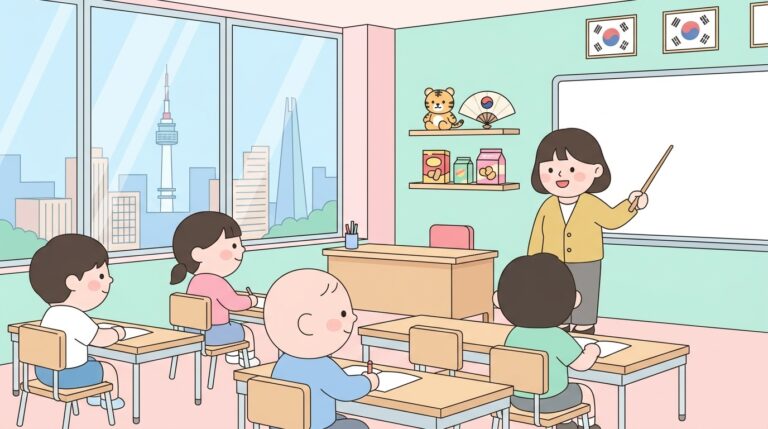
Phase 1: Empathy — Welcome to the K-Classroom
Hello! I’m your Daily Hangul Editor, your veteran Korean tutor and Seoul culture navigator.
Imagine this: It’s your very first day at a Korean language institute in Seoul. You’ve got your brand new notebook, a cute pen you bought at a local stationery shop, and your heart is beating fast. The teacher walks in, gives a bright smile, taps the whiteboard, and says a phrase you will probably hear fifty times today.
In K-Dramas like Crash Course in Romance or True Beauty, you often see strict Hagwon (cram school) teachers shouting a similar phrase to wake up sleeping students. But in real life, especially in adult language classes, it’s said with an encouraging, polite tone.
If you don’t know this phrase, you might be staring at your textbook while everyone else is looking at the front! Don’t worry. This guide is based on the real panic moments of my A1 students. Today, we are going to master the absolute basics of classroom survival and the magic of polite requests in Korea.
Phase 2: Core Expressions Deep Dive
Let’s break down the most essential phrases your teacher will use.
1. 칠판 보세요 (Look at the board)
- Pronunciation: chilpan boseyo [chil-pan bo-se-yo]
- Meaning: (Literal) Board look please. (Real nuance) Please look at the board.
- K-Culture Moment: You’ll hear this when the teacher is about to explain a crucial grammar rule. In a K-Pop idol’s live stream, they often say “이거 보세요!” (Look at this!) when showing off a new album or snack to their fans.
- Editor’s Insight: The ending
~세요(se-yo) is the golden ticket to polite commands in Korean. It’s like adding a very polite “please” to an action.칠판means blackboard or whiteboard.- Situation Spectrum:
- Teacher to students (Formal but warm): ✅
- You to a friend (Casual): ⚠️ (Too polite, say “이거 봐” instead)
- You to your boss (Formal): 🚫 (Never command your boss!)
- 🤔 Think About It: Why is a teacher using polite language to students? In traditional Korean schools, teachers use casual language (반말) to kids. But in adult language classes, teachers respect you as an adult learner, so they use the polite
~세요ending. How do teachers address adult learners in your culture?2. 잘 들으세요 (Listen carefully)
- Pronunciation: jal deureuseyo [jal deu-reu-se-yo]
- Meaning: (Literal) Well listen please. (Real nuance) Please listen carefully.
- K-Culture Moment: When a drama villain is about to lay down their rules, they might say this (though usually in a ruder form). In class, your teacher will say this before playing an audio track for a listening test.
- Editor’s Insight:
잘(jal) means ‘well’ or ‘carefully’.듣다(to listen) changes shape to들으세요. It sounds soft but holds authority.- Situation Spectrum:
- Teacher to students (Classroom): ✅
- Parent to child (Discipline): ✅
- Colleague to colleague (Semi-formal): ⚠️
3. 따라 하세요 (Repeat after me)
- Pronunciation: ttara haseyo [tta-ra ha-se-yo]
- Meaning: (Literal) Follow do please. (Real nuance) Please repeat after me.
- K-Culture Moment: Think of K-Pop fan chants! The fan club leader might guide others to follow along. In class, this is your cue to speak up.
- Editor’s Insight: When you hear this, don’t be shy! Koreans love it when foreigners try to speak aloud. Volume up, confidence up!
- Situation Spectrum:
- Language class: ✅
- Karaoke room (Noraebang) getting friends to sing along: ✅
- Work presentation: 🚫
Phase 3: Textbook vs Real Korean
Here is how what you read in your textbook differs from what actually happens in a dynamic Korean classroom.
[Getting the Teacher’s Attention]
* 📖 Textbook Korean: 선생님, 질문이 있습니다. (Teacher, I have a question.)
* 🗣️ Real Korean: 쌤! 저요! (Ssaem! Me!) / 질문 있어요! (I have a question!)
* 💡 Why the difference?: 쌤 (Ssaem) is the affectionate, universally used slang for 선생님 (Teacher). It breaks the ice and creates a friendly vibe.
[When the Teacher Checks Understanding]
* 📖 Textbook Korean: 여러분, 다 이해하셨습니까? (Everyone, did you all understand?)
* 🗣️ Real Korean: 알겠죠? (Got it?) / 질문 없어요? (No questions?)
* 💡 Why the difference?: Modern adult classrooms lean toward a friendly, semi-formal atmosphere rather than strict military-style textbook Korean.
Bottom Note: For A1 beginners, it’s perfectly fine to stick to the polite “질문 있어요” (I have a question). Calling your teacher “쌤” (Ssaem) will definitely earn you insider points!
Phase 4: Cultural Context — K-Culture Deep Dive
4-1. Non-verbal Cue: The ‘Eye Contact’ Rule
In Western cultures, looking directly into a teacher’s eyes shows you are paying attention. In Korea, while eye contact is good, staring intensely can be seen as slightly aggressive. When the teacher says “칠판 보세요” (Look at the board), genuinely turn your body and eyes to the board. It shows respect and active participation through body language. This is a subtle part of 눈치 (Nunchi)—reading the room!
4-2. K-Drama & Hagwon Culture
If you’ve watched K-Dramas like Crash Course in Romance (일타 스캔들) or Black Dog, you know Korea has a massive tutoring and Hagwon (private academy) culture. The classroom is a sacred space of intense focus. While your Korean language class for foreigners will be much more relaxed and fun, the core respect for the teacher remains.
Critical View: Dramas often show students sleeping and getting hit by chalk thrown by the teacher. Don’t worry, this is an old-school trope! Modern Korean classrooms, especially for expats, are incredibly warm, interactive, and completely chalk-throwing-free.
Phase 5: Real-world Roleplay Scenario
Setting: A sunny Monday morning at a Korean Language Institute in Hongdae. You are holding a fresh cup of iced Americano.
Characters:
– YOU: An excited but slightly nervous A1 Korean learner.
– Teacher Kim (김 쌤): 30s, energetic, uses lots of hand gestures.
Dialogue:
김 쌤: 안녕하세요 여러분! 만나서 반갑습니다. 👋
(annyeonghaseyo yeoreobun! mannaseo bangapseumnida.)
[Hello everyone! Nice to meet you.]
YOU: 안녕하세요!
(annyeonghaseyo!)
[Hello!]
김 쌤: 자, 오늘 첫 시간이에요. 모두 칠판 보세요.
(ja, oneul cheot siganieyo. modu chilpan boseyo.)
[Now, it’s our first class today. Everyone, please look at the board.]
(🎭 Stage Direction: Teacher Kim writes ‘안녕하세요’ on the board.)
김 쌤: 제 발음을 잘 들으세요. 안. 녕. 하. 세. 요.
(je bareumeul jal deureuseyo. an-nyeong-ha-se-yo.)
[Please listen carefully to my pronunciation. An-nyeong-ha-se-yo.]
YOU: (Nodding and listening intently)
김 쌤: 자, 이제 따라 하세요. 안녕하세요!
(ja, ije ttara haseyo. annyeonghaseyo!)
[Now, please repeat after me. Annyeonghaseyo!]
YOU: 안녕하세요!
(annyeonghaseyo!)
[Annyeonghaseyo!]
김 쌤: 네, 아주 좋아요! 혹시 질문 있어요?
(ne, aju joayo! hoksi jilmun isseoyo?)
[Yes, very good! By any chance, do you have any questions?]
🔀 Your Turn! How do you reply?
– A) 선생님, 질문 있어요! (Teacher, I have a question!)
– B) 아니요, 없어요. (No, I don’t.)
– C) 야! 질문 있어! (Hey! I have a question!)✅ Best Choice: A or B. Both are polite and perfect for the classroom.
⚠️ Choice C Analysis: Oh no! “야” (Ya / Hey) and casual speech (반말) to a teacher is a massive cultural faux pas! Save that for your close friends.
🎁 Bonus K-Culture Roleplay: The Shopping Extravaganza
The word 보세요 (boseyo – please look) isn’t just for the classroom! Imagine you are shopping in Myeongdong.
Shop Staff: 손님, 이거 한번 보세요. 신상품이에요!
(sonnim, igeo hanbeon boseyo. sinsangpumieyo!)
[Customer, please take a look at this. It’s a new arrival!]
YOU: 우와, 예뻐요.
(uwa, yeppeoyo.)
[Wow, it’s pretty.]
Phase 6: 10-Second Shadowing Drill
Practice these sentences out loud. Pay attention to the pauses (/) and the emotion tags!
- 👨🏫 선생님처럼 (Like a teacher): 자, 여러분 / 칠판 / 보세요!
(ja, yeoreobun / chil-pan / bo-se-yo!) - 🤫 진지하게 (Seriously): 제 말을 / 잘 / 들으세요.
(je mareul / jal / deu-reu-se-yo.) - 😊 밝게 (Brightly): 자, 저를 / 따라 하세요!
(ja, jeoreul / tta-ra ha-se-yo!)
Phase 7: K-Culture Mini Dictionary
1. 학원
* Romanization: hagwon
* English: Private academy / Cram school
* Context: The backbone of Korean education. From English to math, K-Pop dancing to gaming, there is a Hagwon for everything!
2. 쌤
* Romanization: ssaem
* English: Teacher (Slang/Affectionate)
* Context: A shortened version of 선생님 (seonsaengnim). It’s incredibly common and makes you sound like a local student.
3. 눈치
* Romanization: nunchi
* English: Social sense / Reading the room
* Context: Knowing when to look at the board without being told twice is having good ‘nunchi’.
4. 질문
* Romanization: jilmun
* English: Question
* Context: In Korean classrooms, students are often shy to ask questions. Be the brave one who says “쌤! 질문 있어요!” (Teacher! I have a question!).
Phase 8: Traveler Survival Kit
You might not be in a classroom, but the ~(으)세요 (polite command) and 보다 (to look) are essential for your Korea trip!
🆘 Survival Phrases Using ‘보세요/주세요’
– 🇰🇷 “메뉴판 좀 보여주세요.” (menyupan jom boyeojuseyo.)
– 🗣️ English Guide: Please show me the menu.
– 📍 Where to use: Restaurants, cafes.
– 💡 Pro Tip: When you want to buy something in a store, pointing and saying “이거 주세요” (igeo juseyo – Please give me this) is your ultimate magic spell.
📌 Editor’s Travel Note
– Map Apps: Google Maps doesn’t work well in Korea. Download Naver Map or KakaoMap.
– Etiquette: When handing your credit card to the cashier, try using two hands (or supporting your right elbow with your left hand). It’s a sign of respect, just like using polite language!
Phase 9: Critical Thinking Corner — “One Step Deeper”
Language & Power in Korea
In Korean, the language you use defines your relationship. The polite request ending ~(으)세요 (-seyo) implies that the speaker respects the listener. Historically, teachers had absolute authority and would use casual commands. However, modern Korean society has shifted. By using 보세요 (Please look) instead of 봐! (Look!), the teacher acknowledges you as an equal adult and a valued customer of their language institute. Language evolves as society’s power dynamics change.
💬 Your Turn: Does your native language have a specific way to show respect to teachers or elders? Or is it more casual? Let’s discuss in the comments!
Phase 10: FAQ & Common Mistakes
Q: Can I use “보세요” to my boss or an elder?
A: ⚠️ Tricky! While it is polite, giving a direct command to someone much higher in status can be considered rude. Instead of saying “이거 보세요” (Look at this), it’s safer to say “이것 좀 확인해 주시겠어요?” (Could you please check this?). But for a teacher to a student, or between strangers in a shop, it’s perfect.
Q: Can I call my favorite K-Pop idol “쌤” (Ssaem)?
A: No! 쌤 is strictly for teachers. Call your idol by their name + 오빠/형/언니/누나, or just their name if you are the same age!
❌ Common Mistake #1: Replying to the teacher with “응” (Eung – Yeah).
✅ Do this instead: Always say “네” (Ne – Yes) in class. “응” is only for close friends and will make the whole classroom gasp!
Phase 11: Summary & Action Items
One-Liner Summary: “칠판 보세요” (Chilpan boseyo) means “Please look at the board” and is your first step to surviving the Korean classroom and mastering polite requests!
Action Mission 3 Steps:
– 🥉 Bronze (Solo): Look at a mirror, point to yourself, and say “칠판 보세요” 3 times with a warm teacher’s smile.
– 🥈 Silver (Online): Comment below with “쌤, 질문 있어요!” and ask me any Korean question you have.
– 🥇 Gold (Real Life): Next time you show a photo on your phone to a Korean friend, say “이거 보세요!” (Look at this!).
K-Culture Mission:
Watch one episode of a school K-Drama (like True Beauty or Extraordinary You). Listen carefully. Can you hear the teacher say “보세요” or “조용히 하세요” (Be quiet)?
Phase 12: Quiz — Interactive Challenge
1. Situational Judgment: Your Korean teacher walks in and wants everyone to look at page 10 of the textbook. What will they most likely say?
A) 칠판 보세요 (Look at the board)
B) 책을 펴세요 (Open your books)
C) 잘 들으세요 (Listen carefully)
2. Fill in the Blank:
Teacher: 여러분, 제 발음을 잘 ___________. (Everyone, please listen to my pronunciation carefully.)
3. True or False – K-Culture Edition:
In an adult Korean language class, it is perfectly fine to call the teacher “야” (Hey) to sound friendly. (T/F)
(Check your answers by highlighting the invisible text below!)
Answers:
1. B (책을 펴세요 means open your book!)
2. 들으세요 (deureuseyo)
3. False! Never use “야” to a teacher. Use “쌤” (Ssaem) or “선생님” (Seonsaengnim)!
Frequently Asked Questions (FAQ)
Q: What does "칠판 보세요 (Look at the board)" mean in Korean and how do you pronounce it?
A: In Korean, "칠판 보세요 (Look at the board)" is pronounced [chilpan boseyo [chil-pan bo-se-yo] and means: (Literal) Board look please. (Real nuance) Please look at the board.
Q: What does "잘 들으세요 (Listen carefully)" mean in Korean and how do you pronounce it?
A: In Korean, "잘 들으세요 (Listen carefully)" is pronounced [jal deureuseyo [jal deu-reu-se-yo] and means: (Literal) Well listen please. (Real nuance) Please listen carefully.
Q: What does "따라 하세요 (Repeat after me)" mean in Korean and how do you pronounce it?
A: In Korean, "따라 하세요 (Repeat after me)" is pronounced [ttara haseyo [tta-ra ha-se-yo] and means: (Literal) Follow do please. (Real nuance) Please repeat after me.






