

Greetings from Daily Hangul!
Hello! I’m your Daily Hangul Editor.
Picture this: You are at Everland, standing right in front of the legendary ‘T-Express’ wooden roller coaster. In K-Dramas, couples hold hands and smile beautifully as the wind gently blows through their hair. But in reality? Even K-Pop idols and variety show stars scream their lungs out here! Your Korean friend turns to you, eyes sparkling with excitement, and says, ‘Let’s ride it!’ Your heart is pounding. How do you tell them you are terrified, or maybe, that you are actually having the time of your life?
If you only know textbook Korean, you might sound like a robot during this thrilling moment. Let’s learn the real, raw expressions Koreans use when dropping 50 meters down a roller coaster track!
Core Expressions: Scream Like a Local!
1. 진짜 무서워요!
- Pronunciation: jin-jja mu-seo-wo-yo (For ‘mu’, think of a cow’s ‘moo’. For ‘seo’, make a ‘so’ sound but open your mouth wider!)
- Meaning: Literal: It is really scary. / Real nuance: I’m terrified!
- K-Culture Moment: In the variety show ‘Running Man’, whenever the members are forced to ride a terrifying attraction, they yell “무서워! (mu-seo-wo!)” with their eyes squeezed shut.
- Editor’s Insight: If you drop the ‘yo’ at the end (진짜 무서워!), it becomes casual. When you’re genuinely screaming on the ride, nobody uses polite language! Just yell “무서워!”
- Situation Spectrum:
- Casual: ✅ (진짜 무서워!)
- Semi-formal: ✅ (진짜 무서워요)
- Formal: 🚫 (You probably shouldn’t take your boss on a roller coaster anyway!)
- 🤔 Think About It: Why do Koreans add ‘요(yo)’ at the end of feelings even when they are scared? It shows that Korean politeness levels are deeply ingrained, even in moments of panic! Does your language have polite words you use even when you’re terrified?
2. 너무 재미있어요!
- Pronunciation: neo-mu jae-mi-i-sseo-yo (neo-mu means ‘so/too much’. jae-mi-i-sseo-yo sounds like ‘jay-me-ee-so-yo’).
- Meaning: Literal: There is too much fun. / Real nuance: This is incredibly fun!
- K-Culture Moment: Imagine a K-Pop idol doing a vlog at Lotte World. They finish the ride, hair messy, smiling brightly at the camera, saying “Wow, 너무 재미있어요!”
- Editor’s Insight: Use this right after the ride ends when your soul finally returns to your body.
- Situation Spectrum:
- Casual: ✅ (너무 재미있어!)
- Semi-formal: ✅ (너무 재미있어요)
- Formal: ⚠️
- 🤔 Think About It: Koreans use ‘너무 (too much)’ for both negative and positive things. “Too much fun” means it’s the best thing ever. How do you emphasize excitement in your culture?
3. 살려주세요!
- Pronunciation: sal-lyeo-ju-se-yo (sal sounds like the name ‘Sal’, lyeo sounds like ‘lyo’, ju-se-yo sounds like ‘joo-say-yo’).
- Meaning: Literal: Please save my life. / Real nuance: Help! / Get me out of here!
- K-Culture Moment: This is the ultimate K-Variety show survival phrase. It’s used humorously when a ride is way too fast or scary.
- Editor’s Insight: Screaming this on a roller coaster is culturally hilarious. Koreans will definitely laugh and think you are very witty.
- Situation Spectrum:
- Casual: ✅
- Semi-formal: ✅
- Formal: 🚫
- 🤔 Think About It: Using dramatic phrases like “Save my life” for minor inconveniences is a fun part of modern Korean slang. Do you exaggerate for comedy in your native language?
Textbook vs. Real Korean
[When the roller coaster drops]
* 📖 Textbook Korean: 저는 매우 두렵습니다. (I am very afraid.)
* 🗣️ Real Korean: 엄마야! (Mommy!) or 살려주세요! (Save me!)
* 💡 Why is it different?: In moments of shock, Koreans instinctively call out “엄마 (Mom)”. It’s a universal reflex, but “엄마야!” is the perfect natural exclamation.
[Asking to ride it again]
* 📖 Textbook Korean: 다시 탑승합시다. (Let us board again.)
* 🗣️ Real Korean: 한 번 더 타요! (Let’s ride it one more time!)
* 💡 Why is it different?: Casual and energetic verbs like ‘타다(to ride)’ are preferred in everyday life over formal Sino-Korean words like ‘탑승(boarding)’.
Cultural Context — K-Culture Deep Dive
4-1. Non-verbal Elements
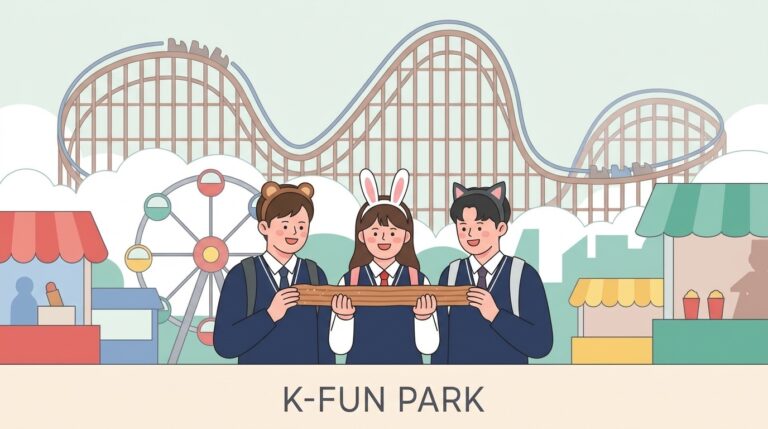
When you are scared on a Korean roller coaster, it’s very common to link arms (팔짱 끼기, pal-jjang kki-gi) tightly with your friend. Also, don’t forget the ‘Headband (머리띠)’ culture! In Korean amusement parks, wearing cute animal ears is almost mandatory, even for tough guys! It shows you are ready to fully immerse yourself in the fun.
4-2. The K-Variety Show Trope
If you watch Korean variety shows, the amusement park is a classic punishment location. The contrast between someone yelling “살려주세요!” (Save me!) while wearing a cute bunny headband is a classic K-Comedy trope. Also, keep an eye out for the ‘School Uniform (교복)’ trend! Many young Koreans in their 20s and 30s rent high school uniforms to wear at Everland or Lotte World to relive their teenage memories.
Real-Life Roleplay Scenario
Setting: Saturday afternoon at Everland. The sun is shining, and you are standing in a 60-minute line for the T-Express. You can hear the wooden tracks roaring and people screaming. You are wearing a cute fox headband.
Characters:
– YOU: A traveler in Korea, excited but slightly regretting your choice to ride.
– Minho: (28, your Korean friend, a total roller coaster fanatic).
Minho: 와, 드디어 우리 차례예요! 준비됐어요? 🎢
(wa, geu-di-eo u-ri cha-rye-ye-yo! jun-bi-dwae-sseo-yo?)
[Wow, it’s finally our turn! Are you ready?]
(🎭 Stage Direction: Minho excitedly points at the empty seats)
YOU: 아니요… 저 진짜 무서워요. 😰
(a-ni-yo… jeo jin-jja mu-seo-wo-yo.)
[No… I’m really scared.]
Minho: 에이, 괜찮아요! 눈 꼭 감고 있으면 금방 끝나요.
(e-i, gwaen-chan-a-yo! nun kkok gam-go i-sseu-myeon geum-bang kkeut-na-yo.)
[Hey, it’s okay! Just close your eyes tight and it’ll be over soon.]
YOU: 진짜죠? 믿어도 되죠?
(jin-jja-jyo? mi-deo-do doe-jyo?)
[Really? Can I trust you?]
Minho: 그럼요! 자, 출발합니다!
(geu-reom-yo! ja, chul-bal-ham-ni-da!)
[Of course! Here we go, departing!]
(🎭 Stage Direction: The coaster slowly climbs up the steep hill…)
Minho: 야호!!! 너무 재미있어요!!!
(ya-ho!!! neo-mu jae-mi-i-sseo-yo!!!)
[Yahoo!!! This is so fun!!!]
🔀 Your Turn! The coaster is dropping. How do you respond?
– A) “저는 지금 두렵습니다.” (I am currently afraid.)
– B) “아아악! 엄마야!! 살려주세요!!!” (Aaah! Mommy!! Save me!!!)
– C) “날씨가 참 좋네요.” (The weather is quite nice.)✅ Best Choice: B — Reason: This is the ultimate native reaction! Screaming “엄마야!” or “살려주세요!” will make you sound 100% like a Korean variety show star.
⚠️ Choice A Analysis: Way too robotic! You might sound like an AI navigating a roller coaster.
🎁 Bonus K-Culture Roleplay: Buying a snack after the ride
Staff: 안녕하세요! 츄로스 하나 드릴까요? (Hello! Would you like one churro?)
YOU: 네, 하나 주세요. 얼마예요? (Yes, one please. How much is it?)
Staff: 3,500원입니다. (It’s 3,500 won.)
YOU: 여기 있습니다. 감사합니다! (Here you go. Thank you!)
10-Second Shadowing Drill
Let’s practice the essential rollercoaster emotions! Repeat after me:
😨 엄마야! / 진짜 / 무서워요!
(eom-ma-ya! / jin-jja / mu-seo-wo-yo!)
Say it like you are holding onto your safety bar for dear life!
😆 우와! / 너무 / 재미있어요!
(u-wa! / neo-mu / jae-mi-i-sseo-yo!)
Say it brightly with a big smile after surviving the ride!
K-Culture Mini Dictionary
1. 놀이공원
* Romanization: no-ri-gong-won
* English: Amusement Park
* Context: Literally means “Play Park.” Lotte World and Everland are the top two famous parks in Korea.
2. 눈치게임
* Romanization: nun-chi-ge-im
* English: Nunchi Game (Guessing the crowd)
* Context: When planning an amusement park trip, Koreans play “Nunchi Game” by trying to guess which day will have the fewest people. If you fail, you wait 2 hours for one ride!
3. 머리띠
* Romanization: meo-ri-tti
* English: Headband
* Context: The essential cute accessory. If you don’t buy an animal headband at a Korean amusement park, did you even go?
4. 츄로스
* Romanization: chyu-ro-seu
* English: Churros
* Context: The ultimate theme park snack in Korea. It’s almost an unwritten national rule to eat a churro after riding a roller coaster to calm your nerves.
Traveler Survival Kit
🆘 Survival Phrase #1
– 🇰🇷 “이거 많이 무서워요?”
– 🗣️ Pronunciation: i-geo ma-ni mu-seo-wo-yo?
– 📍 Where to use: Asking staff or friends before getting in line.
– 💡 Pro Tip: Point to the ride. If the staff smiles mysteriously and says “조금요 (A little bit)”, brace yourself!📌 Editor’s Travel Note
– Useful App: Everland App / Lotte World App (Mobile queuing, called ‘Magic Pass’, is essential for skipping lines!)
– Cash vs Card: Korean theme parks are 99% cashless. Bring your credit card or use mobile pay for those churros and headbands.
– Dress Code: Comfortable shoes are a must, but prepare to see many Koreans in rented high school uniforms—it’s a massive trend you can join too!
Critical Thinking Corner — “One Step Deeper”
🧠 Think Deeper: Media vs Reality (The Cute vs. Thrill Paradox)
If you watch K-Dramas, amusement parks are highly romanticized. The male lead buys the female lead a cute headband, they eat cotton candy, and share a sweet moment on the merry-go-round. This has created a unique ‘Cute Culture’ at Korean theme parks, where aesthetics and taking perfect photos are just as important as the rides themselves. However, the reality of Korean roller coasters (like the T-Express) is intense and hardcore. This creates a funny paradox: Koreans will survive extreme drops while wearing the fluffiest, cutest bunny ears imaginable.💬 Your Turn: Does your culture’s amusement parks focus more on the “extreme thrill” or the “cute and romantic experience”? Let us know in the comments!
FAQ & Avoiding Mistakes
- “Can I scream in my own language?”
Yes, of course! But dropping a dramatic “살려주세요! (Save me!)” will definitely earn you a laugh and respect from the locals. - “Is it okay to ask the staff to hold my phone/bag?”
Before you board, there are usually specific cubbies on the opposite side of the train where you MUST leave all loose items. The staff won’t hold them personally! - “Can I wear my cute headband on the roller coaster?”
Usually, no! The staff will ask you to take off your 머리띠 (headband) so it doesn’t fly away and hit someone behind you.
❌ Common Mistake #1: Trying to use highly formal textbook Korean (저는 두렵습니다 – I am afraid) while on a chaotic ride.
✅ Do this instead: Embrace the casual exclamations! “아! 무서워!” (Ah! Scary!) is perfectly natural and makes you sound like a local.
Summary & Action Items
One-Liner Summary: When on a Korean roller coaster, forget the textbook and just yell “무서워요!” (scary) or “재미있어요!” (fun) like a true local!
Your Action Missions:
– 🥉 Bronze (Solo): Stand up, pretend you are dropping from a roller coaster, and yell “엄마야!” (Mommy!) 3 times.
– 🥈 Silver (Online): Find a POV video of Everland’s T-Express on YouTube and comment “너무 재미있어요!” or “진짜 무서워요!”.
– 🥇 Gold (Real Life): Next time you visit an amusement park in Korea, use these expressions with your friends or even quietly to yourself!
🎢 K-Culture Mission:
Search for “Running Man Roller Coaster” on YouTube and count how many times they say “살려주세요” or “무서워”!
What is the scariest ride you’ve ever been on? Let’s chat in the comments! 👇
Quiz — Interactive Challenge
1. Situational Judgment: The roller coaster is slowly going up the steep hill. Your heart is beating fast. What is the most natural thing to say to your Korean friend?
– A) 다시 탑승합시다. (Let’s board again.)
– B) 저 진짜 무서워요. (I’m really scared.)
– C) 츄로스 주세요. (Give me a churro.)
2. True or False — K-Culture Edition: “It is very common for adults in their 20s and 30s to rent and wear high school uniforms at Korean amusement parks.”
3. Fill in the blank: When the ride ends and you had the best time of your life, you say: “너무 ______!” (Hint: It means fun)
🎯 Click here for the Answers!
- B (If you chose C, you might just be too hungry!)
- True! It’s a huge trend to relive school memories.
- 재미있어요 (jae-mi-i-sseo-yo)
Frequently Asked Questions (FAQ)
Q: What does "진짜 무서워요!" mean in Korean and how do you pronounce it?
A: In Korean, "진짜 무서워요!" is pronounced [jin-jja mu-seo-wo-yo (For 'mu', think of a cow's 'moo'. For 'seo', make a 'so' sound but open your mouth wider!] and means: Literal: It is really scary. / Real nuance: I'm terrified!
Q: What does "너무 재미있어요!" mean in Korean and how do you pronounce it?
A: In Korean, "너무 재미있어요!" is pronounced [neo-mu jae-mi-i-sseo-yo (neo-mu means 'so/too much'. jae-mi-i-sseo-yo sounds like 'jay-me-ee-so-yo'] and means: Literal: There is too much fun. / Real nuance: This is incredibly fun!
Q: What does "살려주세요!" mean in Korean and how do you pronounce it?
A: In Korean, "살려주세요!" is pronounced [sal-lyeo-ju-se-yo (sal sounds like the name 'Sal', lyeo sounds like 'lyo', ju-se-yo sounds like 'joo-say-yo'] and means: Literal: Please save my life. / Real nuance: Help! / Get me out of here!






